


This post is the second in a 5-part Series designed to provide something akin to a photo album of my 40 posts on The Climate Movement thus far, a narrative of snapshots. Or, switching metaphors, Climate Movement Cliff Notes or Spark Notes, if you will. In this Series I will summarize each post in the order in which they were published, an annotated Table of Contents. For Part One of this Series, go here.
13.1 Campaigns, Initiatives, & the Climate Movement
Campaigns and Initiatives are more ways we can be together enough, our sixth characteristic/imperative/goal.
Whether to create positive change or stop bad stuff, campaigns are about
collective action to achieve
agreed-upon goals
by a set time.
The term “Initiative” is used for efforts that also share the three characteristics of campaigns. In many cases “initiative” is a safer word to use than campaign — especially if one wants to avoid the taint of politics or edgy advocacy. As such, campaigns and initiatives can have stylistic differences even as they share core characteristics.
Some hard-core movement folks may think we don’t have time to be nice and play it safe. But to become big and broad enough we can’t confine ourselves to those normally drawn to movements. A softer approach may attract more people faster, or a specific targeted group more quickly and successfully. Simply put: we need both campaigns and initiatives, and campaign-types shouldn’t look down their noses at initiatives and those that gravitate toward them.
Campaigns are nearly always organized by “the professionals.” However, most campaigns will only be successful if they recruit enough of what campaign organizers consider to be “the grassroots.” Professional campaign organizers activate. The volunteer grassroots passively wait to be activated and told what to do.
But as Climate Action Artist-Athletes we cannot adopt a stance of passivity if we are to play our part in achieving our Major Goal. We cannot be trapped in this passive grassroots mentality.

We are Artist-Athletes on our Olympian Fields of Action, not viewers watching on TV or sitting in the stands. We are all leaders of ourselves; we must activate ourselves, not wait for someone to turn us on or tell us what to do.
We are forward leaning, constantly in search for the next strategic thing for us to accomplish together to achieve victory.
As Climate Action Artist-Athletes not only can we join together in Climate Action Teams (CATS), we can create campaigns and initiatives; we don’t need anyone’s permission. The kairos-climate moment we find ourselves in, and the vision, purpose, and Major Goal we need to achieve, are all the permission we need.
13.2 Campaigns and Movements
Is a campaign and a movement the same thing? Are these terms interchangeable?
No. Campaigns are organized by a person or a collective entity like an organization. Someone or some group is in charge and determines the goals, etc.
No person or collective entity is in charge of a movement, including The Climate Movement. Our Movement Value of freedom is at the core of who we are. Such freedom makes movements creative and organic. It can also make them messy and unfocused!
Campaigns and initiatives are more structured, disciplined, and linear, even as they adapt to changing circumstances. Most give individuals the gift of being strategic, of achieving a victory we could not win by ourselves, of becoming a part of something greater than what we could be on our own.
But campaigns/initiatives being strategic is also a gift for The Climate Movement, since we must be both organic and strategic to overcome climate change by creating a just and prosperous sustainability that enhances wellbeing for everyone and everything.
14.1 Coalitions, Alliances and Networks — Introduction
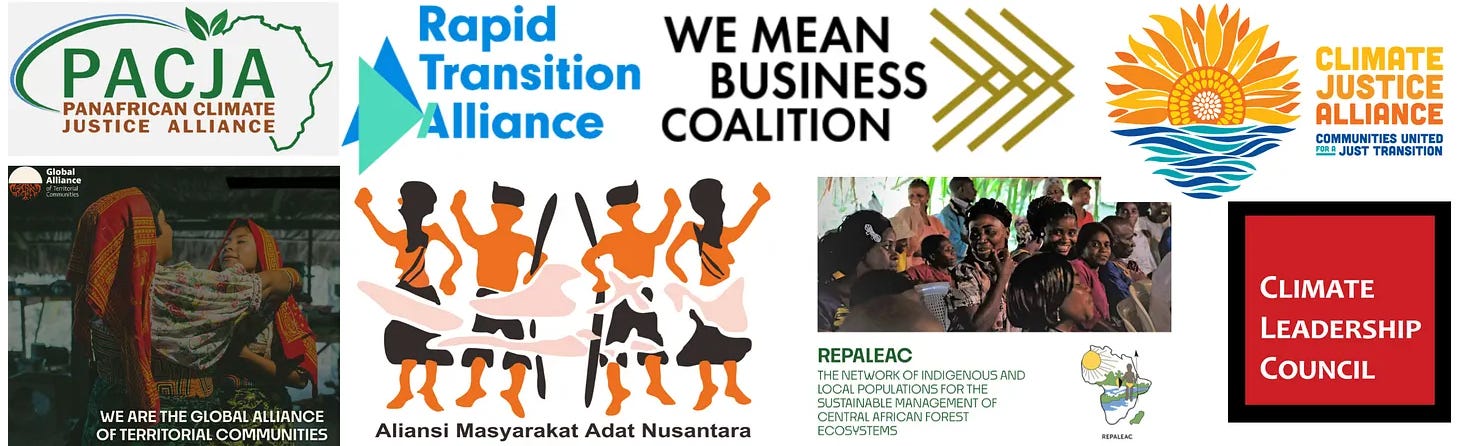
Continuing our conversation about how we can be together enough, our sixth Movement characteristic/imperative/goal, this post introduces a 9-part Subseries on coalitions, alliances, and networks. Coalitions and alliances are usually made up of collective entities — groups, organizations, associations, teams, businesses, schools, faith communities. Networks can be individuals and groups, but here I am focused on those that have collective entities.
14.2 Coalitions, Alliances, and Networks — Brief Descriptions
This post provides an illustrative sampling of the breadth of these collective entities who help us with the three ways to be together enough: shared goals, action events, and meeting together regularly.
Catching a glimpse of the various coalitions that currently exist helps us see that the Climate Movement is growing bigger and broader, and we can find inspiration and hope from those who are working hard through such coalitions to overcome climate change while creating a just and prosperous sustainability that enhances wellbeing for everyone and everything.
14.3 The Global Alliance of Territorial Communities
This post begins a more in-depth look at select coalitions, with some chosen in part to raise questions and spark discussion about the boundaries of The Climate Movement.
The Global Alliance of Territorial Communities (GATC) is one of the most remarkable coalitions in the climate space. Many of these folks literally put their lives on the line for climate and sustainability.
GATC is made up of five large regional coalitions, that are themselves made up of smaller coalitions. Thus, like nesting dolls, we have a global coalition made of regional coalitions made of smaller coalitions. At every level these inspiring coalitions are worthy of recognition in their own right.
The GATC has as its mission:
To be a single voice to fight for the collective rights of our peoples and communities, for the legal recognition of our territories, for protecting Mother Earth and all human beings, and to combat the causes of climate change.
Their courage inspires all of us to dig deep and match their courage and commitment with our own.
14.4 The Climate Justice Alliance and The Climate Leadership Council
The first characteristic/imperative/goal of the Climate Movement is to be big and broad and active enough.

But can these two coalitions both be a part of the Climate Movement? How broad is too broad?
As the Climate Justice Alliance states:
We are locally, tribally, and regionally-based racial and economic justice organizations of Indigenous Peoples, Black, Latinx, Asian Pacific Islander, and poor white communities who share legacies of racial and economic oppression and social justice organizing.
The Climate Leadership Council began as “a coalition of major companies, top environmental organizations, and opinion leaders from both the right and the left.” Part of its coalition are major fossil corporations like ConocoPhillips, BP, Shell, and TotalEnergies.
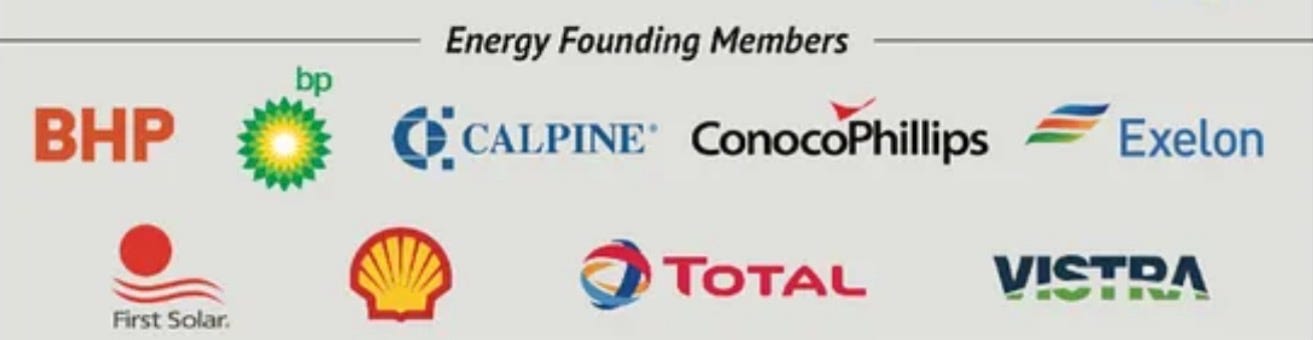
Who’s in and who’s out. Who decides?
14.5 Climate Movement and Foundation-led Coalitions
Here I highlight two foundation-led coalitions that have us asking once again, how broad is too broad for The Climate Movement?
The first is the Global Energy Alliance for People and Planet (GEAPP, or, in their shorthand, “The Energy Alliance”) is a self-described “radical collaboration” spearheaded by three powerful Foundations: The Bezos Earth Fund, the Rockefeller Foundation, and The IKEA Foundation. It is also made up of agencies like the International Renewable Energy Agency (IRENA), and investment banks like the World Bank. (“Radical”? Hmmm…)
I contrast GEAPP with The CLIMA Fund , a “collaboration” comprised of the Global Greengrants Fund, Grassroots International, Thousand Currents, Urgent Action Fund for Feminist Activism, and Youth Climate Justice Fund. They believe that climate change can’t be adequately tackled without addressing underlying causes, as pictured below.

14.6 The #StopEACOP Coalition
#StopEACOP is a coalition of organizations that have come together to protect people, nature, and the climate from the construction of the biggest heated oil pipeline in the world, which is about 81% finished as of June. #StopEACOP is an example of Climate Movement Activists and Supporters from the rich countries working together with Activists on the ground in the Majority World. Both are needed to achieve their two-part plan:
support frontline activists, making sure their voices are heard, and;
stop the needed investment of money and insurance.
#StopEACOP is another example of activists literally putting their lives on the line.
Conclusion
I hope that some if not all of the coalitions highlighted here inspire you. They are making hope happen as we become the greatest and most long-lasting social change movement in the history of the world. Join us! And stay tuned for the third installment in this 5-part Climate Movement Cliff Notes Series arriving next Wednesday at 5pm.
If you are new here, check out our Intro Series, as well as other posts in the Fields of Action Series on The Climate Movement. If you like this post, please “like,” comment, and share. And thanks for all you’re doing.
Great synopsis of ways to join together for climate solutions and to make hope happen.
Good idea. I didnt realize there were so many climate groups and different ways to get involved.