

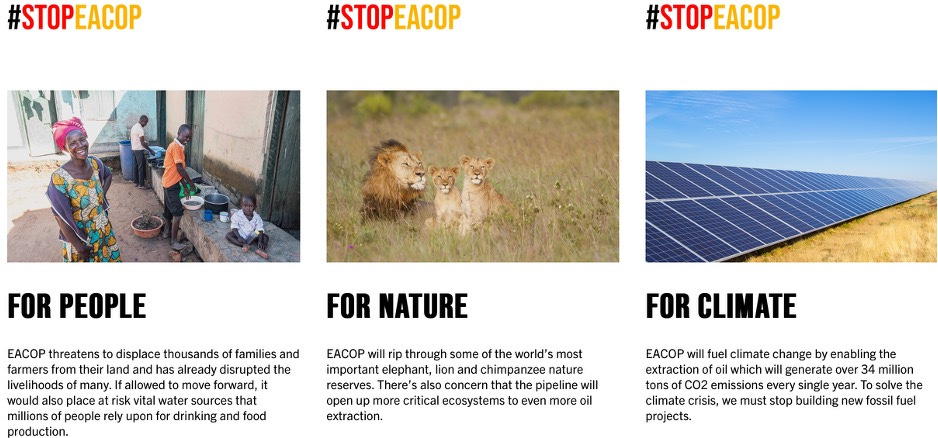

With this post we are continuing to explore what it means to be together enough on all of our Fields of Action, the Climate Movement’s sixth characteristic/imperative/goal. This post on #StopEACOP is part of our Subseries on the variety of coalitions that currently exist that are helping us be together enough.
#StopEACOP is a coalition of organizations that have come together to protect people, nature, and the climate from the construction of the biggest heated oil pipeline in the world, which is about 75% finished as of the end of December and is on track to begin operation in October 2026 according to its promoters. So we’re running out of time to stop this thing before it starts.
The #StopEACOP effort includes over 260 organizations, such as: the Africa Institute for Energy Governance (AFIEGO); GPFOG, a youth organization in Uganda; 350.org Africa; Fridays For Future Uganda; the Laudato Si Movement. (Sadly, the Catholic Bishops in Tanzania have come out in favor of EACOP and have been criticized by the Laudato Si Movement in eastern Africa as well as leading Catholic environmental activists.)
#StopEACOP is an example of Climate Movement Activists and Supporters from the rich countries working together with Activists on the ground in the Majority World — because, as will be shown, both are needed for success.
As its name declares, #StopEACOP is working to stop something bad. This is one of the three desires and demands of justice, which calls us to (1) stop bad stuff, (2) set wrong right, and (3) make things better. As such #StopEACOP helps us create the virtuous circle of hope and justice; every step towards justice brings us hope since justice is what we hope for.
#StopEACOP succinctly summarizes the situation on their website:
French oil giant Total and the China National Offshore Oil Corporation are on the cusp of building a massive crude oil pipeline right through the heart of Africa — displacing communities, endangering wildlife, and tipping the world closer to full-blown climate catastrophe. The East African Crude Oil Pipeline needs to be stopped and we have a plan to do exactly that.
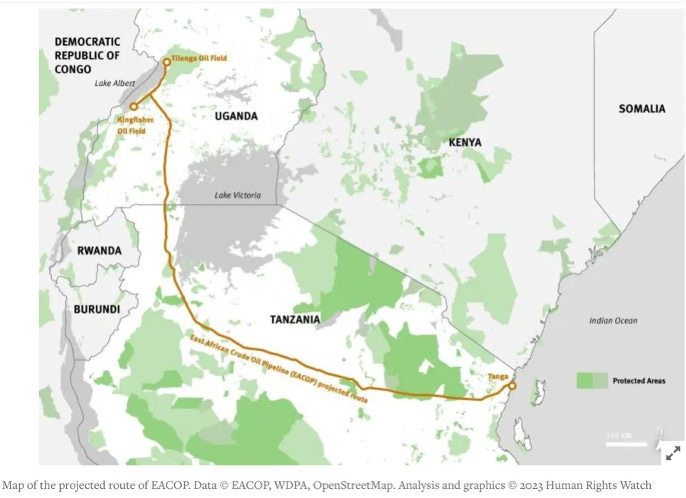
To highlight one aspect of the injustice #StopEACOP is fighting, an excellent report by Human Rights Watch documents how the powerful — such as the oil giant Total and their allies in government — have tricked and coerced powerless illiterate farmers into selling their land. Those that won’t sell can have their land seized by the government. For most, without their original land their poverty becomes much worse.
All told, around 118,000 will have their land impacted by this project, according to BankTrack.
Proponents tout the economic benefits. But to whom? As an example of petrolcolonialism, most of the profits will be gulped down by foreign corporate giants who suck out the oil and leave the locals with the mess. Economically there is a much better way to go. For example, “Uganda’s tourism industry accounts for about 7% of the country’s gross domestic product and provides over 600,000 jobs. In contrast, EACOP is expected to create only 200-300 permanent jobs.”
#StopEACOP argues for looking at the whole economic picture:
Rather than betting its development on a dying industry, we need to recognize that East Africa’s economic strength comes from the region’s biodiversity, heritage and natural landscapes. Investing in renewable energy, tourism, small-scale agriculture, fishing and reforestation programs will provide far more jobs to local communities, a wider range of economic benefits for East Africa and a cleaner environment which will benefit the whole world.
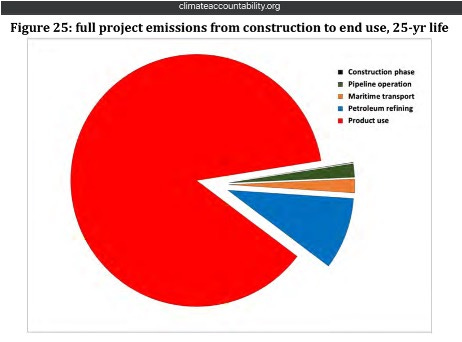
And of course there are the climate impacts from this oil, which is like throwing accelerant on a fire: 34 million tons of CO2 every year. Over its lifetime of 25 years, a full value chain analysis by the Climate Accountability Institute projects 379 million tons of CO2-equivalent will be emitted.
With all this money at stake, it should come as no surprise that frontline activists, community groups, and citizens involved in court cases about the project and with the companies behind it have been harassed and intimidated, physically harmed, arrested and jailed on trumped up charges, had their activities criminalized, and even had their lives threatened. “It is very costly to say ‘Stop EACOP’ said the head of an NGO. One leader who has toned down her efforts put it this way: “You cannot advocate for anything when you are dead.”
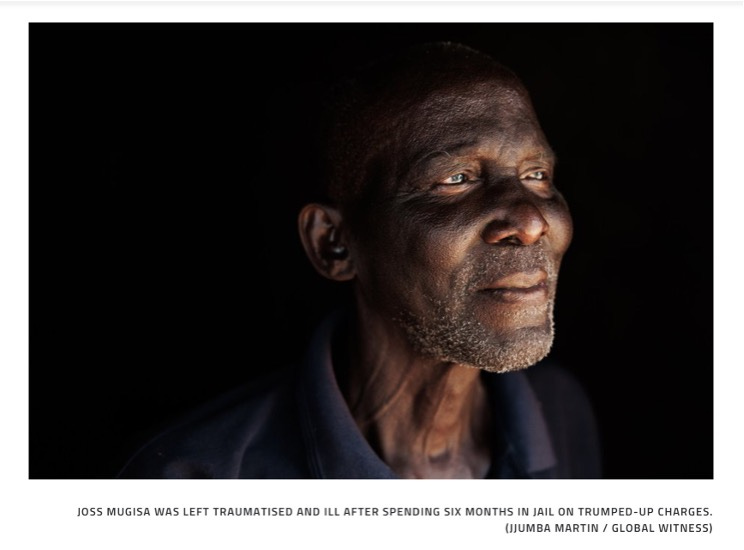
One local leader in Uganda, Joss Mugisa, spent six months in jail as his health deteriorated. The human rights organization Global Witness tells his story:
“The oil town Buliisa is among the most dangerous places in Uganda to be a land and environmental defender. Joss Mugisa, a frail 66-year-old and the founder of the Buliisa-based Oil & Gas Human Rights Association, found this out firsthand. In October 2021, his organisation’s office was raided by over a dozen armed men, including government officials and the oil and gas police. They took files, certificates of registration and documents before removing the organisation’s signs from outside and telling them they were shut down.
Shortly afterwards, Mugisa was arrested on trumped-up charges. ‘They know without me the organisation would die,’ he said.
He spent six months from late 2022 enduring gruelling conditions in a Buliisa jail, squashed with dozens of other men into a tin hut, sharing a small bucket to wash. He has been left traumatised and ill by the experience …”
This petrolcolonial climate-busting pipeline can only go forward if it has both the investment capital and the insurance coverage it needs. While frontline activists literally put their lives on the line, those of us living where the investors and insurers are must expose their support for the project or the companies or both and demand they withdraw it or convince them not to support EACOP in the first place. This is why Climate Movement Activists and Supporters from the rich countries are working together with #StopEACOP’s frontline Activists. Each has an important role to play.
Thus, #StopEACOP has a two-part plan:
support frontline activists, making sure their voices are heard, and;
stop the needed investment of money and insurance.
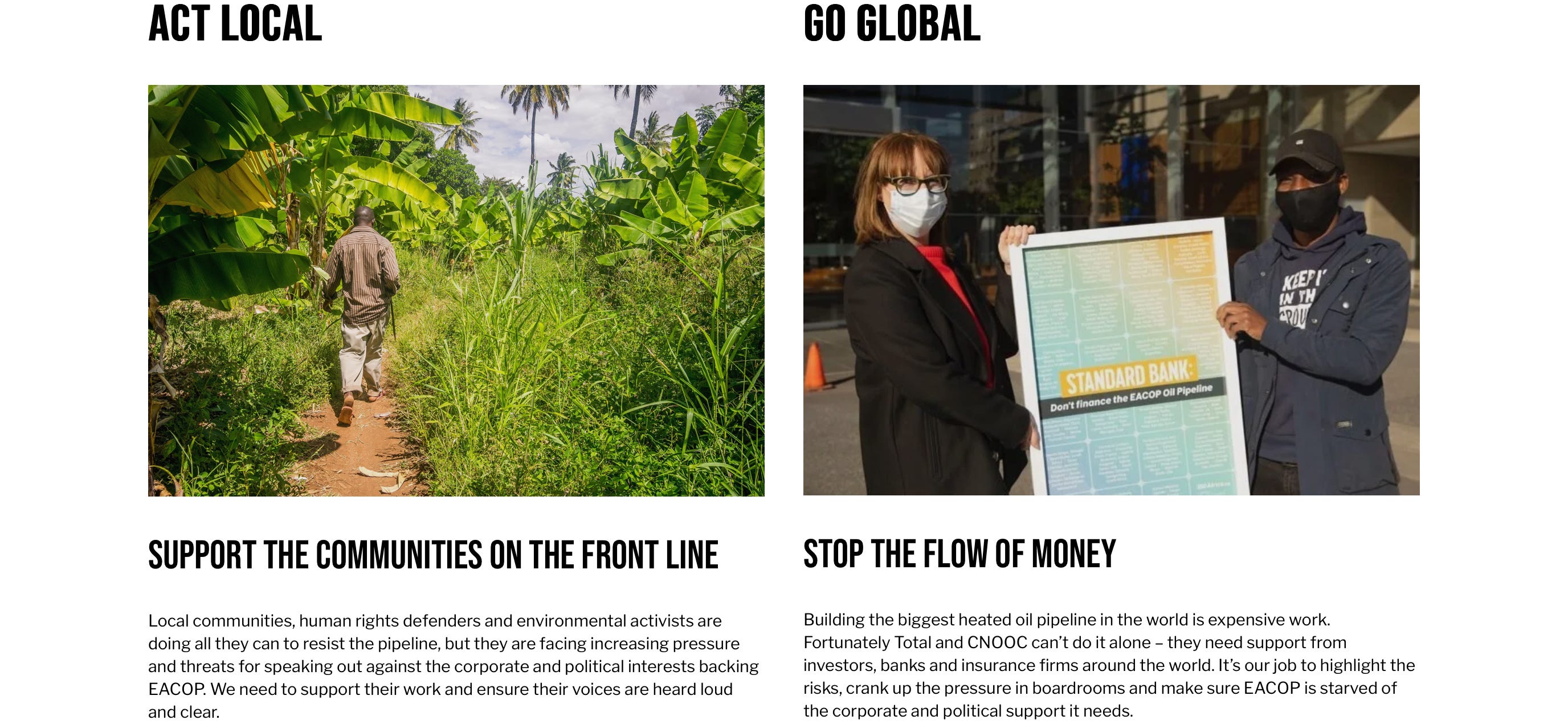
According to the #StopEACOP website and a recent article in Common Dreams, two of the banks supporting the oil giant Total are Goldman Sachs, which provided them with $1.69 billion between 2016-2020, and Bank of America, which loaned them $1.96 billion.
In addition to finance provided by banks, major pension funds in North America are also propping up these companies with over $1 billion, as detailed in a report from Climate Safe Pensions and Stand.Earth.
As for insurance, due to pressure from activists, Chubb has decided not to insure EACOP. However, “AIG, Liberty Mutual, and Tokio Marine have still not ruled out providing coverage for EACOP” according to Public Citizen.
In conclusion, petrolcolonialism on its own is more than enough of a reason to nix this awful pipeline — which should be done this year before its projected start date in October. It is well past time we put an end to such unjust practices where the powerful trample the powerless for profit, polluting the planet in the process. Throw in climate change and there’s no way on Earth this pipeline should be built.
More generally, #StopEACOP is, effectively, part of a broader trend of efforts summed up in the tag line: “Keep It In The Ground.” (See, for example, the Keep It In The Ground campaign, and The Guardian’s campaign.) This trend includes efforts towards a Fossil Fuel Nonproliferation Treaty and a more limited bill introduced in the US Congress in 2024. Instead of targeting emissions, these efforts target the source of the pollution. This strategy focuses on the supply side instead of the demand side. Cut off the supply of fossil fuels and they can’t be burned by consumers. While opposing the pipeline doesn’t literally keep the oil in the ground, the reason for the pipeline is to make it economical to get the oil to the international market. Without sufficient profit, it won’t be worth it to pump the oil out in the first place.
The reason for such keep-it-in-the-ground efforts and related ones like #StopEACOP is pretty straightforward. If we are going to achieve 1.5C, we have to leave fossil fuels in the ground. Even the International Energy Agency has recognized that the world must stop approving fossil fuel projects to keep 1.5C within reach.
Where’s the hope in all of this? #StopEACOP itself — a terrific example of frontline activists working together with those in the rich countries where the finance and insurance are coming from — is hope incarnate. Join us!
If you are new here, check out our Intro Series as well as other posts in our Fields of Action Series. If you like this post, please “like,” comment, and share. And thanks for all you’re doing.