


This post is the third in a 5-part Series designed to provide something akin to a photo album of my 40 posts on The Climate Movement thus far, a narrative of snapshots. Or, switching metaphors, Climate Movement Cliff Notes or Spark Notes, if you will. In this Series I will summarize each post in the order in which they were published, an annotated Table of Contents. (Check out the previous posts, Part One and Part Two.)
The five posts summarized below all have an economic connection.
14.7 The We Mean Business Coalition
In our exploration of coalitions the We Mean Business Coalition raises the question: can an effort focused mostly or even exclusively on reducing climate pollution be considered a part of the Climate Movement?
For some that may be a confusing, even absurd, question. Isn’t reducing climate pollution to avoid the really bad stuff what we’re all about?
For me, and many others, no. Remember our vision, purpose, and Major Goal as I have articulated them: to overcome climate change by creating a just and prosperous sustainability that enhances wellbeing for everyone and everything.

They describe themselves as:
a global nonprofit coalition working with the world’s most influential businesses to take action on climate change. Together, we catalyze business and policy action to halve global emissions by 2030 in line with a 1.5C pathway.
They do briefly discuss a just transition for impacted workers. But that is only one part of a just and prosperous sustainability.
Does this mean we shouldn’t consider the We Mean Business Coalition as part of the Climate Movement, until, say, they have more of a track record on our fuller vision?
Absolutely not.
We all have our roles to play on our particular Fields of Action. The We Mean Business Coalition is part of the Climate Movement as long as they are supportive of our efforts for our fuller vision.
14.8 The Green Economy Coalition & the WEALL Coalition
While the We Mean Business Coalition that I just covered is focused almost exclusively on 1.5 and pollution reduction, the first part of our vision, purpose, and Major Goal, these two are focused on the second part, i.e., creating a just and prosperous sustainability that enhances wellbeing for everyone and everything.
When you see who’s involved in The Green Economy Coalition — e.g. UNEP, Oxfam — you see they are reformers, not revolutionaries.
But the reforms they champion would represent a true transformation of our economic systems. They state:
A green economy is one where wellbeing, justice, sufficiency, good governance and planetary boundaries are at the heart of decision-making, for governments, businesses and citizens.
Sound familiar? It is very much in keeping with my articulation of our vision, purpose, and Major Goal. However, the need for urgency, although occasionally recognized briefly, is not one of their primary messages.

This points to the fact that overcoming climate change and creating a green economy are not the same thing, even as they share a good deal. It is why our vision, purpose, and Major Goal joins these two imperatives together.
A coalition quite similar to the Green Economy Coalition, including, again, a vision very similar to ours, is the Wellbeing Economy Alliance or WEALL, which is chock full of NGOs trying to transform our economic systems.
WEALL’s mission is “To change the debate and build momentum for economic transformation so that economies around the world deliver shared wellbeing for people and planet by 2040 (emphasis added).”
Such an economic transformation will be made possible when “our definition of societal success shifts beyond GDP growth to delivering shared wellbeing.”
It is vital that our thinking about the economy and the economic structures of our societies be transformed to be climate-friendly, sustainable, and creators of justice, enhancing wellbeing for everyone and everything. These coalitions are hopeful signs that such thinking and efforts already exist.
What the broader Climate Movement needs to bring alongside their efforts is urgency and our three forms of power — moral power, people power, & staying power — to transform ideas into reality.

14.9 Race to Zero & Race to Resilience; But Justice Demands More
Post 14.9 concludes my 9-part Subseries on coalitions and how they help us to be together enough, our sixth Climate Movement characteristic/imperative/goal. My final examples of coalitions are Race to Zero and Race to Resilience. Race to Zero claims to be “the world’s largest coalition of non-state actors,” while Race to Resilience seeks to help 4 billion vulnerable communities become resilient by 2030.
Both of these coalitions are instigated by a governing entity, the United Nations. Can such a government-related effort be considered to be a part of the Climate Movement? Hmmm …
Race to Zero and Race to Resilience view things from the top down, as is clear from their collective label for who/what is being engaged: “non-state actors.” There are nation-states, and then there are institutions, businesses, and local governments.
And individual volunteers in a mass movement viewing things from the bottom up? Not on their map.
Race to Zero has two meta goals in keeping with 1.5C:
1) achieve net-zero by 2050;
2) halve emissions by 2030.
It’s their second goal that puts the race in Race to Zero and makes sure it’s not actually a scam. Without the second goal, the first can be a con job.
Whereas Race to Zero has very clear and measurable targets, the Race to Resilience’s criteria are much vaguer. This reflects not only the differing subject matters, but, more importantly, the fact that reducing the causes of climate change has received much more attention than dealing with the consequences. Race to Resilience is doing good things and providing leadership where it has been sorely lacking.
But when measured against the three actions of justice — to stop bad stuff, set wrong right, and make things better — it is clear we must do much more. Resilience, even if you added in “loss and damage,” isn’t all that justice requires. We must work for prosperous sustainability — the good stuff — for everyone as well.
15.1 The Climate Movement and Businesses: Foes

This is the first in a two-part Subseries on climate change and businesses and how some can help us be together enough.
Here are two things to look for when thinking about whether we should consider a particular business a friend or foe of the Climate Movement:
§ profit-motive;
§ ideology, or more broadly, behavior-shaping ideas.
The profit-motive is usually going to be the deciding factor. But ideology cannot be overlooked.

We must be ever mindful that the profit-motive for Big Producers of Polluting Products provides a powerful incentive for Grifter hope-stealing greenwashing, where businesses want to appear climate-friendly for PR purposes to enhance sales and burnish their image.
But, when it comes to businesses we cannot say “a pox on all your houses.” We need those in the business sector who are our friends, because most of the implementation of climate mitigation will take place in the market. Thus, thinking clearly about both business friends and foes is essential.
15.2 The Climate Movement and Businesses That Are Friends

Markets are already playing a vital role because profits and price now favor clean energy.
The green/climate economy has surpassed $5 trillion annually and will exceed $7 trillion by 2030.
To achieve 1.5C by 2050 — our temperature reduction goal — about 75% of needed mitigation efforts are cost competitive today (55%) or nearly so (20%).
Two charts (below) from the World Resources Institute (WRI) utilizing data from the International Energy Agency (IEA) clearly shows clean energy investments and jobs are going up, up, up, while the fossils are going down, down, down.
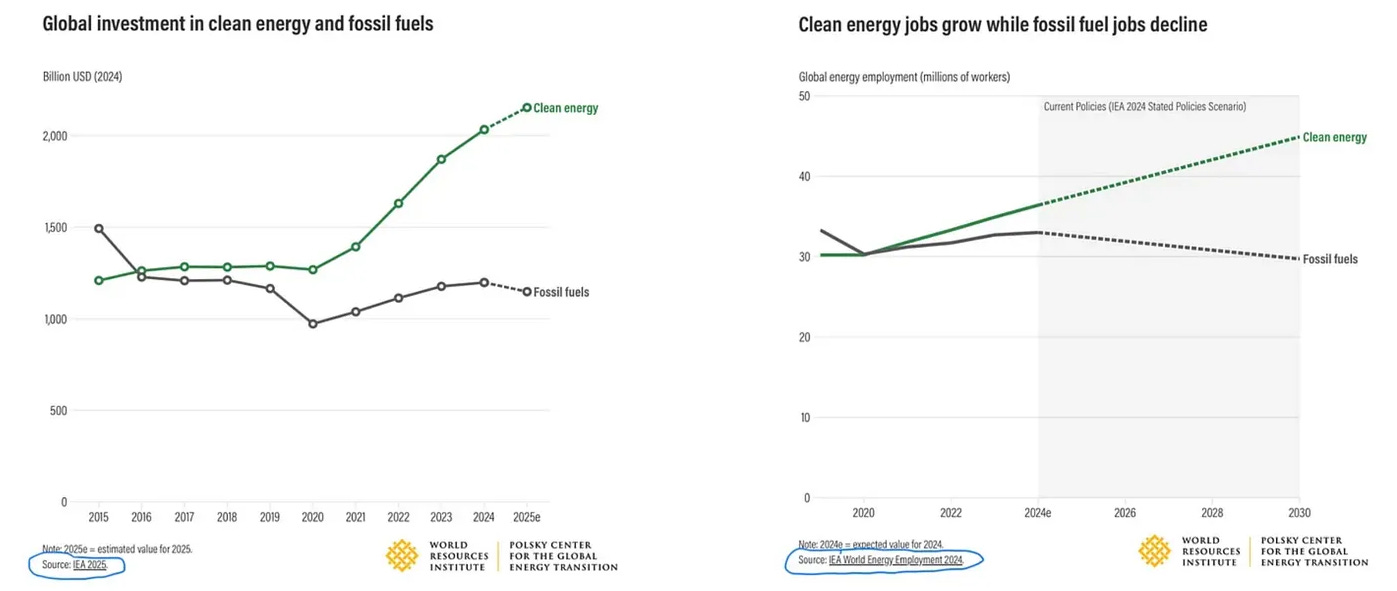
How did profits and price become so favorable? It happened because the four Catalytic Sources of Transformation worked for decades to make it so.

The fourth of The Catalytic-4 is Governments-&-Markets. The hyphens I’ve placed to connect them are there to emphasize that they must work together to play their part. “Governments” is put first because they must find ways to make markets achieve our vision, purpose, and Major Goal. This could result from a wide variety of government policies: incentives, taxes, regulations, mandates, codes, standards, public-private partnerships.
But to achieve the needed speed and scale of change, The Climate Movement (#1), bolstered by Climate Action Supporters (#2), must push governments to make the accelerating rate of tech change or ARTC (#3) strategic, and structure markets to achieve our purpose.
One of the things we can do in our businesses is create Climate Action Teams (CATS) to support each other— one social form nesting in another.
We’ve all got a job to do because we are the hope we’ve been waiting for. We are at work making the impossible possible and the possible actual and the actual beautiful and our future come faster. Join us!
If you are new here, check out our Intro Series and our Fields of Action Series. If you like this post, please “like,” comment, and share. And thanks for all you’re doing.