


To conclude this 9-part Subseries on coalitions and how they help us to be together enough, my final examples are Race to Zero and Race to Resilience. As you can see from the quote above from their website, they claim Race to Zero to be “the world’s largest coalition of non-state actors,” while Race to Resilience is helping 4 billion vulnerable communities become resilient by 2030.
These self-described coalitions have and will continue to make important contributions. But our vision, to overcome climate change by creating a just and prosperous sustainability that enhances wellbeing for everyone and everything, requires more — something I’ll address briefly at the end of this post.
Government-Initiated Coalition-Campaign Hybrids
Both of these coalitions have two interesting characteristics from the perspective of the Climate Movement. First, they are instigated by a governing entity, the United Nations. Can such a government-related effort be considered to be a part of the Climate Movement? Hmmm …
The second interesting thing to note is that Race to Zero and Race to Resilience are hybrids. They have characteristics of both campaigns and coalitions/alliances/networks. Indeed, they use both words to describe themselves.
They are like campaigns in that the entire effort, including the goals and requirements, are not hammered out initially by the partners; everything is predetermined and accepted as part of becoming part of the campaign(s).
In contrast, usually the initial members or partners of a coalition create their effort from the ground up, including its name, purpose, goals, membership criteria, etc. The members of the coalition can change these characteristics and goals. Not so here.
Race to Zero and Race to Resilience are like coalitions/alliances/networks in that they are made up of collective entities rather than individuals. These fall in two categories: “partners” and “members.”
Partners have functional attributes like those of coalitions. They “are the funnels through which individual members can join.” They are “independent initiatives, subject to their own governance structures and decision making process. Partners are responsible for managing their members … [and] implementing the Race to Zero criteria.”
Both partners and members are “non-state” or “sub-national” entities — in other words, not part of the UN. Members can be any collective entity that is not a nation-state. This includes:
any level of government that is below a nation-state;
businesses of all shapes and sizes;
financial institutions;
educational institutions;
healthcare institutions.
Even though they cannot determine the goals, Race to Zero and Race to Resilience also are like coalitions in that partners and members get to determine how they will achieve them.
Part of The Climate Movement?
Race to Zero and Race to Resilience view things from the top down, as is clear from their collective label for who/what is being engaged: “non-state actors.” There are nation-states, and then there is everything else — but that everything else is viewed as being made up of institutions, businesses, and local governments; it is a collection of entities administered by professionals and bureaucrats, not individuals who are volunteers in a mass movement.
As for most of the rest of us in the Climate Movement, we view things from the bottom up. And so it can be strange and disorienting to see things through the eyes of professional institutionalists and hear them talk in wonk-speak and acronyms that proliferate like invasive species. Even when they use some of the same words and concepts we do, they don’t look like or sound like what we think of as the Climate Movement.
This can make us uneasy and suspicious.
Institutionalists and bureaucrats are not known for speed. They are not known for radical transformation. Indeed, they are the administrators of the various systems that run things. They are the status quo. Radical change is not what they do. In fact, the opposite is true.
So should status quo administrators and professionals be the ones to rally others of their kind to achieve transformation at the speed and scale necessary?
Looked at it this way, it starts to make a strange sort of sense. Like-rallying-like is a prominent dynamic in any movement, including ours. And there is much to like about both the Race to Zero and the Race to Resilience.
So should they be considered a part of the Climate Movement? Given that they and their partners and members have definitely made a sustained commitment to collective action over time, I say yes.
Race to Zero
As the name implies, Race to Zero has two meta goals in keeping with 1.5C:
1) achieve net-zero by 2050;
2) halve emissions by 2030.
Participants in Race to Zero are not to just meander their way to net-zero by 2050; they just can’t wait around until 2045 and then get off their duffs and begin to get serious.
It’s their second goal that puts the race in Race to Zero and makes sure it’s not actually a scam. If they don’t have the second goal, the first can be a con job. It can make scammers sound serious, when in actuality they don’t have to do a damn thing.
Race to Zero participants must meet detailed and rigorous criteria to help ensure their seriousness. This includes “maximum effort toward or beyond a fair share of the 50% global reduction in CO2 by 2030.” To join this race at what they call the “Starting Line,” also described as “a minimum floor for robust net zero commitments,” all members must fulfill “procedural requirements” known as “the 5 Ps”:
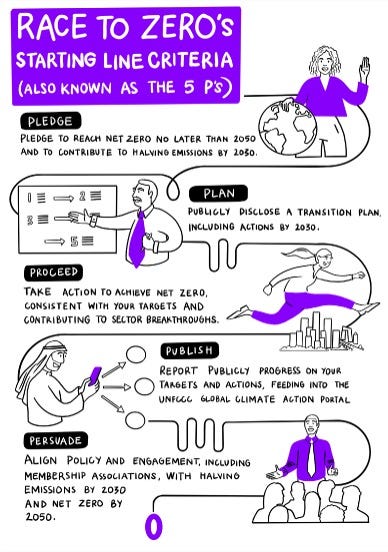
It is the last one, “Persuade,” which has its own 46-page explanatory document, that is particularly important from a Climate Movement perspective. This requirement to Persuade lays out how all Race to Zero members must be active on both of the two major Fields of Action of the Climate Movement: (1) growing and improving the Climate Movement itself, and (2) being active in public policy engagement focused on achieving our vision, purpose, and Major Goal.
Members must “align external policy and engagement, including membership in associations, to the goal of halving emissions by 2030 and reaching global (net) zero by 2050.” What, exactly, does this mean? In their Interpretation Guide they spell it out. To “align” means:
ensuring that all external engagement activities (e.g. lobbying, public relations campaigns, events, membership in associations that engage in public policy advocacy, etc.) are consistent with the objectives outlined in Pledge for halving emissions by 2030 and reaching global net zero by 2050 (p. 15).
As for membership in trade associations, Race to Zero members are to “Pursue efforts to shift” any such associations to be in “alignment with global climate goals.” If they cannot, “you are urged to remove yourself from such a trade association.”
(This is, for all intents and purposes, the opposite of the approach taken by the Climate Leadership Council, which has major oil companies as its members. See my earlier post discussing the CLC.)
Race to Resilience
Race to Zero’s “sibling” effort, Race to Resilience, has basically the same infrastructure and approach. However, whereas Race to Zero has very clear and measurable targets, which are based on how to achieve 1.5C, the Race to Resilience’s criteria are much vaguer. This reflects not only the differing subject matters, but, more importantly, the fact that reducing the causes of climate change has received much more attention than dealing with the consequences.
Furthermore, from what I can gather, it is only within the last few years — spurred on by the international climate negotiations and Race to Resilience itself — that many coalitions have sprung up to promote resilience and/or adaptation.
(Resilience concerns capacity or potential. Adaptation is a process. If you have resilience, you are better able to adapt. If you have adapted, you are more resilient.)
In their latest report (Nov 2025) they claim to have made about 438 million people more resilient.
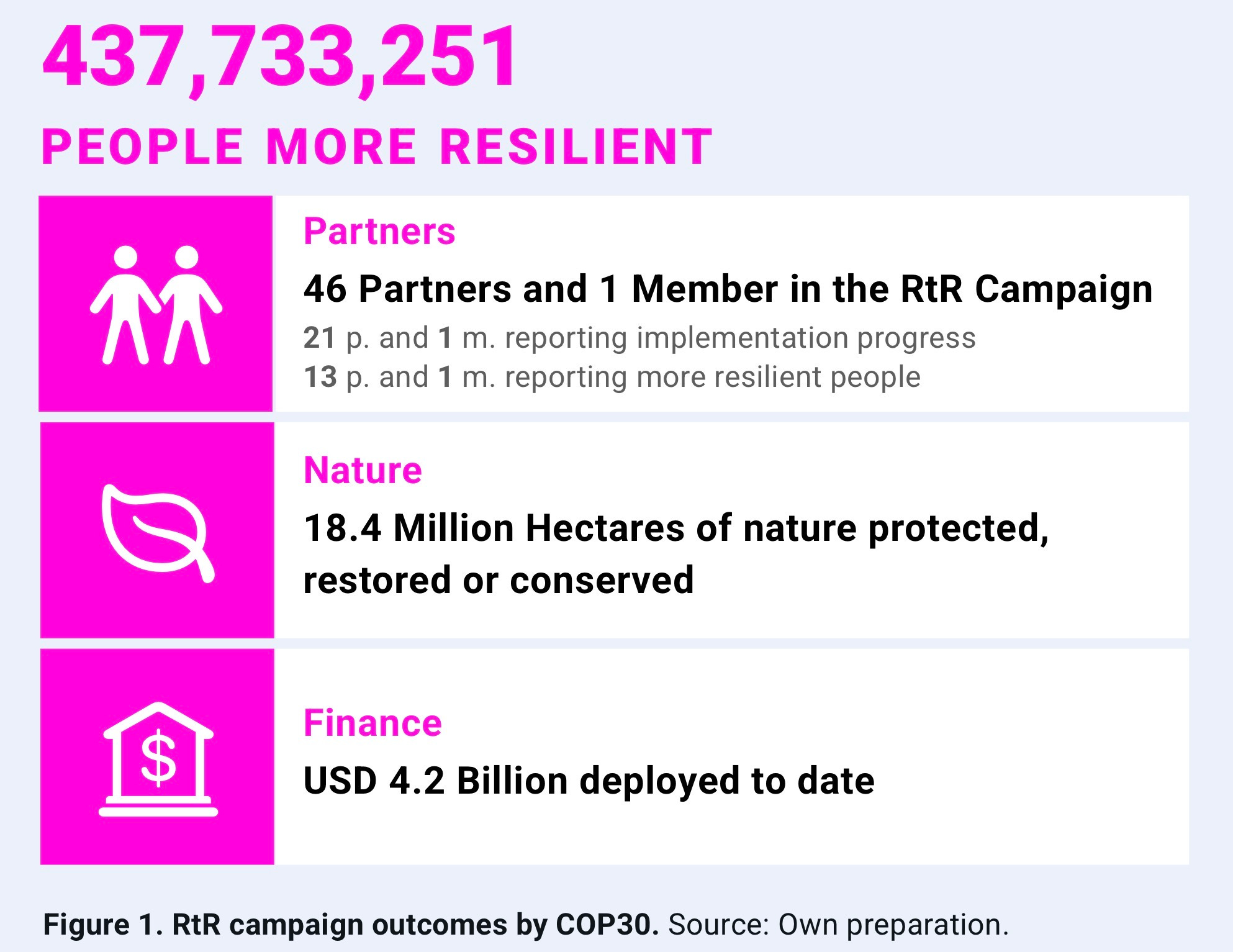
The outcomes in their Figure, above, are substantial. 438 million helped that wouldn’t have been otherwise. But the honest truth is this is nowhere near what justice requires.
Justice Demands More
If you asked the average Climate Action Artist-Athlete what resilience or adaptation is, or what we should be trying to achieve with them, my guess is that you wouldn’t get anywhere near the clarity or even the understanding that you would compared to reducing climate pollution in keeping with 1.5C.
But if we are to be about justice, if we are to be empowered by the hope that springs from every step towards justice — and remember, the three actions of justice are: (1) stopping bad stuff; (2) setting wrong right; and (3) making things better — then we cannot simply be focused on stopping climate pollution and achieving 1.5C. We must also be about creating a just and prosperous sustainability that enhances wellbeing for everyone and everything. We want to achieve 1.5 in a way that also achieves the the rest.
Part of making prosperous sustainability just is by lifting up those harmed by our unsustainable practices; we must set wrong right. This means supporting efforts to rectify what has come to be called “loss and damage” in the context of the international climate negotiations. (See a good explainer by the World Resources Institute here.)
While rich countries don’t want to be legally on the hook for this, we can’t escape the fact that we are morally on the hook.
Climate impacts hitting the poor in poor countries the hardest though they have done next to nothing to cause it is one of history’s most profound injustices. And we in the rich countries have been major contributors to creating this historic injustice. For decades we were ignorant of doing so. But no longer.
Time to make amends. Time for us in the rich countries to clean up the mess our societies have allowed the Big Producers of Polluting Products to make. They are accountable for the problem. But we are responsible for setting wrong right by helping poor countries — particularly the poor in poor countries — adapt to climate consequences, become more resilient to climate impacts, and provide resources to make up for loss and damage. To make things better, we must work to ensure that those unjustly burdened share in the benefits of a prosperous sustainability. We must work to enhance the wellbeing of everyone — especially those unjustly harmed.
So I am grateful for all those participating in the Race to Resilience and the various coalitions, alliances, and campaigns that make it up. It’s a start. Every step towards justice is a victory of the human spirit.

At the same time, everyone in the Climate Movement must see such efforts as working towards our larger vision. Thankfully, some of the text used to describe the Race to Resilience points towards this.
However, we must consciously and consistently do even more: move efforts on resilience, adaptation, and loss and damage towards a prosperous sustainability for everyone wherein overcoming climate change brings about something much larger than simply stopping bad stuff or helping people cope with the bad stuff or even making them resilient to the bad stuff. We want them to have the good stuff, too.
This is one case where more is better:
We want more.
They deserve more.
Justice calls for more.
Hope envisions more.
We can achieve more.
What, then, is this more, this prosperous sustainability? I’ve discussed it more fully in an earlier post. But let me summarize it here.
We are talking about sustainable economic progress that lifts everyone into prosperity as we simultaneously create balance and harmony with the rest of the natural world, a progress where economics is simply a means, not an end. But progress towards what end? Towards the flourishing of ourselves and the rest of the natural world, where we are free to be creative, free to deepen our human relationships and our relationship to the rest of the natural world because we are striving to be in harmony with it. Prosperous means people having plenty of healthy food they enjoy, a clean and healthy environment, nice homes that are warm in the winter and cool in the summer, reliable clean energy to power our sustainable lifestyle, work that is meaningful, and time to be creative and enjoy the good things in life.
I make no bones about it: this is a moral vision, an audacious vision that nevertheless sounds so simple, as it should. Such visions are meant to have us reach for something. We may not get it all, but in the striving we create a better world, along with hope and justice and joy.
This vision, and the desire for it, comes from our hearts. Big vision. Big hearts.
Even as all the coalitions that are part of The Climate Movement help us to be together enough, our sixth characteristic/imperative/goal, we must also be passionate enough and deep enough, our second and third characteristics.
Do you like this vision? Then join us as we make the impossible possible and the possible actual and the actual beautiful and our future come faster.
If you are new here, check out our Intro Series, as well as other posts in our Olympian Fields of Action Series. If you like this post, please “like,” comment, and share. And thanks for all you’re doing.