


[Friends — we interrupt our regularly scheduled post with a song we need right now sung by Lady Gaga. Won’t we be all neighbors?]
[Now back to our regularly scheduled post … ]
This post continues our discussion about how coalitions help us to be together enough, our sixth characteristic/imperative/goal of The Climate Movement.
The next two examples of coalitions are united in their belief that our current economic systems are in need of transformation if we are to achieve our vision, purpose and Major Goal.
The We Mean Business coalition that I covered previously, is focused almost exclusively on 1.5 and pollution reduction, the first part of our vision, purpose, and Major Goal.
In contrast, these two are focused on the second part, i.e., creating a just and prosperous sustainability that enhances wellbeing for everyone and everything.
The Green Economy Coalition
The Green Economy Coalition, when its 50+ members are considered — such as the United Nations Environmental Program (UNEP), the Organization of American States (OAS), Oxfam, and the International Institute for Sustainable Development — represents the institutional/organizational left. They are reformers, not revolutionaries.
But the reforms they champion would represent a true transformation of our economic systems. They state:
A green economy is one where wellbeing, justice, sufficiency, good governance and planetary boundaries are at the heart of decision-making, for governments, businesses and citizens.
Sound familiar? It is very much in keeping with my articulation of vision, purpose, and Major Goal.
Furthermore, they are in sync with how we should view and shape the Fourth Catalytic Source of Transformation, Governments-and-Markets:
Green economies mean more than wind turbines or resource efficiency. It is about re-wiring our economies to ensure that everyone can live well within our ecological limits. That requires deep-rooted reform: Our economies can be guided by different goals, they can be sustained by different activities, they can deliver different results.
They are reformers who recognize that incrementalism, a reformer’s normal pace and scale of change, just won’t do.
Rather, we must be transformationalists who fight for what our kairos-climate moment calls for without burning things down. But how is this transformation to be brought about? Thankfully they recognize their coalition needs popular support:
Here at the Coalition, we know that reforming our economies starts with people - not policy documents. This transition needs to respond to people’s lives — to their realities, their worries, their hopes — if it is to go to scale at speed. It needs to be relevant at ballot boxes, shop counters and job centres. It needs to be rooted in local experiences and national contexts (emphasis added).
To this end they are working to connect with possible supporters, including “activists,” through what they call “National Dialogue Hubs.” Thus far they have eight of them, located in South Africa, Brazil, the Caribbean, Uganda, Senegal, Peru, India, and Mongolia.
To what end? To inspire “national conversations on economic reform” by addressing such questions as:
What does green investment mean for small companies in the Caribbean? What does growth within ecological limits mean to an economic power-house like India? What job opportunities do renewable energies offer the poorest in South Africa?
But how are they going to take this to scale?
Simply put, their vision, like ours, won’t be achieved without:
the #1 Catalytic Source of Transformation, the Climate Movement, one that is big and broad and active enough (our first characteristic/imperative/goal).
But the Climate Movement on its own, while indispensably strategic, cannot achieve our Major Goals or the Green Economy Coalition’s vision without the other three Catalytic Sources of Transformation:
#2 broad-based popular support supplied by Climate Action Supporters;
#3 ARTC or the properly channeled accelerating rate of technological change, and;
#4 Governments-and-Markets, where governments restructure markets to overcome climate change while creating a just and prosperous sustainability that enhances wellbeing for everyone and everything.
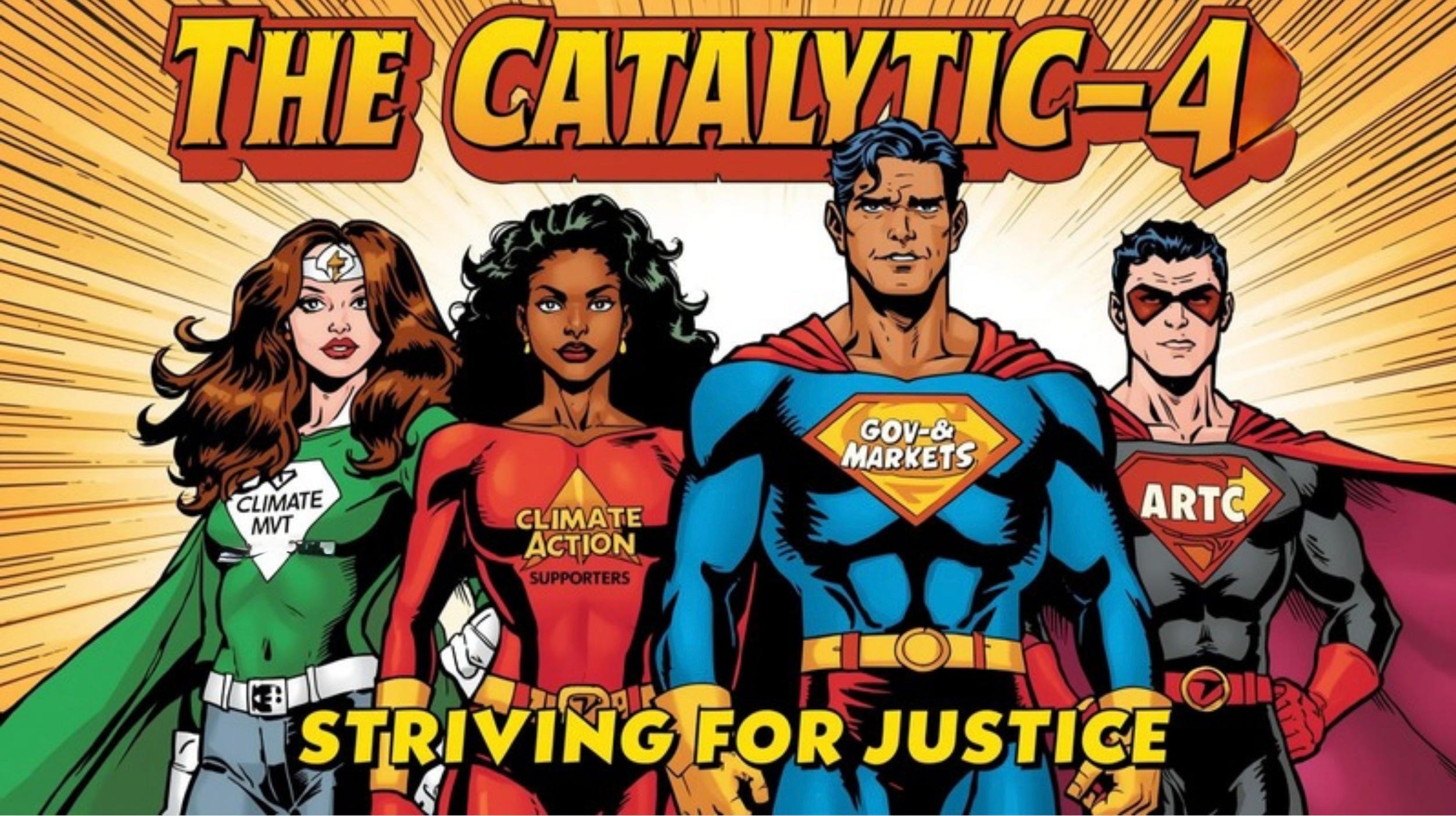
At the same time, these other three cannot play their parts without the Climate Movement pushing everyone forward at the speed and scale necessary. That is why we are indispensably strategic.
In the case of the Green Economy Coalition, our push to make our future come faster is especially needed, since the need for urgency, although occasionally recognized briefly, is not one of their primary messages. That we are in kairos-climate-time is not something that drives their communications or, from what I can gather, the pace of their activities.
This points to the fact that overcoming climate change and creating a green economy are not the same thing, even as they share a good deal. It is why our vision, purpose, and Major Goal joins these two imperatives together. We are to overcome climate change — something requiring speed and scale. That’s the first part. But we are to do so by also achieving the second part, creating a just and prosperous sustainability that enhances wellbeing for everyone and everything.
I’m quite grateful that most or even all of those in the Green Economy Coalition are also Climate Action Artist-Athletes on their Olympian Fields of Action. They need the rest of the worldwide Climate Action Team to play our parts, especially when it comes to making our future come faster. This is also true of our next example.
WEALL, the Wellbeing Economy Alliance
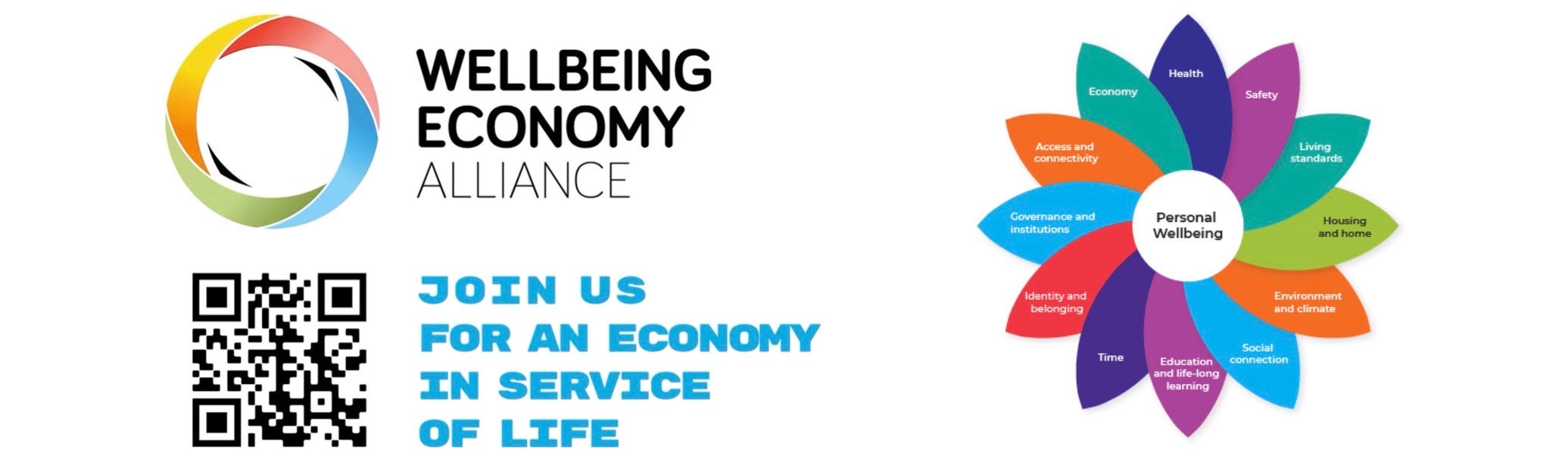
A coalition quite similar to the Green Economy Coalition, including, again, a vision very similar to ours, is the Wellbeing Economy Alliance or WEALL. In fact, the Green Economy Coalition is part of this Alliance. WEALL is chock full of NGOs trying to transform our economic systems.
WEALL’s mission is “To change the debate and build momentum for economic transformation so that economies around the world deliver shared wellbeing for people and planet by 2040 (emphasis added).”
Such an economic transformation will be made possible when “our definition of societal success shifts beyond GDP growth to delivering shared wellbeing. This involves a fundamental systems change.”
WEALL’s vision is:
a world where everyone has enough to live in comfort, safety, and happiness. Where all people feel secure in their basic comforts and can use their creative energies to support the flourishing of all life on this planet. Where we thrive in a restored, safe, and vibrant natural environment because we have learned to give back as much as we are given. A world where we have a voice over our collective destiny and find belonging, meaning, and purpose through genuine connection to the people and planet that sustain us (emphasis added).
How do they think their vision can become a reality? They nicely summarize their assumptions about how change happens:
Nothing ever changed without a movement demanding it and demonstrating for it (emphasis added)
A movement will never form without a compelling story that people want to be a part of
Ideas evolve and improve through sharing, listening and learning
Ideas become actions through a variety of approaches that chip away at different points of the system – we won’t know in advance which approach finally cracks the old system.
Therefore we need a mosaic movement of different folk with different skills and different spheres of influence.
I agree with all of these assumptions!
To help turn their vision into reality, WEALL has:
over 500 organizational members who “value togetherness over agreement and believe that if we are going to create global system change, we need to be collaborative and action-oriented;”
17 local “hubs,” which are currently concentrated in the British Isles and Europe; such hubs are “self-organising, place-based groups that facilitate collaboration and activity towards building a Wellbeing Economy;”
governments — “WEGos” — who implement policies in keeping with a Wellbeing Economy; currently there are six — Scotland, New Zealand, Iceland, Wales, Finland, and Canada;
a Policymakers Network where they can “share experiences, challenges, and best practices,” including through bimonthly workshops;
WEALL “Ambassadors” or “leaders, experts, movers and shakers who are working to build a wellbeing economy.”
Will WEALL on its own transform the economies of the world?
No.
I seriously doubt they have any illusions about that.
But do they hope they can be a part of starting this transformation in earnest? I think they do.
To be successful in this way, however, just like the Green Economy Coalition, WEALL needs the first three Catalytic Sources of Transformation — #1 the Climate Movement, #2 Climate Action Supporters, and #3 ARTC — to transform #4, Governments-and-Markets.
When WEALL is seen as a part of our Climate Movement, then their vision, so much in keeping with our vision, purpose, and Major Goal, looks like it could start to become a reality if we play our strategic role, which, again, includes complementing their efforts with climate urgency and the need for speed.
It is vital that our thinking about the economy and the economic structures of our societies be transformed to be climate-friendly, sustainable, and creators of justice, enhancing wellbeing for everyone and everything. WEALL and the Green Economy Coalition are hopeful signs that such thinking and efforts already exist.
Together as Climate Action Artist-Athletes we are making the impossible possible and the possible actual and the actual beautiful and our future come faster. Won’t we be all neighbors? Join us!

If you are new here, check out our Intro Series, as well as other posts in our Olympian Fields of Action Series. If you like this post, please “like,” comment, and share. And thanks for all you’re doing.