

In our Smog-Climate Subseries, we have been exploring the history of the LA/So. Cal smog challenge for insights to enlighten our way forward on climate action. I have identified 10 take-aways in this regard, which I am fleshing out in three posts.
Part One discussed the first three take-aways.
The three historic anti-pollution groups — activists, scientists, businesspeople — need each other.
The Denier’s Playbook will be run against anyone.
Courageous scientists prevailed.
Part Two only covered one of the take-aways, #4. But it’s a big one:
Why enviro activists were late to the climate challenge.
This post is Part Three of our comparing the smog and climate challenges. Here we will cover the final five take-aways.
#5: The Climate Effort Lacked a Clearly Discernible Problem and a Corresponding Movement to Address It
Why did it take much less time for the smog problem to be understood and acted upon in comparison to climate change? A key reason is grassroots and public support demanding action. With LA smog, the three main historic types of actors – activists, business leaders, and scientists/engineers – were not just supported, they were pushed by the grassroots and the public – who, in turn, were pushed by their continual experience of the problem itself. They could see it, smell it, cough and gasp and become teary-eyed from it.
But without a problem that simply can’t be ignored like smog, The Denier’s Playbook and other opposition tactics find fertile ground, as they did with the climate challenge. Then they can do the first and most fundamental part of the Playbook: deny that the problem exists.
Grassroots and public support for climate action only began to move toward what is required once impacts became a part of people’s lived experience. But they must make the connection. And that has taken decades of education in the face of The Denier’s Playbook.
# 6: Partisanship Has Risen, Impacting Environmentalism and Fueling Denial
Another take-away from comparing the smog and climate challenges is recognizing how much partisanship and ideological polarization have increased, which has played a vital role in bolstering denial. Unfortunately, as partisanship has risen, so has an anti-environmentalism within the Republican Party. Mix the two together on our issue and the results have not been good: climate change has been at the tip of the partisan spear for the last two decades. Again, this will take some unpacking.
One barometer of partisanship is the House of Representatives. A study published in April 2015 found that “partisanship or non-cooperation in the U.S. Congress has been increasing exponentially for over 60 years with no sign of abating or reversing.” While such partisanship began to increase in the 1950s, it exploded after the Gingrich Revolution when Republicans took over the House after 40 years of Democratic control.[1]
Since 2015 things have only gotten worse, as a Pew study found in 2022: “Democrats and Republicans are farther apart ideologically today than at any time in the past 50 years.” Democrats have moved slightly left, while Republicans have lurched to the right. As a result, in 2022 there were only “about two dozen moderate Democrats and Republicans left on Capitol Hill, versus more than 160 in 1971-72.”
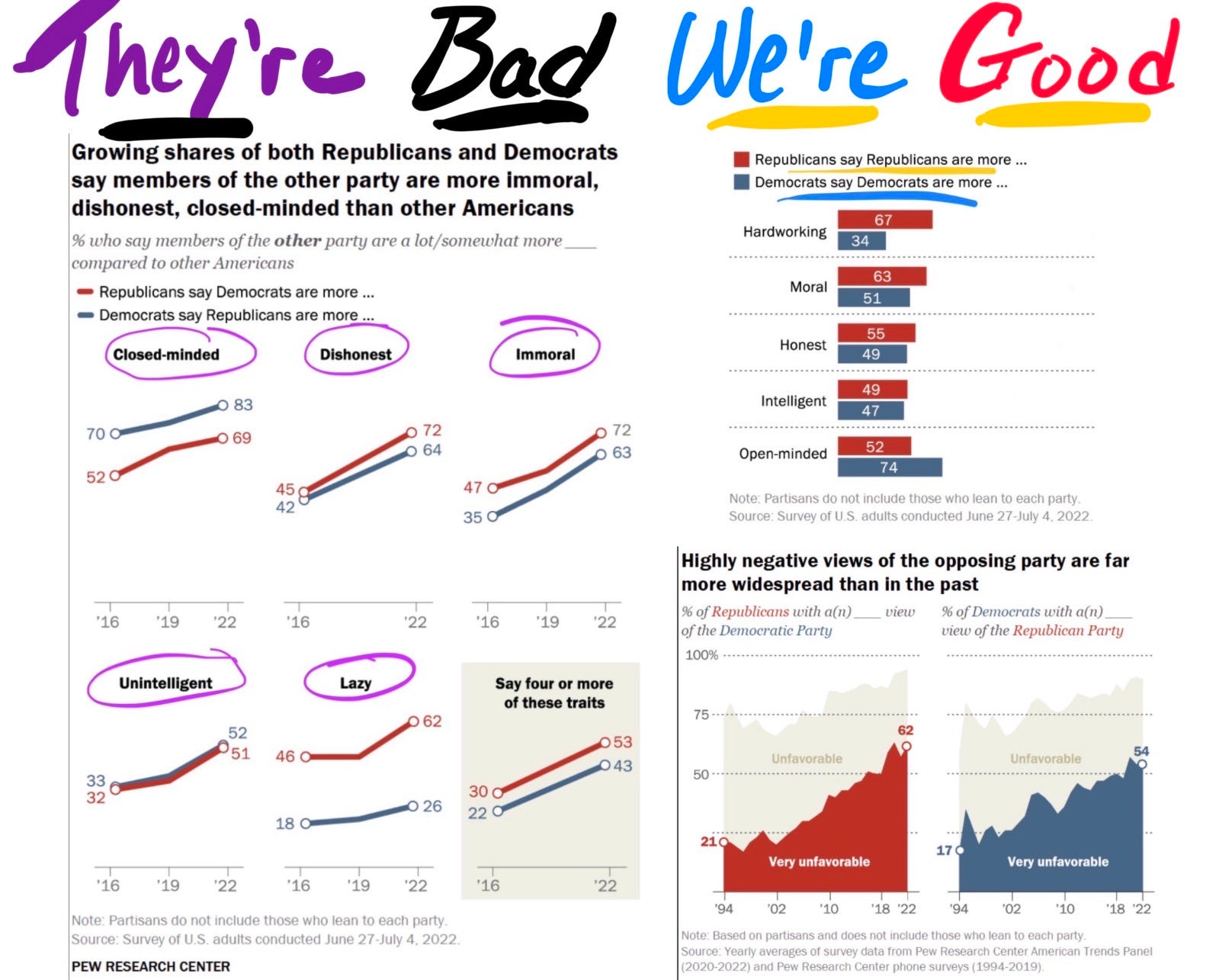
Polls of the public reflect the same increase in partisanship. The Pew Research Center’s polling has shown that unfavorable views of the other party were already high in 1994, with 74% of Republicans and 59% of Democrats having an unfavorable view of the other. That increased to 91% and 86%, respectively in 2016 – nearly everyone in one party had an unfavorable view of those in the other party.
But — disturbingly — as can be seen below, what has changed since 2016 is the intensity of unfavorable views driven in good measure by the perception that members of the other party are immoral, dishonest, lazy, and closed-minded, whereas member’s of one’s own party are the opposite: moral, honest, hardworking, and open-minded.
In other words, the other side isn’t simply misguided politically. They have deep character flaws while we have strong character. In short: they’re bad; we’re good.
And furthermore, Pew polling from last Fall shows that 85% of Americans believe political violence has increased and that extremism is a big concern. It’s just that it’s the other side’s extremism that’s the real problem:
77% of Republicans say left-wing extremism is a major problem in the country. Far fewer (27%) say this about right-wing extremism.
Democrats’ views are nearly the reverse: 76% say right-wing extremism is a major problem, while 32% say left-wing extremism is a major problem.
So, the other side is immoral, dishonest, and close-minded, with extreme views fueling political violence.
This is a far cry from when Republican businessman Arnold Beckman was a leader on smog in the 1950s.
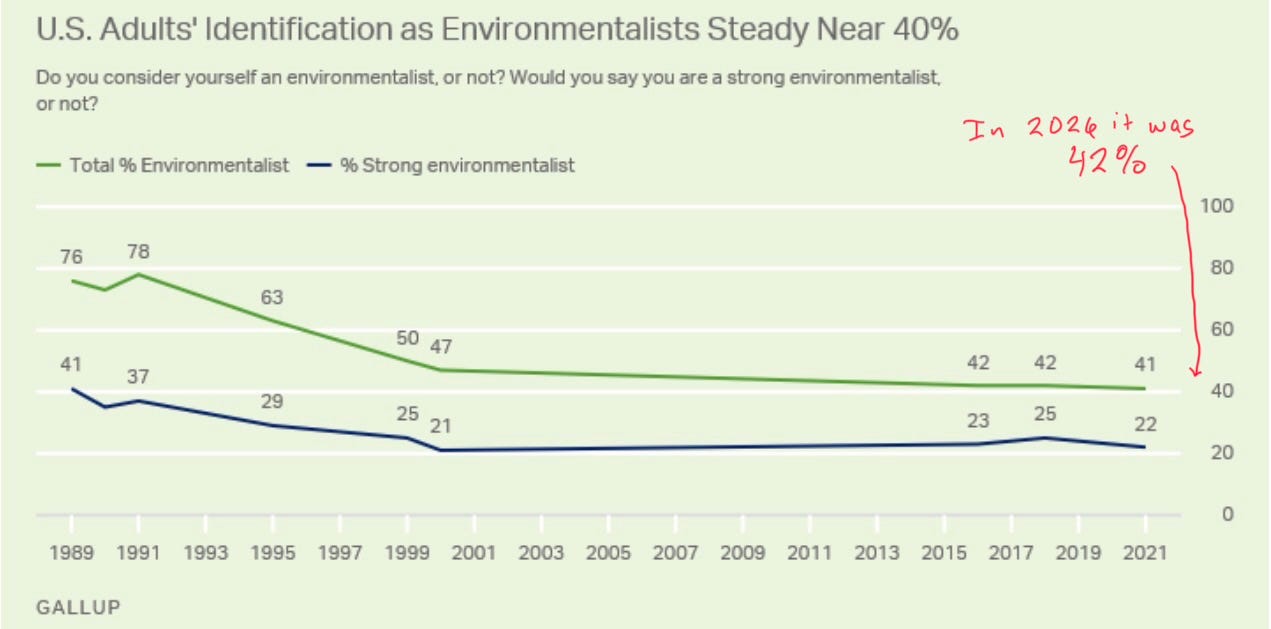
The rise of anti-environmentalism is another sad tale. In 1989, the year George H. W. Bush assumed office after campaigning to be the “environmental President,” 76% of Americans considered themselves to be environmentalists. The President followed through with his pledge with one of the nation’s best environmental laws, the 1990 Clean Air Act.
But during the 1992 campaign President Bush gave a tremendous boost to the partisan polarization on the environment. He criticized the Clinton-Gore ticket for its environmental positions, calling then-Senator Al Gore “Ozone Man,” saying “This guy is so far off in the environmental extreme, we’ll be up to our neck in owls, and out of work for every American. This guy’s crazy. He’s way out. Far out, man.”[2]
In 1994 Republicans won the House with the Gingrich Revolution and its Contract With America. Speaker Gingrich and his allies proposed laws to fundamentally weaken environmental protections against pollution. Gingrich’s rhetoric defending these changes sounds eerily similar to that of the Oil Industry in the smog fight. He claimed that environmental protections:
“have been absurdly expensive, created far more resistance than was necessary and misallocated resources on emotional and public relations grounds without regard to either scientific, engineering or economic rationality.”[3]
By 2016 the number of Americans who considered themselves environmentalists was 42 percent, and has basically stayed there. So from 1989 until the present the percentage of environmentalists went down 34 points, one-third of the country. Worse, the vast majority of that was in one political party. This partisanship/anti-environmentalism symbiosis has wreaked havoc on climate action.
Living in and living out our Climate Movement Values means The Climate Movement must be a vital part of defanging deadly partisanship. Our value of pragmatism and our first characteristic/imperative/goal to be big and broad and active enough pushes us to find common ground with our political opponents so that some become allies and even part of The Climate Movement. (More on this in future posts!)
#7: We Were Winning The Climate Fight Ahead of Where We Should Have Been — Until Trump’s Reelection
This may strike many as counterintuitive. How could we have been ahead of where we should have been before Trump 2.0 if activists were late to the fight, and if scientists keep telling us we’re behind on the necessary emission reductions?
Here’s why.
§ Unprecedented and Invisible — The climate problem is unprecedented in human history, global in scope yet local in terms of impacts. In contrast to air and water pollution, which you can see, smell, and taste, climate pollution is invisible to the naked eye with no discernible connection between cause and effect. Its main constituent, CO2, is an invisible gas we breathe out. Only in recent years are its impacts part of one’s experience here in the U.S.
§ Guilty But Powerless — When you are told that just about everything you do makes you guilty, but at the same time your good behavior won’t make things right, such powerlessness can easily become the handmaiden of denial.
§ Tailor-made For Denial — Given that it is unprecedented but invisible and people feel guilty but powerless, message point #1 of The Denier’s Playbook – deny the problem exists – sells itself with climate change. In contrast with smog, where opponents couldn’t deny the problem and their message of denial only worked for less than a decade, being able to deny the problem’s existence has allowed The Denier’s Playbook to have varying degrees of success for more than 40 years, culminating in the Trump 2.0 abberation.
§ Lack of Trust — As described in take-away #6 above, denial has been much easier given the increase in partisanship, ideological polarization, and anti-environmentalism, with climate placed at the tip of the partisan-ideological spear by opponents. Mistrusted messengers from outside your group are not going to be very successful in convincing you that an unprecedented and invisible threat must be dealt with by the heavy hand of government limiting the use of fuels that have heretofore powered our economy and make our way of life possible.
§ Economic Allies Only Recently Joining the Fight — Opposition has been led by those who see their economic well-being threatened, such as loss of profits and loss of jobs. Only recently has economic well-being begun to work in our favor, as more and more profits and jobs are tied to solutions.
Given all of this, our success through the Biden years was quite remarkable. We were winning the climate fight, despite these (and other) significant impediments.
Sadly, Trump’s reelection has been the worst thing to befall climate action in the US. His election is an historic aberration in a plethora of unprecedented ways — including on climate action and clean energy. Some of his supporters back parts of what Trump 2.0 has actually done. But not his climate extremism and stupidity on coal and renewables. (More in this in a forthcoming post!)
Trump wasn’t elected because of his extreme opposition to climate action and clean energy. He was elected in spite of it.

#8: The Arnold Beckmans Of Our Time Must Be Part of The Future
Now more than ever, as we push forward aggressively on solutions, we need the Arnold Beckmans of our time to step to the fore: inventors, innovators, businessmen and businesswomen, conservatives, Republicans, and philanthropists.
Many of today’s climate activists will not be completely comfortable with today’s Arnold Beckmans.
Well, you know what? We’re all going to have to get over it. Speed and scale demand it.
Just as was the case with smog, and smoke abatement before that, we may not like each other, but we are going to have to find a way to work together. The stakes are much too high, and the opportunities to create a better world too great.
If Only We Could Go Back to the Bad Old Days
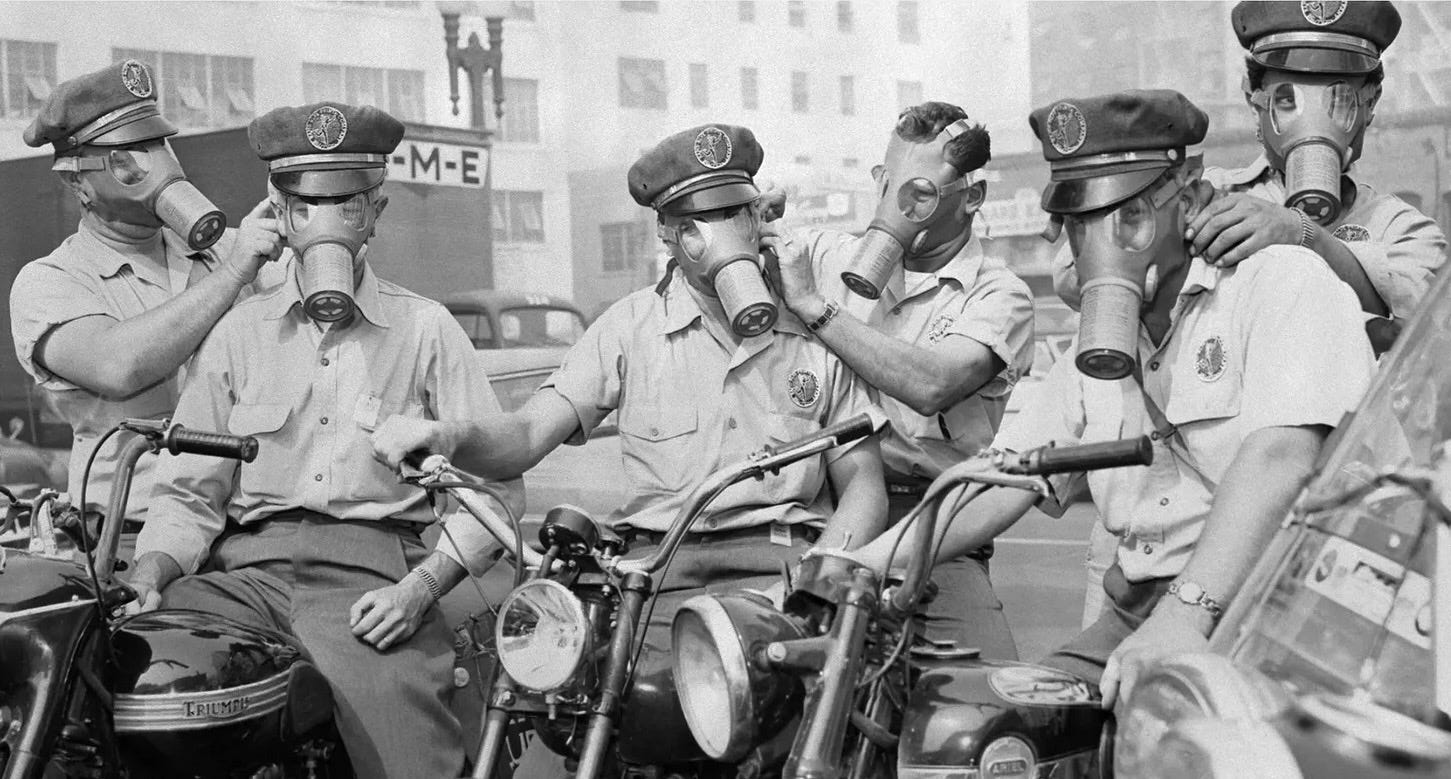
In comparing the smog and climate fights, we may be tempted to think, “Wow. If we only had a simple problem like smog, something people can see, smell, and taste, something that makes them gasp when they walk out their front door.”
Yes, that would make things easier for us.
But that doesn’t mean the smog challenge was easy.
When the three main anti-pollution actors began working on the smog challenge there was no EPA or comparable regulatory agency. There was no environmental consciousness, no environmental movement; there were no national environmental organizations with a focus on pollution. There were no scientific instruments to measure the pollution they were fighting, no agencies reporting on the pollution that in time would be measured by such instruments. So many things we take for granted — they didn’t have them. They helped to create them. They were scrappy. They were creative. They kept going. They made a difference.
Arie Haagen-Smit and Arnold Beckman and all of the smog activists of their time had their day. They rose to the challenge. Now it’s our turn. This is our time.

#9 MAGA Voters Are Not the Enemy. We Don’t Have Enemies. We Do Have Common Ground
We don’t have enemies. That’s what I hope all of my Climate Movement Artist-Athlete teammates can affirm.
Clearly we have opponents. But we must not turn them into enemies. Not labeling people as enemies is not some mushy, we-want-everyone-to-like-us, let’s-all-be-nice kinda deal. It protects both them and us.
Enemies are people we can harm, supposedly in the name of good. To conclude someone is an enemy is profoundly dangerous for both them and us.
It’s a short step from labeling someone an enemy to demonizing and dehumanizing such individuals and groups. Demonization of our opponents degrades them and us, corroding and weakening our Movement Values, thereby weakening one of our three forms of power: our moral power.
So I’ve said “them and us” three times. Sometimes such distinctions are needed. But we gotta be careful here. “Them” ain’t the enemy. In fact, “them” could become “us.” Indeed, we want “them” to become a part of us! Opponents can become allies and Climate Action Artist-Athletes.
As was the case with smog, when it comes to climate consequences, there’s no “them and us.” There’s just us. That’s not to say that the consequences are equal. Far from it. As I discussed in a 36-part Hope & Justice Series, how climate consequences has and will harm people is profoundly unjust. It’s not equal. But no one escapes climate consequences. And no one escapes the moral call such consequences create, nor the Better Future Covenant that we are all called to.
So just like smog, there is common ground when it comes to climate consequences. But there is also common ground when it comes to the benefits and co-benefits: clean air and water; cheap electricity via renewables; locally-grown clean energy via microgrids, community solar, and rooftop and plug-in solar, and; good paying jobs.
While we must defeat MAGA politicians (more on this soon), we must find common ground with MAGA voters and opponents more generally.
#10 Hyperpartisanship Is One More Obstacle For Us to Overcome
Sadly, over the last two decades hyperpartisanship, anti-environmentalism, and anti-climate-action have gone hand in hand, an unholy trinity.
I’ll have more to say about this in an upcoming post. So here I’ll be brief.
Our response must be two-fold. Dialing down hyperpartisanship can:
create space for climate action to rise in intensity/priority for Republicans still concerned about climate change;
open up opportunities for cooperation, including with those who aren’t interested in climate action, but are interested in the co-benefits.
As I’ll discuss more fully in an upcoming post, we don’t have a popular support problem. We have an intensity problem, a priority problem, a perception/framing problem. We must raise our intensity level across the board, including Republicans of all stripes.
To do so we must be two of our values, wise and pragmatic, wily and crafty for good, like Arnold Beckman.
The Smog & Climate Challenges Compared: Conclusion
So what do our 10 take-aways teach us?
Here’s what we know.
We have already overcome arduous challenges. That’s good, because climate change is offering us ones never seen before in history.
We will never give up.
It won’t be easy.
We will achieve victory together.
This is our moment. Now is the time for regular folk to become heroes together. Nothing less than greatness is our calling. Join us!
[1] Clio Andries, et al., “The Rise of Partisanship and Super-Cooperators in the U.S. House of Representatives” PLOS One (April 21, 2015): Fig. 2.
[2] Mary Matalin, James Carville, and Peter Knobler, All’s Fair in Love, War, and Running For President (Simon & Schuster, 1995): p. 449.
[3] John Cushman, Jr., “Congressional Republicans Take Aim at an Extensive List of Environmental Statutes” New York Times (Feb. 22, 1995).
[4] Leiserowitz, A., Maibach, E., Roser-Renouf, C., Feinberg, G., & Rosenthal, S. Politics & Global Warming, Yale University and George Mason University. New Haven, CT: Yale Program on Climate Change Communication (Fall 2015): p.4.