

Introduction
Looking back at the LA/Southern Cal smog story one could ask, “Was the effort a success? Is the smog gone?”
Success? Yes. Smog gone? No.
But how can we say it’s a success if the smog isn’t gone? Because smog pollutants have been significantly reduced even as population, vehicles, and vehicle miles traveled have exploded.
For example, one study found that “Despite a 38% increase in regional motor vehicle activity, vigorous economic growth, and a 30% population increase, total estimated emissions of NOx … decreased by 54% …” between 1993 and 2011. (NOx or nitrogen oxides, is the chief smog-producing pollutant.)
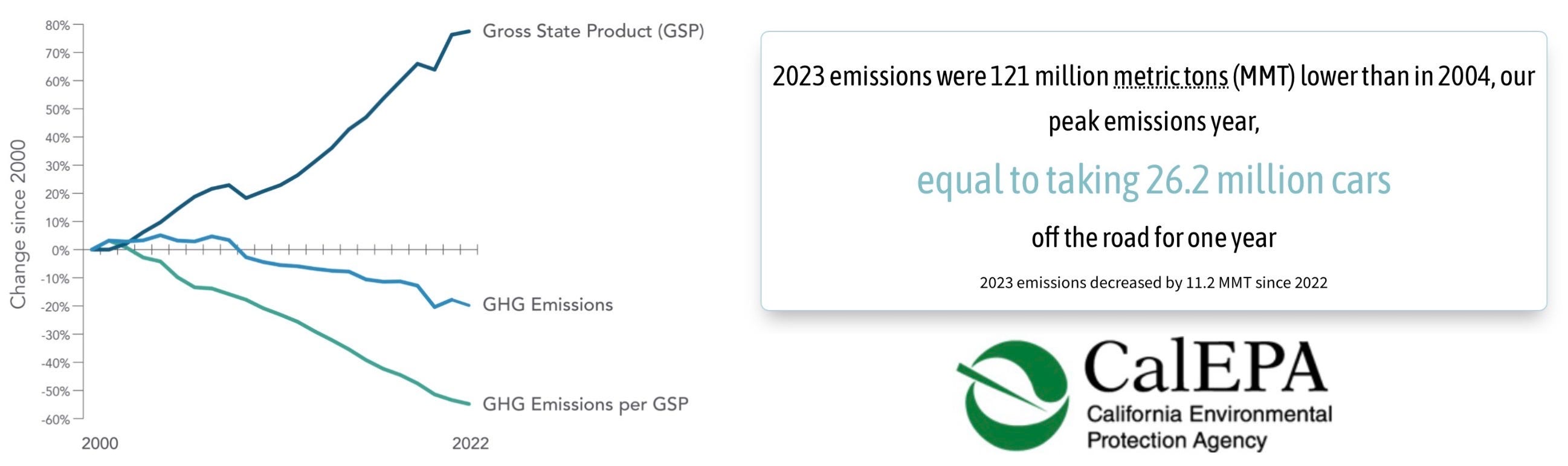
More broadly, California, with the fifth largest economy in the world and the second largest per capita, has continued to lead the nation and the world in reducing all forms of air pollutants, including climate pollution. It’s climate efforts received a major boost from the Global Warming Solutions Act of 2006, signed by Gov. Arnold Schwarzenegger. Since then, just like smog pollution, climate pollution has gone down while economic growth has gone up as the graph below demonstrates.
All of this had its beginnings in the LA/Southern Cal smog challenge. California has blazed a path that the rest of the US and the world has followed.
What Can We Learn? 10 Take-Aways
Thus far in this Smog-Climate Subseries we have discussed the following:
#2.1 Smog Lifts, Climate Warms, and the Creation of The Denier’s Playbook
#2.2 Smog Fight Helps Create Environmentalism
#2.3 The Denier’s Playbook: Stanford Research Institute (SRI) Defends the Oil Industry
#2.4 Arie Haagen-Smit: The Scientist Who Decoded LA Smog and Was Attacked For Doing So, Part One
#2.5 Arie Haagen-Smit: The Scientist Who Decoded LA Smog and Was Attacked For Doing So, Part Two
#2.6 Arnold Beckman: Scientist, Inventor, CEO, Republican Power-player, Smog-fighter — Part One
#2.7 Arnold Beckman: Scientist, Inventor, CEO, Republican Power-player, Smog-fighter, Part Two
For Climate action types, what can we learn from comparing the smog and climate challenges?
I have identified 10 take-aways, which I will discuss in three posts. This is Part One. Parts Two and Three will arrive on the next two Saturdays. These three will conclude our Smog-Climate Subseries.
#1: The Three Anti-Pollution Types Need Each Other
As I covered earlier, in the second half of the 19th Century and the first part of the 20th, as the Industrial Revolution came to full flower in the United States with its attendant pollution, groups across the country worked to address what was then called “smoke abatement.” There were three main anti-smoke types:
reformers/activists,
engineers/scientists, and
civic/business leaders.
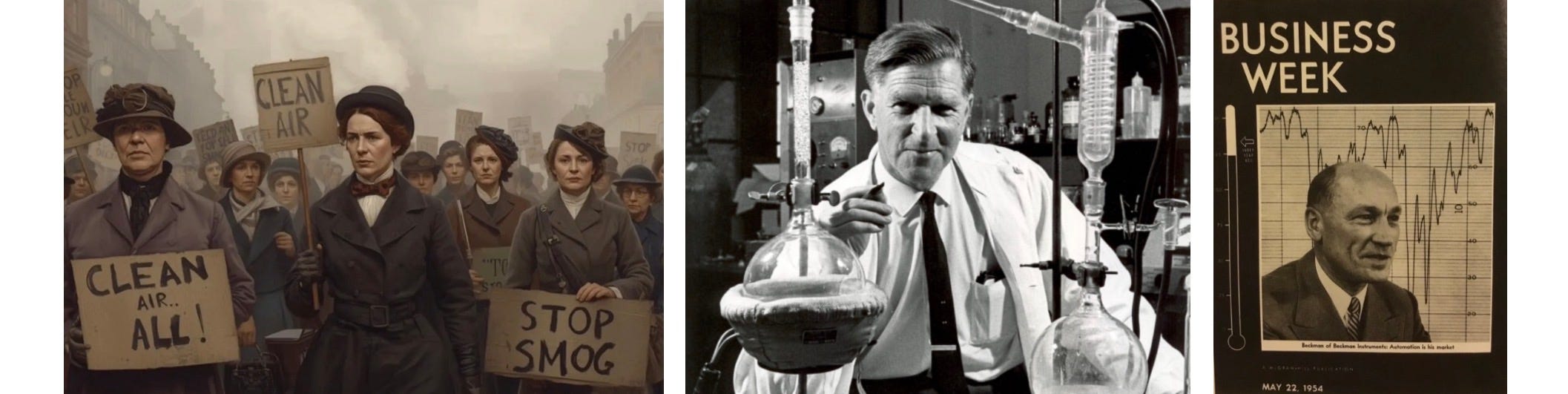
As I’m sure many of us trying to reduce pollution would recognize, we still fit in these three basic categories. The one that might raise some eyebrows would be business leaders.
We tend to be a bit surprised today when business leaders support caring for the environment by addressing pollution. But that has always been the case in this country.
For example, in 1898 Andrew Carnegie told the Pittsburgh Chamber of Commerce that industrial smoke had to go. Based on his urging, the Chamber sprung into action, guided by its Committee on Smoke Prevention. The Committee stated:
“there will always be found individuals who will insist that unless they are at liberty to make smoke at their pleasure, they will be ruined. Such protestations will have to be ignored.”[1]
As folks who’ve been working on environmental and climate challenges know, this tired old “It will ruin the economy” “Jobs vs. Environment” line is still trotted out. But at the turn of the 20th Century Andrew Carnegie and the Pittsburgh Chamber of Commerce already exposed that canard.
Thus, the LA Chamber of Commerce’s concern with smog was not an aberration; rather, it was consistent with past stances. As they said in the Smog Elimination Action Program: air pollution “poses serious threats to living values, business values and property values in the Los Angeles Basin.”
Dr. Beckman’s response to smog was also in keeping with history, in his case doubly so. He fits two of these three types, businessman and scientist/engineer.
The smog fight also illustrates another pattern: these three types don’t always agree or get along, but they nevertheless need one another – even if they may not like each other.
Dr. Beckman makes it very clear that it was the activities of the third group, the citizen activists, those “emotionally charged people” who “go off half-cocked” and create “unnecessary chaos,” that pushed him into the smog fight.
This was true not only for Dr. Beckman, but for the Chamber as well. Two years before they asked Beckman to become involved the Chamber sprung into action in 1944 when a local grassroots group proclaimed: “If the authorities don’t do something about this, the people will.”[2] The Chamber did not believe “that citizens demanding hurried action … can bring about a satisfactory solution of the problem.”[3] More than this, both the smoke abatement efforts and the LA smog fight show that business leaders who want to reduce pollution would rather have polluters cooperate voluntarily than be required to by the government.
It is the activists who must push for the government to have pollution reduction power and use that power to do a its most basic job: defend its citizens against a dangerous threat.
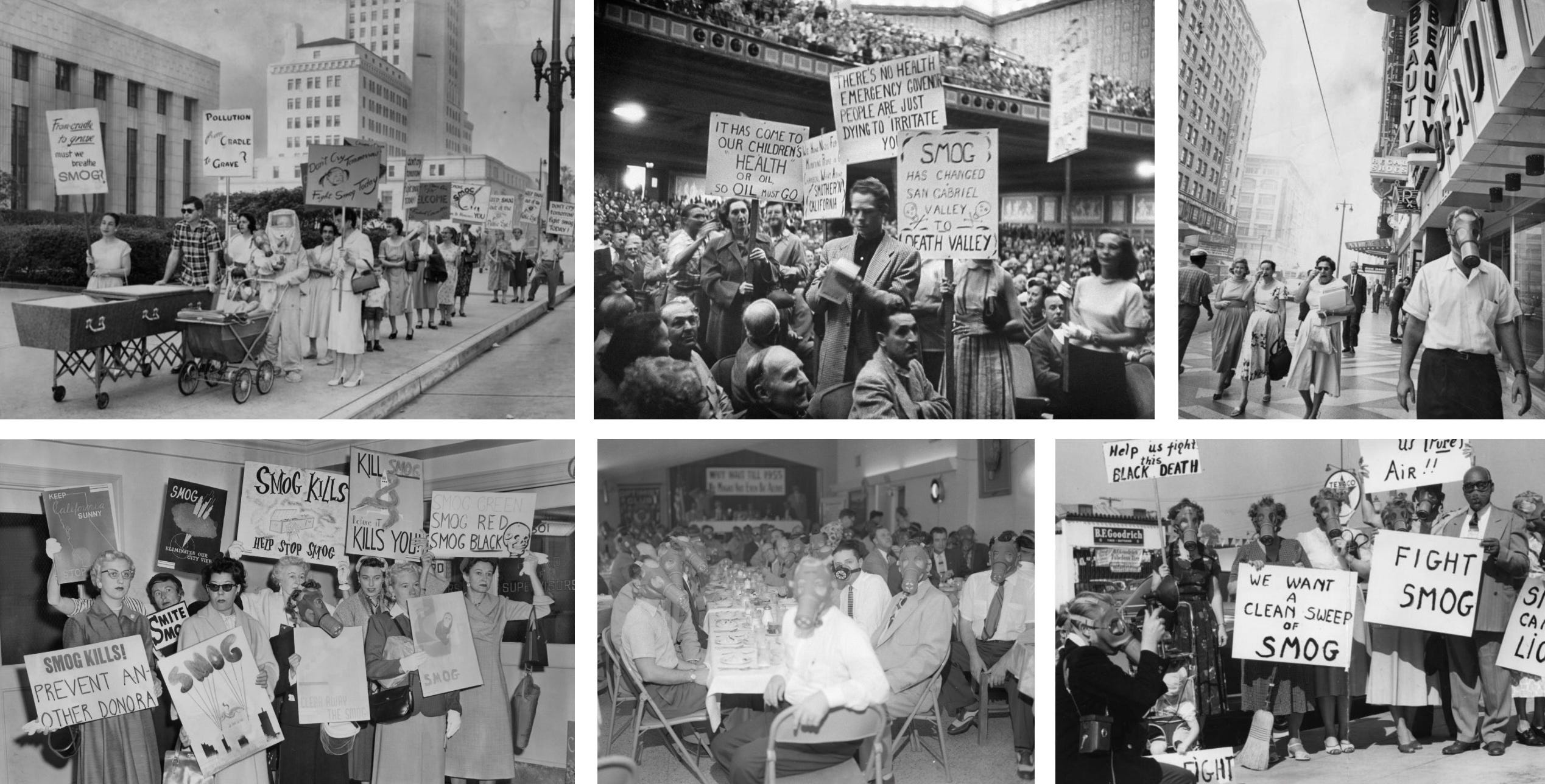
The activist ruckus-raisers and the business and scientist/engineer rationalists are never going to be completely in sync, never going to be completely comfortable with each other. But without the ruckus-raisers, the rationalists may never get off the dime. Without being an irritant, without making them uncomfortable, progress my come too slow or not at all.[4]
This is not just true on the business side of things. It’s a also true for the scientific findings needed to properly address the problem. In many situations, if it were not for activists raising concerns, the conservative nature of scientific inquiry would have the process take much longer than the problem requires. Lack of funds can also be an impediment, and activists can help secure what’s needed to increase the pace and scale of scientific progress.
But without the facts, and with a chronic problem like smog wreaking havoc, activists can rush to judgment, hurting their cause. Even more basic, we want to solve the actual problem, and to do so we need to understand what’s causing it. While in the case of smog we could argue, retroactively, that the efforts to reduce SO2 helped improve air quality in other ways, it didn’t help with the smog problem. That hurt credibility and gave an opening to the deniers.[5]
So, activists need Haagen-Smit and Beckman the scientists/engineers. But we also need Beckman the inventor and businessman, not only to help push for public policies, but to create and implement the solutions throughout the economy; that is where the problem will be solved.
#2: If They Run The Denier’s Playbook Against Smog, Well …
Few today would not want to do something about smog, and the struggle continues in LA and across the nation.[6] Yet when the need for action was greatest, the Oil Industry and their hired scientists ran The Denier’s Playbook to thwart or slow down needed action.
And they haven’t stopped doing it! Incredibly, the Oil Industry still has been opposing efforts to combat smog.
For example, in Fall 2016 the Environmental Protection Agency (EPA) proposed some overdue guidelines for methane or natural gas leaks in the industry’s infrastructure. (Natural gas contains smog precursors.) Here’s what the American Petroleum Institute had to say:
“Moving forward with these guidelines without robust data could impose unachievable emission reduction requirements on the industry, while adding potentially significant costs to the American economy, jobs, consumers and the environment.”[7]
Sound familiar?
Let me add a bit of snarky commentary:
“… robust data …” – Yea, somehow there never seems to be enough data, always just a bridge too far; to riff on an old saying, data, data, everywhere, but not a byte to eat.
“… unachievable emission reduction requirements …” – Except for all those other requirements they’ve met once they had to.
“ … significant costs …” – They’re serious this time, this one will really wreck the economy.
“… and the environment.” – Oh what the heck, throw the environment in there, that will be wrecked, too, if we reduce this pollution.
Fool us once, shame on you. Fool us 2,942.06 times, shame on us!
BTW, the Biden Administration subsequently issued new methane regulations, only to have the Trump EPA gut them in November 2025, with the American Petroleum Institute cheering them on:
“Smart regulations are essential to sustaining our industry’s progress in reducing methane emissions. We commend E.P.A. for its thoughtful and timely work to finalize a rule that supports innovation while balancing environmental progress and meeting the world’s growing energy needs.”
In their Orwellian doublespeak, “balancing” somehow means backtracking.
#3: Courageous Scientists Prevailed
If the Fossils and their allies would attack Arie Haagen-Smit, an apolitical member of the Chamber of Commerce and researcher for agribusiness, then they will attack anyone.
Scientific statesmen like Haggen-Smit are needed to stand up for what the facts demand. It is not enough to simply find the facts; we must have scientists who will stand up for the truth and its requirements in the face of withering attacks. And the rest of us must support them.
We continue to need scientists who are truth-tellers on climate change like Haagen-Smit was on smog. As unpleasant as it was for Haagen-Smit, his experience pales in comparison to that of many climate scientists.

At this point the debate within the scientific community is long over. That’s largely due to such courageous scientists like James Hansen, Ben Santer, Sir John Houghton, Michael Mann, and Katharine Hayhoe, who have withstood attacks to stand up for the truth and for what’s right.[8] I, for one, will be forever grateful for what they’ve done.
Conclusion to Part One
The dynamic smog duo of Arie Haagen-Smit and Arnold Beckman, scientists who followed the truth wherever it led, then fought for the truth even as The Denier’s Playbook was run against them, and then did what needed to be done to address the problem — their examples help to light our way.
It’s good to know they weren’t perfect. That means the rest of us have a shot at standing for truth and what’s right for such a time as this.
And, of course, we have many climate scientists who have faced adversity for the sake of the truth, heroes for our great cause.
They had their Olympian Fields of Action, and we have ours. The scientists on their own can’t do it. They need the activists. They need us. Each of us are called to our own Fields of Action to play our part, something no one else on Earth can do.
Ours is a time for regular folk to become heroes together. Nothing less than greatness is our calling. Join us!
[1] As quoted in Robert Dale Grinder, “From Insurgency to Efficiency: The Smoke Abatement Campaign in Pittsburgh Before World War I,” The Western Pennsylvania Historical Magazine, vol. 61, no. 3 (July 1978): pp. 190-191.
[2] As quoted in Elkind, How Local Politics Shape Federal Policy, p. 59.
[3] Minutes from a Los Angeles Chamber of Commerce meeting on Sept. 14, 1944, as quoted in Elkind, How Local Politics Shape Federal Policy, p. 63.
[4] Historian Frank Uekoetter makes a similar point. When cooperation between regulators and industry succeeded in reducing pollution, it was usually because a less attractive alternative helped push them to do so: “Throughout history, cooperative modes of regulation were usually at their best when they competed with a different, more confrontational approach; conversely, they were in danger of sclerosis when no alternative was in sight. … if cooperation worked, it did so not because industrialists were nice people, but rather because they wanted to prevent a shift to less attractive policies.” See The Age of Smoke: Environmental Policy in Germany and the United States trans. Thomas Dunlap (University of Pittsburgh Press: 2009): p. 17.
[5] For example, the API’s Vance Jenkins called it “The Sulfur-Dioxide Fable.” See Jenkins, “The Policeman is Coming!” p. 295.
[6] The Los Angeles Air Pollution Control District (APCD) eventually became the South Coast Air Pollution Control District. As two news articles show, LA has continued working to reduce smog through the APCD. From the LA Times: “The first five months of 2026 in Southern California have been the smoggiest — with the highest number of unhealtful air days — in more than a decade, according to statewide air monitoring.” That piece adds a new wrinkle: warmer days create more bad smog episodes. The NYT article highlights that many of the arguments for and against are quite similar to those during the time of Haagen-Smit and Beckman. See Tony Briscoe, “L.A. Region Begins the Year with the Smoggiest First 5 Months in a Decade,” Los Angeles Times (June 6, 2026), and; Mike McPhate, “California Today: Tackling Los Angeles’s Deadly Smog,” New York Times (Feb. 6, 2017).
[7] Reid Porter, “Implementing EPA’s Control Techniques Guidelines Without Proper Scientific Input Is Bad Public Policy,” American Petroleum Institute (Oct. 20, 2016).
[8] As the historian of climate science, Spencer Weart, reminds us, besides standing up to the attacks, other forms of courage were needed for “the struggles of thousands of men and women over the course of a century. For some, the work required actual physical courage, a risk to life and limb in icy wastes or on the high seas. The rest needed more subtle forms of courage. They gambled decades of arduous effort on the chance of a useful discovery and staked their reputations on what they claimed to have found.” See Spencer R. Weart, The Discovery of Global Warming, revised ed. (Cambridge: Harvard University Press, 2008): p. vii.
[9] Spencer Weart, “Global Warming: How Skepticism Became Denial,” Bulletin of the Atomic Scientists, vol. 67 no. 1 (2011): p. 45.
[10] For the history of climate change, see Spencer Weart, Discovery of Global Warming; Weart also maintains an excellent website with up-to-date revisions and additions. See also Joshua P. Howe, “Making Global Warming Green: Climate Change and American Environmentalism, 1957-1992,” Ph.D. Diss (Stanford University, July 2010.)
[11] Roger Revelle, “Statement of Dr. Roger Revelle Concerning the Oceanography Investigation,” Testimony Before the Subcommittee of the Committee on Appropriations of the House of Representatives, Report on the International Geophysical Year (Feb. 1959): p. 78.
[12] President Johnson’s quote found in an article by Marianne Lavelle, “Fifty years ago this month President Johnson voiced concern over invisible fossil fuel emissions in a special message to Congress. It was the first time a U.S. president warned the nation about our carbon habit,” The Daily Climate (Feb. 2, 2015). A scientific report for President Johnson with a chapter on climate change was released later that year. See Restoring the Quality of Our Environment, Report of the Environmental Pollution Panel, President’s Science Advisory Committee, The White House (November 1965).
[13] Charles Jones’ peer-reviewed 1958 report states that API had funded research to provide an “Analysis of the gaseous carbon compounds in the atmosphere to determine the source of atmospheric carbon.” See Jones, “A Review of the Air Pollution Research Program of the Smoke and Fumes Committee of the American Petroleum Institute, p. 271.
“The dynamic smog duo of Arie Haagen-Smit and Arnold Beckman, scientists who followed the truth wherever it led, then fought for the truth even as The Denier’s Playbook was run against them, and then did what needed to be done to address the problem — their examples help to light our way.”
It’s good to know they weren’t perfect. That means the rest of us have a shot at standing for truth and what’s right for such a time as this.
And, of course, we have many climate scientists who have faced adversity for the sake of the truth, heroes for our great cause.
They had their Olympian Fields of Action, and we have ours. The scientists on their own can’t do it. They need the activists. They need us. Each of us are called to our own Fields of Action to play our part, something no one else on Earth can do.
Ours is a time for regular folk to become heroes together. Nothing less than greatness is our calling. Join us!