


Six thousand pounds of pineapples. That’s how much the Pineapple Research Institute of Hawaii sent Professor Arie Haagen-Smit of Cal Tech in 1945 so that he could study what made up pineapple flavor.1 Some of his colleagues speculated at the time that his work could lead to a Nobel Prize. Instead, in a few years he found himself in a fight with the Oil Industry, one they and their hired scientists picked to discredit him and sully his reputation. As he would later remark about its potential career impact: “It was a case of being handed your own death certificate.”2
Before this Haagen-Smit was an unknown scientist, toiling in obscurity with his pineapples, whose publications included such page-turners as “Über den Einfluss unbekannter ausserer Faktoren bei vermischen mit Aven sativa,” and “The excystment of protozoa: Isolation of crystalline excystment factors for Colpoda duodenaria.” His day job didn’t pay enough to afford to buy a house in the expensive SoCal market. So he tested racehorse urine for doping as a side gig.
It turned out Haagen-Smit, or “Haagy,” had what Tom Wolff called The Right Stuff to stand up to the Oil Industry’s intimidation. What they didn’t know was that in high school Haagen-Smit had become a formidable boxer.

This former boxer, horse-piss tester, and pineapple flavor expert was the wrong guy to pick a fight with.
No doubt the Oil Industry didn’t care one whit about pineapple flavor, except as something they tried to push Prof. Haagen-Smit back to studying; they wanted him chastened and forgotten, a cautionary tale to other scientists.
The Oil Industry’s Concerns that Pollution Could Hurt Profits Began Early
What they did care about was how pollution could impact their bottom line, a concern that stretched at least as far back as the creation of the American Petroleum Institute (API) in 1921. In its founding year3 the API created a committee to deal with problems arising from pollution caused by the production and use of their products. During the early decades interest waxed and waned throughout the industry, committees were formed and reformed.4
It was smog in the Los Angeles (LA) area that brought this concern about pollution into much sharper focus.
Why I Became Interested in the LA Smog Story: Creation of The Denier’s Playbook
I stumbled into the LA smog story as someone who’s been fighting climate change for over 30 years. When I saw that the same basic arguments were trotted out against addressing smog, as well as the same modes of attack against those trying to tell the truth, I felt compelled to investigate.
So I’m telling the smog story from the vantage point of a climate veteran. I’ll be comparing the smog and climate struggles for what they can teach us as we continue on our Olympian Fields of Action.
I also discovered the inspiring stories of two men – Haagen-smit and Arnold Beckman – who were absolutely essential to the success of the smog fight.
In The Beginning There Was LA Smog, and It Wasn’t Very Good
The smog story begins in earnest after World War Two, when LA became ground zero for the early pollution fights with the Oil Industry. It was during the late 40s and early 50s that the industry’s modus operandi or M.O. against pollution control efforts was put into effect.5 Leading the effort was the “Petroleum Industry Committee on Smog,” later to be known as the “Smoke and Fumes Committee.”
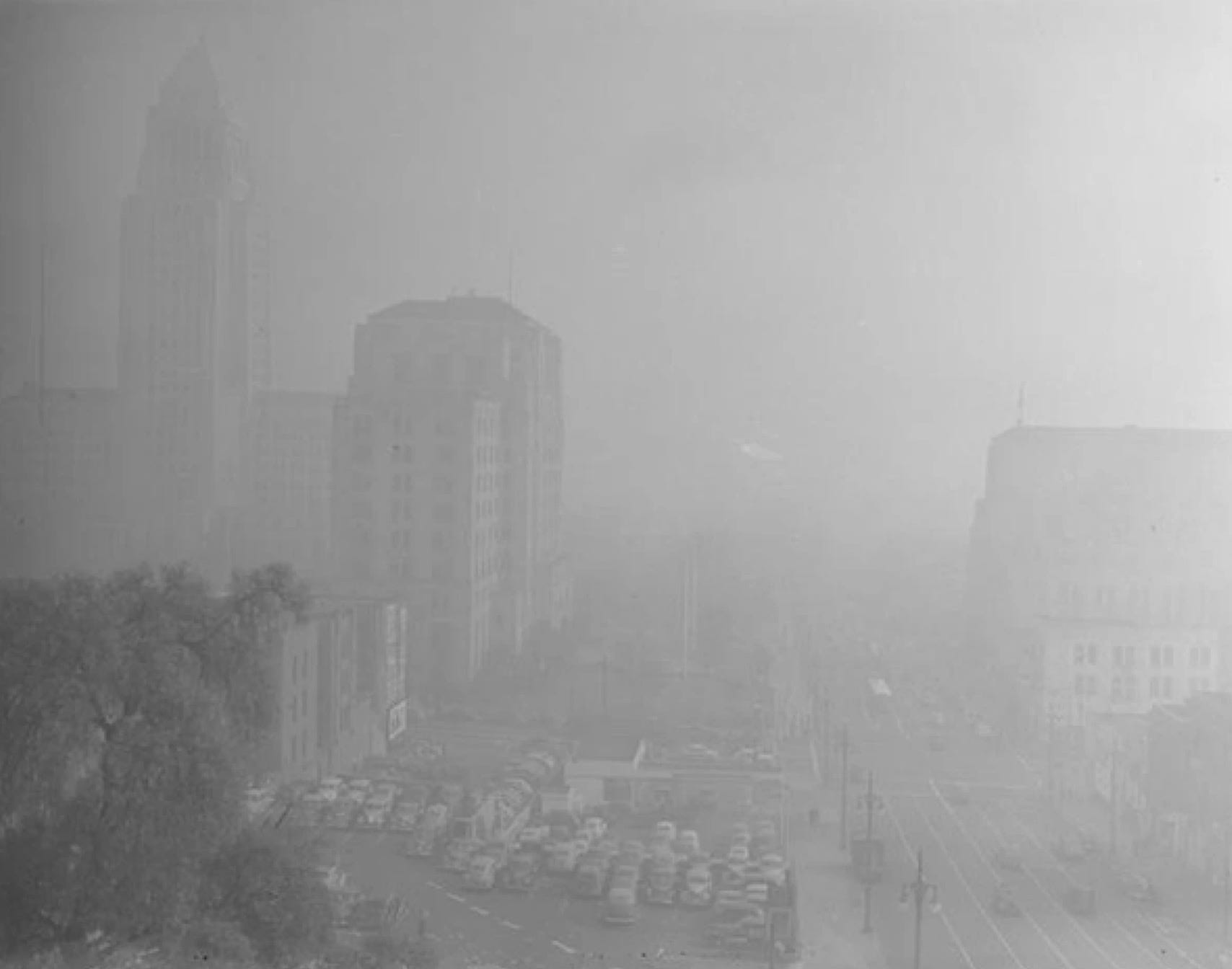
In the fight against climate action, some have suggested that opponents mimicked the tobacco companies in their attempts to sow doubt. What the smog fight reveals is that the Oil Industry already had their M.O. at least as far back as the late 1940s.
In struggles like these each side tries to choose the field of battle and occupy the ground most advantageous to its cause. A key strategic decision is whether to pursue your goals behind the scenes using one’s relationships and influence, in public, or a combination of the two.
For the Oil Industry the smog fight was to be a combination. I will concentrate primarily on the public fight.
The Denier’s Playbook
So when we look at how the Oil Industry has fought both action on smog and climate change in public, some basic patterns emerge, what I call The Denier’s Playbook, hope-stealing in action. This consists of two basic parts.
I. Part One — Pound Home a Simple Message for Public Consumption: Deny, Deny, Deny
Deny there is a problem (if you can).
Deny we know enough.
Deny culpability.
II. Part Two — Operationalize The Message
Hire scientific consultants to do “research,” propose theories friendly to Industry interests, and help proclaim the basic 3-part message of denial.
Attack and discredit legitimate scientists telling the truth.
Proclaim to media and elected officials/policymakers that we don’t know enough to act; more research is needed; the science isn’t settled.
In subsequent posts I will tell the story of how The Denier’s Playbook was run against Prof. Haagen-Smit in the Oil Industry’s attempts to thwart smog control efforts that would cost them money.
But I will also show that there was another path available in this smog fight to members of the Oil Industry and their scientific allies, one trod by Dr. Arnold Beckman — scientist, inventor, entrepreneur, CEO, and conservative Republican. It was Beckman who first asked Haagen-Smit to study smog and supported him at crucial times during the fight. Without Beckman there would have been no Haagen-Smit. And without Haagen-Smit, addressing smog may have been significantly delayed.
Finally, the smog fight provides another lesson from the history of fighting air pollution. As I’ve already highlighted, stretching back into the 19th Century there have been three main types of individuals seeking to address pollution: (1) pro-action types; (2) scientists/engineers, and; (3) business leaders. They haven’t always gotten along or even liked each other, but each is essential to success.
Today these types are found in The Four Catalytic Sources of Transformation or The Catalytic-4. The pro-action types are our first two catalytic sources: The Climate Movement and Climate Action Supporters. Scientists/engineers are key to our Third Catalytic Source: ARTC or the accelerating rate of tech change. And business leaders are important players in our Fourth Catalytic Source: Governments-&-Markets.
Truth Matters
The truth matters. It is the only thing we can build a realistic future upon. The hope-stealing Denier’s Playbook is having its last hurrah with Trump & MAGA. They will have to live with their consciences and history’s condemnation. Some, sadly, will die deniers.
As a moral movement, we are committed to the truth: to facing the truth about climate change, but also the truth that we can overcome it. We are also committed to the truth that justice for today’s children and subsequent generations requires that we build them a better future as part of our Better Future Covenant.
So join us as we make the impossible possible and the possible actual and the actual beautiful, our world more just, and our future come faster.

If you are new here, check out our Intro Series, as well as other posts in Our Story Together Series. If you like this post, please “like,” comment, and share. And thanks for all you’re doing.
See “Arie Jan Haagen-Smit: Caltech’s Crusader for Clean Air,” Engineering and Science (Feb. 1969): p. 21.
Chip Jacobs and William J. Kelly, Smogtown: The Lung-Burning History of Pollution in Los Angeles, Overlook Press (NY: 2008), p. 82.
The unearthing and release of Oil Industry documents related to their pollution concerns, especially climate change, started in September 2015. Initially the focus was on Exxon. A series of articles from news outlets began to lay out what Exxon knew and when it knew it concerning climate change, based on its own documents going back to the 1970s. Even earlier documents from the American Petroleum Institute (API) and other industry associations show that their concerns about how pollution from their products could lead to economic costs has been around for about a century.
Vance N. Jenkins, “The Petroleum Industry Sponsors Air Pollution Research,” Air Repair vol. 3.3 (1954): p. 145.
Whether or not this was the first time the Oil Industry employed their M.O. I don’t know. The industry documents I’ve reviewed don’t include anything earlier.