

In our first post in this Smog-Climate Subseries, I introduced what I call The Denier’s Playbook that the Oil Industry developed in the first half of the 20th Century to attack pollution reduction efforts.1 As I explored in the second post, it all came to a head with the smog challenge in Los Angeles. As we will see through the remainder of this Smog-Climate Subseries, The Denier’s Playbook was operationalized in the late 1940s and early 1950s to a degree of scale and sophistication not yet seen before.
Here, again, is …

I. Part One — Pound Home a Simple Message for Public Consumption: Deny, Deny, Deny
Deny there is a problem (if you can).
Deny we know enough.
Deny culpability.
II. Part Two — Operationalize The Message
Hire scientific consultants to do “research,” propose theories friendly to Industry interests, and help proclaim the basic 3-part message of denial.
Attack and discredit legitimate scientists telling the truth.
Proclaim to media and elected officials/policymakers that we don’t know enough to act; more research is needed; the science isn’t settled.
In Los Angeles beginning in earnest in the 1940s there was no denying that smog was a problem without denying what your senses were telling you: you could see it, smell it, and taste it.
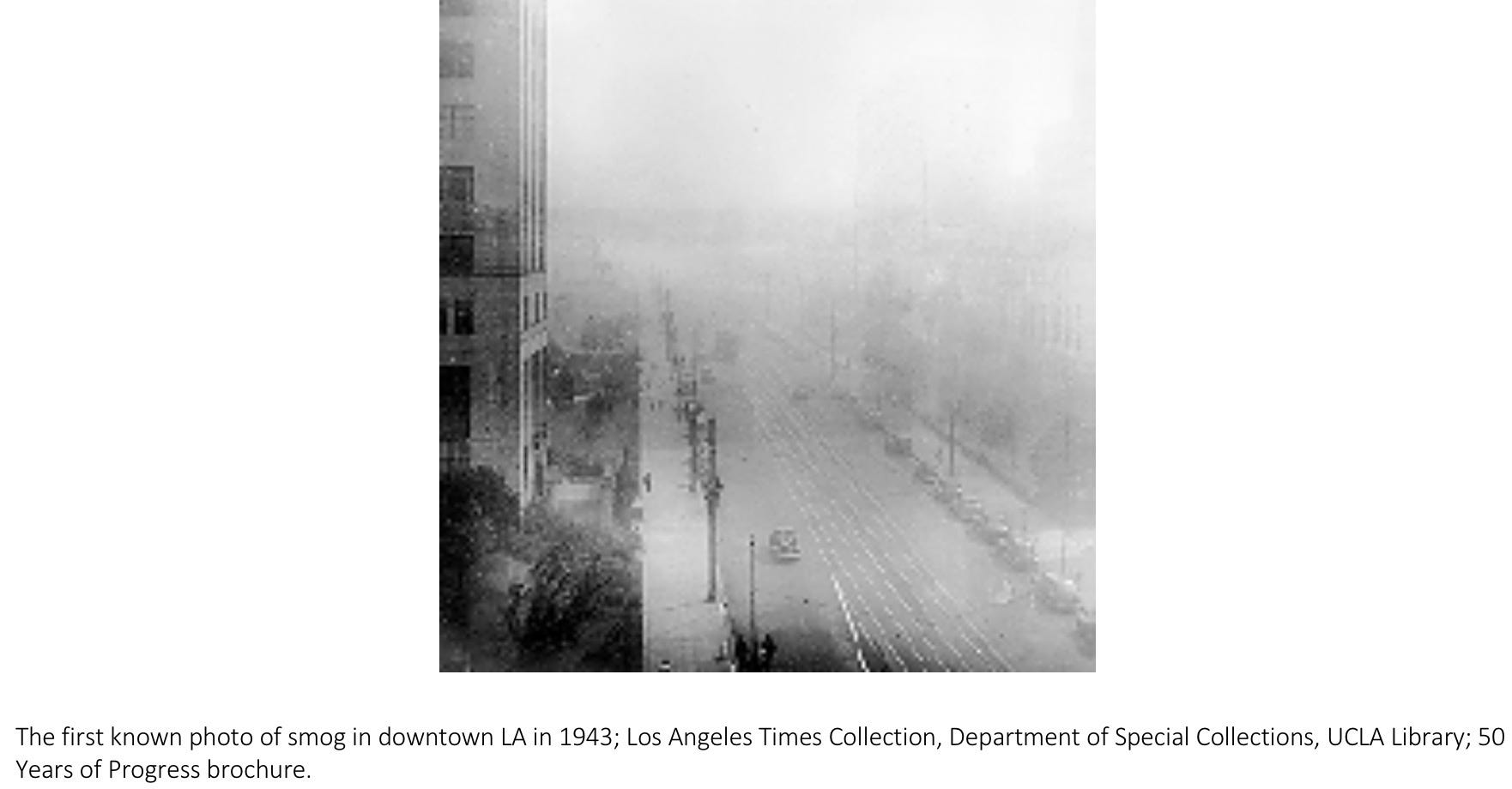
Because the Oil Industry had no recourse in the LA smog challenge to the first message point – denying the problem – they simply moved on to the next two message points: deny we know enough and deny culpability.
They began Part Two of The Denier’s Playbook: operationalizing the message. Step One is to hire scientific consultants to do research and help deliver the message both behind the scenes and in public. So in March 1947 they hired the newly formed Stanford Research Institute (SRI).2
Today what is now called SRI International is a world-class research institute with 20 locations around the world and an annual budget of approximately $400 million. Their best known contribution would be Siri, Apple’s digital assistant, created through a Defense Department program (DARPA). Their promotional materials have boasted millions of lives improved or saved by their work and $4 billion of R&D in the last decade.
But back in 1947 when it was hired by the Oil Industry to help with operationalizing their message, in this case attacking Dr. Haagen-Smit (step two), the Stanford Research Institute (SRI) was a brand new organization struggling financially that had a significant relationship with the Oil Industry.
When I first started looking into SRI’s history with the Oil Industry and smog I had two basic thoughts about why SRI did what it did. Both turned out to be wrong.
First, I thought they must be in desperate financial circumstances and needed the money.
My second thought was that influential Board members with deep ties to the Oil Industry unduly influenced SRI.
Both these ideas suggested that SRI’s innocence and integrity were compromised by the need to survive, and once they had done so, they doubled-down, with their own guilt and insecurity fueling their contest with Haagen-Smit.
I was wrong – not about the facts, just my interpretation of the facts.
First, when SRI took on smog, when it began Step Two to operationalize the Denier’s Playbook with its attack on Haagen-Smit, the organization was indeed in serious financial difficulty threatening its survival. Without crucial infusions from the Oil Industry in the form of contracts, grants, and loans, SRI may not have made it; they literally needed oil money to make payroll.3
Second, those affiliated with the Oil Industry were indeed influential, but not unduly so in the sense of corrupting SRI’s own understanding of its moral integrity.
The whole point behind the creation of SRI was to have science help industry achieve economic growth. Given that industry employed most scientists up until this time, such an aspiration was nothing new. But SRI’s founders felt science was being underemployed and insufficiently utilized by business, to its detriment, and they hoped to help rectify this problem.
SRI’s Charter states4 that its purpose is:
To promote and foster the application of science in the development of commerce, trade and industry, the discovery and development of methods for the beneficial utilization of natural resources, the industrialization of the western United States of America, and the improvement of the general standard of living and the peace and prosperity of mankind.
Science that fosters “commerce,” the “beneficial utilization of natural resources,” and “industrialization.” In the late 1940s, oil fit this bill.
This helps us see that SRI’s major players – the founders of SRI, Stanford University’s Board and senior leadership, SRI’s Board, and SRI staff – would have viewed their positive relationship with the Oil Industry as good, natural, and vital to economic progress and well-being. If we were to single out the Oil Industry as some odorous influence it probably would have struck them as odd, a comment coming out of nowhere. That is because there was no daylight between them.
A final point to explain SRI’s close relationship with the Oil Industry has to do with interpersonal relations. The individuals involved respected one another; they liked one another; they trusted one another; they wanted to help each other.5
One of the best examples of this is Bill Stewart, the same Oil executive who convinced his colleagues not to oppose the smog legislation and would go on to become the Chair of the American Petroleum Institute’s Smoke and Fumes Committee, responsible for financing pollution research by SRI and others.6 Stewart was on SRI’s Board and arranged for loans and grants when SRI was in financial difficulties, including one for $125,000 in 1948.7 He was a mentor in a brotherly fashion to both SRI’s second CEO, Dr. Jesse Hobson, and Abe Zarem, the head of SRI’s LA Office, who became the chief nemesis of Haagen-Smit. Indeed, it was Stewart who encouraged the creation of the LA office with Zarem as its head, and they became “close friends” during the smog fight.8[8]
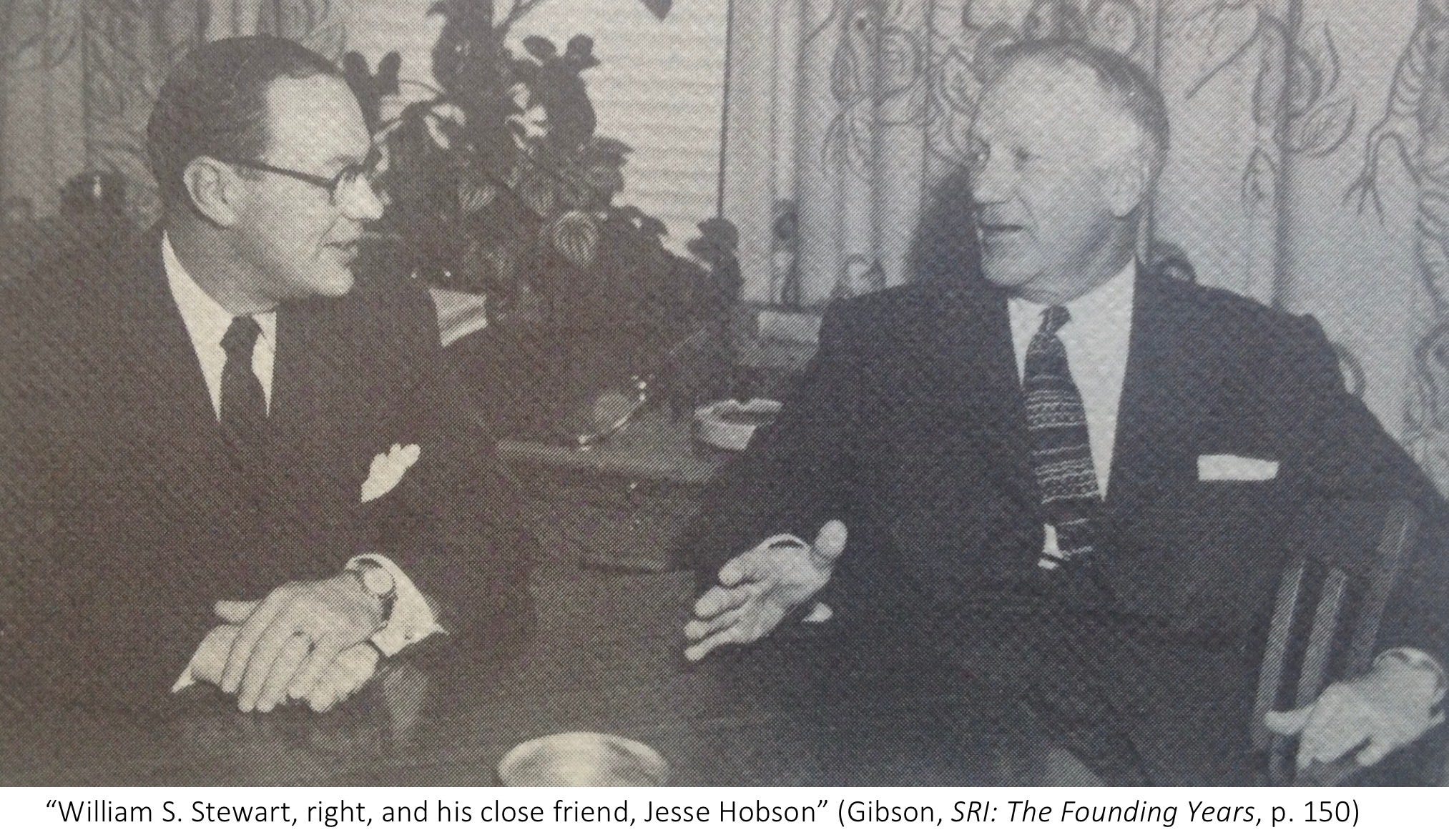
Thus, the smog work was not about SRI being co-opted or corrupted by nefarious Oil men. Rather, the smog project was one of the ways they helped SRI as mentors, friends, and business partners. They were part of the same world; they were on the same team.
It comes as no surprise, then, to see this comment from authors of one of the first major treatments of the history of the smog fight. SRI: “seemed not at all shy about occasionally adopting the posture of a petroleum industry spokesman.” They quote as an example this comment to the local press in October 1953 by an SRI representative:
“the [oil] industry is concerned lest final judgements be taken too soon about smog’s causes which could result in the industry being forced to take measures which would not eliminate smog and would be extremely costly.”9
This SRI representative is not imparting scientific findings; this is not even strong representation for a client. This is defending one’s team.
As we will see in the next post in this Subseries, Arie Haagen-Smit was perceived to be on the opposing team, and SRI attacked him, running what I call The Denier’s Playbook, as if victory was on the line. They only saw him as an opponent, when in fact his research would largely exonerate the local oil refineries who were being blamed by the public and the press. It was the burning of their product by vehicles in sunny California that was the problem, not their refineries.
Stay tuned!

If you are new here, check out our Intro Series, and other posts in the Our Story Together Series. If you like this post, please “like,” comment, and share. And thanks for all you’re doing.
Those aware of the excellent work of Naomi Oreskes and Erik Conway may mistakenly jump to the conclusion that they are telling the full historical story of how the fossil industry has fostered denial of environmental problems, including climate change. That’s not what they are doing, as they state explicitly in the book. Theirs is “a story about a group of scientists who fought the scientific evidence and spread confusion on many of the most important issues of our time,” especially tobacco (p. 8). Right at the top of the cover it states that their focus was on “a Handful of Scientists,” namely Frederick Seitz, Fred Singer, William Nierenberg, and Robert Jastrow. These men are the “Merchants of DOUBT.”
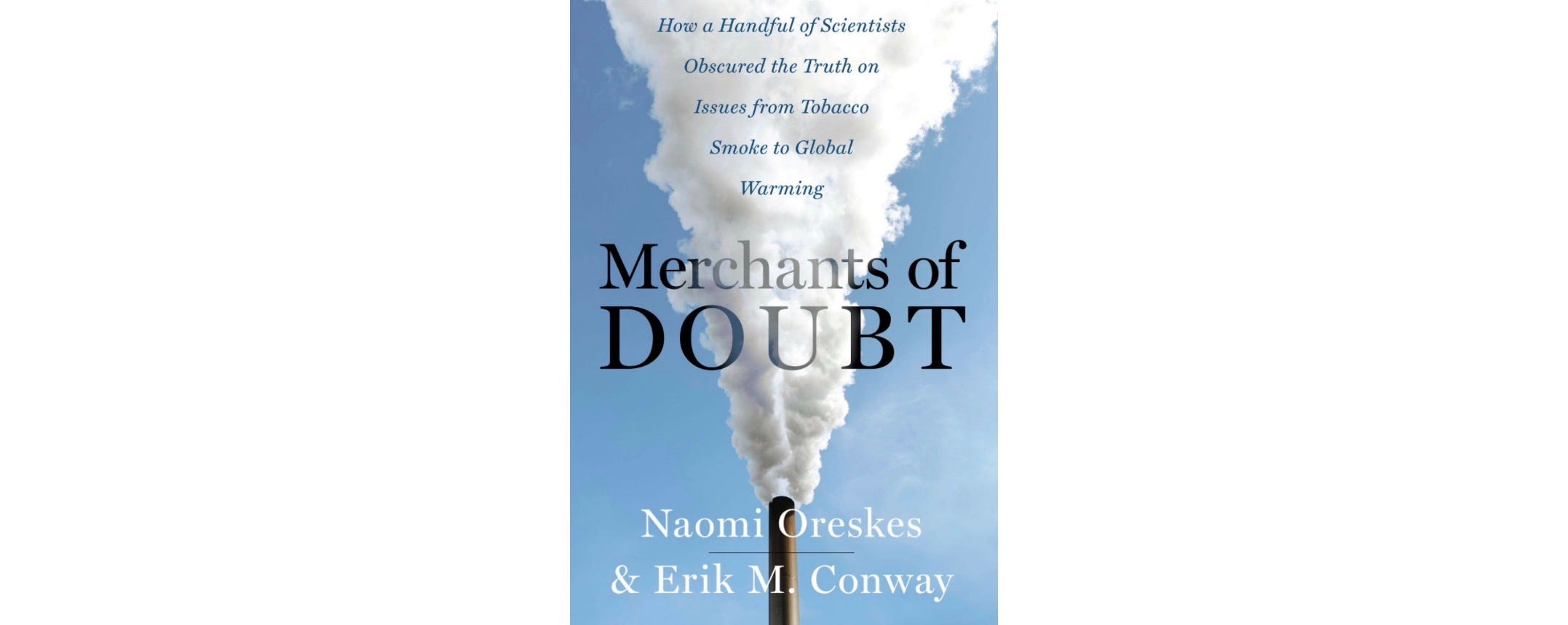
The story I’m telling is that there were many others in the Oil Industry before them sowing doubt through what I call “The Denier’s Playbook.” Mine is also not the full story. I’ll leave that to someone else!
Vance Jenkins, “The Petroleum Industry Sponsors Air Pollution Research,” Air Repair, Vol.3:3 (Feb. 1954): p. 147. Jenkins was the Executive Secretary (senior staffer) of the American Petroleum Institute’s Smoke and Fumes Committee. Another brief recounting by the Oil Industry itself of its smog work can be found in Paul L. McGill, et al, “Smog: Fact and Fiction,” Proceedings, Seventeenth Mid-Year Meeting, Division of Refining, American Petroleum Institute, San Francisco, May 12 to 15, 1952, pp. 286-291. Refreshingly, it mentions the work of Haagen-Smit in a neutral, straight-forward manner (p. 290).
Two of SRI’s first three contracts were with the Oil Industry. Consider the following (see full citations at the end):
SRI’s second contract was with the Richfield Oil Corporation, which began a long series of projects for Richfield. [Gibson, p.102]
The Western Oil and Gas Association smog contract, the organization’s third, – was for $505,649 over 30 months, and without it the organization would not have been able to pay its bills. [Nielson, p. 9-18; ] SRI’s smog work for the Oil Industry would last about a decade.
In early 1948 when there was a cash-flow problem, Standard Oil of California gave a gift of $15,000 to tide them over. [Gibson, p128]
A $125,000 loan from the Western Oil and Gas Association in late 1948 was arranged “when we were desperately short of working capital.” [Gibson, p. 153]
(There may be other instances of Oil Industry financial infusions in these early years of which I am unaware, given I do not have complete budgetary information.).
In a formal assessment of revenue potential in early 1948 one senior SRI official, Dr. William E. Rand, who at that moment was serving briefly as the interim CEO, considered the smog contract as a good omen for more business with the Oil Industry. At the time, many other industries had not yet seen the value of research more generally and SRI’s role in particular. In contrast, the Oil Industry was “’alive to its research needs,’” and Rand felt that in terms of revenue generation from the business sector the Oil Industry offered the greatest potential. [Gibson, p. 124]
This raises the question: Who is pursuing who here? See Weldon B. Gibson, SRI: The Founding Years: A Significant Step at the Golden Time (Los Altos: 1980); and Donald L. Nielson, A Heritage of Innovation: SRI’s First Half Century (SRI International: Menlo Park, 2006).
Gibson, SRI: The Founding Years,: p. 92. In 1952 an SRI report would put things more bluntly: “The prime responsibility of Stanford Research Institute is to serve Industry.” See Stanford Research Institute, Institute Sponsored Research: January 1951 Through June 1952 (Stanford Research Institute: Stanford, 1952): p. 1.
The person who gave the most time, energy, and social capital to the creation of SRI was Atholl McBean, formally recognized as SRI’s “Founder” about a decade later. McBean had his own investment firm and sat on numerous corporate Boards – including as a director on the Executive Committee of Standard Oil of California (now Chevron). When SRI was first being considered in late 1945, one of the influential business leaders McBean convinced to help was Gwin Follis, Standard of California’s President/CEO. Both men committed to raise funds to start SRI, including a pledge to underwrite the salary of SRI’s first executive director for three years if funds failed to materialize. [Gibson, SRI: The Founding Years, p. 67]. Because of his role, McBean was considered a mentor and father figure to many of the SRI staff. This included the first two SRI executive directors whose tenures spanned the smog fight: Dr. William Talbot (Sept. 1946-Dec. 1947), and Dr. Jesse Hobson (Mar. 1947- Dec. 1955).
In May 1952 “the formation of the Smoke and Fumes Committee of the American Petroleum Institute under the Chairmanship of W. L. Stewart, Jr. of the Union Oil Company of California was authorized” See Jenkins, “The Petroleum Industry Sponsors Air Pollution Research,” p. 148. In 1950 Stewart himself was the one who recommended the formation of this committee in a speech to the API in Tulsa: “I’d like to propose that we form a national API Committee on Smoke and Fumes, with enough money and scientific talent behind it to find the answers to all our air-pollution problems – and I mean the communities’ problems. … If we tackle this air-pollution problem as it should be tackled; if we accept our moral responsibilities and adopt the manners of constructive citizenship; if we assert our leadership by sponsoring research, by broadcasting the knowledge we already have, by letting the public know we are doing something – voluntarily – about the problem, I am satisfied we shall gain the everlasting respect and gratitude of the people. … To me, it is also smart to be leaders, to be good neighbors, to play fair, to practice the golden rule; but, above all, to be the sort of Americans we should like America to be made up of” (Stewart, “Laws, Morals, and Manners,” p. 13). Stewart wanted SRI to find the truth: “We told them there were no holds barred – let the chips fall where they may!” (p. 12).
Gibson, SRI: The Founding Years, p. 153.
Weldon Gibson, the chronicler of SRI’s early days, who was one of the first hires and worked his entire career there in senior management, describes Stewart’s interpersonal SRI connections as follows:
Stewart and Hobson [SRI’s second CEO] were immediately attracted to each other and became warm friends. Hobson often sought his advice and help more or less in a ‘brother’ relationship. Their close association grew in part out of SRI’s early work for the Western Oil and Gas Association on the smog problem in and around Los Angeles. Among other things, with Stewart’s encouragement, the project led to an SRI office in Los Angeles under Abe Zarem’s leadership. Stewart and Zarem soon became close friends … [Gibson, SRI: The Founding Years, p. 153.]
James E. Krier and Edmund Ursin, Pollution and Policy: A Case Essay on California and Federal Experience with Motor Vehicle Air Pollution, 1945-1975 (University of California Press, 1977): p. 82.