

In our Smog-Climate Subseries, we have been exploring the history of the LA/So. Cal smog challenge for insights to enlighten our way forward on climate action. I have identified 10 take-aways in this regard, which I am fleshing out in three posts.
Part One discussed the first three take-aways: (1) the three historic anti-pollution groups — activists, scientists, businesspeople — need each other; (2) The Denier’s Playbook will be run against anyone, and; (3) courageous scientists prevailed.
This post Part Two, only covers one of the take-aways, #4. But it’s a big one.
#4: Activists Were Late to the Climate Challenge
In comparing the efforts to combat smog and climate change I came to realize something that took me a bit by surprise: activists were late to the climate challenge. This is going to take a bit of unpacking.
We think of activists as those who raise the alarm in society on new problems, or problems being ignored. They are ahead of the curve, including being ahead of scientific consensus. This was the case with smog. Not so, climate change.

It was scientists like James Hansen in his congressional testimony in 1988 who began raising the alarm, not the activists. And, as I will sketch below, Hansen’s testimony was a decade after committees of the National Academy of Sciences had issued three reports.
Even the public seems to have been ahead of the activists. A 1980 poll conducted by the Opinion Research Corporation in the US showed that fairly early on, of the 38% who were aware of climate change, 65% of them were concerned: 37% considered global warming “very serious,” while 28% considered it “somewhat serious.” These folks listened to the scientists.[1]
What If …
What if activists had begun to push in 1965 for a faster pace of scientific research? We certainly could have used it. The pace and scale of scientific inquiry on climate change was too slow given the enormity of the problem.
What if activists would have pushed for greenhouse gases (GHGs) to be included in some way in federal clean air laws passed in 1967, or 1970, or 1977, or 1990? What if by the 1990 Clean Air Act GHGs were formally recognized as a pollutant?
Even by the slow pace of scientific inquiry that did occur, and corresponding events in politics and policy, such outcomes were quite plausible.[2]
After all, Svante Arrhenius propounded the greenhouse theory in 1896, which for decades was treated to the scientific community’s inherent skepticism.
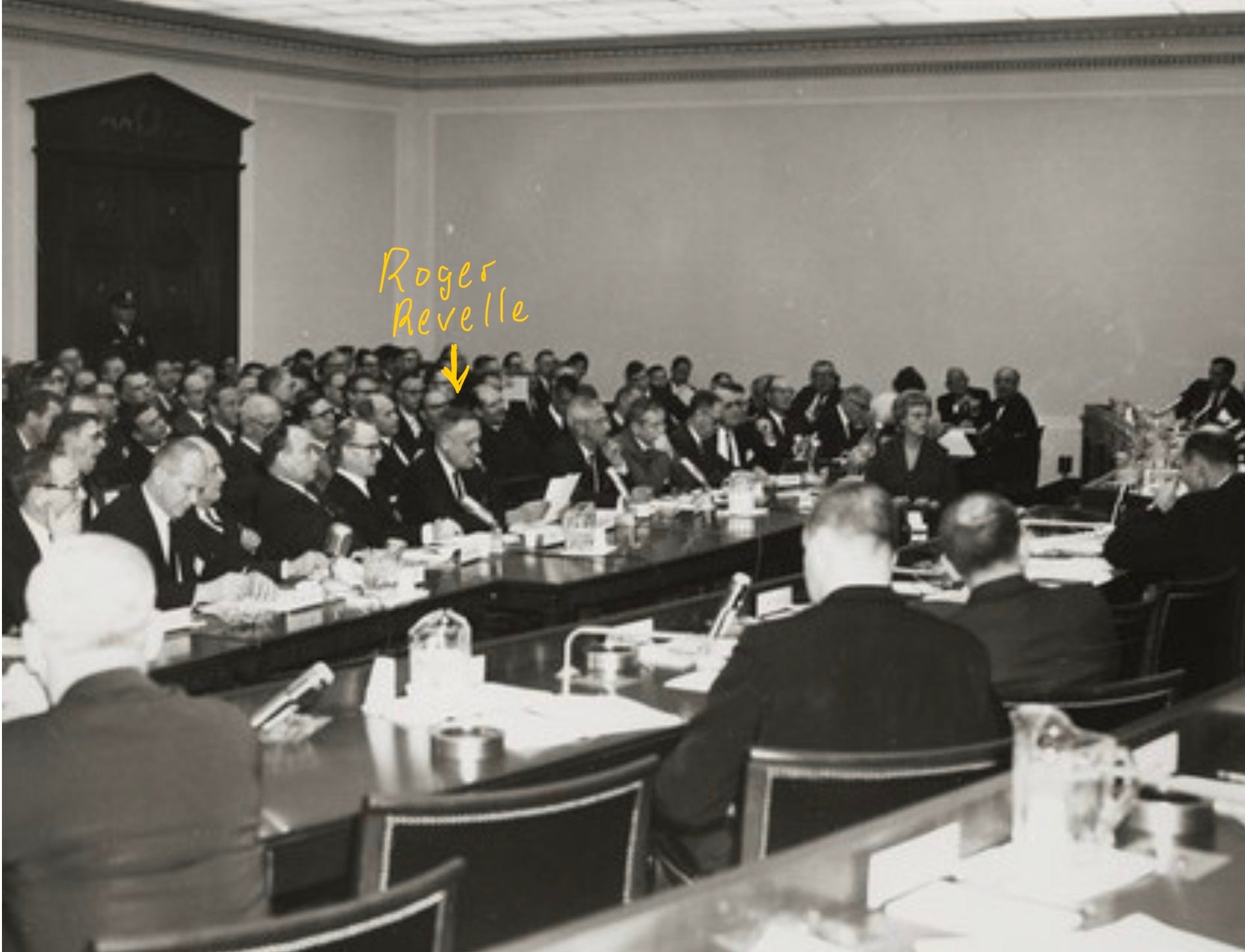
Then Roger Revelle and Charles David Keeling and others began demonstrating in the late 1950s and early 1960s how it could be a serious problem. Beginning in 1956 and for several years thereafter Revelle testified before Congress about the importance of funding climate research, saying in 1959 it should not be allowed to fail:
“We know that the average weather conditions we call climate can change over a few decades, and we suspect that changes in the storage of gases and heat in the oceans will profoundly influence the process.”[3]
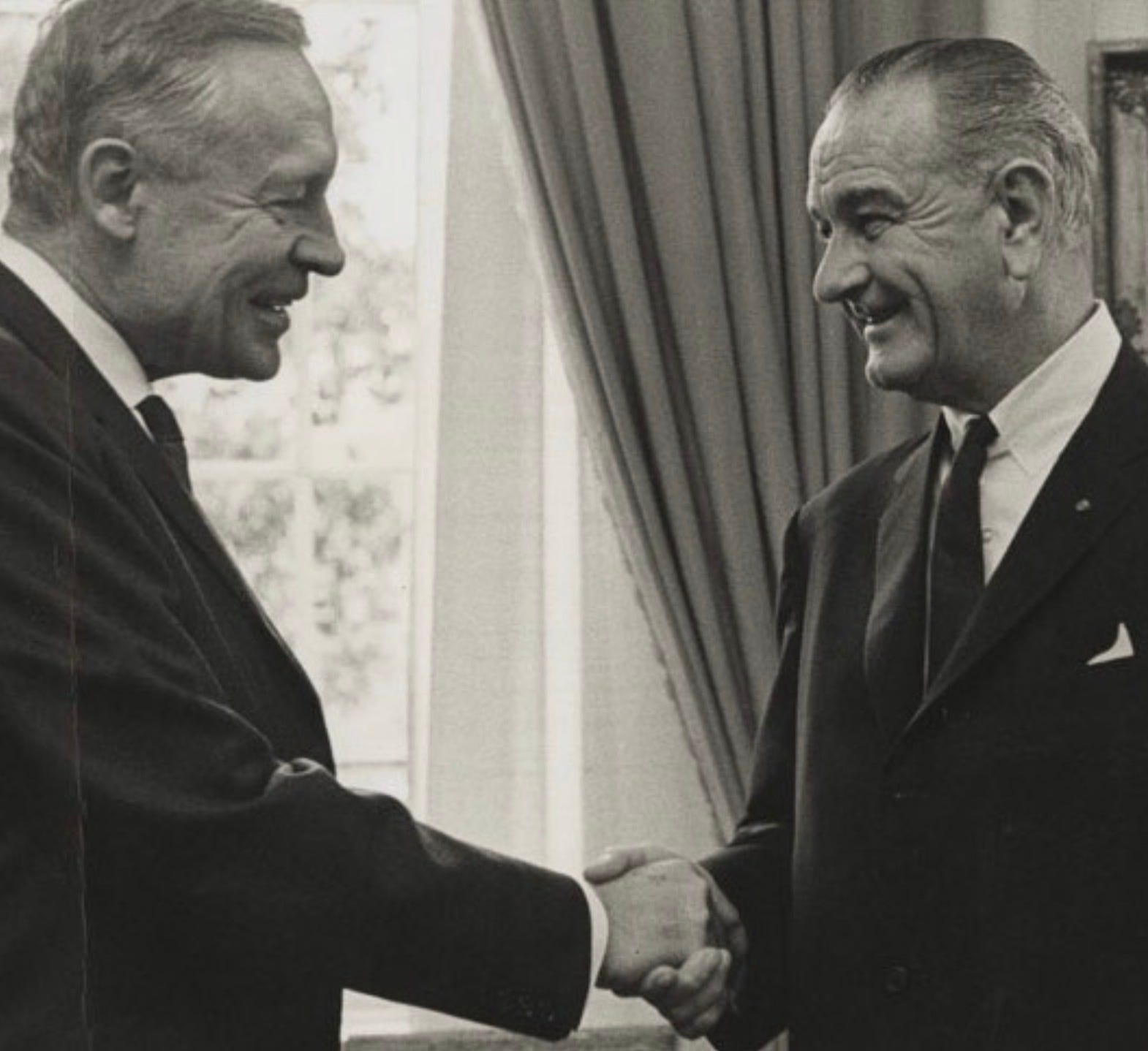
By 1965 President Johnson issued a warning to Congress:
“This generation has altered the composition of the atmosphere on a global scale through radioactive materials and a steady increase in carbon dioxide from the burning of fossil fuels.”[4]
A scientific report for President Johnson, Restoring the Quality of Our Environment, with a chapter on climate change, was released later that year.
The Oil Industry was also on the problem early, funding research in the late 1950s and having the Stanford Research Institute or SRI do a comprehensive private report in 1968.[5]
To their credit, the SRI scientists concluded:
“ there seems to be no doubt that the potential damage to our environment could be severe … CO2 and submicroscopic particles may be the cause of serious world-wide environmental changes.”[6]
This was a far superior response scientifically by SRI in comparison to their deplorable work on smog as part of the Oil Industry’s running of The Denier’s Playbook.
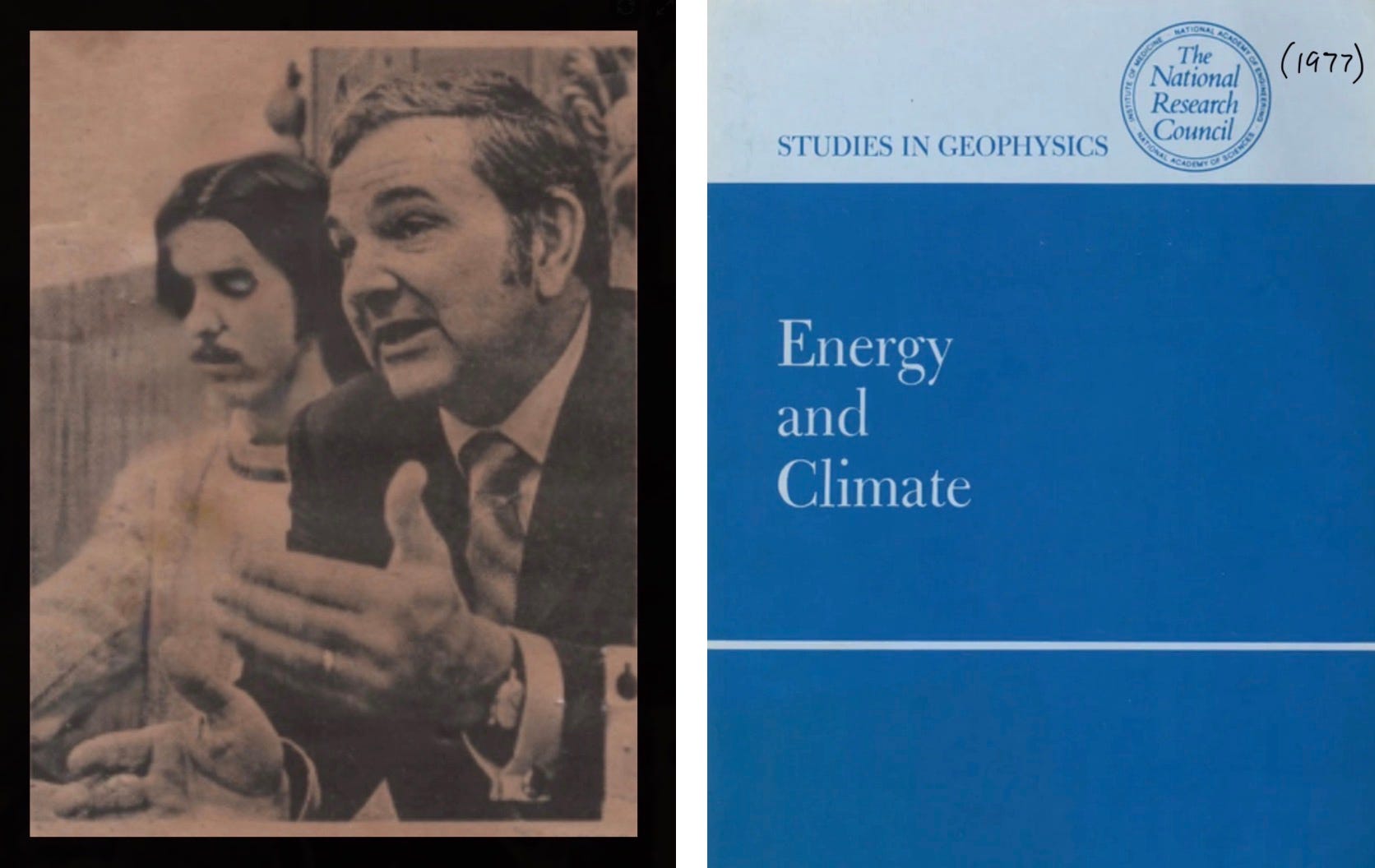
Less than a decade after SRI’s private report to the Oil Industry, the National Academy of Sciences (NAS) began issuing three reports on climate change from small research committees, in 1975, 1977, and 1979. The 1977 report by their Energy and Climate Committee, which was widely reported in the media,[7] forthrightly stated that a major shift away from fossil fuels could be required:
“Worldwide industrial civilization may face a major decision over the next few decades—whether to continue reliance on fossil fuels as principal sources of energy or to invest the research and engineering effort, and the capital, that will make it possible to substitute other energy sources for fossil fuels within the next 50 years.”[8]
It warned that what made the climate problem so different from other environmental problems – its lack of a personal experience of cause and effect – is also what helped to make it so dangerous:
“If the decision [to act] is postponed until the impact of man-made climate changes has been felt, then, for all practical purposes, the die will already have been cast” (emphasis added).[9]
Thus, it called upon government leaders to act with wisdom:
“The possibility of modification of the world’s climate by carbon dioxide released in the production of energy from fossil fuels should be given serious prompt consideration by concerned national and international organizations and agencies.”[10]
The 1979 report from a study group on climate had a statement that is as strong as anything ever written by a nationally or internationally recognized scientific body:
“We now have incontrovertible evidence that the atmosphere is indeed changing and that we ourselves contribute to that change.”[11]
So Hansen’s 1988 testimony, which many think of as a break-through moment in society for the climate challenge, came over 10 years after the first two NAS committee reports, and 20 years after the Oil Industry was alerted by SRI.
Summing up: activists were late to climate action; they did not help push the scientific inquiry along in the early stages;[12] nor were GHGs included in clean air legislation.
Why Late? Smog Clears Things Up
The smog challenge helps us understand why. Historically activists have raised their ruckuses over pollution problems that had local consequences people could see and smell and taste.
Not so with climate change (until recently, that is). It is caused primarily by CO2, an invisible, orderless, tasteless gas we breathe out. But when it becomes too much of something in the wrong place causing harm it becomes pollution, and therefore is an environmental problem. It’s just that the place where this heat-trapping gas is causing a problem, in this case global warming, is way up in the atmosphere where no one can experience it. And the problem is not just that it is getting hotter down on earth. The problem is that it is changing the climate, the average weather of an area — and a stable, predictable climate has been the foundation upon which human civilization has been built.
Thus, it is much more than an environmental problem. It is its own category, something the world has never seen before, global in scope, with local consequences that have no easily grasped connection to its causes.
With smog all you had to do was walk out your door and gasp to understand what pollution was doing. Activists geared towards making their local situations better simply had no frame of reference for a problem like climate change; no one did.
Furthermore, before 1970 pollution activists organized themselves into local groups that came and went. In 1965 when President Johnson mentioned climate change, environmentalism focused on pollution was a nascent movement at best. The major national environmental organizations that dealt with pollution as a first order of business didn’t exist.[13] Who was there to champion an increase in the pace and scale of climate research?
Scientists & Political Champions Acted Before the Activists
But were there other signs to alert activists of this growing problem, especially in the 1970s when environmental organizations were in existence, like the Environmental Defense Fund (1967), Friends of the Earth (1969), the Union of Concerned Scientists (1969), the League of Conservation Voters (1970), and the Natural Resources Defense Council (1970)?
In contrast to the activists, beginning in 1965 with the Johnson Administration scientists and politicians and government officials were taking notice and acting.
In 1969 Nixon policy advisor (and future Senator) Daniel Patrick Moynihan wrote a memo to Nixon’s top domestic advisor John Ehrlichman warning of “the carbon dioxide problem.” He attached the 1965 report from the Johnson Administration.
In 1972 a little known governor of Georgia, Jimmy Carter, was underlying articles dealing with climate change in the journal Nature.
In 1974 the NAS established a Committee on Climate Variation, which recommended a climate research program. That same year the Domestic Council of the Nixon/Ford Administration drafted a National Climate Program Act.
The various NAS committee reports in the ‘70s (highlighted above) were partly due to the leadership of Congressman George Brown (D-CA), who also introduced the National Climate Program Act in 1976, which was signed by President Carter and enacted on September 17, 1978.[14] The Act begins in Sec. 2 (1) with a finding that succinctly captures why it is in the national interest to both understand and address the problem:
“Weather and climate change affect food production, energy use, water resources and other factors vital to national security and human welfare.”
The purpose of the Act is succinctly articulated in Sec. 3:
“to establish a national climate program that will assist the Nation and the world to understand and respond to natural and man-induced climate processes and their implications.”
So, even though climate change was unlike any other environmental problem, including smog, in that our own senses and experiences were not telling us something was wrong, there were other signs – the NAS reports and media coverage of them, hearings and legislation – alerting environmental organizations and activists that climate change could be a major problem.
Indeed, by 1979 the basis for national action had been established with:
1) the nation’s leading scientists on the issue telling us the problem and our role in it were “incontrovertible,” and that delaying action until impacts were felt would be too late, and;
2) the finding by Congress in the National Climate Program Act that climate change could have serious consequences for “national security and human welfare,” meaning it is in our national interest to address it.

The Fossils Laid in Wait with The Denier’s Playbook
While activists/environmentalists were late, and scientists were doing their normal, painstakingly slow process, the fossil fuel industry laid in wait, monitoring what was occurring in scientific and policy circles, and doing their best to slow things down at meetings of the Intergovernmental Panel on Climate Change (IPCC) that hardly anyone was paying attention to. The well-worn Denier’s Playbook stood ready for a public campaign once policymakers and broader society began seriously to consider action.
Activists and environmental organizations were late to the climate challenge. But it’s not too late to become a Climate Movement Artist-Athlete and take your place on your Olympian Fields of Action. Join us!
If you are new here, check out our Intro Series, as well as other posts in the Our Story Together Series. If you like this post, please “like,” comment, and share. And thanks for all you’re doing.
[1] Spencer Weart, “Global Warming: How Skepticism Became Denial,” Bulletin of the Atomic Scientists, vol. 67 no. 1 (2011): p. 45.
[2] For the history of climate change, see Spencer Weart, Discovery of Global Warming; Weart also maintains an excellent website with up-to-date revisions and additions. See also Joshua P. Howe, “Making Global Warming Green: Climate Change and American Environmentalism, 1957-1992,” Ph.D. Diss (Stanford University, July 2010.)
[3] Roger Revelle, “Statement of Dr. Roger Revelle Concerning the Oceanography Investigation,” Testimony Before the Subcommittee of the Committee on Appropriations of the House of Representatives, Report on the International Geophysical Year (Feb. 1959): p. 78.
[4] President Johnson’s quote is found in an article by Marianne Lavelle. “Fifty years ago this month President Johnson voiced concern over invisible fossil fuel emissions in a special message to Congress. It was the first time a U.S. president warned the nation about our carbon habit,” The Daily Climate (Feb. 2, 2015). A scientific report for President Johnson with a chapter on climate change was released later that year. See Restoring the Quality of Our Environment, Report of the Environmental Pollution Panel, President’s Science Advisory Committee, The White House (November 1965).
[5] Charles Jones’ peer-reviewed 1958 report states that API had funded research to provide an “Analysis of the gaseous carbon compounds in the atmosphere to determine the source of atmospheric carbon.” See Jones, “A Review of the Air Pollution Research Program of the Smoke and Fumes Committee of the American Petroleum Institute, p. 271.
[6] See E. Robinson and R. C. Robbins, Sources , Abundance, and Fate of Gaseous Atmospheric Pollutants, SRI Report prepared for the American Petroleum Institute, February 1968, p. 110.
[7] Weart, Discovery of Global Warming, p. 99.
[8] National Academy of Sciences, Geophysical Research Board, Geophysics Study Committee, Panel on Energy and Climate, Energy and Climate: Studies in Geophysics (1977): p. 1
[9] NAS, Energy and Climate: Studies in Geophysics, p. 3.
[10] NAS, Energy and Climate: Studies in Geophysics, p. 5.
[11] See National Academy of Sciences, Report of an Ad Hoc Study Group on Carbon Dioxide and Climate, Carbon Dioxide and Climate: A Scientific Assessment, (1979): p. vii.
[12] Funding was nearly non-existent in the early years. Keeling recounts how the famous Mauna Loa observatory was shut down briefly, and almost permanently, in 1964, due to lack of funds. See Charles D. Keeling, “The Influence of Mauna Loa Observatory on the Development of Atmospheric CO2 Research,” in Mauna Loa Observatory. A 20th Anniversary Report, ed. John Miller (National Oceanic and Atmospheric Administration Special Report, September 1978): p. 52.
[13] I am drawing a distinction here between preservation/conservation organizations, of which there were a good number before 1965, and environmental organizations that also dealt with pollution. One might suggest that the Sierra Club was an environmental organization in this sense. However, in the 1960s they were focused on preservation fights – even to the point of advocating for coal-burning power plants in place of electricity from proposed dams. The preservation/conservation organizations did address some pollution issues before 1965, but these were associated with keeping their protected areas pristine.
[14] Howe, “Making Global Warming Green: Climate Change and American Environmentalism, 1957-1992,” pp. 210-211.
Excellent analysis comparing the smog and climate fights and how, for the latter, activists could have done more.