

The Climate Movement’s AI Climate Action Team
I thought I would close out this initial Series on AI and Climate Action with a positive effort called Climate Change AI (CCAI). Their stated mission is:
To catalyze impactful work at the intersection of climate change and machine learning [a form of AI].
Here’s how they describe themselves:
Climate Change AI (CCAI) is an organization composed of volunteers from academia and industry who believe that tackling climate change requires concerted societal action, in which machine learning can play an impactful role. Since it was founded in June 2019 (and established as a US domestic non-profit on June 14, 2021), CCAI has led the creation of a global movement in climate change and machine learning, encompassing researchers, engineers, entrepreneurs, investors, policymakers, companies, and NGOs.
Given that they have devoted time and energy as volunteers to create CCAI, and that “tackling climate change requires concerted societal action,” I consider them a part of The Climate Movement — those of us who have made a sustained commitment to collective action over time to overcome climate change.
More importantly, they consider themselves “a global movement in climate change and machine learning …”.
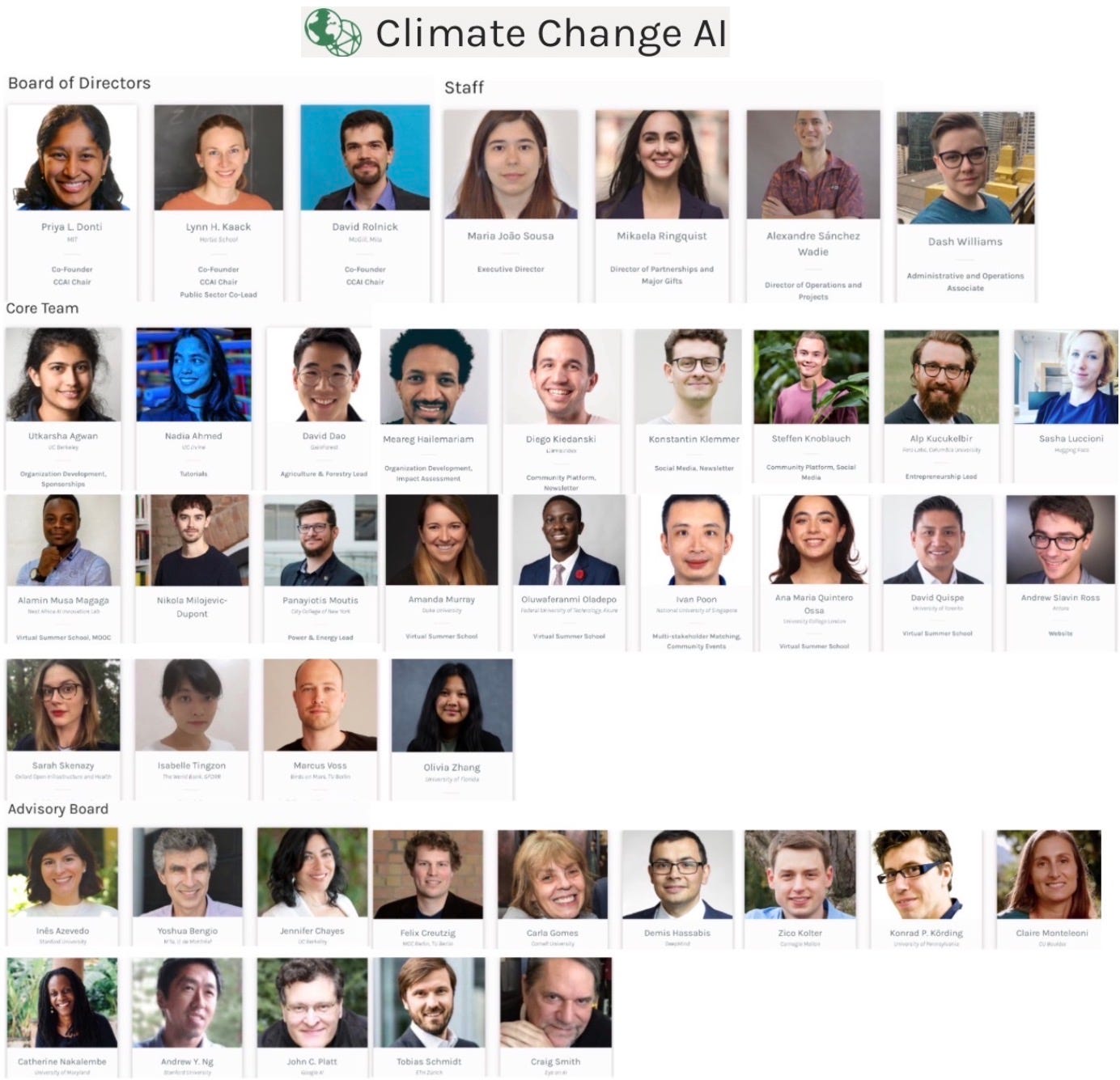
CCAI is a terrific example of individuals coming together as a team of Artist-Athletes upon their particular Olympian Field of Action to exercise their gifts, knowledge, passion, wisdom, and values. They are helping The Climate Movement with our seven characteristics/imperatives/goals.
Big and broad and active enough — CCAI is helping us to be broad enough by their particular focus on AI and their bringing together into The Climate Movement “researchers, engineers, entrepreneurs, investors, policymakers, companies, and NGOs.” CCAI is helping us to be active enough through all they are doing.
Passionate enough — As volunteers their passion is self-evident and serves as an inspiration to all of us.
Deep enough — They are driven by their stated values and their commitment to creating the Common Good; particularly evident is their commitment to justice in their desire for “equity” and their recognition of disproportionate impacts on “the world’s most disadvantaged populations”.
Dynamic enough — CCAI is being dynamic enough in their combination of (1) the tried and true (e.g., machine learning itself!); (2) discipline; (3) freedom, and; (4) creativity.
Organic and strategic enough — Organic change flows from the coming together of these individuals in common cause, the combination of their values, gifts, and personalities, resulting in new creative outcomes; CCAI’s mission, “To catalyze impactful work at the intersection of climate change and machine learning,” makes them strategic. On a strategic Field of Action they are doing things the rest of us can’t do that has the potential to maximize society’s ability to deliver the needed speed and scale of transformation.
Together enough — By establishing the CCAI itself, these individuals have created a structure through which they can regularly come together and do more than they could alone, supporting one another and others in strategically applying their particular gifts and knowledge; for CCAI, creating a community “of diverse stakeholders” is one of their major goals, and the only way to create community is to be together enough.
Long enough — How long will CCAI last? Who knows? But just look above at the people who are involved. Consider the fact that having started in 2019 they already have 60 individuals who they list as “Former Core Team Members.” This is actually a sign of strength that CCAI is replenishing itself as folks rotate in and out. From what I can tell, CCAI isn’t going away any time soon.
A CCAI Snapshot
Through the community they have created, CCAI is a facilitator and supporter of efforts to apply AI to climate action, as is clear from their four stated goals:
Community: To build a community of diverse stakeholders.
Education: To guide impactful work through educational resources and programs.
Infrastructure: To fill gaps in essential infrastructure such as funding, tools, and datasets.
Discourse: To advance discourse and advise relevant players.
In short, echoing their mission statement, they exist to catalyze AI-Climate action.
» A Roadmap of Paths One Might Choose
Fairly early in their existence these Artist-Athletes created a roadmap that was published as a peer-reviewed journal article showing the many paths one could take to combine AI and climate action.
Here’s their summary:
In the fight against climate change, ML [machine learning] has significant contributions to offer across domain areas. ML can enable automatic monitoring through remote sensing (e.g., by pinpointing deforestation, gathering data on buildings, and assessing damage after disasters). It can accelerate the process of scientific discovery (e.g., by suggesting new materials for batteries, construction, and carbon capture). ML can optimize systems to improve efficiency (e.g., by consolidating freight, designing carbonmarkets, and reducing food waste). And it can accelerate computationally expensive physical simulations through hybrid modeling (e.g., climate models and energy scheduling models).
And here’s a visual summary using a good number of their diagrams.
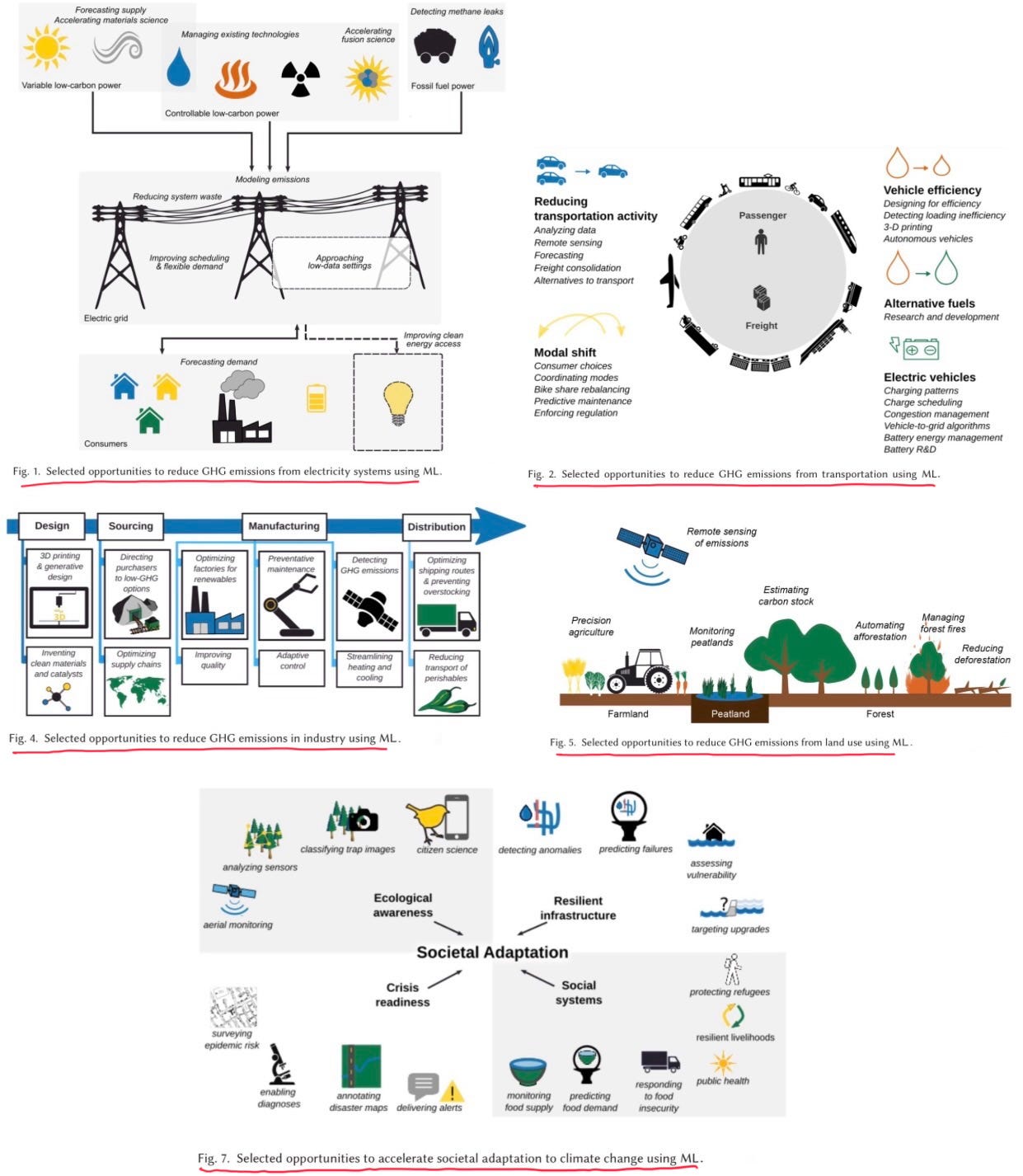
These diagrams from their article illustrate opportunities in electricity, transportation, industry, land use, and adaptation.
At the end of their article these Artist-Athletes offer some sound advice to those thinking about using AI for climate action:
Learn — Identify how your skills may be useful. … Remember that often the most impactful work lies in solving well-defined, domain-specific bottlenecks, and is not always flashy.
Collaborate — Find collaborators, who may be researchers, entrepreneurs, established companies, or policy makers. Every domain … has experts who understand its opportunities and pitfalls, even if they are not experts in ML.
Listen — Listen to what your collaborators and other stakeholders say is needed for addressing the problem effectively. Keep in mind that complex methodologies are not always needed.
Deploy — Work with deployment partners to ensure a pathway to impact for your work, and incorporate deployment-related considerations during development.
» Funding for Grants
There’s an old saying in fundraising. If you want funding, ask for advice. If you want advice, ask for funding.
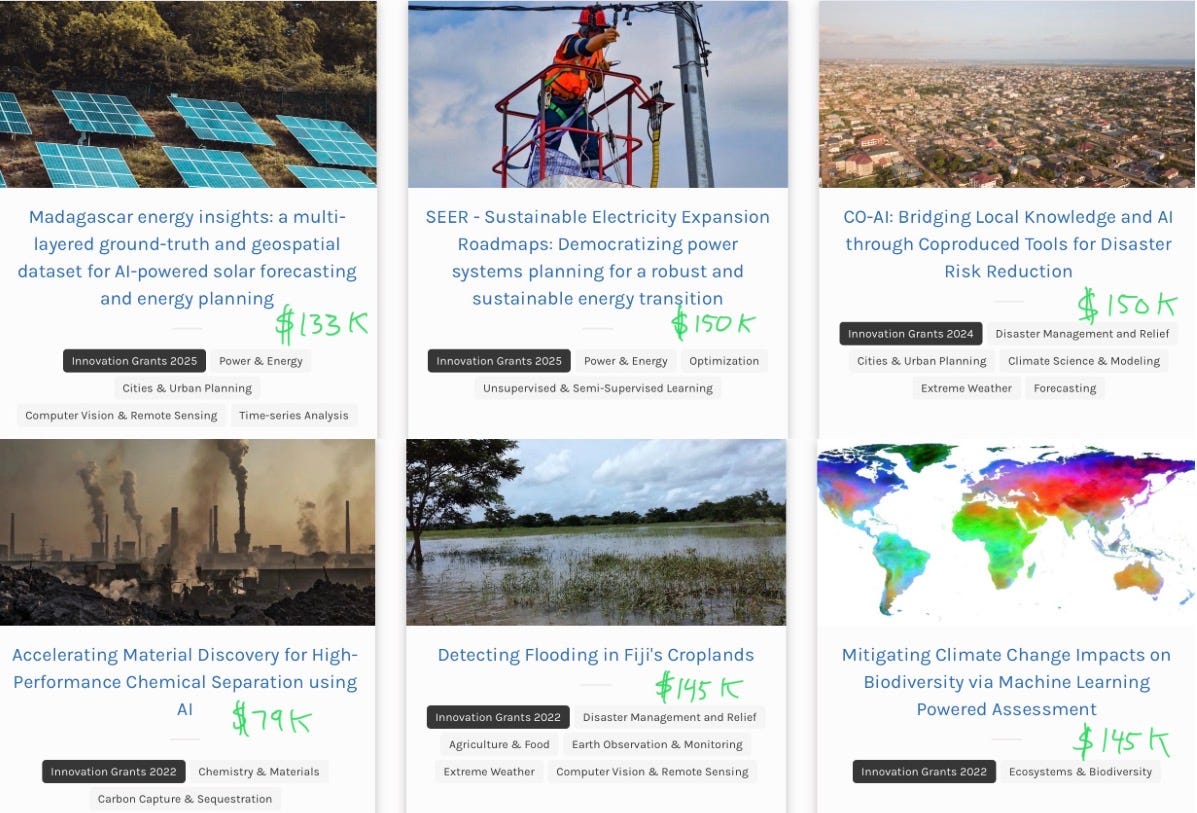
Well, CCAI offers not only advice, but through 2025 had offered funding, too. (For anyone out there who wants to fund their grant program, be in touch with them via partnerships@climatechange.ai.)
Here’s just a few of their grants (I’ve penciled in the amounts):
» Educating Others
For the past four years CCAI has organized and implemented what they call their “Climate Change AI Virtual Summer School” involving 32 lecturers and 56 tutorial creators from all over the world.
As they describe it,
participants will
Gain essential grounding in AI, climate, and their intersection,
Engage with important frameworks for doing responsible, ethical, and impactful work in this space,
Gain exposure to a diverse range of AI-for-climate applications,
Gain hands-on practice in employing AI techniques for climate-relevant problems.
The program is designed for a global audience from across sectors and career stages, including researchers, practitioners, decision-makers, and students across academia, industry, entrepreneurship, civil society, and the public sector.
For a group of volunteer Artist-Athletes on their particular Field of Action, CCAI is doing some remarkable things for all of us.
How The Rest of The Climate Movement Can Help
I’m profoundly grateful for everyone working through CCAI, as well as others trying to have AI work for us. Their efforts are truly inspiring. They are all Climate Action Heroes!
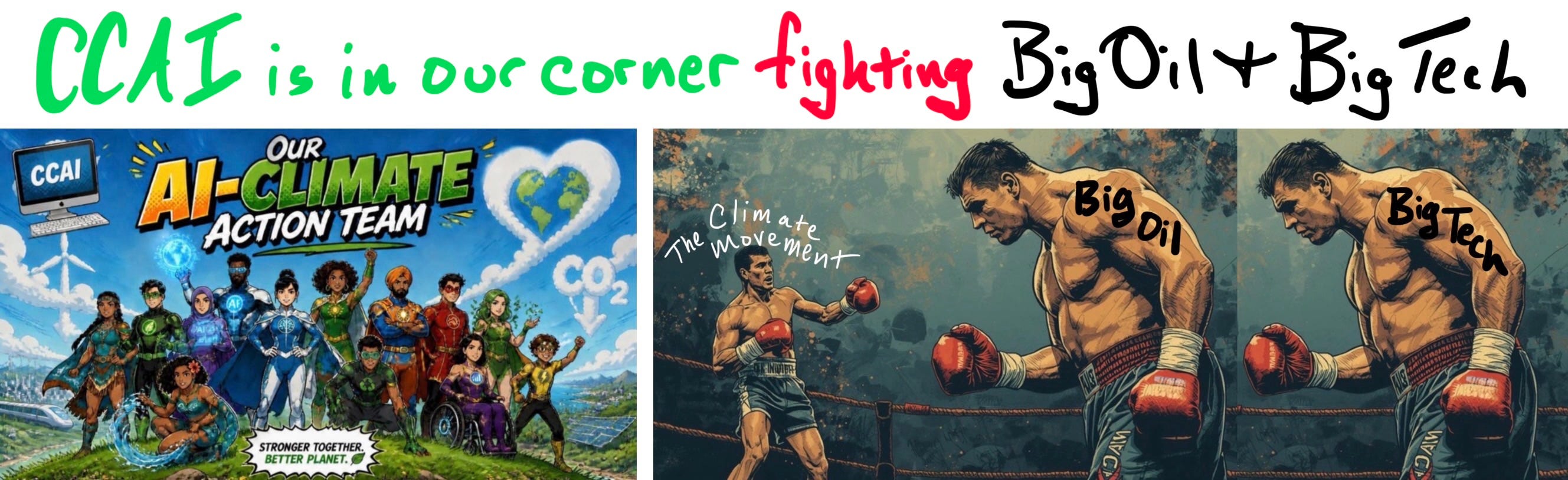
But the CCAIers are under no illusions, and neither should we be. These valiant AI-Climate Action Heroes and others on this particular Field of Action need our help.
So how can we play our part to have AI be for us and not against us? The CCAIers are in our corner as we face not just one Goliath, but two. We’ve got lots of work to do.
I’ve discussed previously how Big Tech has teamed up with Big Oil creating what is now called AI enabled emissions — i.e., stuff that kills people that wouldn’t have happened otherwise without AI’s help.
But for the corporations themselves, profits are winning out over the planet.

Corporations choosing profits should surprise absolutely no one. That is the destructive deadly demented logic of an unchecked market.
The only way we have a shot at AI working more for us than against us is by The Catalytic Four striving to make it so. And within The Catalytic-4 the broader Climate Movement must lead the way. In other words, our fellow Artist-Athletes at CCAI are counting on us.

CCAI is the harnessing of strategic ARTC (the accelerating rate of tech change), our Third Catalytic Source of Transformation. To overcome the power of the two Goliath’s, Big Oil and Big Tech, and their use of AI, our First and Second Sources of Transformation, i.e., the broader Climate Movement and Climate Action Supporters, must push governments to:
fund strategic targeted AI-enhanced R&D that bolsters the creation of new inventions in the AI and self-driving labs space as well as the innovation of existing tech, and bar the fossils from using it;
fund the use of AI to help with adaptation and the more efficient structuring of human societies;
reign in — or even make illegal — this Big Oil/Big Tech death duo to make sure markets are working for us and not against us.
In other words, The Climate Movement and Climate Action Supporters must push our Fourth Catalytic Source of Transformation, Governments-&-Markets to play its role in protecting society from unregulated markets while also channeling its strengths towards creating the common good.
The rest of us can help CCAI and similar efforts by following their example and doing what we can on our particular Fields of Action that fit our gifts, abilities, and knowledge. While they play their specific part, we play ours.
More broadly, we can help to make this Big Tech/Big Oil partnership less impactful by all of our efforts to reduce and eliminate climate pollution. We must make it so it doesn’t matter what the deadly duo of Big Oil and Big Tech do together.
How?
We must:
continue to push to make renewables and other clean tech cheap and make the fossils pay for the damage from their products; profits and price are already with us, but speed and scale of the needed transformation means we must make it even more so;
transform our energy infrastructure and laws to favor climate action, such as removing roadblocks to clean distributed energy; in other words, we must transform our old 20th Century energy systems into ones fit for the 21st Century;
continue the various “Keep It In The Ground” efforts and campaigns that target shutting down specific fossil infrastructure, e.g., a refinery, a coal-burning power plant, etc.
In short, We must put the fossils out of business; fossils are the past; their time has come and gone.
It’s our time now. Join us!
If you are new here, check out our Intro Series, as well as other ARTC posts. If you like this post, please “like,” comment, and share/restack. And thanks for all you’re doing.