

“You have to spend years building a self-driving lab, and then once you turn it on, though, it’s like a Ferrari.” — Alan Aspuru-Guzik, Oct 20, 2023

Some Context
Let me back way up here and start wide — big picture.
As we’ve discussed before, technological progress hasn’t been some gradual progression in human history. Once we hit the Industrial Revolution it shot up like a rocket, and with it economic growth and many things that have improved human wellbeing.
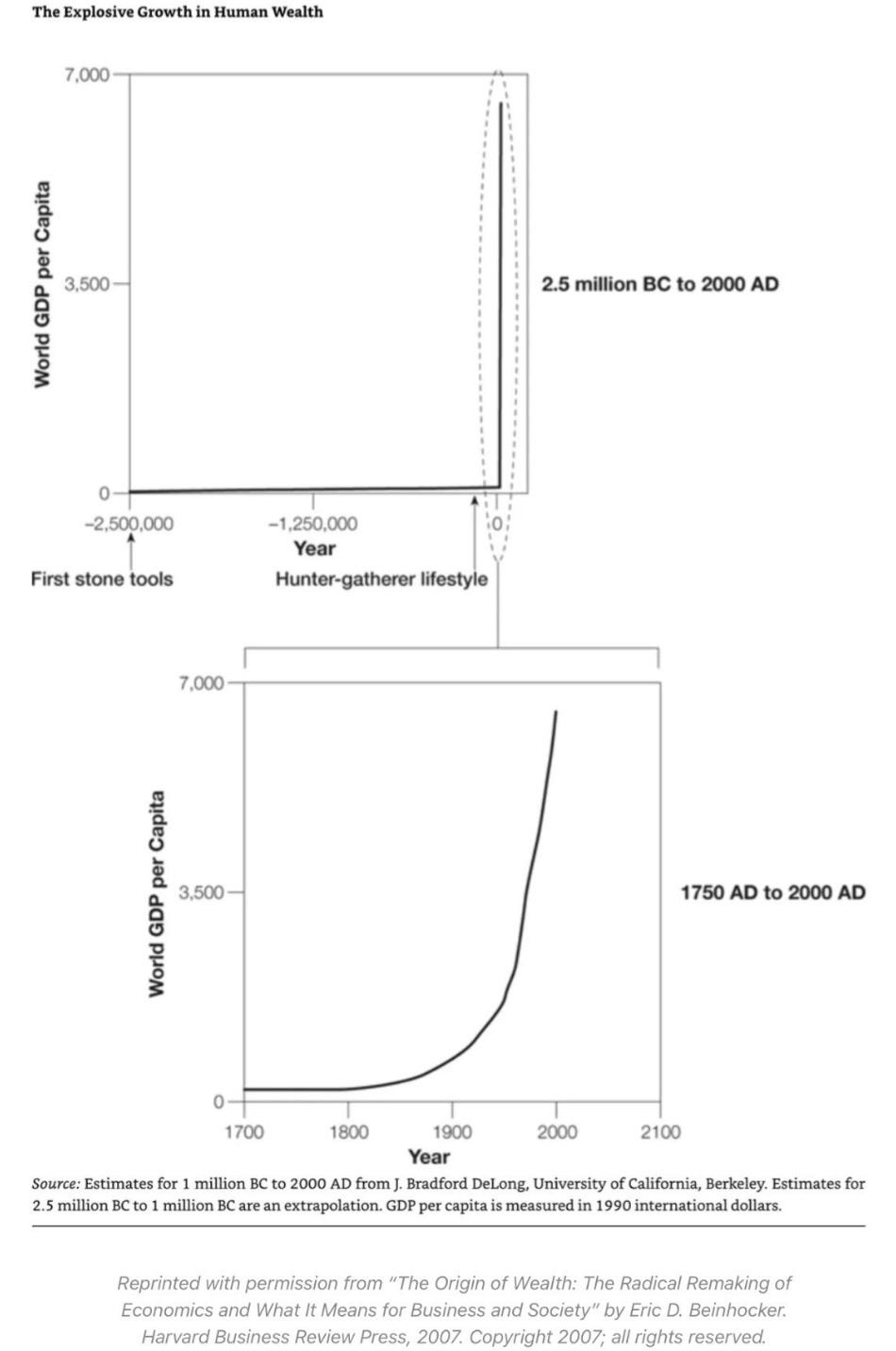
The graphs above help to illustrate this because tech progress is responsible for 85-90% of economic growth, and so charting such growth also tracks the tech change behind it.
Of course, there was a big problem, a big cost. The fuels we used, fossil fuels, created deathly pollution and climate change.
So the fuel brought wealth and death and the greatest threat humanity now faces.
So how do we get ourselves out of this conundrum? We chuck the bad and keep the good. It’s just that the bad makes lots of money, has lots of power, and is intwined in our economies and cultures.
So how do we create the transformation? It’s already well underway, obviously, and as I’ve argued previously, we don’t need to wait to get going in a big way with the tech we already have. But to overcome climate change we need both to happen much faster. We need speed and scale.
Tech progress has been fueled by the fossils. But it has come about due to the production of what Nobel prize winner Joel Mokyr calls “useful knowledge.” It’s knowledge that is, well, useful.
Its production isn’t powered by the fossils. It is powered by the human brain. And useful knowledge and the tech change driving economic growth that it spawns continue to go up like a rocket because of what I call the ARTC-combo:
specialization;
the non-rival nature of knowledge (ideas are easily copyable and useable);
competition.

Our Third Catalytic Source of Transformation for overcoming climate change is ARTC, the accelerating rate of tech change. For those of us who want to do something about climate change, our job is to create and support strategic ARTC, ARTC that helps us with speed and scale.
But given the nature of useful knowledge, strategic doesn’t mean narrow.
This won’t just come about with today’s “clean tech.” We must not be trapped in a clean tech silo.
Thus, there are two kinds of strategic-ARTC: (1) broad-based, and (2) targeted.
We don’t know what we don’t know. By that I mean solutions can come from many fields of scientific and technological knowledge, which form a symbiosis. That’s why we must be all in on basic science R&D. This is broad-based strategic-ARTC.
Mokyr points out that throughout history, tech progress like the steam engine can happen without scientific understanding of why the tech works (which, by the way, is happening with AI, where its creators don’t exactly know how some of it is working). Tech progress can also spur scientific advances, especially with the creation of instruments like the microscope, or, on our case, AI and robotics. So it’s not a one-way street, science-to-tech. It’s also tech-to-science.
But, eventually, tech progress runs out of steam without new scientific advances, which, again, is why we must support basic science, or broad-based strategic-ARTC and not just targeted strategic ARTC, or, more narrowly, clean tech R&D.
At the same time, there’s plenty we do know, and pushing for targeted strategic ARTC is crucial for speed and scale. When we see an area of discovery that can help, we must give it all the help it needs to become strategic for us.
Autonomous Experimentation
When we’re talking about Self-Driving Labs or Autonomous Experimentation, what do we mean?
It’s the scientific method performed without humans, made possible by AI + robotics. Their human creators, on the outside of this process, call this a “closed-loop,” as pictured with 1-4 below.
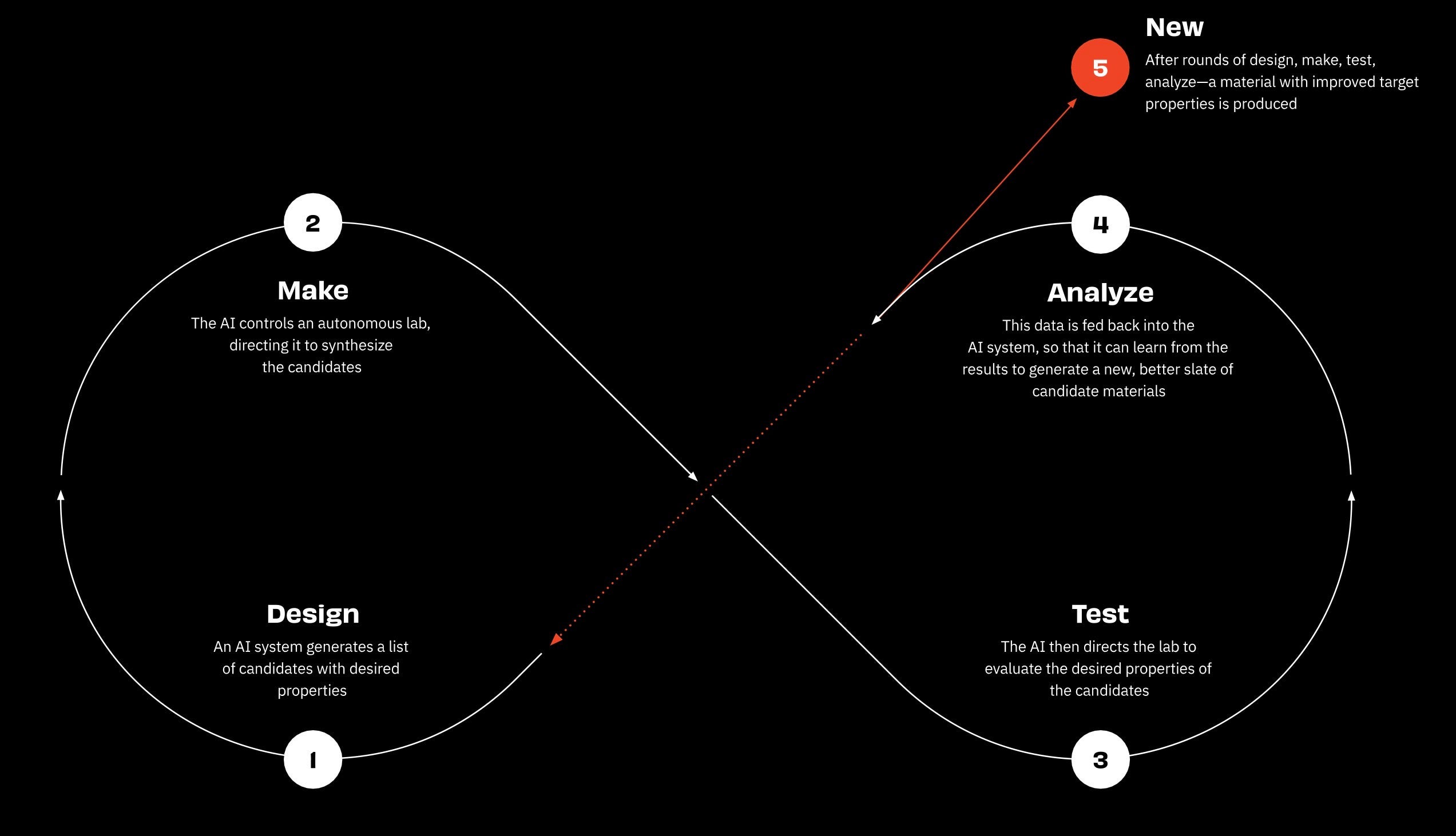
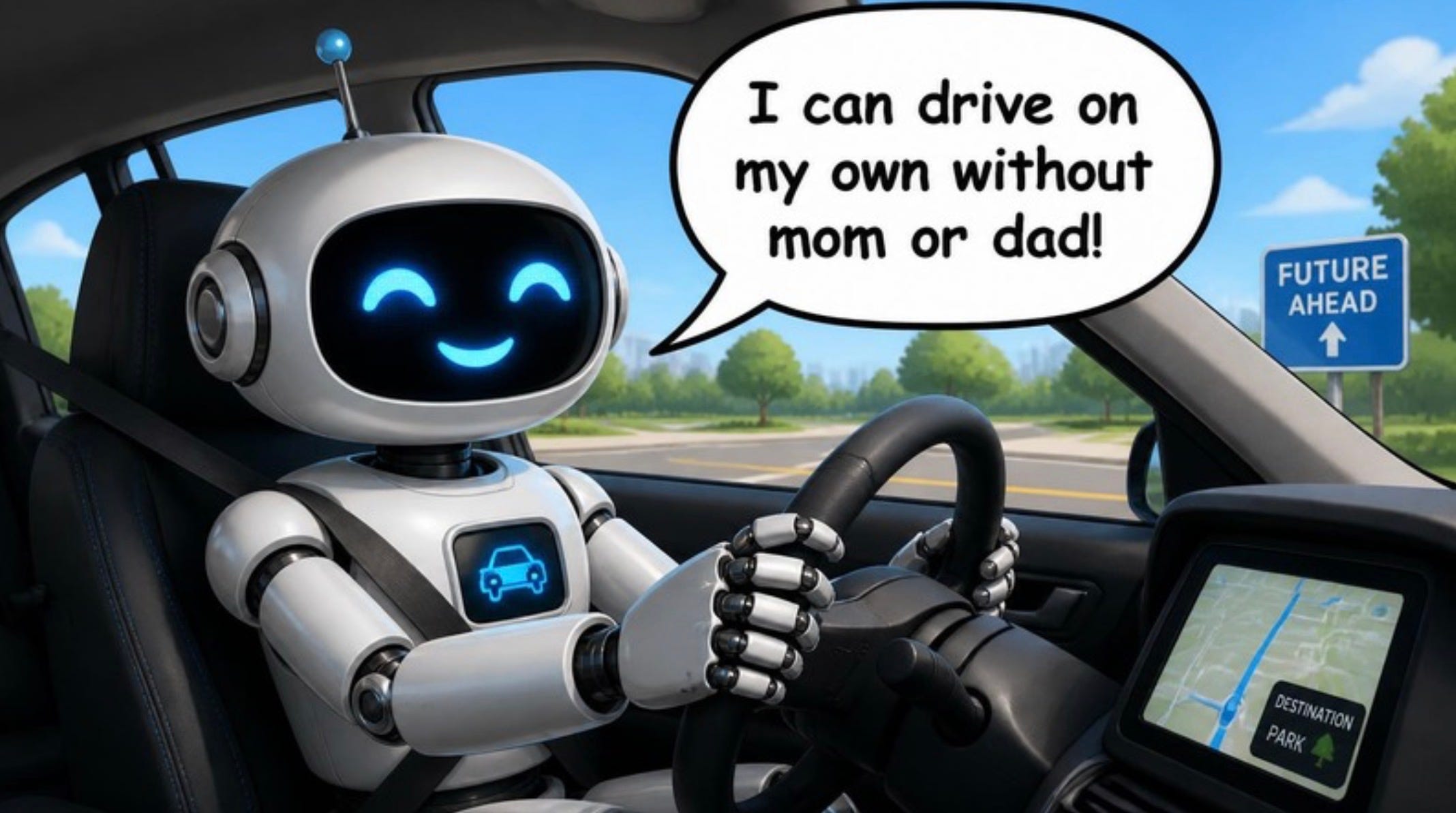
In other words, a closed-loop system doesn’t need intervention from humans from the outside. It’s beyond the “driver-permit” stage, has passed its driver’s test, and now has its driver’s license and can drive on its own. Kinda scary, but also liberating.
Self-driving labs form hypotheses, run the experiments, analyze the results, and run it over again until obtaining the desired outcome (e.g., #5 in the loop pictured above).
So how are AI and robotics doing this? Here’s a good description from some Korean friends:
Two technologies converged to make this possible. The first is physical AI — robotic systems precise enough to handle microliter volumes, computer vision that monitors reactions in real time, and LLMs capable of reading scientific literature and generating experimental protocols. The second is digital twins — virtual replicas of the lab environment that let the AI run millions of simulated experiments before touching a single reagent. Where these two meet, the experiment cycle compresses from years to weeks (emphasis added).
AI gulping down data to find a grain of sand, labs in cyberspace running millions of experiments before one is done in our reality where robotics that can be delicate and more precise than any human are aided by super-duper cameras. This ain’t the future. It’s now.
Must Go Faster: ARTC on Steroids
So to overcome climate change what do we need? Speed and scale.
We’ve got a need for speed.
In human history tech progress shot up like a rocket when we had more human brains thinking about both science and technology (examples of the specialization part of the ARTC-combo). Brains hooked on science and tech. Brains thinking like scientists and technologists and engineers. The results? The Scientific Revolution and the Industrial Revolution.
Now we have artificial “brains” (AI) who can do certain things much faster than we can.
So we’ve got both human brains and artificial brains on the job, complementing one another.
One of the pioneers of self-driving labs is Ross King from Great Britain, who began thinking about autonomous experimentation in the late 1990s. His first journal article on the topic (with numerous colleagues) was in Nature in 2004, “Functional genomic hypothesis generation and experimentation by a robot scientist.”
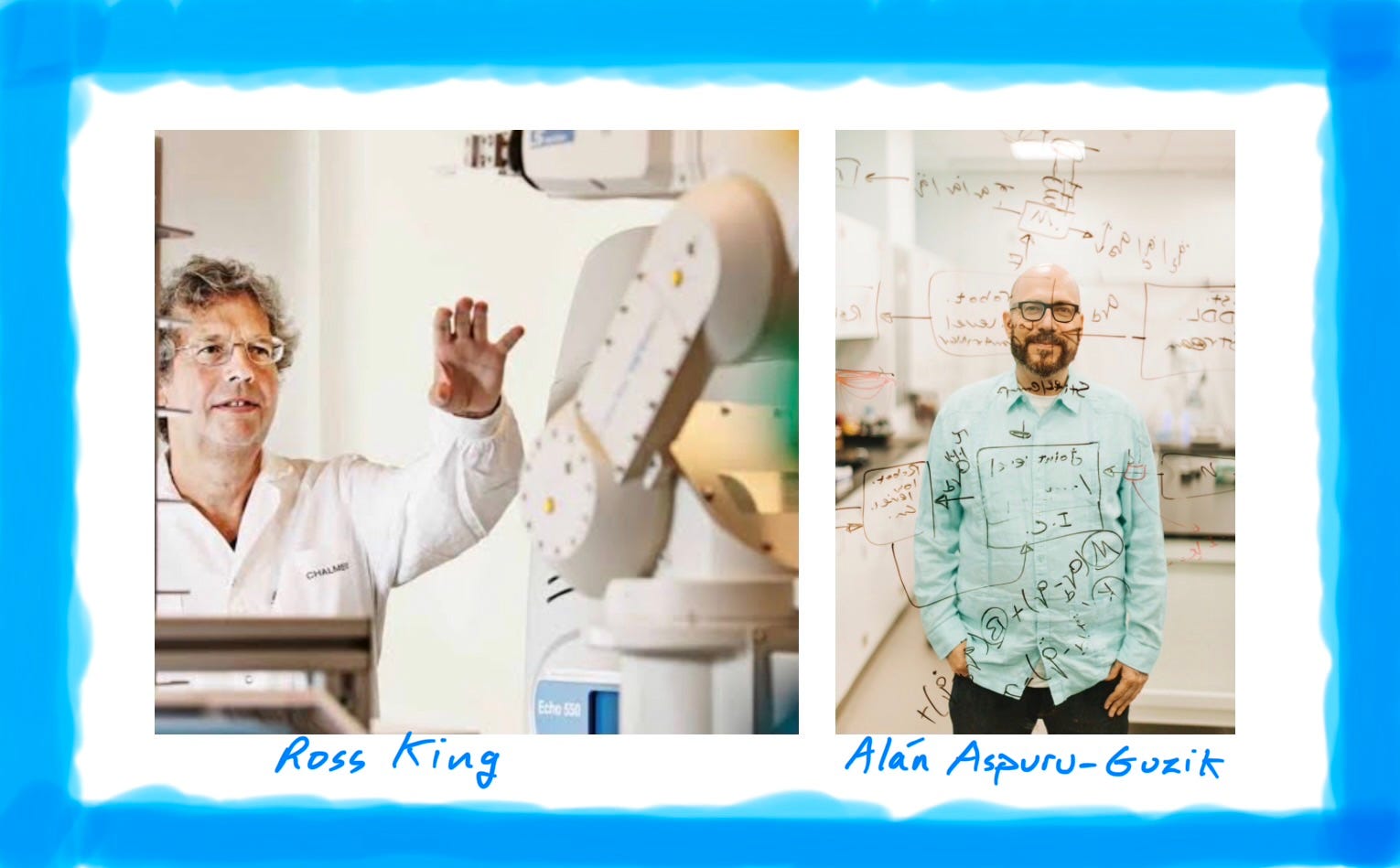
King was interviewed recently where he offered this reflection:
In my mind, science is still at the pre-industrial level. A PI [Principal Investigator] with some post-docs and a few students is like a cottage industry, as opposed to a factory of science.
So when it comes into its own the self-driving autonomous experimentation juggernaut will not just be about speed, but also scale, both together pushing one another to become bigger and faster. Not just science labs, but science factories.
And when that happens, when such science factories take discoveries and then produce products for human wellbeing all under one roof — well, science fiction will be transformed into science fact. Indeed, not too long from now many of these scientific factories with far more advanced 3-D printers, or dare I say, replicators, won’t be in the cookie-cutter mass production business, they’ll be in the made-to-order customer-designed business. The volume may be big, but each will be tailor-made.
Right now there are tremendous benefits from combining the strengths of artificial brains with human brains. An artificial brain, or AI, is not just a human brain that’s an artificial one. It works differently. It’s both dumb and a genius simultaneously. As King points out:
They can’t see deep analogies or connections, but they are brilliant at other parts of science. They can literally read everything – they have read every paper in the world 1000 times. If you have a small amount of data, machine learning systems can analyze it better than humans would. In this sense, they have superhuman powers.
With such “superhuman powers” they can quickly chew through a gazillion tons of data and find connections that lead to drugs that can help cure malaria. It’s why we were able find what was needed to develop the COVID vaccine so quickly.
Now autonomous experimentation has created a “super-antigen,” which “marks a pivotal leap forward in our ability to deliver broad, lasting viral protection.” Once perfected, such vaccines will help train the human immune system to provide protection from whole families of virus’s. No more annual flu or COVID shots!

As for targeted strategic-ARTC, King comments:
Areas with low-hanging fruit include materials science, as we need better battery materials, better solar panels, and lots more. There’s something of a gold rush happening there right now … (emphasis added).
A self-driving lab called “Ada” is focused on materials science. It’s development is headed up by another of the leaders in this field, Alan Aspuru-Guzik at the University of Toronto. Here’s a taste of what Ada is doing:
Starting with perovskite solar cell candidates, Ada now autonomously navigates broad swaths of chemical space. Its throughput matches what a multi-person research team could accomplish in several weeks — compressed into a single day (emphasis added).
Aspuru-Guzik is motivated by climate change and the need for speed:
“What I personally am driven [by] is the slow pace of science and technology discovery.”
To speed things up, Aspuru-Guzik has also created a collaboration called the Acceleration Consortium, which they describe as:
a global community of government, academia, and industry that uses AI and automation to accelerate the discovery of materials and molecules needed for a sustainable future—such as life-saving medications, biodegradable plastics, and renewable energy.
Another self-driving lab is run by the US Department of Energy’s Argonne National Laboratory, with an explicit focus on clean tech:
Targeting battery electrolytes, catalysts, and energy storage materials, the system sequences X-ray diffraction, fluorescence spectroscopy, and electrochemical characterization under AI control — continuously. Argonne frames this explicitly as part of the DOE’s clean energy mission: autonomous labs can accelerate materials discovery for grid-scale storage and next-generation solar at a pace that conventional research cannot match (emphasis added).
King also makes a potent observation. Once we really get going on self-driving labs it’s going to make science really cheap to do.
The big picture is that the economic cost of science is dropping. A lot of the actual thinking involved in science can now be done by AI systems, and the experimental work can be done very well by lab automation. You don’t need to employ people to move things around, and people aren’t as accurate and don’t record things as well as automation does. So that’s the big picture: what can we do if we can make science much cheaper?
With cheap can come speed and scale. With cheap can come science not held back by lack of funding. With cheap we can go from science labs to science factories inventing and innovating and producing products we need to fulfill the Better Future Covenant.
Turning Potential Into The Reality We Desire
So how do we make the potential of self-driving labs become the reality we desire?
First, as an incredible example of targeted strategic-ARTC, we need significantly more public funding. Right now there are too few self-driving labs around the world. We need to create a ton more! We need to drive down the cost to democratize this self-driving lab product so that it becomes cheap enough for garage start-ups and science factories to pop up everywhere, pushing the ARTC-combo to new heights.
Second, vision and values.
How do we make autonomous experimentation work for the common good of humanity more broadly? And how, more specifically, do we ensure that it helps us achieve our vision, purpose, and Major Goal: to overcome climate change by creating a just and prosperous sustainability that enhances wellbeing for everyone and everything?
Don’t be lulled into a sugar-high from confectionary tech optimism spun autonomously by a smart machine or tech-bro manifestos.
Justice won’t come from a self-driving lab, or a scientific factory. Indeed, the opposite can be the case. We must work for justice in this realm like any other.
As Bill Gates recently warned about AI more broadly: “AI will either be the greatest equalizer ever invented, or the worst source of injustice. The challenge is monumental.”
Thankfully, many of the scientific leaders in this space like Alan Aspuru-Guzik and others are motivated by climate action and sustainability more broadly.
But as I covered in my last post, AI is being used by the fossils. Big Tech and Big Oil have teamed up together and they are way ahead of the volunteers seeking to use AI for climate action. Right now, as I put it, “Our folks must be 4-5 times better just to break even, but many are not even out of the starting blocks while the AI-fossils are half way around the track already.” There’s absolutely no reason our opposition can’t tap into the potential for speed and scale from self-driving labs to help them torch the planet.
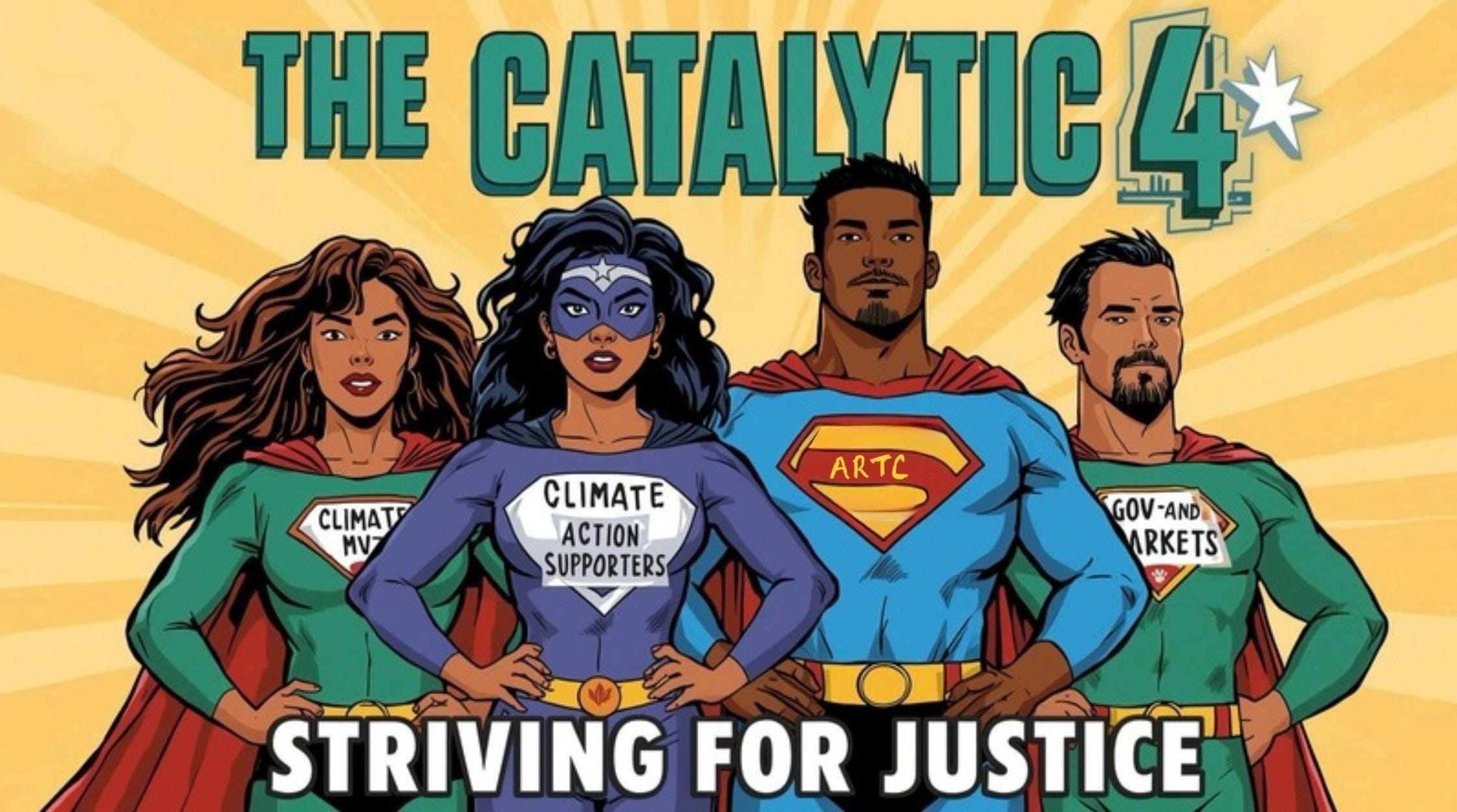
This is where our first two Catalytic Sources of Transformation come in, The Climate Movement and Climate Action Supporters. It’s our job to see that our vision and values become a reality, that the other two Catalytic Sources, ARTC and Governments-&-Markets, play their parts. The Catalytic-4 must work together for justice.
The AI race is happening so fast right now it’s running past the meager human safeguards that currently exist and pushing data centers onto communities so quickly Big Tech isn’t taking the time to do them right, creating a well-deserved backlash. Instead of the unconstrained rush job we have now, data centers should be showcases of our values: off-grid and completely powered by clean energy they produce on site, zero impact on local water supplies, full-time local good-paying jobs, excellent relations with the community.
We need speed of transformation to implement our vision and values, not to empower the Big Tech Broligarchy and Big Oil and authoritarian regimes, none of which give a damn about our freedom, one of our Ten Movement Values.
It’s our job to see that speed is for us and not against us, not at the expense of freedom but in service to it and justice.
For some of us, creating the speed we need through self-driving labs is your Field of Action. For others, it is making sure the speed creates justice and prosperous sustainability as we overcome climate change. Thankfully, folks like Alan Aspuru-Guzik are combining both.
For all of this we need our three forms of power — Moral Power, People Power, Staying Power. That’s why growing and improving The Climate Movement is the most strategic thing we can all do together. Join us!
If you are new here, check out our Intro Series. If you like this topic, check out our ARTC series. If you like this post, please “like,” comment, and share/restack. And thanks for all you’re doing.