

Polling Results in Our Climate Action Context
Let me put our polling discussion in context by recapping and summarizing a bunch of stuff. Here goes.
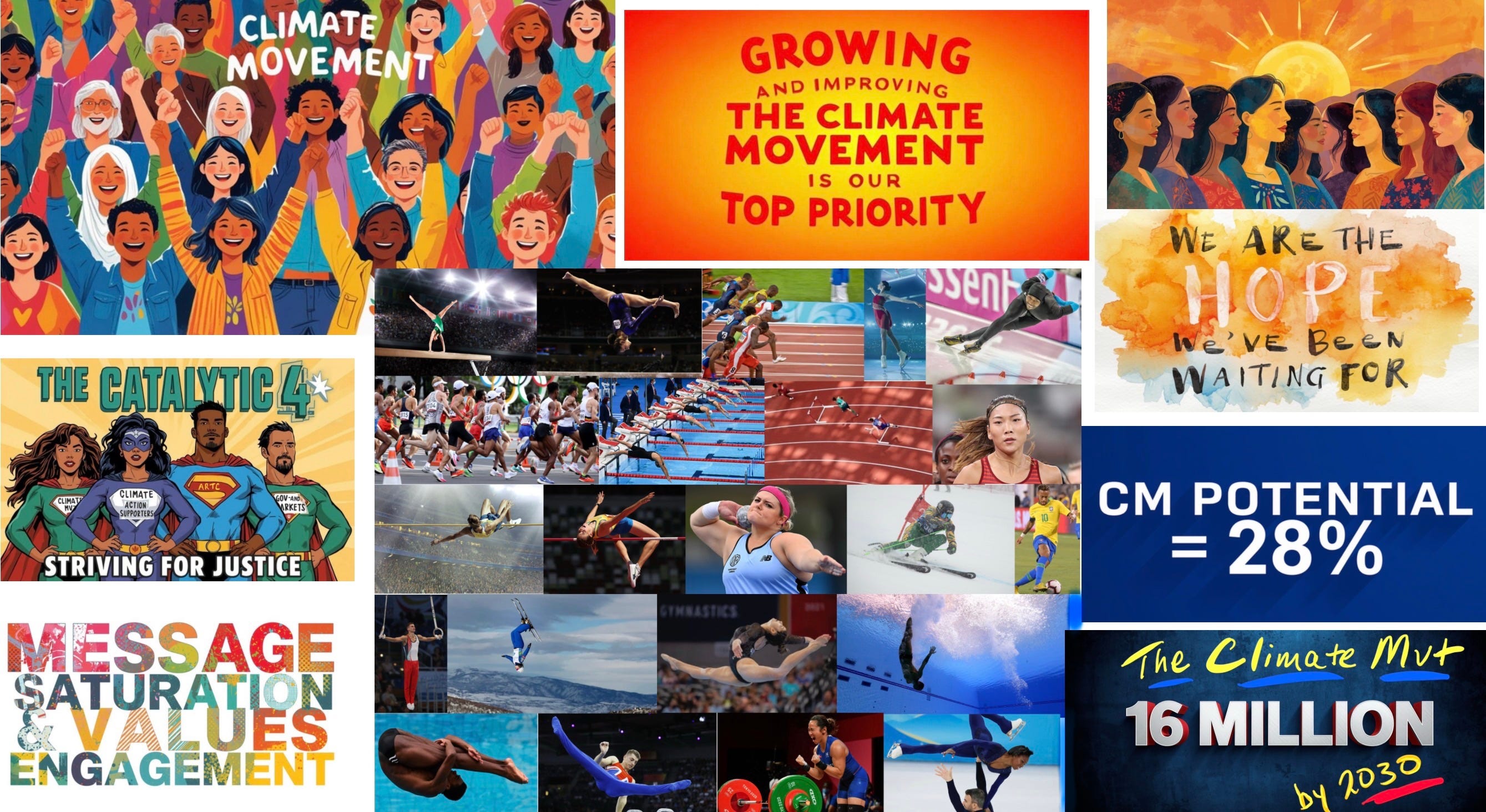
My dominant metaphor for The Climate Movement is the Olympics. We all have our particular Olympian Fields of Action where we can shine. But, given the speed and scale of transformation required to overcome climate change, we also have two large Fields of Action where all of us must be active: (1) growing and improving The Climate Movement, and; (2) our two forms of politics, electoral-politics and policy-politics.
Our first characteristic/imperative/goal of The Climate Movement is to be big and broad and active enough.
Big enough means 5% of a population by 2030. In the US that’s 16 million folks.
Broad enough means we look like America with Climate Movement Artist-Athletes from across the spectrum.
Active enough means we are achieving message saturation and values engagement — i.e., political leaders and the average person are reminded regularly of the necessity of bold climate action now and that everyone has a role to play, so much so that this is at the forefront of their hearts and minds and engages their values and connects to what they hold most dear.
Our two forms of political engagement are essential to achieve speed and scale of transformation. Only The Climate Movement, our First Catalytic Source of Transformation, can drive the needed change, can push everyone else to join in.
But without our Second Catalytic Source of Transformation, Climate Action Supporters, we won’t have the popular support needed to have our electoral-political and policy-political efforts be successful.
I believe popular support for bold action, i.e., both The Climate Movement and Climate Action Supporters combined, must be around 80%.
Finally, polls can tell us different things when it comes to our two forms of political engagement. In general, there will be more and broader support for policies than there will be for how much climate action will determine voting and electoral-political activity. Creating policy coalitions can involve even folks who aren’t explicitly in support of “climate stuff,” or are even against anything with a climate label — but are for the co-benefits, the other good stuff, of climate action.
Questions to Ask of Polls
Given our context sketched above, when we’re looking at polling we should be asking ourselves some questions. (Polling and intensity of commitment will be discussed in a forthcoming post.)
» Growing the Climate Movement
Where are we with our 5% Climate Movement goal?
What is the CM Potential?
Polls can group respondents into categories, e.g., conservatives, liberals, Republicans, Democrats, etc. Using a poll’s categories, where are potential recruits?
Is there potential to make us broad enough, to make us look like America?
Polls won’t give us a direct answer to the first question because they aren’t yet asking how many have made a commitment to collective action over time (my definition of a Climate Movement Artist-Athlete). But are there proxies, and what are those results?
» Growing Climate Action Supporters
Where are we with our 80% goal for both Climate Action Supporters and The Climate Movement?
Using a poll’s categories, where are potential recruits?
In contrast to the Climate Movement, with Climate Action Supporters polls can give us direct answers to question #1.
» Electoral-Political
How many of each category say climate action is their top voting priority or in their top three?
How many say they will vote for a candidate who supports climate action and clean energy?
How many say they will vote for a candidate who wants to reduce climate pollution or reduce fossil fuels? How many will help such candidates with money and time, etc.?
How does climate action/clean energy relate to other salient voting concerns, e.g., affordability? How do these relate to election-coalition allies?
» Policy-Political Coalitions
How many are in favor of clean energy and other related questions?
How many are in favor of specific pieces of legislation?
How many are in favor of regulating climate pollution?
How many are willing to devote time and money to climate action policy campaigns?
Polls may not answer these specific questions. But they can provide proxies.
Hope From Polls
Answering all of our questions would make this post much too long. So I’ll be sharing some highlights.
» Growing The Climate Movement
CM Potential:
Pew = 28% Yale/GM = 33% More in Common = 30%
Various poll questions can give us a sense of how much potential there is for Climate Movement recruitment, or the CM Potential. Remembering that our goal for The Climate Movement is 5%, my analysis of an answer from a recent Pew poll asking how much of a concern is climate change showed a CM Potential of 28%.
As you can see below in a graph I’ve modified, the Yale/GM Fall 2025 poll asked how many were already participating in “a campaign to convince elected officials to take action to reduce global warming.” That yielded a CM Potential of 33% (with 2% of that already realized).
But this question also provides a better sense of the strength of the potential. We already have 2% affirming they are a part of a campaign and thus a part of The Climate Movement.1 11% say they “definitely” are “willing to join” (circled in red, below).
So, to achieve 5%, we already have 2%. All we need to do is recruit 3% from the 11% who say they are definitely willing to join.

So our job is to turn 3% of the 11% into Climate Movement Artist-Athletes. The trick, of course, is finding that 3%.
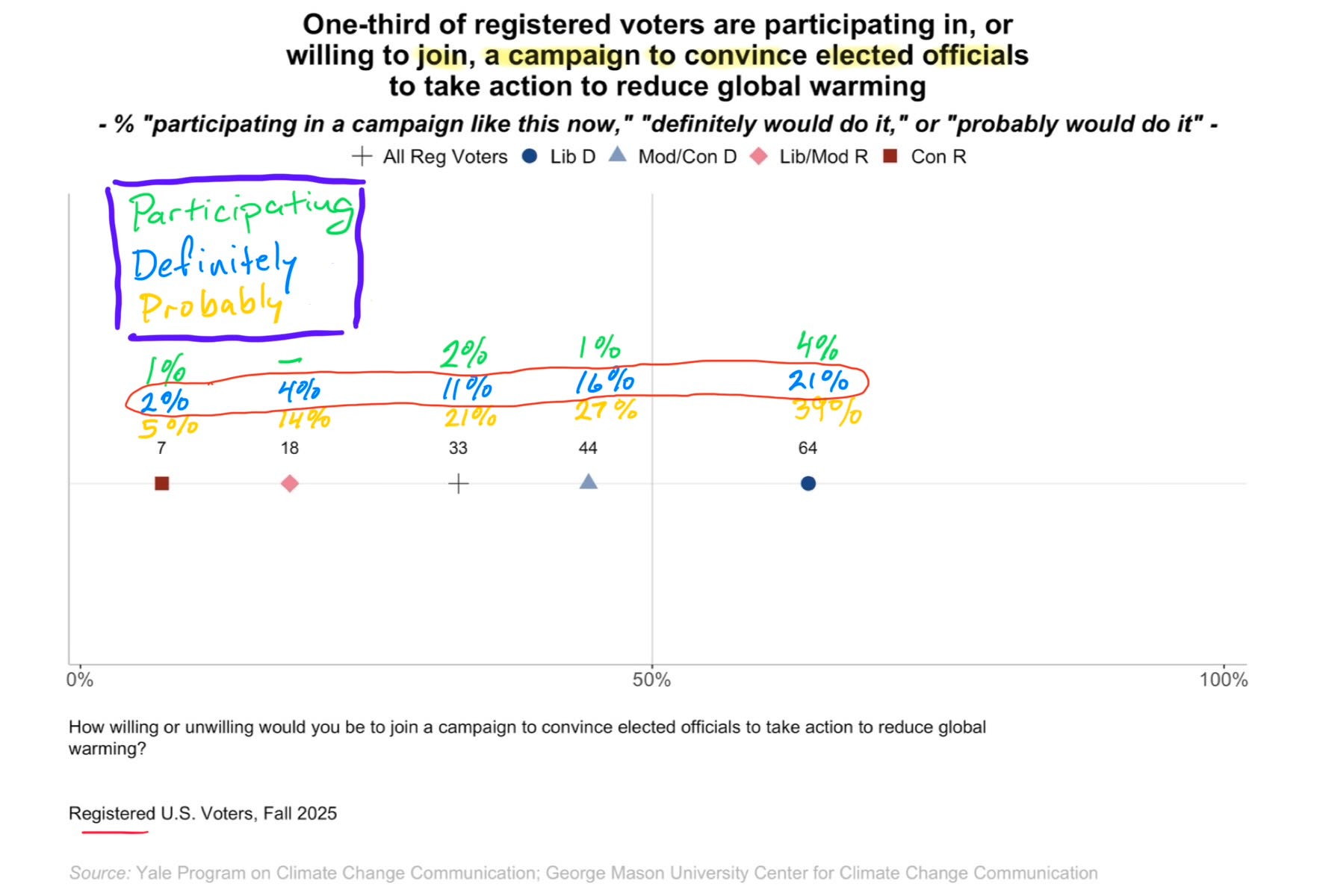
Ok, if we want The Climate Movement to be not just 5%, but also be a broad representation of America, what does this 11% look like? The circled numbers in the graph above give us a political sense. (We want lots of different kinds of diversity, not just political diversity. But it’s a start.)
As for Conservative Republicans, we already have 1% in The Climate Movement! And 2% are definitely willing. Definitely willing Moderate Rs are at 4%, Moderate Democrats are at 16%, and Liberal Ds are at 21%.
We need to pick up some more Rs if we can, but this is a good beginning.
» Climate Action Supporters
An April 2025 poll by the group “More In Common” gives us a sense of where we are with Climate Action Supporters in the US. Answers about clean energy can be a proxy, but because people can be in favor of clean energy but have different feelings about climate change, it is only a rough approximation.
As you can see below in the first graph, 67% agree “we need to speed up action on climate change.” (The total for “Strongly agree” is 30%, in keeping with our CM Potential numbers, above.) Of course we want to “speed up action.” That characterization, stronger than other similar questions, gives added heft to this 67%, makes it a solid number.
There’s a larger number on whether “the US should be a world leader in developing clean energy”: 83%. But this provides a softer sense of what we want to access.
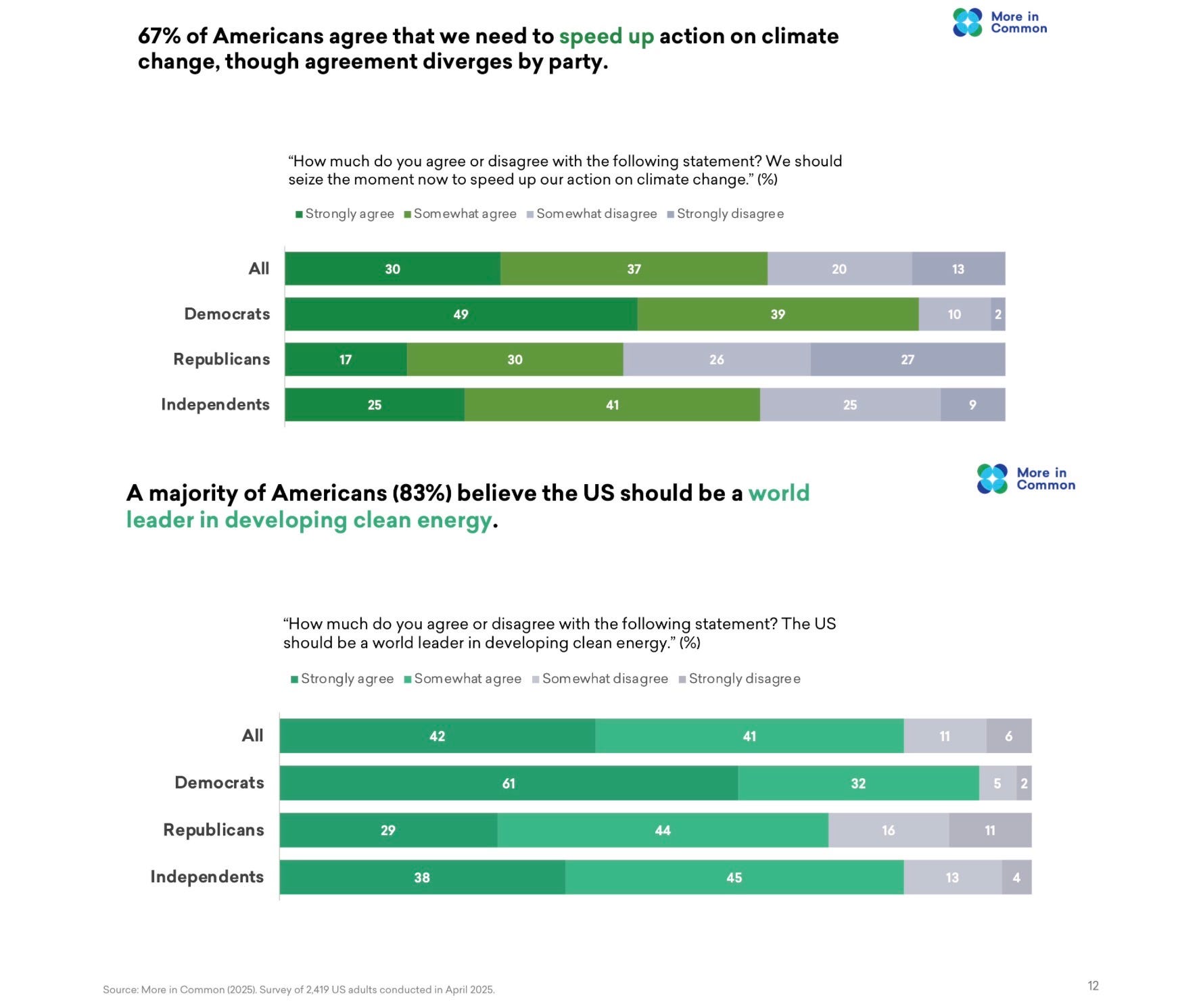
So if we just looked at the first graph, at 67% we are 13 points off of our 80% goal. But if we split the difference on these two questions our rough sense of Climate Action Supporters would be about 75%.
Bottom Line: With Climate Action Supporters in the US we’ve got some work to do, but we have a solid foundation.
» Electoral-Political
The Climate Movement and Climate Action Supporters must push political candidates to have the government push markets to achieve speed and scale. The best way to do this is by only voting for those in favor of strong climate action.
The Yale/GM graph below (modified by me) will serve as a proxy on climate action and voting behavior. It provides data on two questions: increasing renewables and decreasing fossil fuels.
Importantly, it gives percentages of those who will only vote for candidates who will increase renewables and decrease the fossils. This is the strength of commitment we must have.
Also important is that they asked about decreasing fossil use — because, substantively, we must do both. This question also provides a stronger sense of commitment.
As you can see in the graph below, overall, 28% and 26% will only vote for those increase renewables and decrease fossils, respectively. This roughly tracks with our CM Potential numbers, above.
These numbers below can mean the difference between winning and losing primary races and close general races. That‘s even true for the lower Republican numbers:
15% of Republicans will only vote for a candidate who increase renewables.
13% of Republicans will only vote for those who decrease the fossils.
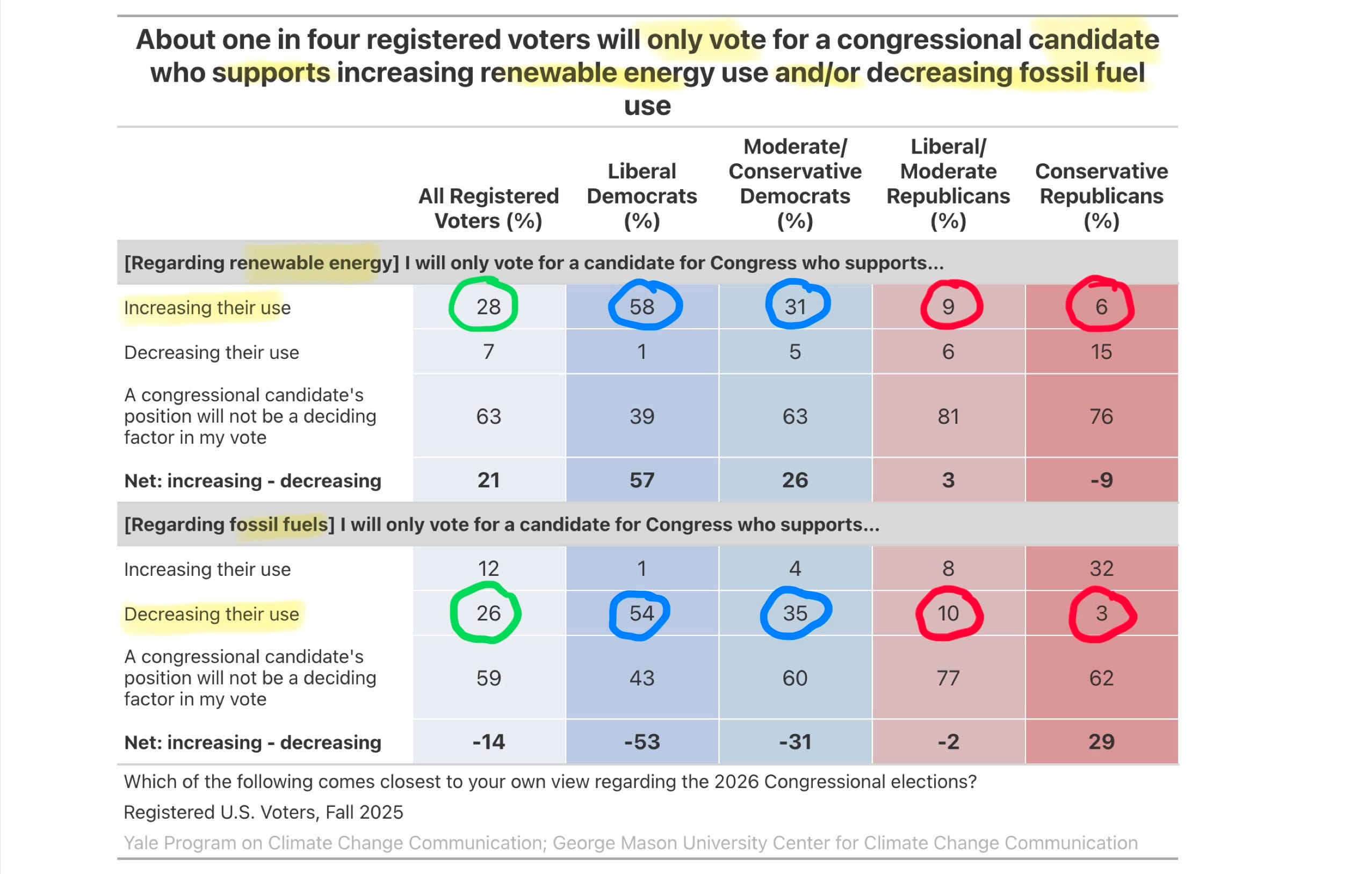
Our job is to shore these folks up come election time, and continue to grow these types of numbers.
But we also need to be joining forces with other messages that resonate and with allies we can work with. A recent poll (June 5) sponsored by the League of Conservation Voters (LCV) found that a candidate:
who talks about building more affordable, American-made wind and solar energy in conjunction with stopping Trump’s agenda and making life affordable again has a greater electoral advantage than one who leaves clean energy out. This is just as true in Likely-and-Lean R districts as it is in Lean D ones, proving that clean energy messaging has real value regardless of a district’s political bent.
The most compelling pro-Democratic message we tested is the idea that expensive energy is driving up the cost of everything else and that investing in more cheap, clean energy can bring gas and utility costs down. A solid secondary message — that cheap clean energy can give people back control over their unpredictable electricity bills — shows Democrats as being aligned with consumers and against big corporations.
» Policy-Political Coalitions
As I’ve said, electoral-political and policy-political coalitions can look quite different. Electoral foes, both voters and politicians, can become policy allies. For example, there’s no reason we can’t have MAGA as part of some of our policy coalitions.
I’ll be using two Yale/GM graphs to illustrate policy-political potential. Their category of Liberal Democrats helps provide the foundation upon which many policy coalitions will be based. But on their own they will never succeed. The more we pull from the rest of the categories, the better our chances for success.
So to give us a sense of the potential, I’ll focus on the Conservative Republicans.
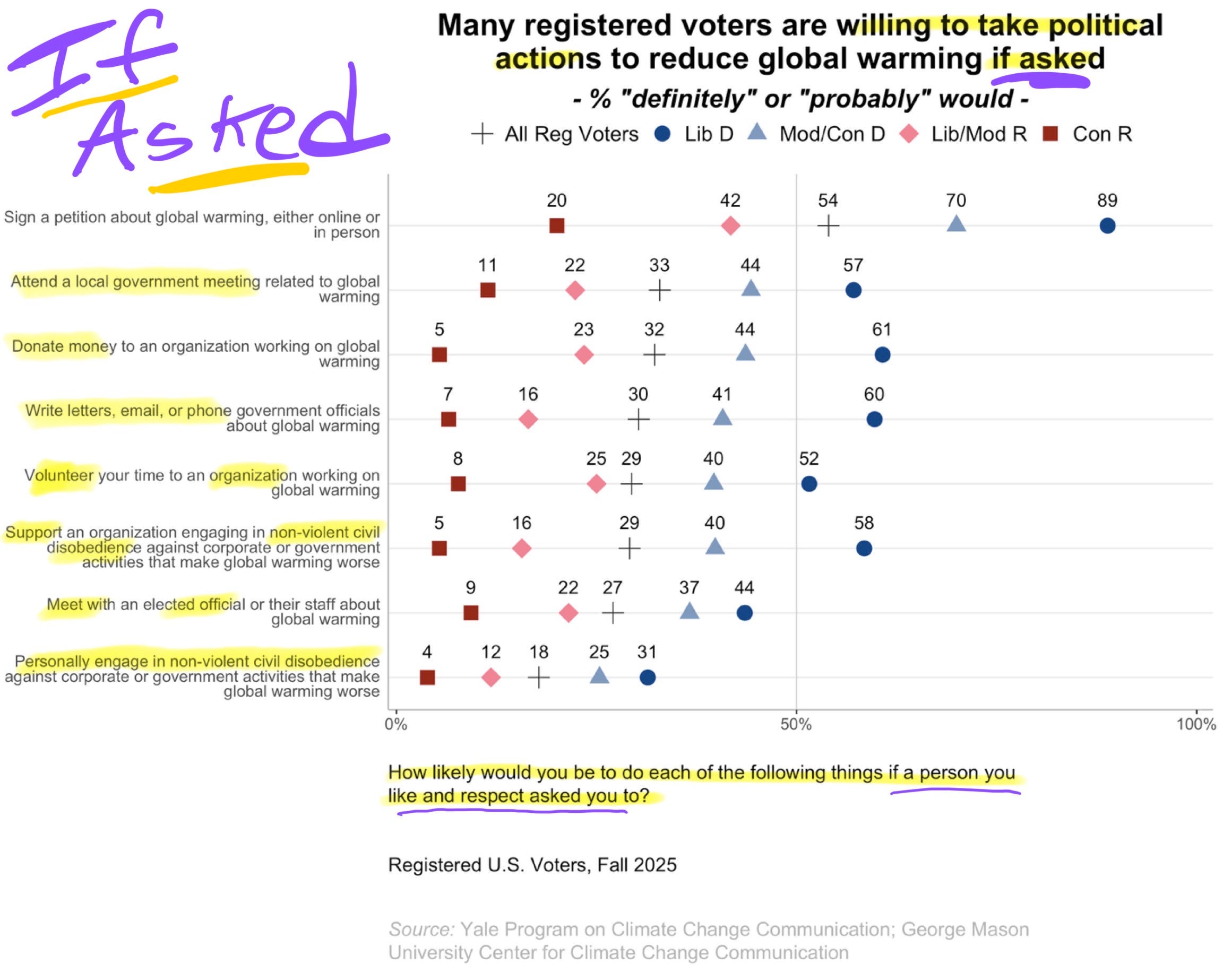
The first Yale/GM graph below gives an excellent sense of the potential for voters to be in coalitions. Importantly, this potential is based on being asked to participate. If we ask, they will come.

Who will come?
Well, Conservative Rs will come! (I’m betting some will even come out of Iowa cornfields if asked.) And they will be a crucial part of coalitions.
9% will meet with their elected officials;
8% will volunteer for a climate action organization;
5% will support those doing non-violent civil disobedience;
4% will participate in non-violent civil disobedience themselves.
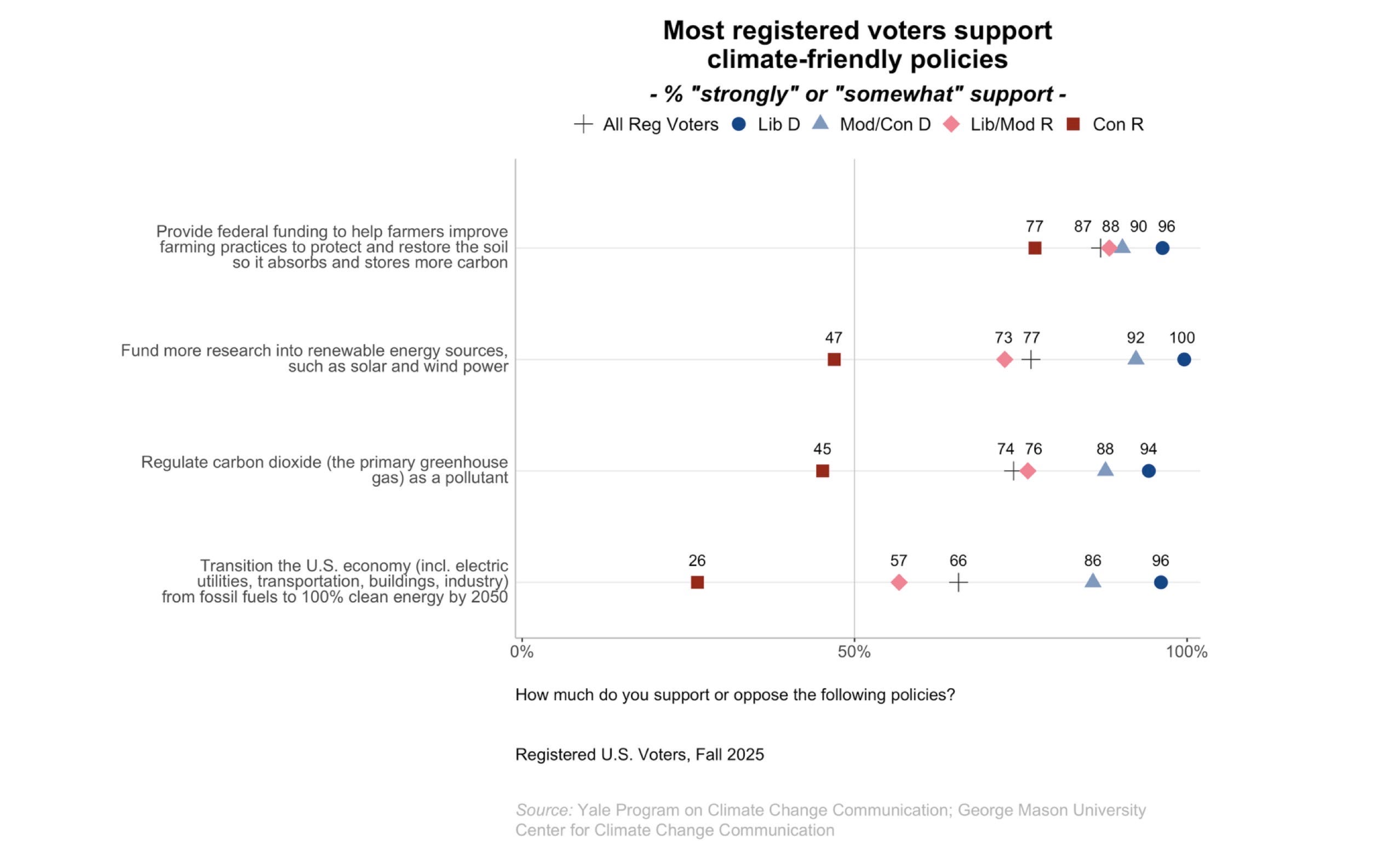
The second graph below gives us a sense of support for particular policies.
Big majorities of all political categories are in favor of helping farmers with climate-friendly practices.
Renewable R&D gets the next amount of love, including from 47% of Conservative Rs.
Incredibly, 45% of Conservative Rs say they are in favor of regulating CO2! Combined with Moderate Rs at 76%, that’s a clear Republican majority.
Even 26% of Conservative Rs support a transition to 100% clean energy by 2050. Added to the 57% of Moderate Rs, that’s another strong Republican contribution.
One important thing to keep in mind is a key connection between the electoral-political and the policy-political. If Republicans are in charge of one or both chambers of Congress, policy progress becomes much harder for everything, impossible for many things. That’s even the case if a majority of Republican members want something but the Speaker of the House or the Senate Majority Leader don’t want to bring it up for a vote.
And, of course, if the President isn’t in favor, chances also become much harder, unless helpful policies are part of must-pass legislative packages or legislation the President wants.
Why
Our loyalty is not to any political party. We are not here for political victories for the sake of winning. We are here for our vision, our purpose, our Major Goal: to overcome climate change by creating a just and prosperous sustainability that enhances wellbeing for everyone and everything.
It is our values that inspire and guide us, and thus they are valuable to us: love, justice, beauty, freedom, creativity, wisdom, pragmatism, non-violence, sustainability, and success. As we engage in electoral- and policy-politics we do so guided by and inspired by our values, with love as our supreme value.
Polls can help us see our strengths — but also our weaknesses. They help show us strengths to build on as we work to turn our weaknesses into even more strengths.
Our strength comes from our three forms of power, our P3: moral power, people power, staying power. We grow our movement not for it to be big, not for us to become the greatest and most long-lasting social change movement in the history of the world — which is our destiny. We become our destiny because it’s the right thing to do. We do it for those we love.
So as we work to grow our movement, as we strive in the often muddy field of politics to defeat our political foes and turn around and work with them to pass and implement policies that help us create our vision, we do it not because we’re right — even though we are right because our vision is right.
We do it because of love.
So join us. For love’s sake.
If you are new here, check out our Intro Series. If you like this post, please “like,” comment, and share. And thanks for all you’re doing.
It’s actually a little less than 2%. That’s because these Yale/GM poll results are from registered voters only, not the entire population. The registered voters are 86% of the total poll population. Our goal is to have 5% of the entire population be a part of The Climate Movement. But here we are wanting to gauge the potential of people joining, and registered voters are an excellent pool to draw from.
Great news! Polling shows we have plenty of low hanging fruit to grow the climate movement and build policy and political coalitions to take the actions we need to get there. Surprising and encouraging findings include that many registered voters, including both liberal Democrats and conservative Republicans, are willing to take political actions to reduce global warming - IF ASKED. So, let’s keep asking!