

Growing to Achieve Success
To be successful in achieving our vision, purpose, and Major Goal — overcoming climate change by creating a just and prosperous sustainability that enhances wellbeing for everyone and everything — requires speed and scale of transformation the likes of which the world has never seen.
Speed and scale drives and shapes everything we do concerning climate action.
We can’t achieve the needed speed and scale by simply letting the market do its thing, or by individuals reducing their emissions, or by waiting for technology to miraculously save our butts.
NO, NO, and NO. That’s a triple NO. I mean it.
To achieve speed and scale requires our three forms of power, our P3: moral power, people power, and staying power. Here we are concentrating on our people power.
Most of the needed change will take place in the market. But for speed and scale to happen in the market requires governments to shape and push markets to do so. This is why our Fourth Catalytic Source of Transformation is Governments-and-Markets, with Governments listed first and the hyphens emphasizing the symbiosis that must occur. Governments and markets working together, with governments shaping and pushing markets.
» People Power
But governments won’t do this without themselves being pushed. That’s where the people power comes in.

Our people power comes not just from the First Catalytic Source of Transformation, The Climate Movement (although it is the key driver of the needed change).
It also comes from our Second Catalytic Source of Transformation, Climate Action Supporters. These are folks who support climate action but don’t yet consider themselves a part of The Climate Movement and most aren’t quite as active as Climate Movement Artist-Athletes.
But there’s a third source of people power we must pull from, a third pool of potential recruits. These are folks who are indifferent or even hostile to anything with a “climate change” label who also want the co-benefits of policies that address climate change, such as the myriad economic benefits of clean energy, or the reduction in air pollution, etc. They aren’t motivated by climate. But they are motivated by the other good stuff.
I’ve provided a rough visualization below.
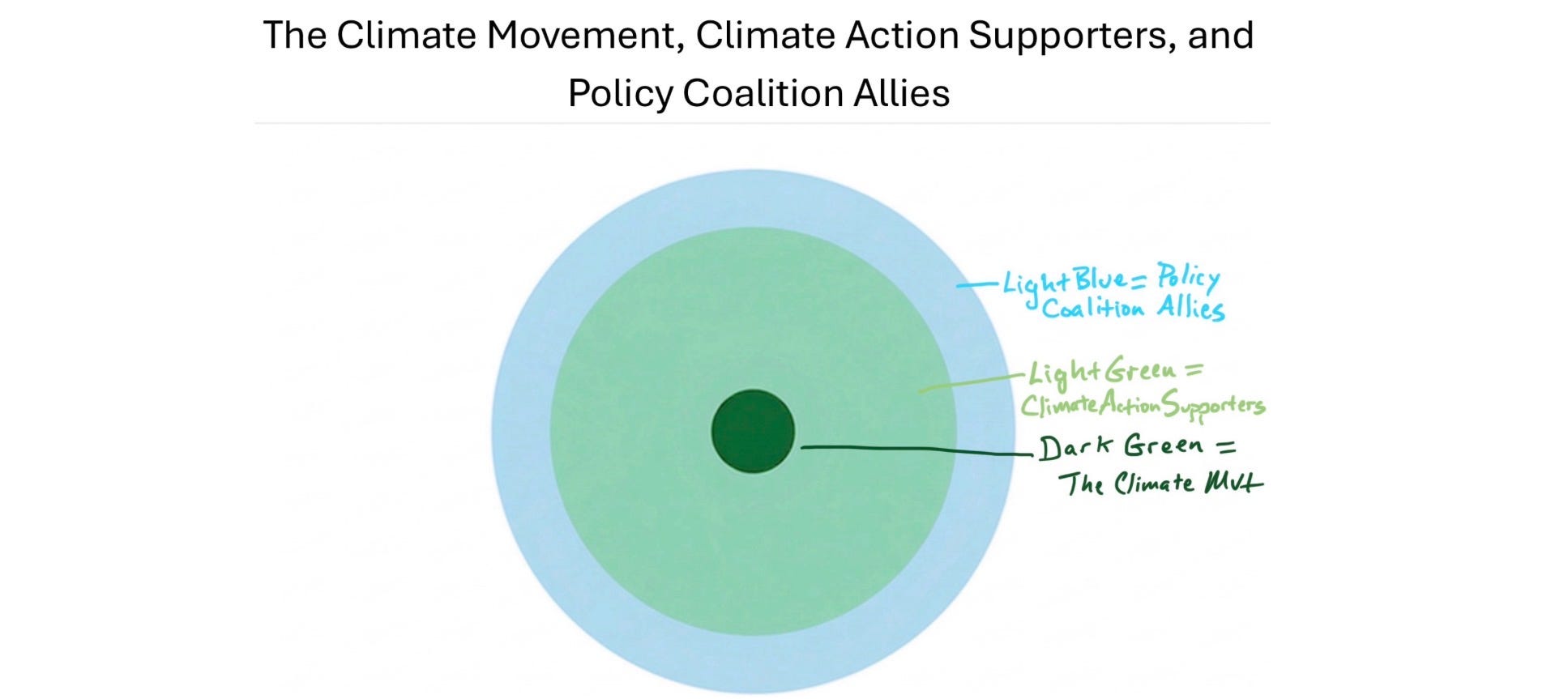
The Climate Movement will be a small — but powerful! — percentage of the total population. It will grow primarily from the much larger pool of Climate Action Supporters. But we can also find a few recruits in our Policy Coalition Allies.
Climate Action Supporters will be the biggest group by far. These are folks who can be rallied to support favorable policies when the time is right. Growth of Climate Action Supporters will come from those who are currently disengaged for some reason or reasons: lack of understanding or knowledge; unmotivated; disinterested; indifferent; hostile.
For many there is a progression of commitment, going, say, from indifferent to a Supporter to a Climate Movement Artist-Athlete. Others may jump from hostile all the way to Artist-Athlete, a Damascus road conversion if you will.
» Politics
Having our people power push governments requires us to be involved in politics. As I explained in a previous post, for us there are two kinds of politics: (1) electoral-politics and (2) policy-politics. The former is focused on elections, while the latter is focused on enacting and implementing policies.
While in electoral-politics we need to defeat all supporters of Trump’s anti-climate agenda and all fossil- and fair-weather-Democrats, in policy-politics these folks and their voters are potential allies. Work with MAGA? If they’ll support policies that move the ball forward, you bet.
So people we work to defeat in elections can be people we work with to pass and implement policies. As I said, such allies can be indifferent or even hostile to anything labeled “climate action,” but for different reasons can be in favor of things like clean energy.
In our engagement with policy-politics, the point is to win policy victories that help achieve our vision, purpose, and Major Goal, not for potential allies to pass some climate purity test. Here we must bring our values of pragmatism, wisdom, and success to the fore.
For policy-politics, we need both people-power and coalitions that push for speed and scale and support those legislative and executive branch leaders who help achieve both.
So in policy-politics we draw from all three of the populations pictured above: The Climate Movement (dark green core); Climate Action Supporters (light green), and; Policy Coalition Allies (light blue outer ring).
This is also theoretically true in electoral-politics, but the chances of pulling in Policy Coalition Allies are much slimmer. The co-benefits would have to outweigh all the other reasons they vote for politicians indifferent or hostile to climate action.
People Power: What We Need
» The Climate Movement in the US
The first characteristic/imperative/goal of The Climate Movement is that we must be big and broad and active enough to help give us our people power. Social science tells us it takes only 3.5% of a population for a movement to be successful. Given the speed and scale of change needed, I think we must become 5% by 2030, or 400 million worldwide and 16 million in the US.

Crazy? Far-fetched? The polling data we will explore in this post and Part Two of this Series says not at all.
» Climate Action Supporters
For Climate Action Supporters we need about 80% of the total population, including The Climate Movement, to be for climate action. As I’ve discussed before, polls from around the world have consistently shown that many countries are at or near or even beyond this goal, including the US.

Polling
I’m going to be digging into some recent polls to tease out how much potential there is to grow The Climate Movement and to engage those who could be Policy Coalition Allies. To finish out this post or Part One of this Series I’ll discuss the first poll by Pew, and in Part Two I’ll cover the other polls. This Pew poll discussion below is focused on the potential it suggests for The Climate Movement, i.e., the CM Potential.
» Pew Poll (Conducted Nov 2025; Report published June 2026)
Pew is the gold standard of political polling due to excellent analysis and their large sample sizes — 10,357 for this poll. Like many pollsters, they look at the results and the demographics of respondents and create typologies, i.e., groupings with what they see as similar characteristics. Their seven typologies for this poll and their descriptions are pictured below. (Their report has much more detailed description of each type.)
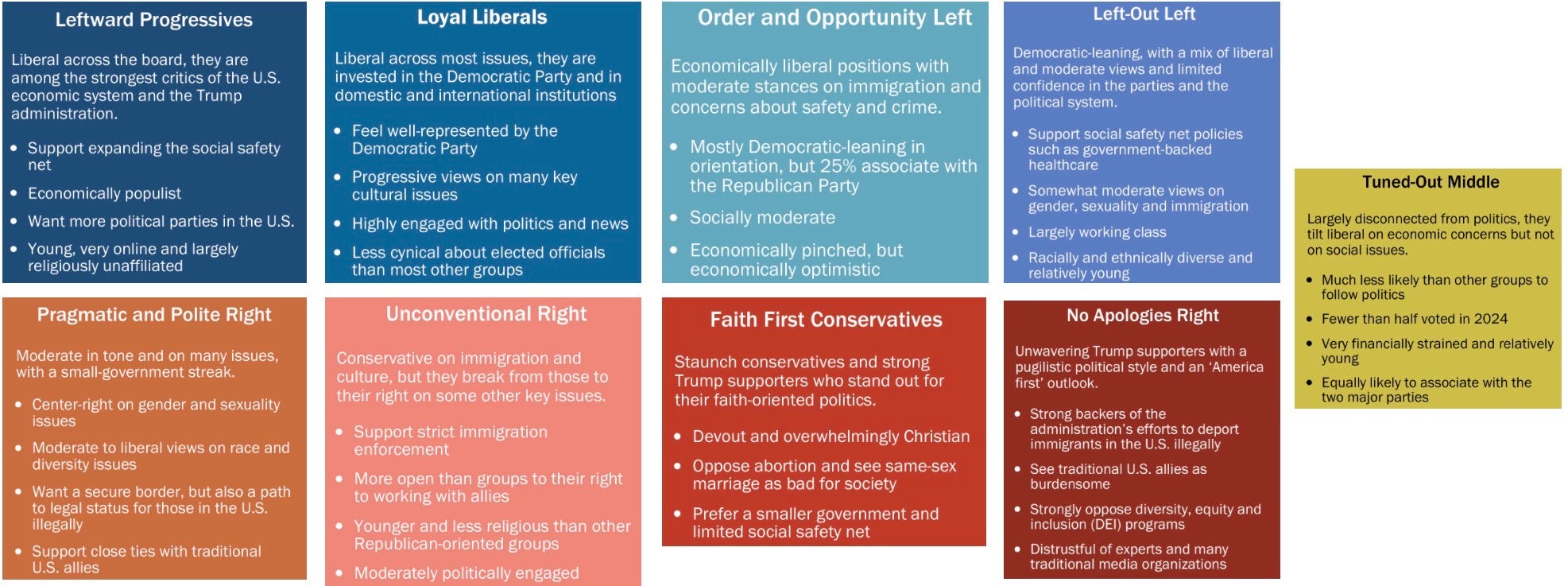
In their diagram below I’ve circled how much each typology or grouping represents in the total population.
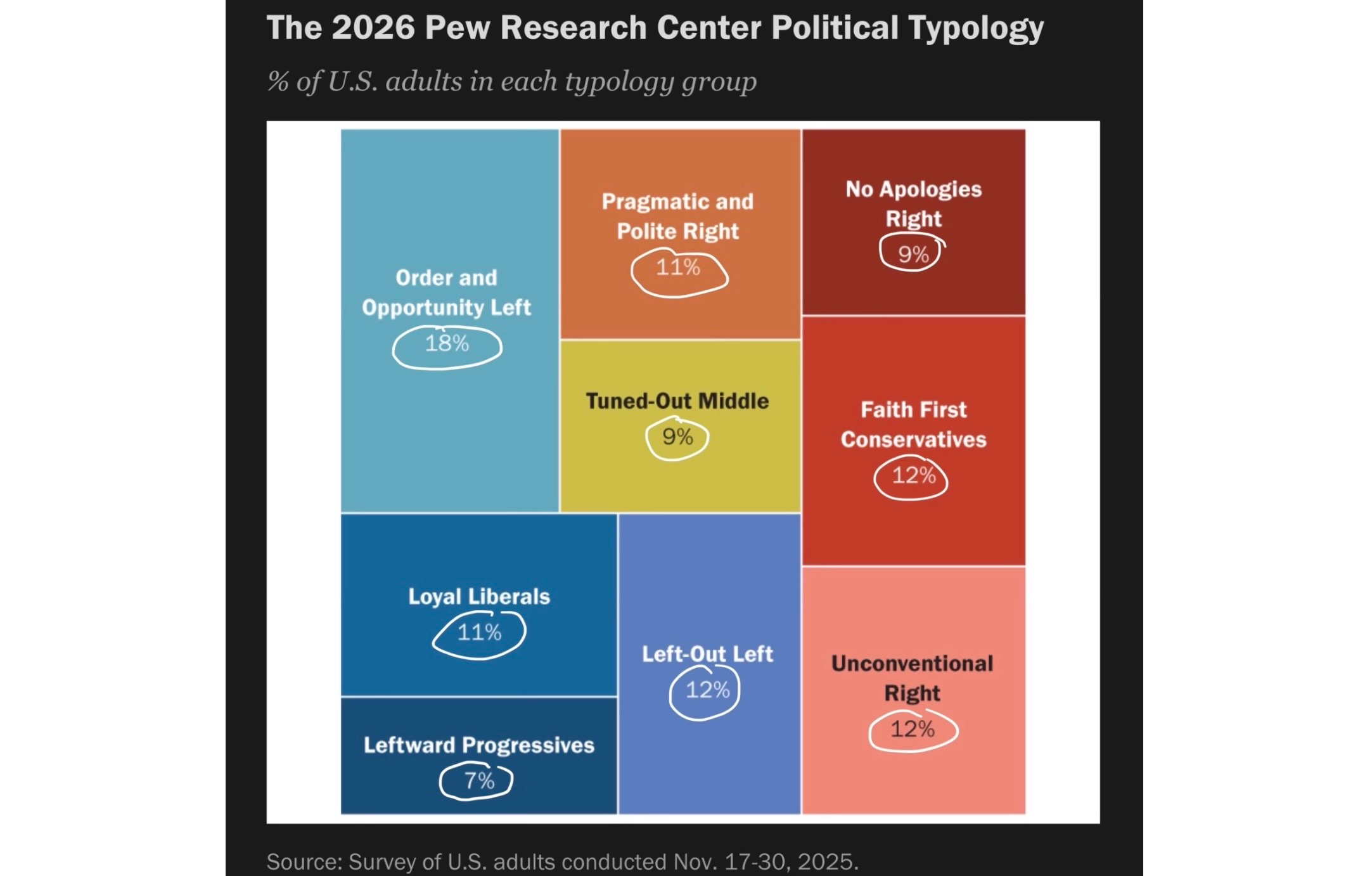
In their polling since at least 2016 they have asked: “How much of a problem do you think climate change is?”
For the latest polling results (Nov 2025) here are the relevant numbers for each type that chose either “A very big problem” or “A moderately big problem,” and the sum of both.
Leftward Progressives: 84% (“very big”) + 15% (“moderately big”) = 99%.
Loyal Liberals: 78% + 20% = 98%.
Order and Opportunity Left: 43% + 40% = 83%.
Left-Out Left: 53% + 37% = 9%
Tuned-Out Middle: 28% + 41% = 69%.
Pragmatic and Polite Right: 31% + 38% = 69%.
Unconventional Right: 9% + 30% = 39%.
Faith First Conservatives: 5% + 14% = 19%
No Apologies Right: 1% + 4% = 5%.
» Climate Movement Potential From Pew Poll
So our numerical goal for The Climate Movement in the US is 5% of the population by 2030. Excluding the Tuned-Out Middle (which I am tuning out), I consider those who answered the Pew climate question by saying it is a “very big” problem to approximate our potential pool of those who are already or should become Climate Movement Artist-Athletes.
For those of each Pew type who answered “very big,” here are the numbers for what they represent of the total population. I consider this to be the Climate Movement potential or the CM Potential.
CM Potential:
Leftward Progressives = 6%
Loyal Liberals = 9%
Order and Opportunity Left = 8%
Left-Out Left = 0.6%
Pragmatic and Polite Right = 3%
Unconventional Right = 1%
Faith First Conservatives = 0.6%
No Apologies Right = 0.009%
Total CM Potential = 28%
So, given our numerical goal of 5%, a CM Potential of 28% is huge!
Now a few of you might be thinking, “Progressives at 6% — that’s enough to exceed our goal. We’re done!”
Not so fast! We don’t just have a numerical goal.
We also want The Climate Movement to be big and broad and active enough, our first characteristic/imperative/goal. We want The Climate Movement to look like America and not to be pigeonholed as a far left phenomenon. That is important for both the growth and strength of Climate Action Supporters, and for politicians who are concerned about swing voters in general elections.
Thus, we want to pull from all the types, not just Progressives. Looked at from that perspective, the 4.6% total of the four types on the right side of the ledger is quite anemic.
Nevertheless, 28%, the overall total of those who answered that climate is “a very big” problem (minus the excluded Tuned-Out) is a terrific starting point!

Olympian Fields of Action
So, looking at the CM Potential of these Pew types some logical questions would be, “How do we think about this strategically? Where should we invest our time and resources?” And a reasonable response might be: “Let’s focus 90% of our efforts on the first three listed: Progressives, Loyal Liberals, and Order and Opportunity Liberals. Let’s focus the remaining 10% on the Pragmatic & Polite Right and the Unconventional Right.”
Sounds logical and reasonable if you were the general or dictator of The Climate Movement.
But, of course, we have no general. We have no dictator. We are a movement, not the military. From the perspective of the military, we’re a mess, a clusterf***. Heck, we’re not even a non-profit.
Yikes. Yup.
What we are is our fifth movement characteristic/imperative/goal: we are both organic and strategic.
Organic?
Here’s a reminder of what we’re talking about from an earlier post:
Organic change in our Movement comes from the Climate Action Artist-Athletes who make us up. Organic change is endemic because of who we are as individuals, our personalities, our gifts, our passions, our values. Organic change doesn’t stifle or suppress these qualities, forcing us into a standardized mold; it sets us free. …
Just as every place in nature at every moment in time is a unique combination, so too does place and time and the individuals who inhabit them create relationships and opportunities that will never happen again, as the new continuously replaces the old…
As such, organic change is rooted in people, place, and time — the combination of which must be activated by freedom and fulfilled through creativity, two of our Movement Values.
For those who can reach out to Faith First Conservatives and feel called to do so, even though their CM Potential is only 0.6%, that’s what you should do. That is a Field of Action for you.
So when you or your CAT or your organization, etc, look at these types it’s up to you to figure out how to combine organic and strategic change in growing The Climate Movement, which is our top priority. Everyone is welcome, even the 0.009% of the No Apologies Right.
People Power — More Than Numbers
People power is not just numbers. We can’t just grow in numbers. What’s currently lacking in The Climate Movement is intensity, something I will cover in an upcoming post. We need both growth in numbers and growth in intensity.
We need you and your energy! Join us!
If you are new here, check out our Intro Series. If you like this post, please “like,” comment, and share. And thanks for all you’re doing.
Its curious that climate action is mainly supported by the left. It isnt inherently a left thing.