

Introduction
In previous posts of this Climate Justice Subseries I have covered the first three distinctive aspects of climate justice: #1) legacy emissions and legacy pollution and #2) the systemic aggregate nature of the problem in post 8.1, and; #3) erasure of margins of climate safety in post 8.2.
Now it’s time to discuss tipping points, the fourth distinctive aspect of Climate Justice.
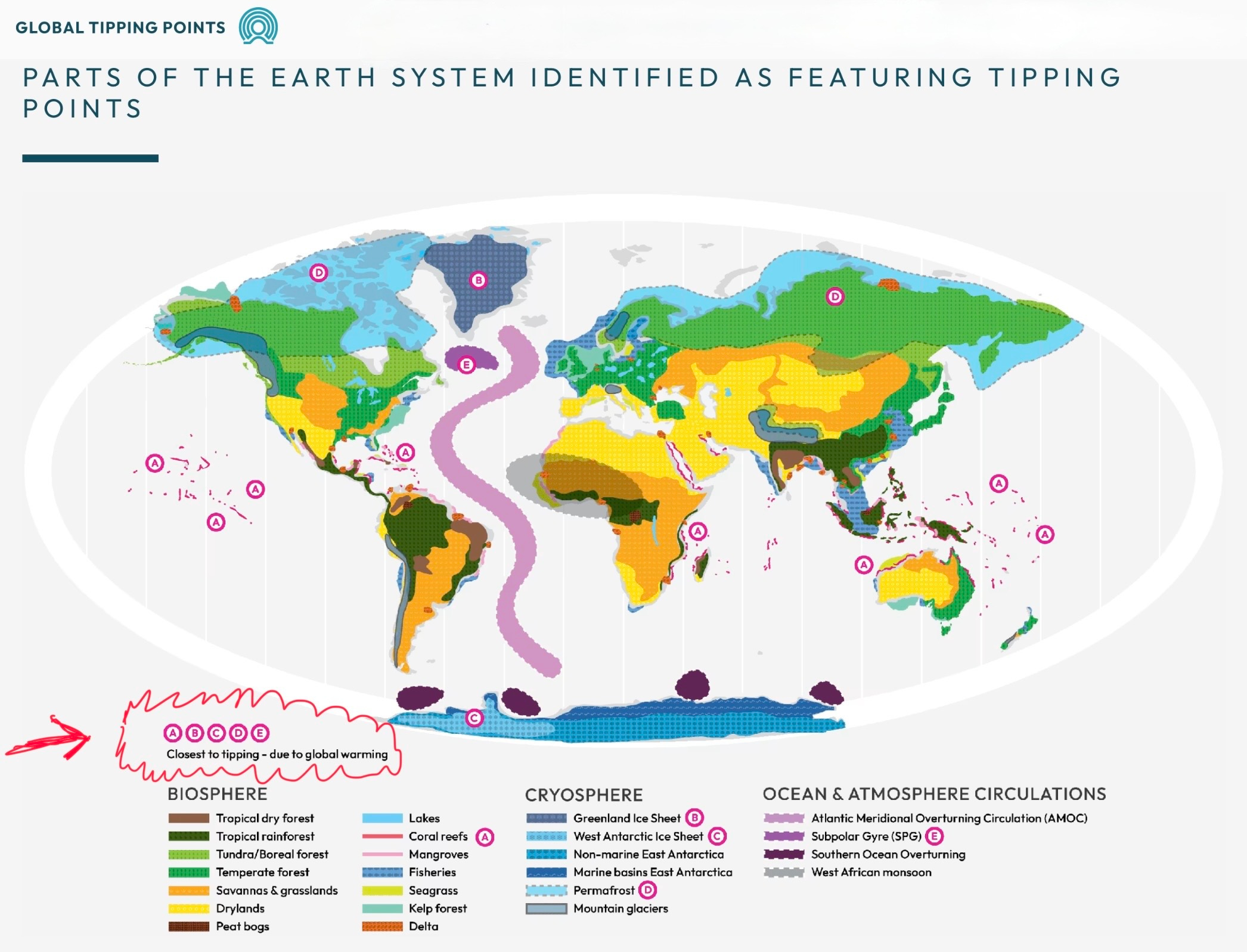
Perhaps the most worrisome consequences of climate change are when tipping points in natural systems are exceeded, leading to the collapse of such systems. The ones closest to tipping are pictured in the map above.
The combination of major climate and environmental tipping points — e.g. climate impacts combined with habitat destruction and environmental degradation — have the awful potential of becoming the greatest injustice ever perpetrated on the future.
According to the world’s leading scholars on this issue, a tipping point is reached when a “change in part of a system becomes self-perpetuating beyond a threshold, leading to substantial, widespread, frequently abrupt and often irreversible impact”.1
Could Come Faster
These tipping points could come faster than scientists have been expecting. That’s because global warming is happening faster than many thought. As I wrote in the previous post in this Subseries:
Climate pollution continues to rise, and a just published study in one of the most respected journals suggests a significant temperature increase since 2015 — the year the international climate talks that took place in Paris affirmed the 1.5C target. At the present rate we will exceed 1.5 by 2030.1
Identified Tipping Points
So far, more than 25 tipping points have been identified.

Tipping points include:
Warm-water Coral Reefs (see areas labeled “A” in map at top). We’re already there: “warm water coral reefs are crossing their thermal tipping point and experiencing unprecedented dieback, impairing the livelihoods of hundreds of millions who depend on them.”
The Greenland and West Antarctic ice sheets. We are close to the point where their melting becomes unstoppable, which will produce two meters of sea level rise by 2100, exposing 480 million people to flooding. It won’t stop there. All told, Greenland’s ice sheet would produce 7 meters. If all the Antarctic ice sheets were to melt they would produce 58 meters.
The death of the Amazon rainforest. This would release a great deal of CO2, further accelerating climate change, and wipe out untold species. Some experts believe we are close the point where death becomes inevitable.
Arctic permafrost thaw, which is already releasing both methane (a potent Greenhouse Gas) and carbon. (See areas labeled “D”, in map above.) The world’s permafrost contains nearly double the amount of carbon currently in the atmosphere, and four times more carbon than we have emitted since the Industrial Revolution.
The shutting down of a major system of ocean currents called the Atlantic Meridional Overturning Circulation (AMOC). This would, among other things, wreak havoc on agriculture, severely disrupting rainfall patterns, potentially leading to massive famine and starvation. A recent study suggests that a shutdown of AMOC could occur around mid-century, or as early as now and as late as 2095; any of these would be sooner than previous research has suggested. As a leading expert puts it: “A full AMOC collapse would be a massive, planetary-scale disaster.”2

Catastrophic Consequences We Must Avoid at All Costs
Natural tipping points will, in turn, lead to political and social tipping points, stressing our human systems and institutions to their breaking points, leading to instability, chaos, conflicts, wars, and collapse. Past civilizations have disintegrated due to climate change, but this would be on a scale never before seen.
Such tipping points would also lead to the collapse of numerous ecosystems and the extinction of many species, which would in turn have catastrophic consequences for humanity.3
Avoiding major tipping points is a key driver for why we are striving to keep warming to 1.5C with minimal overshoot that is quickly brought down to a level natural for our time.
Before going further, however, I must make a vital point. A lot of harm, destruction, suffering, and death can happen before major tipping points are reached. We are already experiencing such harm. Tipping points aren’t necessary to make climate impacts a justice issue. We don’t need to reach tipping points to justify the need for the three actions of justice: stopping bad stuff, setting wrong right, and making things better. They aren’t necessary to justify our vision, purpose, and Major Goal, to justify the need for the Climate Movement to become the greatest and most long-lasting social change movement in the history of the world. We don’t need tipping points to spur us to do everything we should be doing, everything our other Movement Values of love, beauty, freedom, creativity, wisdom, pragmatism, non-violence, sustainability, and success are calling us to do.
That said, major tipping points will make consequences exponentially worse. They can create so much destructive change that adaptation and resilience will be blown away. Tipping points are a profound violation of the Better Future Covenant and make a mockery of sustainability. They are the opposite of hope.

If combined, major tipping points in large natural and human systems have the potential to transform the planet into something never seen before by human civilization. Humanity will survive, but they will curse our memory for perpetuating what could become the greatest injustice ever.
Catastrophe Is Not Inevitable; Making Hope Happen Is the Answer
This is not inevitable. It won’t happen if we all play our part together.
But we must face the fact that it is possible, and the mere specter does harm to our wellbeing. Even so we must face the reality of this possibility.
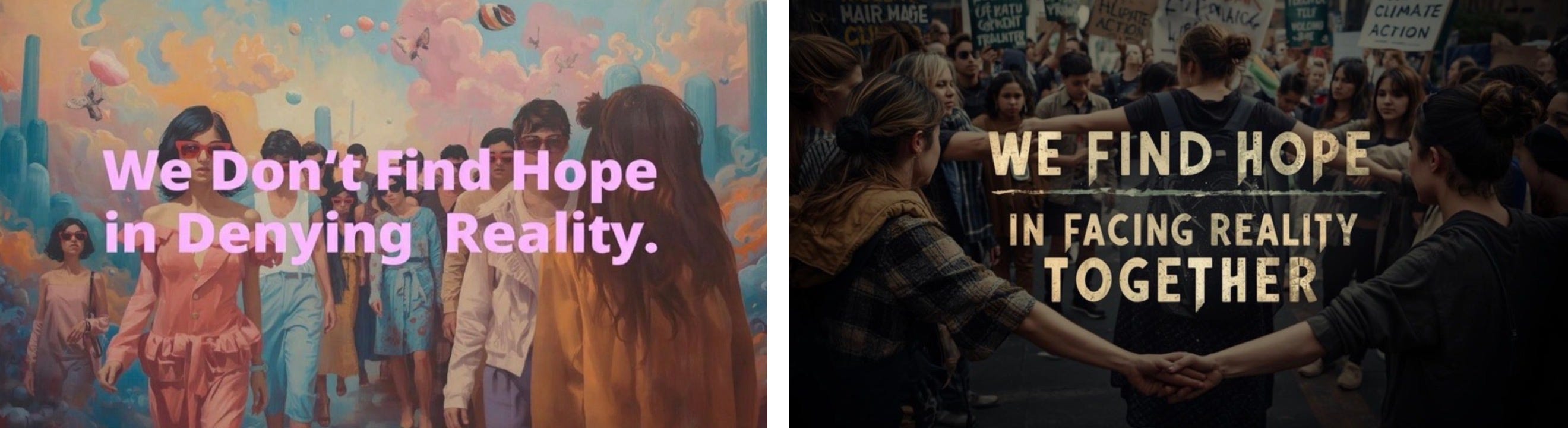
We don’t find hope in denying reality — we find hope in facing it together.
To extinguish this specter we must seize all of the hope available to us: we must become the greatest and most long-lasting social change movement in the history of the world; we must become CATS; we must make hope happen by ensuring the other three Catalytic Sources of Transformation achieve their potential; on all of our Olympian Fields of Action we must make the impossible possible and the possible actual and the actual beautiful, and our future come faster.
We must. We can. We will.
Join us!

If you are new here, check out our Intro Series, as well as other posts in this Hope & Justice Series. If you like this post, please “like,” comment, and share. And thanks for all you’re doing.
Global Tipping Points 2023, p. 36.
Rahmstorf, AMOC Tipping Point? Sept 2024, p. 27.
Many tipping point scientists have signed an urgent statement, The Dartington Declaration, summarizing the danger and calling for bold action. I encourage everyone to read it. Brief and powerful.