


In my introductory post of this Subseries on Climate Justice I wrote that there are five distinct aspects of climate justice that must be considered:
so-called legacy emissions that become legacy pollution;
the systemic aggregate nature of the problem;
the simultaneous erasure of margins of climate safety, such as the destructive momentum built up in the oceans;
tipping points;
the unjust distribution of consequences.
In this post I will discuss the first two: legacy emissions becoming legacy pollution, and the systematic aggregate nature of the problem.
1. Legacy Emissions Becoming Legacy Pollution
Two factors are important in understanding so-called CO2 legacy emissions and legacy pollution. Neither are benign, and one can lead to the other. The first increases risk of harm. The second actualizes harm.
First, in the case of climate change, anthropogenic or human-caused CO2 in the atmosphere doesn’t stop trapping heat until it is removed through the carbon cycle. This means that some of the CO2 released at the start of the Industrial Revolution is still trapping heat, and some of the CO2 we release today will be trapping heat for a thousand years and more.
In other words, CO2 creates a legacy.
Second, emissions don’t become a pollution problem until a threshold is reached and harm begins to occur. (Remember: pollution is too much of something in the wrong place causing harm.)
But even before the harm threshold, legacy emissions reduce the margin of safety and increase the danger, increase the risk of exceeding the threshold, and, much worse, move us closer to tipping points. (On tipping points, see here and here.)
As such, legacy emissions violate the Better Future Covenant.
Once the harm threshold is reached, legacy emissions are transformed, so to speak, and become legacy pollution, because they are contributing to harm. The harm builds upon this legacy, so that past emissions, or legacy emissions, become legacy pollution.
Without legacy emissions there wouldn’t be a climate problem, which today is a climate crisis.
Concerning the past and the present it is too late to do the first action of justice, stopping this particular bad stuff, climate legacy pollution. It has already been emitted and is now where it shouldn’t be causing harm. The damage and the danger have already been actualized. Even if today we could miraculously stop all climate pollution, the bad stuff caused by legacy pollution would still be with us.
However, while for the past and present the harm of legacy pollution has already been baked in, and the harmful consequences we have experienced and are experiencing will continue to reverberate into the future, we can do something to help stop some of the additional new bad stuff from happening in the future due to legacy pollution.
For those of us in the Climate Movement, because we are a moral movement, because of all of our Movement Values, especially justice, we must do something.
We must; we can; we will.
In implementing our vision, purpose, and Major Goal, i.e., to overcome climate change by creating a just and prosperous sustainability that enhances wellbeing for everyone and everything, we should be doing all three actions of justice to help make our future come faster.
With legacy pollution we can’t stop the bad stuff that has already been baked in, impacting past, present, and future. But we can try to stop some of the future bad stuff, and we can work hard to redress the bad stuff impacts through the next two actions of justice, setting wrong right and making things better.
So how can we stop some of the future bad stuff brought about by legacy pollution?
Some good news here is that CO2 legacy pollution doesn’t have to be left up to nature on its own to clean up. There are two ways we can help by actively removing CO2 from the atmosphere.
First, we can work with nature through natural climate solutions, in this case sequestering carbon in trees and soils, which are referred to as sinks because, like a kitchen sink, they can temporarily store carbon. However, as the term sequester and the metaphor of a sink indicates, this storage isn’t permanent. As part of the natural carbon cycle, this carbon will return to the atmosphere once a tree dies and soil carbon is disturbed; the stopper of the sink is released and the sink is drained of its contents. However, while they temporarily store carbon, such natural climate solutions can help buy us time to ramp up everything else we need to be doing at the speed and scale necessary to achieve 1.5C with minimal overshoot while bringing atmospheric CO2 down to a level that is natural for our time.
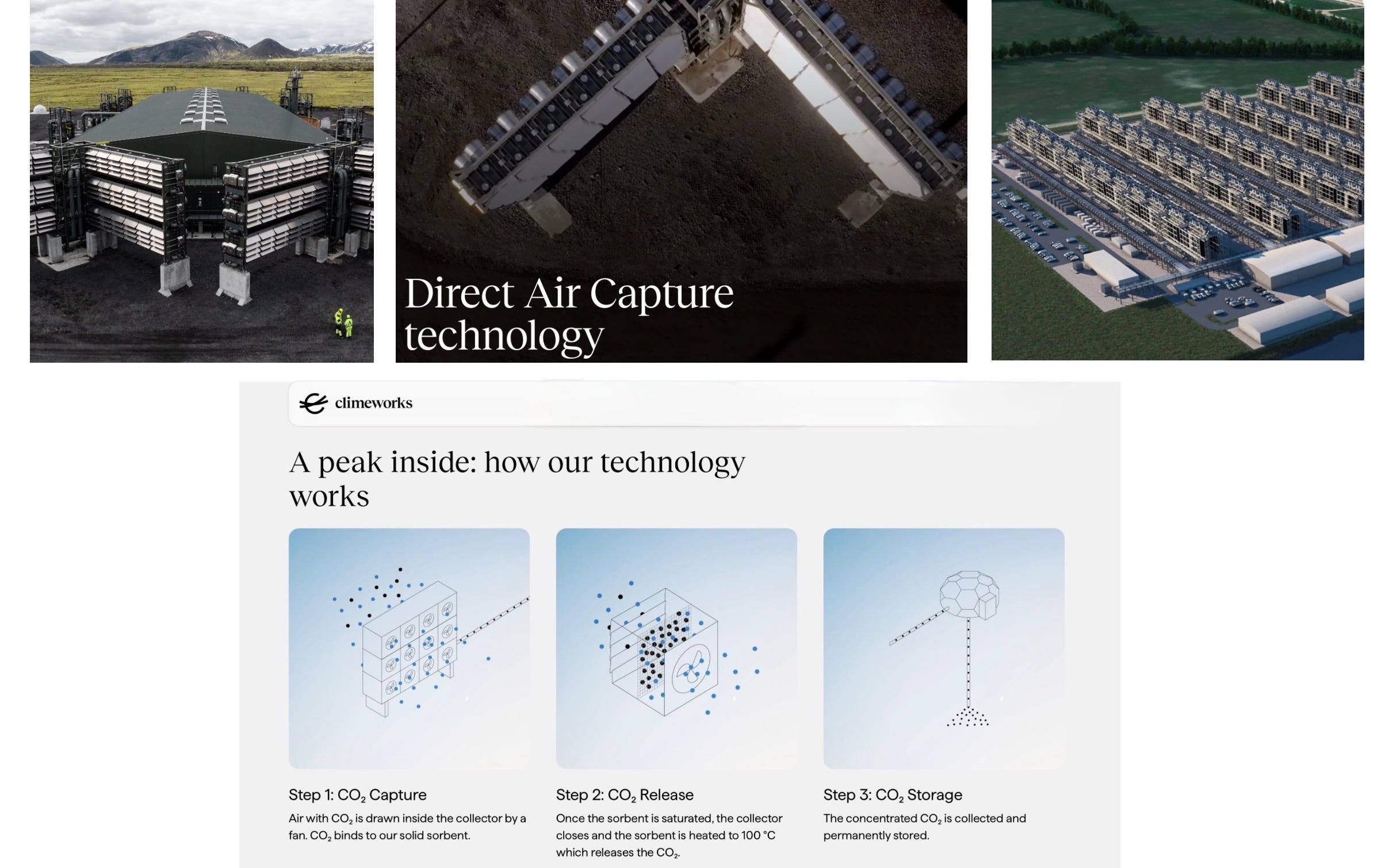
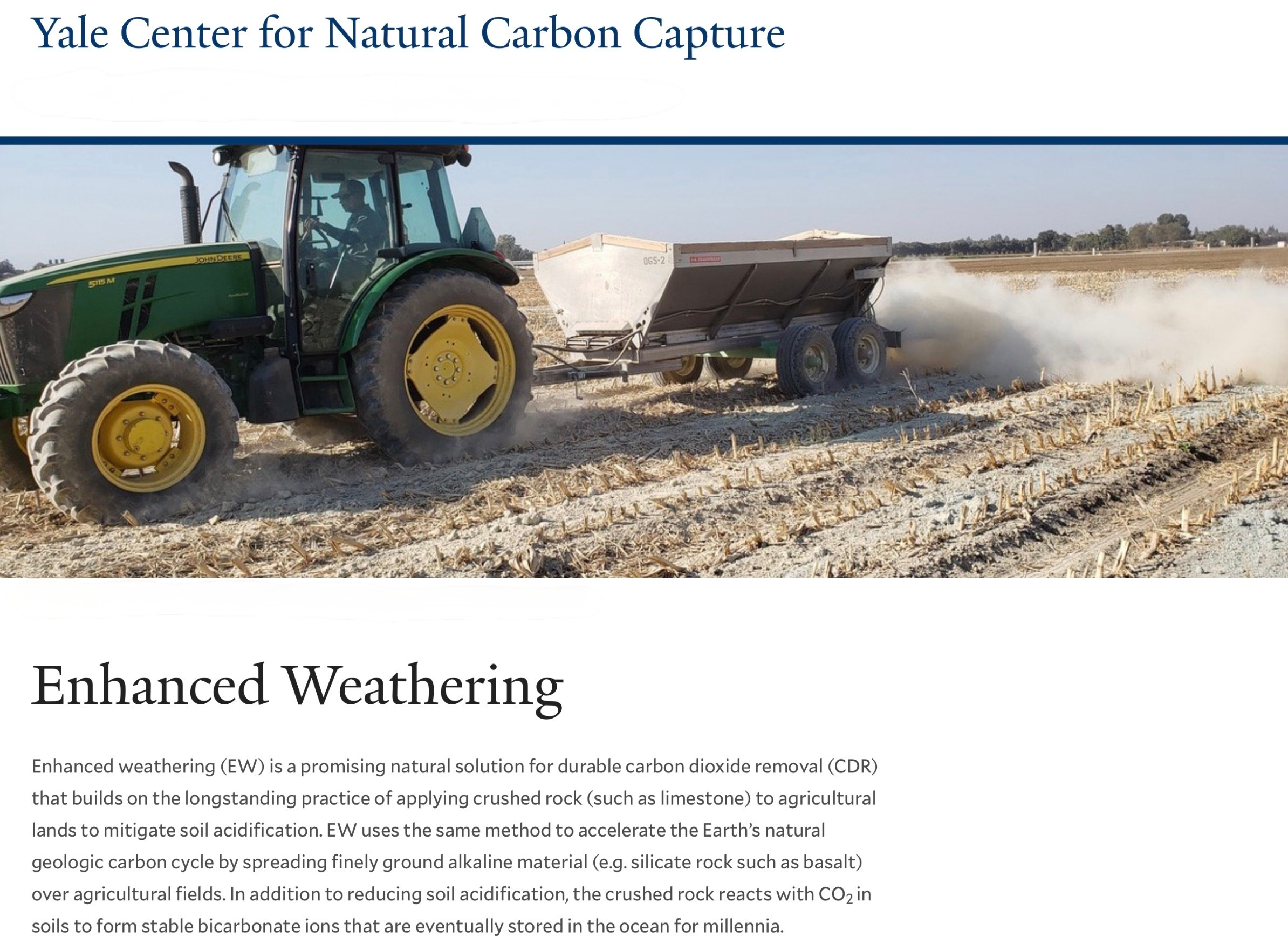
Second, we can also suck legacy carbon out of the atmosphere through carbon dioxide removal (CDR) approaches like direct air capture (pictured above), and enhanced rock weatherization (pictured below), as well as new possibilities needing more R&D like marine CO2 removal (mCDR).
Some in the Climate Movement are afraid that such technologies will be used as an excuse to keep polluting. If we remain true to our vision, purpose, and Major Goal and our Movement Values we will not let that happen. But neither should we oppose these efforts. The opposite is the case. Because of the continuing and future damage of legacy pollution, we must support and encourage such solutions.
(I will have more to say about all of this in a future series of posts called “Just Suck It Up.”)
2. A Systemic Aggregate Problem
I’ve discussed the crucial fact that climate change is a systemic aggregate problem many times. Because of this, it is the Big Producers of Polluting Products and the nations who harbor them, and not individuals, who are accountable. Individuals, by definition, cannot cause or resolve systemic aggregate problems.
So individuals are not accountable for this systemic aggregate problem.
But because we can do something about it together, we are responsible for overcoming it in a way that creates justice.
Why? Two reasons:
the nature of the problem itself, requiring change at a speed and scale never before attempted, and
our Movement Values and the Better Future Covenant.
Because of speed and scale, our societies will never overcome climate change by creating a just and prosperous sustainability that enhances wellbeing for everyone and everything without The Climate Movement pushing for this to become a reality. How? By ensuring that the other three Catalytic Sources of Transformation — Climate Action Supporters, ARTC, and Governments-and-Markets — play their parts. The Catalytic-4 must work together.
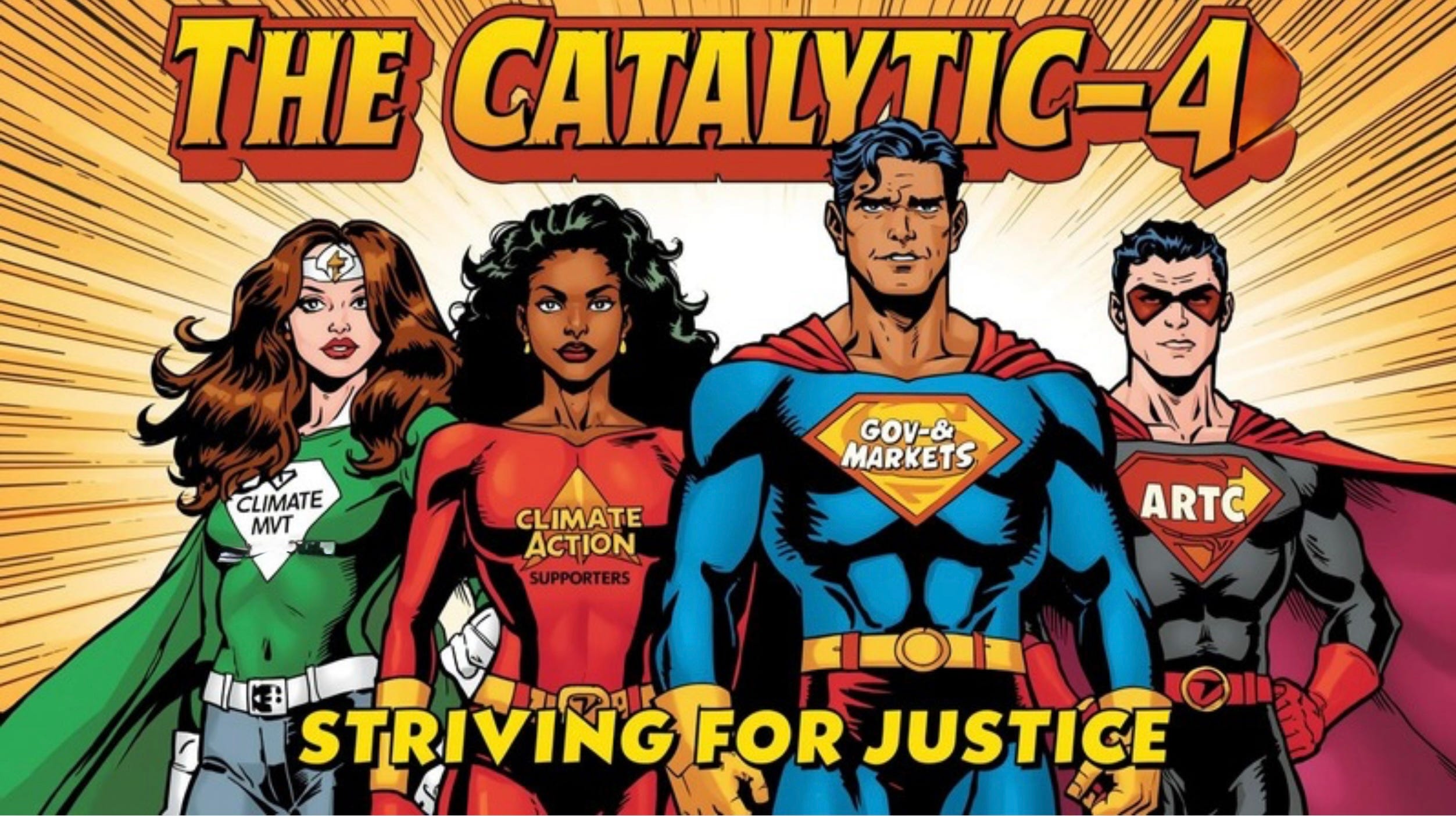
Together, we are indispensable, which means we are responsible.
As individuals we are responsible for playing our part in creating the greatest and most long-lasting social change movement in the history of the world to make our future come faster. We are responsible for not falling for the individualistic carbon footprint scam.
Rather, each of us must find our particular Olympian Fields of Action upon which we give our best and go for gold, knowing that victory for our nation and the world can only be achieved if each of us plays our part for our team.
As individuals we are responsible because this is what our Movement Values of love, justice, beauty, freedom, creativity, wisdom, pragmatism, non-violence, sustainability, success, and the Better Future Covenant calls us to. We are responsible to ourselves and one another to remain faithful to our best selves.
As such, we are responsible for playing our part in achieving the three actions of justice — stopping bad stuff, setting wrong right, and making things better — which includes holding the Big Producers of Polluting Products and nations most accountable to account.
In sum: climate change is a systemic aggregate problem that creates profound injustices, which due to the speed and scale of change needed to overcome climate change in a just manner requires the Climate Movement to become the greatest and most long-lasting social change movement in the history of the world so we can push the other three Catalytic Sources of Transformation to play their parts, including holding the Big Producers of Polluting Products and nations most accountable to account.

If you are new here, check out our Intro Series, and other posts in our Hope & Justice Series. If you like this post, please “like,” comment, and share. And thanks for all you’re doing.