


In our Hope & Justice Series we are exploring the symbiotic relationship between these two. We hope for a just world, and such hope helps us create justice. Such justice gives us hope, which spurs us on towards more justice.
As we overcome climate change by creating a just and prosperous sustainability that enhances wellbeing for everyone and everything, we must be doing the three actions of justice: stopping bad stuff, setting wrong right, and making things better.
In achieving these three in the climate space we must determine two things: who is accountable for causing it, and who is responsible for overcoming it. Individuals on their own aren’t accountable, but all of us are responsible for doing something about it.
So who is accountable? We need to know this to stop the bad stuff (i.e. the climate pollution and unjust climate impacts), set wrong right, and make things better. I have identified the Five Climate Accountability Classes made up of Big Producers of Polluting Products.
If you want to know who to target, it’s the Big Producers in these Five Climate Accountability Classes.
In the earlier post we covered the first two classes of Climate Accountability: (1) national governments, and; (2) state-owned upstream fossil fuel producers.

Here I will discuss the final three:
3) upstream fossil fuel producers that are investor-owned corporations (both public and private);
4) midstream state owned and state-owned-and-run fossil fuel burning utilities;
5) midstream investor-owned fossil fuel utilities.
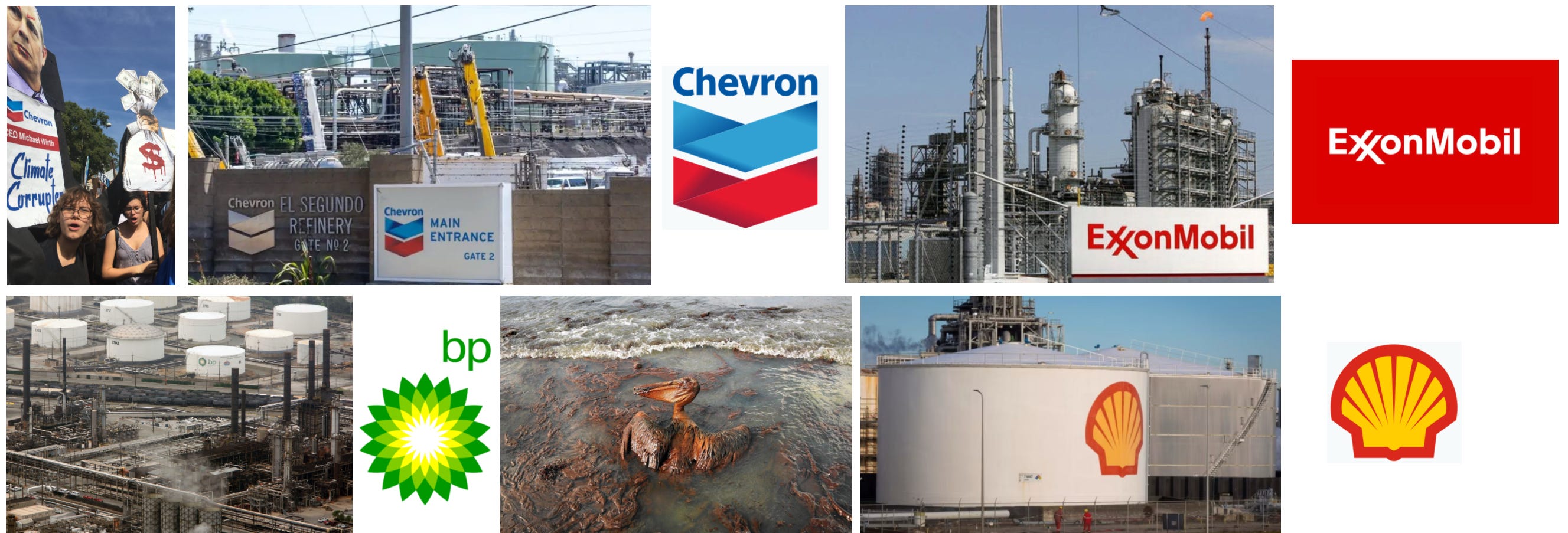
Upstream Investor-owned Big Producers (both public and private)
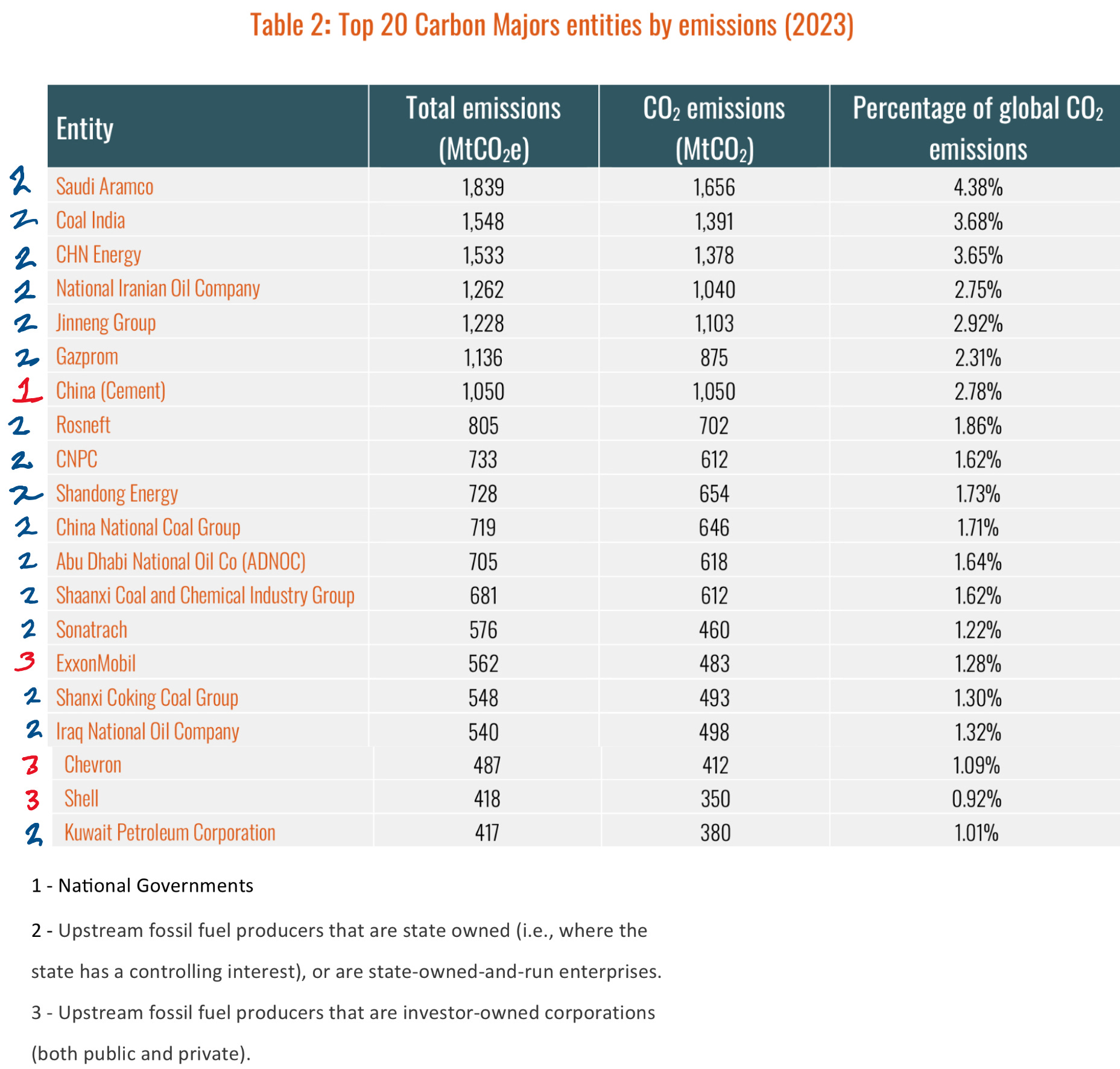
For many of us these are the poster children of the Big Producers of Polluting Products. As can be seen in the Table below from the Carbon Majors 2025 report, Chevron, ExxonMobil, BP, and Shell, are in the top 10.
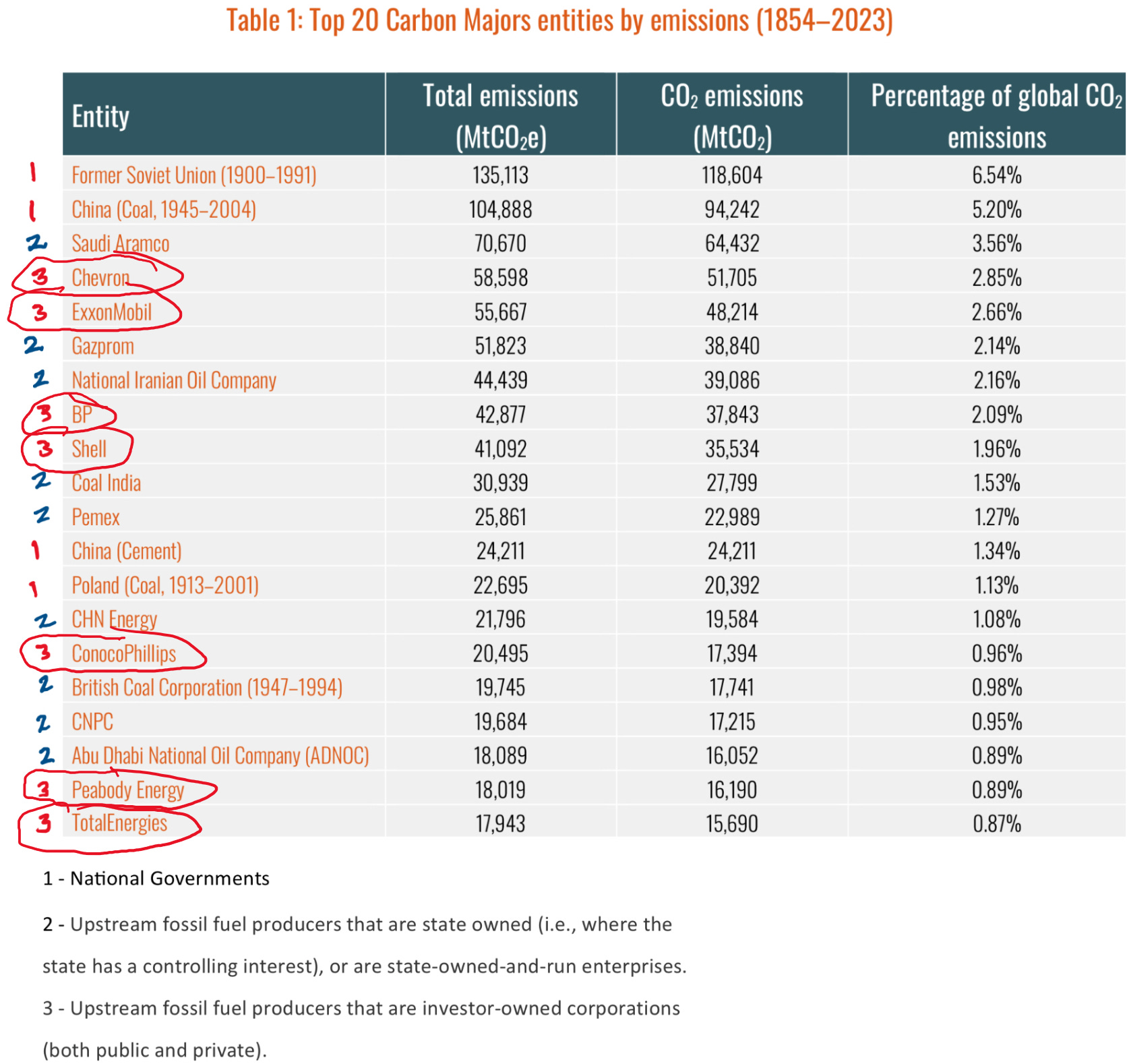
While as a class they aren’t the biggest, nevertheless they are accountable for pushing us beyond the harm threshold.
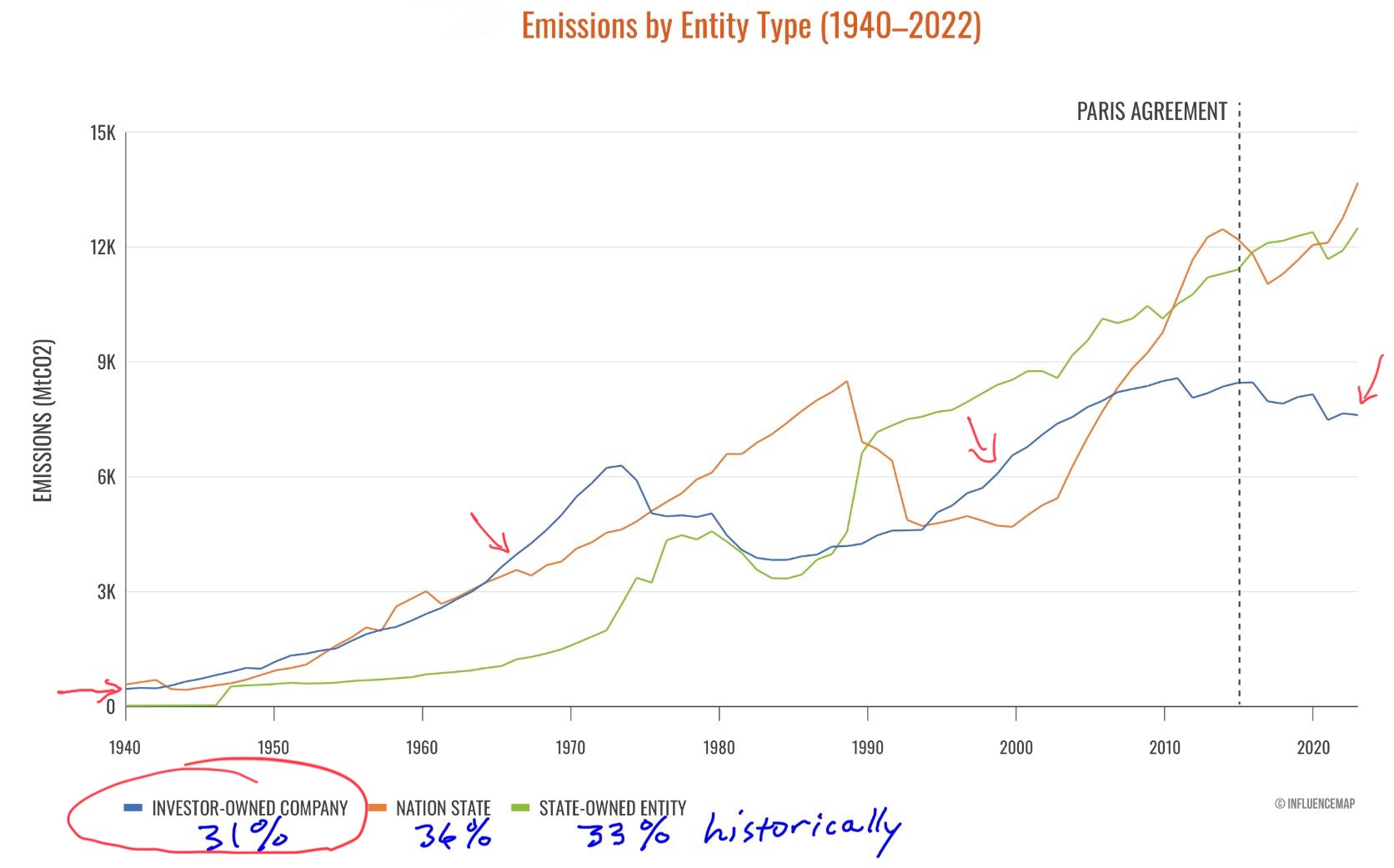
Looking at fossil fuel climate pollution from oil, methane, and coal between 1940-2022, this class is has emitted 31%.
Without them we wouldn’t have a climate crisis.
Upstream Investor-owned Big Producers have one reason for their existence — profit. They are guided by what is good for the stockholders/owners. As economist Milton Friedman famously argued, the only “social responsibility” a company has is “to use its resources and engage in activities designed to increase its profits …”.
This profit-only profile contrasts with the fact that Upstream state-controlled Big Producers (my second class, see Carbon Majors Table 1, above) have multiple reasons for their existence — economic development, jobs, energy independence, low-cost energy for citizens, revenue for the government, etc. They are supposed to be guided by what is perceived to be the good of the country. As such, they can be more amenable to climate action.
Profit-only is why company pledges to reduce their pollution voluntarily — including “Net-zero by 2050” commitments — are completely unreliable as they blow with the winds of profit. When it’s profitable — or as a way to forestall government requirements that would eat into profits — sure. When it’s not, nyet. Many renege; they bail, even on commitments that were shams to begin with. The logic of the market tilts heavily towards this outcome. No matter how many outlier companies we may get to be climate leaders or “first movers” it will only be tinkering at the margins when we must have speed and scale. They may help pave the way for bigger action, and that’s good. But that bigger action will never happen without the government requiring everyone to act.
Of course, there’s the even more negative side. Not only will many renege on any pollution-reduction pledges when profits dictate. They will also do just about whatever it takes to stop efforts to reduce profits associated with climate pollution. They will:
lie;
fund right-wing “think tanks” and PR campaigns and bogus science to confuse and mislead the public and policymakers;
attack, or have their paid functionaries attack, scientists and others telling us the truth;
bankroll sympathetic politicians and fund attacks on those in favor of climate-action.
They are hope-stealing on crack cocaine.
Because the profit motive pushes them to be the worst obstructionists, they punch above their weight when it comes to climate accountability.
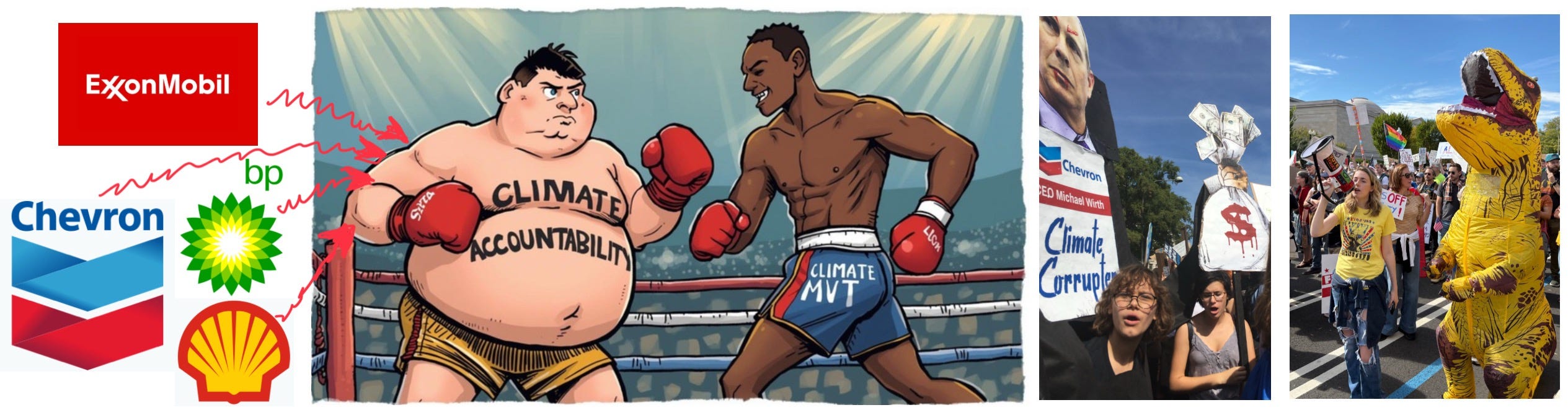
Given the speed and scale of needed change, there is only one answer: other powerful forces — governments and the Climate Movement and Climate Action Supporters — must hold these investor-owned profit-driven Big Producers like ExxonMobil, Chevron, BP, Shell, and ConocoPhillips accountable. The clear-eyed logic of the market — the overriding profit motive that requires everyone to meet the same standards so that no one has an unfair advantage — necessitates it.
Can we rely on governments to do this? No.
So once again do we demonstrate the indispensable nature of the Climate Movement, which must engage and organize Climate Action Supporters at strategic moments to push governments to ensure such corporate accountability. Growing our Climate Movement so we have the power we need and pushing our governments to do what’s right are the two Olympian Fields of Action on which all of us must participate.
4. Midstream State-owned and State-owned-and-run Fossil Fuel Burning Utilities
Let us look briefly at State-Owned Enterprises (SOEs) more broadly before we zero in on utilities.
SOEs collectively — utilities, mining, oil and gas, metals, manufacturing — are the world’s second largest climate polluter behind China. The assets of all types of State-owned Enterprises (SOEs) is about 50% of global GDP, and of that, electricity and gas utilities comprise 21% of the value of SOEs.
When looking at the largest 50 of all energy-related SOEs — oil and gas, coal, coal-burning power plants — if we were to consider them a country their pollution would rank third behind China and the US.
In 2023 global coal demand increased to an all-time high, driven mainly by China and India, with China accountable for over 56% of global demand. China’s use was driven by its utilities, accountable for 63% (IEA, Coal 2024, Dec. 2024).
More than half of electric utilities worldwide are state-owned. Over half of coal-burning power plants, as well as those in the works, are SOEs. While they are gradually becoming more climate-friendly — whether through energy conservation, energy efficiency, or by switching to or adding renewables — in 2016 SOEs generated twice as much electricity from fossil fuels as they did from renewables.
Simply put: we can’t overcome climate change if we don’t get state-owned/controlled power plants off of fossil fuels. The Climate Movement and Climate Action Supporters around the world must push to shut down these coal-burning power plants ASAP. These are vital Olympian Fields of Action.

5. Midstream Investor-owned Fossil Fuel Burning Utilities
Our fifth and final Climate Accountability Class, investor-owned fossil fuel burning utilities, especially coal-burning power plants, have been one of the chief targets of environmental organizations for decades. This began with concerns about air pollution: sulphur oxides or SOx, with sulphur dioxide or SO2 the primary one in this group; nitrogen oxides or NOx, with NO2 the main one, and; mercury.
For many old coal-burning power plants in the US, mercury regulations promulgated in the Obama and Biden Administrations were the final nail in the coffin, when combined with cheaper renewables and concerns about CO2. These air pollution regulations were the culmination of over a century of activism, beginning with “anti-smoke” campaigns in the latter part of the 19th Century all the way up to efforts that continue to this day. (See Our Story Together series on the history of the air pollution fight and the climate fight, the first three on air pollution and the last three on climate: first post, second, third, fourth, fifth, and sixth.)
As a result of these forces, investor-owned utilities in rich countries are undergoing a transformation away from coal towards cleaner sources, and this is having a major impact on climate pollution. According to the International Energy Agency (IEA):
Nearly two-thirds of the decline in [CO2] emissions from advanced economies in 2023 occurred in the electricity sector. For the first time in history, electricity generation from renewables and nuclear reached 50% of total generation in advanced economies, with renewables alone accounting for an unprecedented 34% share. Conversely, coal’s share plummeted to an historic low of 17%. (IEA, CO2 Emissions in 2023 (2024) p. 11)
As stated above, while global coal demand reached an all-time high in 2023, driven by China and India, the use of coal in rich countries fell to a level not seen since 1905. Coal demand has been cut by almost half since its peak in 2007, while renewables more than doubled from 16% to 34%, and natural gas went from 22% to 31% (IEA, CO2 Emissions (2024) pp. 11-12).
This transformation is a prime example of what can happen when continuous pressure by environmentalists and popular support is combined with ARTC and governments-and-markets. The drop in the price of renewables, spurred by (1) decades of government funded R&D, (2) subsidies and other favorable policies, especially in China with solar PV, and (3) market-driven competition and innovation, has made the pace and scale of change much more palatable to investor-owned utilities seeking profits. When The Catalytic-4 work together, big change can happen.
At the same time, every step of the way these utilities have been fighting a rear-guard action of resistance to the pace of needed change, as they have sought to wring out every last drop of profit from old fossil burning power plants that should have been shuttered years ago. Without environmentalists pressuring governments to pass laws and promulgate and enforce regulations this transition would be taking place at a much slower pace, one we can’t afford.
Climate Accountability’s Five Classes: Conclusion
The only way we will achieve justice and overcome climate change is if The Climate Movement makes it happen. We must stop bad stuff, set wrong right, and make things better.
Accountability looks not just at current pollution, but also past emissions or “legacy emissions” given the longevity of heat-trapping gases. Table 1 above gives us a sense of the past and who must be held accountable for setting wrong right.
But we can’t stop the past. It’s already baked in. We can only stop pollution in the present. Table 2 below of top Carbon Majors in 2023 is a rough guide on who we must target. Nine of the top 10 and 16 of the top 20 are state owned.
The clear conclusion is that The Climate Movement around the world must pressure governments to kick the fossil habit. But in this case you can’t beat bad with nothing. You gotta beat bad with better — and we got better, because renewables are leaving the fossils in the dust.
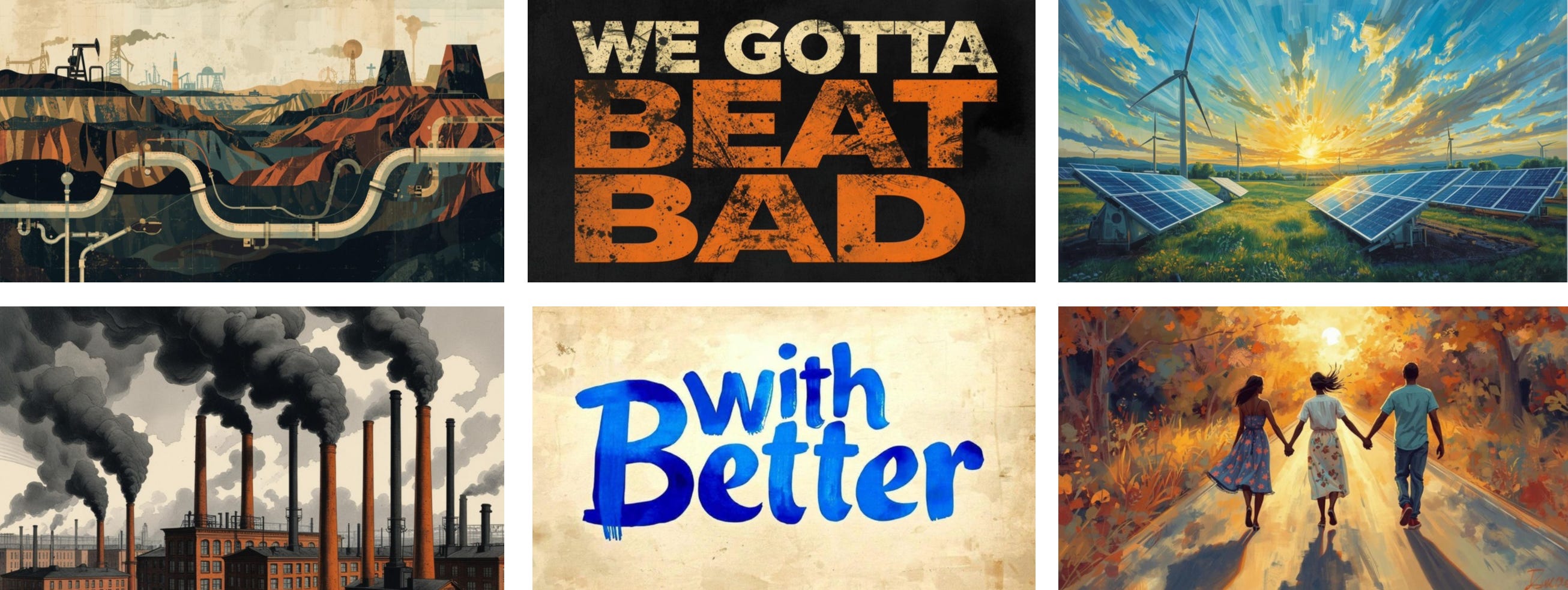
We gotta beat bad with better to overcome the lies and the entrenched fossil infrastructure and their political protectors and plain old inertia.
That’s why we must and we will become the greatest and most long-lasting social change movement in the history of the world. Join us!
If you are new here, check out our Intro Series and other posts in this Hope & Justice Series. If you like this post, please “like,” comment, and share. And thanks for all you’re doing.
Excellent analysis of the Big Producers of Polluting Products and strategies to hold them accountable to achieve climate justice. “The clear conclusion is that The Climate Movement around the world must pressure governments to kick the fossil habit. But in this case you can’t beat bad with nothing. You gotta beat bad with better — and we got better, because renewables are leaving the fossils in the dust.
We gotta beat bad with better to overcome the lies and the entrenched fossil infrastructure and their political protectors and plain old inertia.
That’s why we must and we will become the greatest and most long-lasting social change movement in the history of the world.”