


This is our third in a Subseries of posts (see one and two) explaining who is accountable for climate change. We all are responsible for overcoming climate change and for justice. But we’re not all accountable for causing it.
So which persons, collective entities, and systems are accountable for having caused, or causing, or will cause, or have allowed to cause, the harm associated with climate change?
When it comes to climate accountability, there are five main classes. Remember, we are focused on accountability and identifying these classes because of the three actions of justice: stopping bad stuff (e.g., climate pollution), setting wrong right, and making things better.

Accountability involves individuals and groups. Those accountable may not want to be held to account, or feel powerless to work towards justice because they are in systems that produce the harm.
The Climate Movement and Climate Action Supporters, indeed The Catalytic-4 working together, must ensure that climate accountability for these five main classes helps achieve the three actions of justice.

The five climate accountability classes that make up the Big Producers of Polluting Products are as follows.
Nations, or more specifically, national governments.
Upstream fossil fuel producers that are state owned (i.e., where the state has a controlling interest), or are state-owned-and-run enterprises.
Upstream fossil fuel producers that are investor-owned corporations (both public and private).
Midstream state owned and state-owned-and-run fossil fuel burning utilities.
Midstream investor-owned fossil fuel utilities.
I will discuss the first two here, and 3-5 in the next post.

National Governments
Nations, as the premier sovereign legal entities with the power of enforcement within their borders, have been a major focus of climate change ever since it has arisen as a concern requiring action. That’s because even though climate change is a global problem requiring solutions that reduce the causes worldwide, there is no international entity that has the power and the legal authority to compel compliance with efforts to address the problem.
When looking at nations, currently China is the world’s #1 polluter and historically it is now #2. The United States is #1 historically, and due to legacy emissions, history still matters.
Worldwide, governments collectively are the majority owners of fossil fuel production. They own over half of the coal-burning power plants, both those existing and planned.
But even those governments who aren’t involved in ownership are ultimately accountable for both the pollution products and the pollution that are generated within their borders. Nations are accountable for allowing the Big Producers of Polluting Products to operate within their country, regardless of ownership.
So governments are accountable either for the production or for allowing the production of pollution products where they have legal authority. They have allowed them, and in many cases actively supported them — and they can reign in the Big Producers.
Some may ask, why not let the market deal with this and leave the government out of it? As we will see below, governments have a controlling or exclusive stake in Big Producers that are accountable for 69% of CO2/CH4 pollution from oil, methane, and coal between 1940-2022. We can’t leave them out of it — because they are it.
But let’s pretend for a moment that the Market is responsible for it all. So, then, could we just let the Market handle it?
It wouldn’t work. It would be a disaster.
That’s because when it comes to systemic aggregate problems like climate change, the market cannot police itself because of the five Ps.

The market’s chief, overriding motive is (1) Profit.
Profits within a competitive market system are driven in large part by (2) Price.
Profits and price are focused on (3)the Present, not the future.
(4) Polluters don’t (5) Pay anything for their pollution, dumping it into our environment for free.
When they work together the five Ps make it nearly impossible for the market to make a meaningful contribution to overcoming climate change on its own.
The Invisible Hand — i.e., how the market via profit and price can turn self-interest and even greed into good things — may help create jobs and wealth and beneficial products; it may help to allocate scarce resources efficiently. But The Invisible Hand is crippled when it comes to climate, rendered impotent by its focus on the present and because polluters don’t pay. Its footsoldiers only see profit and price and are blind to the damages its activities bring about.
Whereas the market is focused on profit, for governments protecting their citizens and establishing justice is job #1 (at least theoretically). Pollution and climate impacts are dangerous, deadly, and destabilizing threats to public health, safety, and national security.
Bottom line: governments are accountable for both pollution products and pollution created within their borders, and for protecting their citizens and establishing justice. That’s why the government must do its number one job — protecting its citizenry and establishing justice — by curtailing and eliminating climate causing activities.
In a democracy or representative democracy, citizens who can vote, i.e., citizens who have the franchise, are ultimately, collectively responsible for the actions or lack of actions by their governments. As the sovereign authority, they are accountable to themselves. They are both accountable and responsible.
In sum, national governments are accountable because of the Big Producers within their borders. They are (1) Big Producers themselves, (2) have either actively promoted and supported their activities, or (3) allowed them to create harm.
It is the Climate Movement and Climate Action Supporters that must ensure that governments do their job of protecting their citizens against climate change and establishing justice. We need The Catalytic-4 working together.
Upstream State-owned Corporations and State-run Producers
This climate accountability class involves those entities where (1) the state has a controlling interest, and (2) those owned and run by the state. The common denominator here is state control. A common term for such entities is State-Owned Enterprises (or SOEs).
An excellent report combines this class of upstream state controlled entities with the third class discussed in the next post, investor-owned companies, into what they call “Carbon Majors.” It shows that
six of the top ten
thirteen of the top twenty
twenty-nine of the top 50
fall in my state owned and/or run class.
Looking at fossil fuel climate pollution from oil, methane, and coal between 1940-2022, this class is has emitted 69%, with state-owned at 33% and state-owned-and-run at 36%.
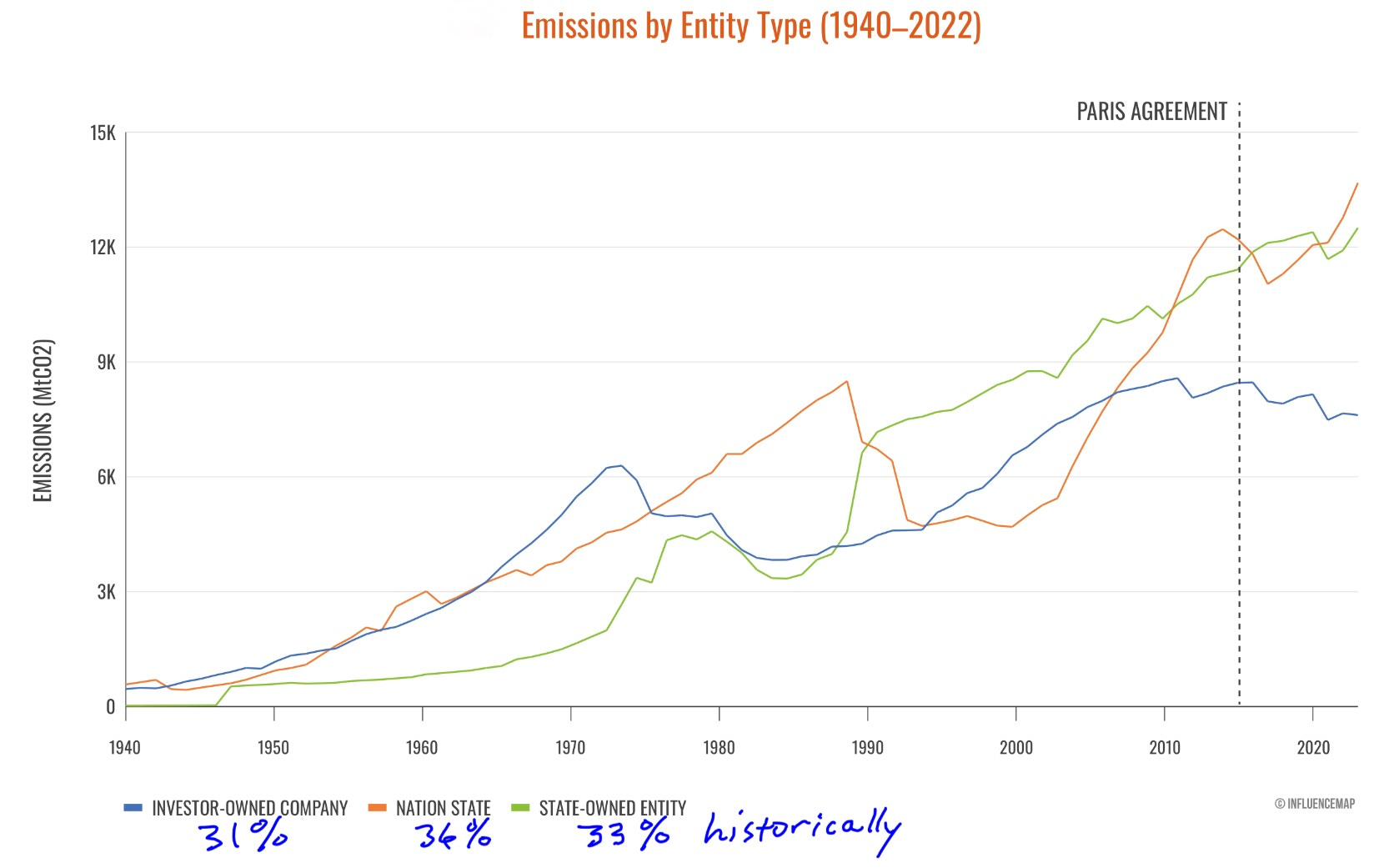
Many of the world’s governments are not simply the protectors of Big Producers, they are the Big Producers.

So where’s the hope? This knowledge and categorization helps us to be strategic and make our efforts count. Knowing who the real Big Producers of Polluting Products are allows us to see who to target with our people power and moral power to stop bad stuff and set wrong right. Most governments are more responsive to the will of the people than are investor-owned corporations, and they can be called out and held accountable for failing to do their #1 job: protecting their citizens and establishing justice.
If nothing else convinces you we need a worldwide Climate Movement to ensure that The Cataytic-4 works together this should: that national governments and state-owned Big Producers make up 69% of climate pollution from oil, methane, and coal between 1940-2022. We must become the greatest and most long-lasting social change movement in the history of the world, one big and broad enough, encompassing 5% of the world’s population by 2030 and 10% by 2040 — and we must be backed up by Climate Action Supporters.
We are the hope we’ve been waiting for. Join us!

If you are new here, check out our Intro Series and other posts in this Hope & Justice Series. If you like this post, please “like,” comment, and share. And thanks for all you’re doing.