

As we already have seen in this Smog-Climate Suberies, Arnold Beckman was essential to: (1) Arie Haagen-Smit discovering what made up LA smog and then (2) having Haagen-Smit’s conclusions be accepted by the scientific, policy, and political communities.
But his contributions didn’t end there.
In 1954 the LA Chamber of Commerce made him Chair of its Air Pollution Committee; at his urging the Chamber defended the regulatory agency, the Air Pollution Control District, from efforts to cripple it, and instead advocated that it be given more resources.[1]
Then in 1956, a decade after becoming involved in the smog issue for the Chamber, Beckman became its President, which at that time had a staff of 120. He made smog their top priority. In his inaugural speech he stated:
“Air pollution is generally conceded to be the major menace to our community … As a scientist I have been personally associated with various aspects of the efforts to eliminate smog since the earliest days of the Air Pollution Control Act [1947], and I have a deep personal interest, for many reasons, in doing everything possible to accelerate the elimination of air pollution. … It is an objective of the Chamber to encourage cooperation between the pertinent governmental and private agencies … and to consider and recommend new forms of attack on the smog problem. … The tempo of the fight must be speeded up. We must cut out nonsense and time-consuming bickering and get on with the job. In its fight on smog the Chamber is battling for the community as a whole, and it will carry on its fight without bias, prejudice, or fear.”[2]
Not only did Beckman think they were fighting for the entire community, one scholarly analysis concludes that elected officials saw it the same way. To them, speaking to Beckman and the Chamber was speaking with the community.[3]
Through Beckman’s leadership the Chamber put forward an impressive “Smog Elimination Action Program,” as can be seen in the document pictured below. While acknowledging that important work had already been done, the Chamber recognized that there was an “urgency for greatly accelerated action.” Their Program was designed to “stimulate that action.”
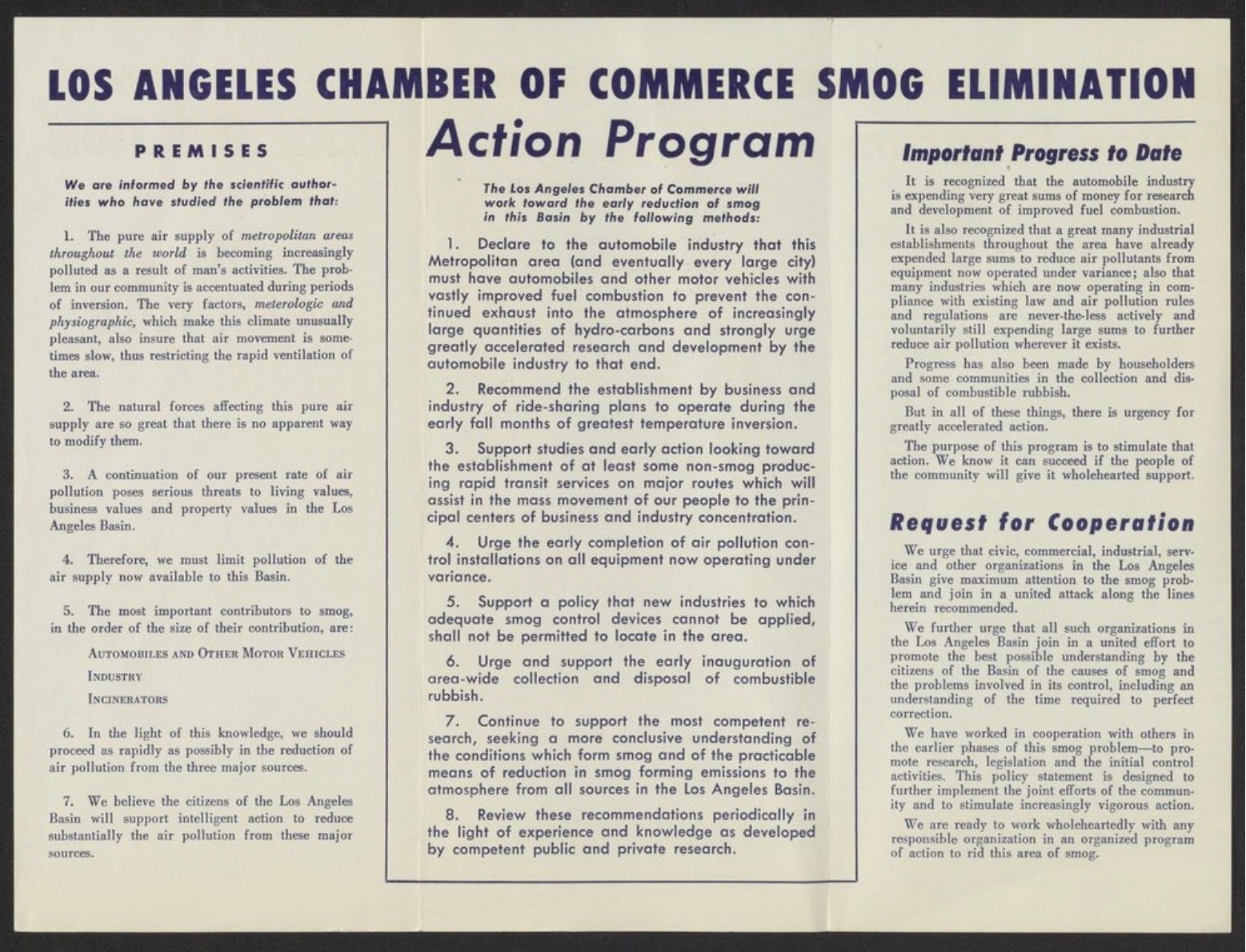
The entire foundation for the Chamber’s Action Plan is stated matter-of-factly right at the beginning: their approach is based upon an understanding of the problem provided by “scientific authorities who have studied the problem.”
This seems so simple, so obvious, that for some your response might be:
“Well, duh.”
Exactly.
Simply put: this is how it should be. It should be as normal and uncontroversial as this document makes it to be. But for those of us involved with addressing climate change, this simple, foundational, affirmation by the Chamber of Commerce is, sadly, amazing.
The document’s first premise is that air pollution “as a result of man’s activities” is not only a problem for LA, but for other big cities around the world. It recognizes that LA’s unique geography and topography might make their smog problem worse, but the real problem is pollution from human activities – something that is a worldwide problem.
Just like opponents to climate action would do in the future, the opponents of smog action — the Oil Industry, SRI, and the automakers after them — would seek to blame a natural cause, LA’s geography and topography, as the real culprit of LA’s unique smog problem.[4]
The Chamber of Commerce was having none of it. While natural factors make it worse, LA’s smog is due to human activities.
Based on the best science available — Haagen-Smit’s work and that sponsored by the Air Pollution Foundation — the Chamber recognized that the top two sources were, (1) vehicles, and (2) industry. Both implicated the Chamber’s members; they were owning up to their own responsibility.
The basic answer is to “reduce substantially the air pollution from these major sources.” To do so, the Chamber called for:
the auto industry to “vastly improve fuel combustion”;
ride-sharing programs and more mass transit;
early completion by industry of air pollution control technology;
a ban on polluting industries for which there are no controls, and;
continued research and development.
So let’s review:
Our response to a pollution problem is to be based on the best science available.
The Chamber rejected the scapegoating of natural causes, forthrightly stating that the problem was pollution from human activities.
The problem is a global one.
It requires urgency.
The Chamber put forward concrete objectives: proper pollution controls, better fuel efficiency/combustion, mass transit, more R&D.
Solving the problem requires cooperation. They extended their hand to any person or organization ready to work together to “rid this area of smog.”
What you have here are the basic ingredients for overcoming climate change.
Beckman’s smog work with the Chamber of Commerce didn’t end in the 1950s. In 1967 he brought this concern into his leadership of the California Chamber of Commerce.[5]
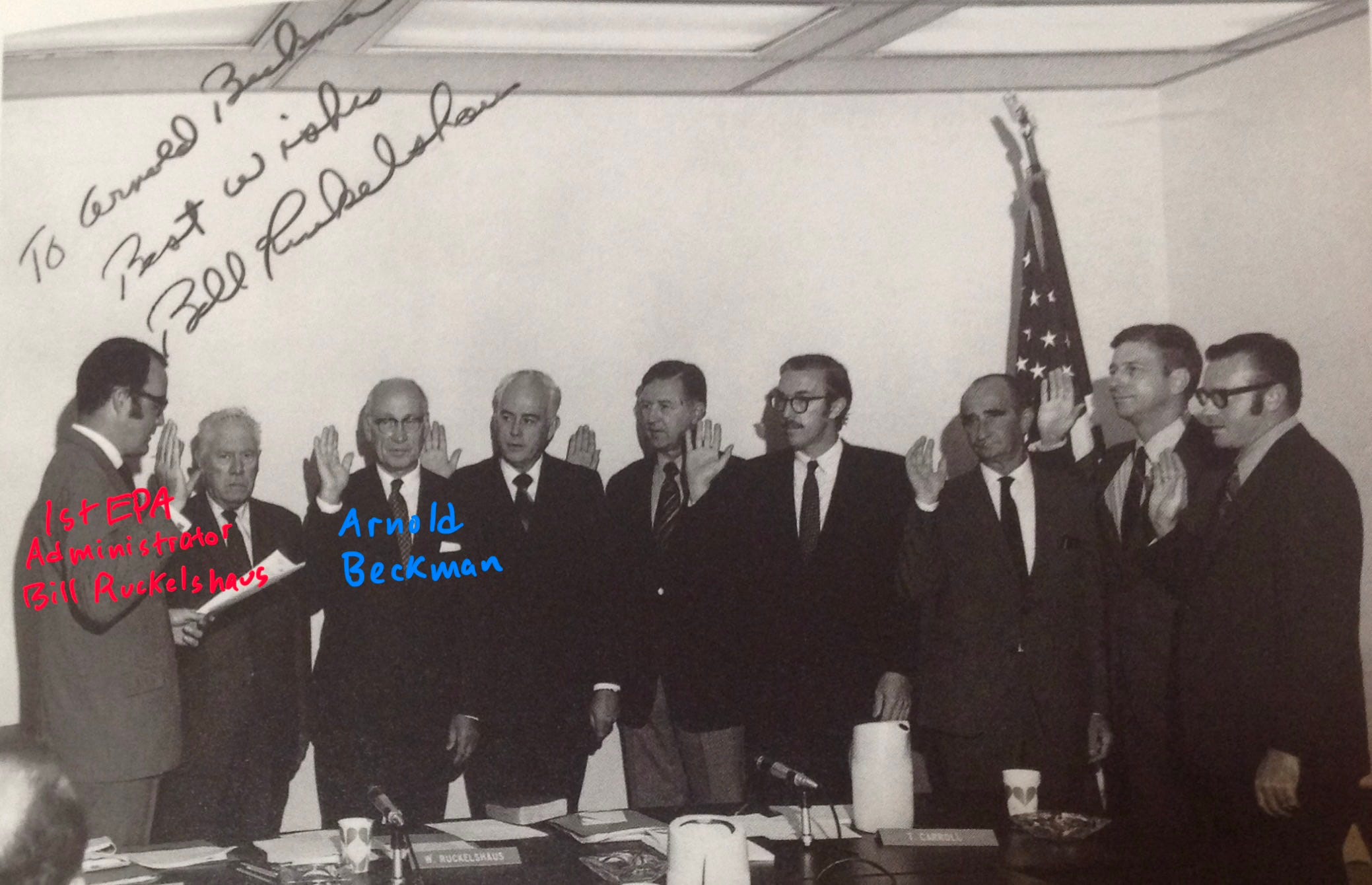
His public service continued also with his appointment by President Nixon to the newly formed Environmental Protection Agency’s Air Quality Advisory Board, on which he served a 4-year term from 1970-74 (see picture, below). This marked nearly 30 years of addressing air pollution as a civic leader.[6]
Tackle Smog With Beckman Instruments
Beckman’s response to smog was not just through public service. When Beckman encountered a problem, his creative mind couldn’t help but go to work on it, especially on what the needs were and how technology could help address them. If no technology yet existed, he would invent it; if one did, he would modify or transform it through innovation – just like he did during his high school years playing piano and organ to provide music for silent movies.
This is exactly what he and his company did when it came to smog: invent and innovate.
In February 1946, the year he became seriously engaged on the issue for the Chamber, he applied for a patent on an instrument that recorded “gas concentrations in the atmosphere.”[7] Keep in mind that this was before California’s law was passed in January 1947, and before Haagen-Smit had his breakthrough in understanding the chemistry of smog in 1948. Yet Beckman already sees the technology that will be needed.
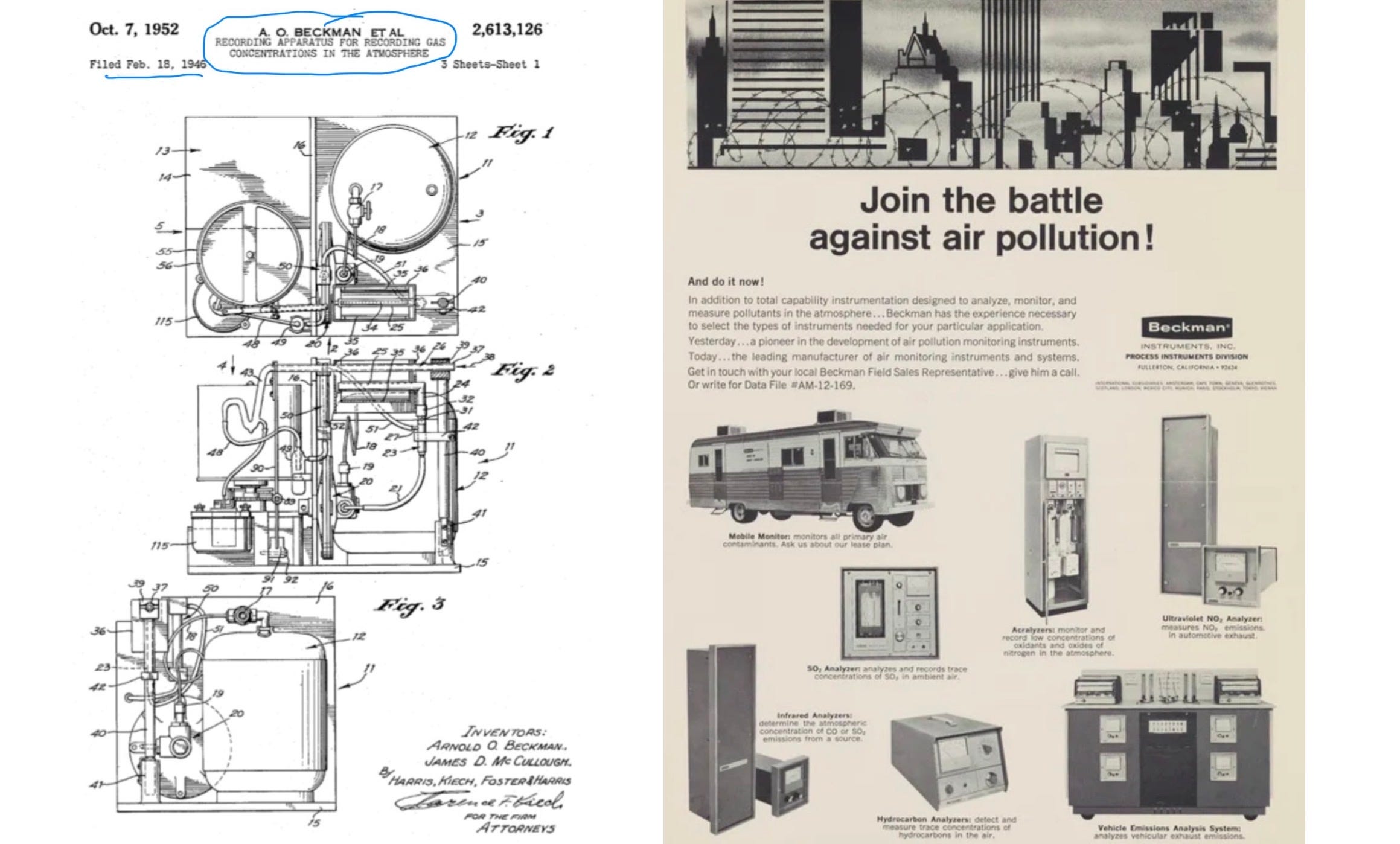
Based on this patent, granted in 1952, Beckman Instruments created an “oxidant recorder” that continuously measured the levels of ozone and nitrogen oxides – smog’s key constituents. From this invention came a host of innovations and products. As Beckman’s biography summarizes:
“There were new specialized instruments for measuring automobile exhaust, both large-scale devices suited for the production lines of automobile manufacturers and smaller instruments suited for testing at local garages and inspection stations. Beckman Instruments also offered highly specialized research instrumentation for use by automotive scientists in their efforts to develop cleaner technologies. The firm eventually even produced ‘air quality monitoring vans,’ customized trucks backed with an array of air pollution-monitoring devices for use by local governments and large industrial enterprises.”[8]
Two final areas of activity round out our story of Dr. Beckman, his politics and his philanthropy.
Political Activities
Arnold Beckman was a lifelong Republican who championed free market principles and believed the poor should not be helped by the government but through charity. “In that little town of Cullom, we had poor. We took care of the poor. We didn’t have hungry people there.”[9] In 1962 he campaigned for Richard Nixon in his losing effort to become Governor. A major lesson Beckman drew from this experience was that fundraising could be greatly improved: “When I saw how money was raised and controlled, I said, ‘This is a horrible way. We as businessmen ought to be able to do a better job of spending our money effectively.’”[10]

As a result, Beckman organized the Lincoln Club of Orange County to help candidates at all levels. “When we found a good candidate, we put money behind his campaign.”[11] This included supporting Ronald Reagan’s successful 1966 gubernatorial bid and Nixon’s election in 1968 to his first term as President. Without the votes he received in Orange County and surrounding areas, Nixon would not have won.[12]
Philanthropy: The Arnold & Mabel Beckman Foundation
Once Dr. Beckman retired from his company he and his wife Mabel effectively began new careers as philanthropists through the Beckman Foundation. Their initial vision was to give nearly all of their wealth away during their lifetimes. But the Beckman’s found that this wasn’t such an easy task. As he remarked, “It is more difficult to give money away than it was to make it.”[13] By the time of Mabel’s death on June 1, 1989, they had donated almost $200 million, which went primarily to the creation of five Beckman institutes/centers for scientific research. But due to the company’s stock doing so well, Dr. Beckman still had about that same amount. After he turned 90, Beckman decided that the foundation “should be recast as a foundation in perpetuity, spending only its income.”[14] The Foundation’s mission was to:
“support leading-edge research in the fields of chemistry and life sciences, broadly interpreted, and particularly to foster the invention of methods, instruments, and material that open up new avenues of research and application in these disciplines and related sciences.”[15]
By the end of his long life, through both direct gifts and the establishment of his foundation, Beckman gave away the vast majority of his wealth, over $400 million.
In recognition of his accomplishments, Dr. Beckman received numerous awards during his lifetime, including the National Medal of Technology (1988), the National Medal of Science (1989), and the Presidential Citizens Medal (1989).
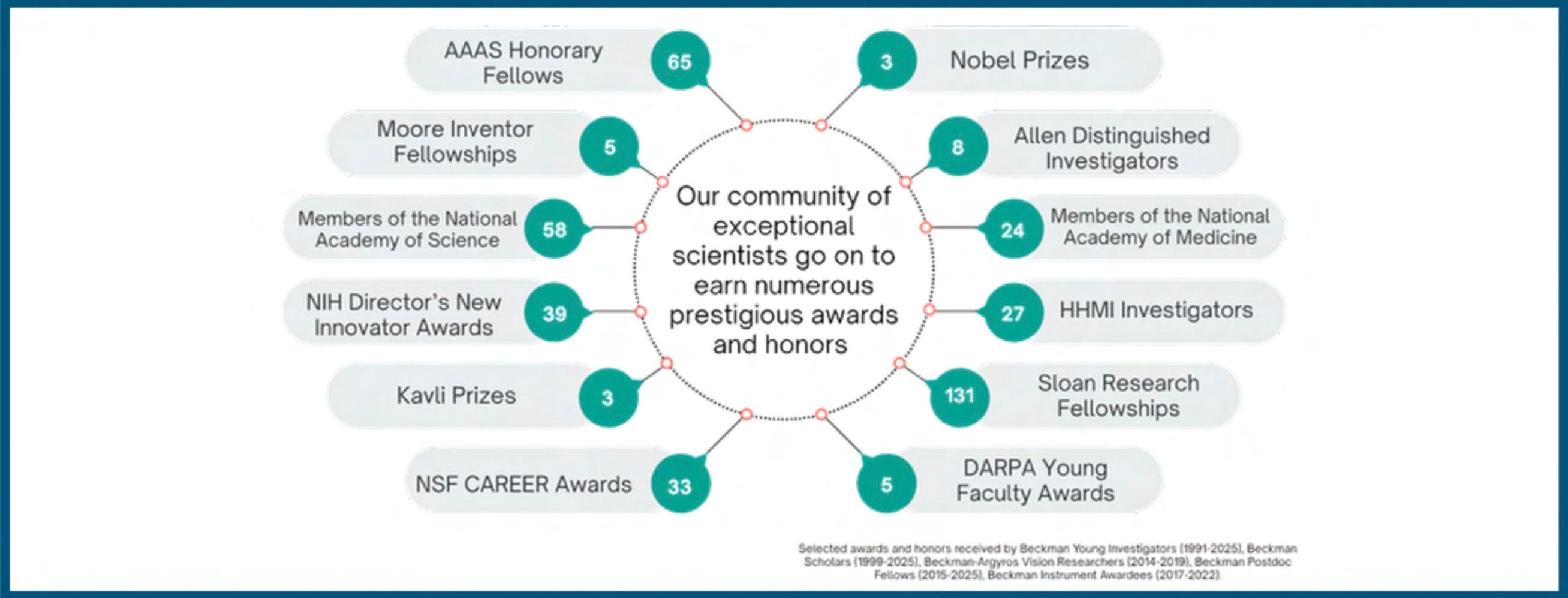
The Beckman Foundation has helped many young scientists who have gone on to receive some of the highest awards in science, including three Nobel Prizes (see below).
A Candidate for Environmental Sainthood? Nyet
Today, some proponents of climate action may be ready to elevate Arnold Beckman to environmental sainthood. But if you are on the center-left of the political/ideological spectrum, your laurels would rest uneasily upon him. You already know some things that would make you uncomfortable, such as his efforts to elect Republicans and his comments on welfare.
Climate Skepticism?
You would be even more uncomfortable with the fact that Dr. Beckman signed the infamous climate skeptic document, the Oregon Petition, which states in part:
There is no convincing scientific evidence that human release of carbon dioxide, methane, or other greenhouse gases is causing or will, in the foreseeable future, cause catastrophic heating of the Earth’s atmosphere and disruption of the Earth’s climate.[16]
It is important to keep in mind that if he signed when the document was first released in 1997 he would have been 97 years old. We don’t know why Dr. Beckman lent his name; indeed, I have found nothing that explains what he thought about climate change (as opposed to Haagen-Smit, who warned about it in 1970).[17] There are numerous reasons he could have signed that have little or nothing to do with climate skepticism; for example, he may not have liked the 1997 Kyoto Protocol, which was the reason for the Oregon Petition.
Or he may have thought it was actually from the National Academy of Sciences (NAS). Many older members like Dr. Beckman were confused about this, given that it was formatted to look like an NAS document and came from a former president of the NAS, whom Beckman probably knew.[18]
I have no doubt that the Dr. Beckman who tackled smog in the 1940s-1950s, and then later became a member of NAS, would have accepted the conclusions of the Academy’s 2001 report confirming the climate threat and humanity’s role.
Be that as it may, the fact remains that he signed one of the most infamous of all climate skeptic documents.
Sounding Like an Oil Exec, But Acting Like a Champion
Aside from this, you also wouldn’t be so comfortable with parts of his smog story.
If you lined up some of the things Dr. Beckman said and compare them to spokesmen from the Oil Industry or SRI they would actually sound very similar. As a businessman and a conservative Republican, he is very much a part of their world.[19]
For example, in an extensive oral history interview for Caltech in 1978, Dr. Beckman reflected on the smog fight.
“Oh, you have no idea how emotionally charged people were. Everybody knew it was sulfur. We had preachers out here mentioning the sulfurous fumes in Hades and referring to the Bible … It was unbelievable … So I said, ‘Let’s analyze the air.’”[20]
And:
“We’ve wasted hundreds of millions of dollars needlessly [to reduce sulfur dioxide]. But that’s what you get when emotionally charged people don’t take the time to find out the facts. So that’s how I got interested in air pollution.”[21]
And:
“I was involved on the legal business side, because I wanted to make sure that we didn’t go off half-cocked and get a lot of well-meaning but uninformed people just creating chaos unnecessarily.”[22]
Now lets compare them to quotes from senior executives of the Oil Industry.
In his peer-reviewed recounting of their research to date, Vance Jenkins, the head of the API’s Smoke and Fumes Committee, had a section labeled “Panicky People,” where he stated:
“The worst thing that can happen, in many instances, is the hasty passage of a law or laws for the control of a given air pollution situation. For in many such cases their passage results from a panicky feeling …”[23]
Concerning pollution, he went on to say:
“unless the matter is viewed calmly and logically and appropriate measures devised to alleviate these situations, a great deal more economic loss and inconvenience is liable ...”[24]
And finally:
“accurate knowledge on a subject must be available before accurate decisions can be made. … accurate information instead of theories and hypotheses … the passage of unnecessary legislation may be prevented thereby, at a great saving of time and expense, both to legislative and enforcement agencies and to industry. … a law designed to improve air pollution might have a reverse effect if not properly and wisely drawn.”[25]
Based on the rush to judgement by those who blamed sulfur dioxide for LA’s smog, and the efforts subsequently required of industry to reduce SO2, Mr. Jenkins’ words ring true.
One might consider Mr. Jenkins’ stance to be a reasonable one until we remember that behind the scenes, as I recounted earlier, he tried to get a young scientist, Harold Johnston, to knee-cap Dr. Haagen-Smit’s reputation. Furthermore, the SO2 mistake by advocates of action allows Jenkins the opportunity to use this against Haagen-Smit’s explanation and put Haagen-Smit and his allies into the same rush-to-judgement camp.
As Jenkins puts it about the policy ramifications of Haagen-Smit’s findings:
“much more money may be spent unnecessarily by the petroleum industry if certain proposed rules and regulations for the control of the emission to the air of certain substances which may play no part in smog formation are put into effect.”[26]
So whether it fits or doesn’t fit, the same rhetorical playbook is deployed.
In 1958, at least three years after the scientific debate on smog was over, Jenkins’ successor, Charles Jones, was still pounding away on this same argument:
“should legislation be regarded as necessary in some instances, fundamental knowledge based on reliable research rather than on theory or hypothesis should be available to government organizations to avert restrictive and uneconomic rulings of the type that had proved unnecessary in the past.”[27]
As we have seen, Dr. Beckman, too, was highly critical of the rush to judgement on SO2. He certainly agreed that not every problem should be solved with legislation. When it is required it should be based on sound science, meaning the facts and an interpretation informed by those facts. Not doing so can lead to solutions that may not solve the problem. So in all of this Dr. Beckman’s words and the overall approach they represent are quite similar to the rhetoric and arguments of the Oil Industry representatives.
Let’s recap the language used:
Beckman: “wasted hundreds of millions of dollars” … “emotionally charged people” … “go off half-cocked” … “creating chaos” … “find out the facts.”
Oil Execs: “Panicky People” … [the problem must be ] “viewed calmly and logically” … “accurate knowledge … accurate decisions” … “fundamental knowledge based on reliable research”… “unnecessary legislation.” …
Given all of this, how is it that a conservative Republican businessman like Dr. Beckman became a champion of action on smog?
The crucial difference is that Dr. Beckman genuinely wanted to find what was causing the problem and then do something about it.
As I quoted Part One, for Dr. Beckman one must have intellectual integrity and base your actions on the truth, not on what you wish the truth to be.[28] As he proudly said about his companies: “We’ve never had anybody point the finger at us and say, ‘Hey, you were dishonest, you didn’t tell us the whole story.’”[29]
The Oil Executives, aided and abetted by their scientific allies at SRI, used science to slow things to a crawl, to deny and delay – a favorite tactic of polluting interests before and since.[30]
Dr. Beckman used science to get things right, to find the facts and act upon them, to have intellectual integrity.
But what about those on the other side? Many of their statements sound like what scientists of their time would say. Such statements reflect the inherent conservatism of scientific skepticism, which pushes for strong validation of any scientific or factual claims.
These Oil Industry representatives cloak themselves in the language of rationality and science, but underneath we find men who will do what it takes to defend the financial well-being of their industry. They see themselves as good people, who want to be “good neighbors,” as this quote from Vance Jenkins demonstrates:
“the petroleum industry is managed by men who want to be good neighbors, by men who will go more than half way in cooperating with enforcement agencies in order to be good neighbors, even when the laws under which they operate are not believed to be wisely drawn.”[31]
And yet their implementation of The Denier’s Playbook against Dr. Haagen-Smit, as Vance Jenkins did, shows this attempt to see themselves as a “good neighbor” was a form of self-delusion that actually allowed them to continue harming people in defense of their industry, their tribe.

When it came to smog, Beckman the scientist never let Beckman the businessman manipulate the facts or forestall the actions those facts required. He was crafty for good, whereas the Oil execs and SRI were crafty for bad.
Beckman = Crafty for Good.
Oil execs & SRI = Crafty for Bad.
He led the Chamber of Commerce to fight for smog action, telling them in his presidential address that “the Chamber is battling for the community as a whole, and it will carry on its fight without bias, prejudice, or fear.”
If today a large local Chamber of Commerce were to have a climate program like Beckman’s smog program it would blow our frikkin’ minds.
In our next post, we’ll compare the smog and climate fights. Stay tuned!
If you are new here, check out our Intro Series, as well as other posts in the Our Story Together Series. If you like this post, please “like,” comment, and share. And thanks for all you’re doing.
[1]Thackray and Myers, One Hundred Years of Excellence, p. 226.
[2] Thackray and Myers, One Hundred Years of Excellence, p. 227.
[3] Elkind, How Local Politics Shape Federal Policy, p. 52.
[4] Krier and Ursin in Pollution and Policy point out that as late as 1960 the auto industry kept touting the idea that LA’s geography/topography made its pollution problem unique, even though many studies had already shown otherwise. In testimony before a congressional subcommittee, a representative of the Automobile Manufacturers Association stated: “‘The popular term ‘Los Angeles smog’ … has sound origin, because photochemical smog is … not likely to occur anywhere else on earth with the frequency and intensity found in this area’” (p. 89) Krier and Ursin found this statement “surprising,” given the evidence of smog being a problem elsewhere. But there is a rhetorical sleight of hand going on here. While I’m guessing that the statement is technically true, it leads to a false impression. LA probably did have the worst problem in the world given its “frequency and intensity.” But that doesn’t mean that other places wouldn’t benefit from the improvements needed to address the LA situation. See pp. 90-92 for documentation of smog’s growing problem across the nation before 1960.
[5] Thackray and Myers, One Hundred Years of Excellence, p. 228.
[6] Thackray and Myers, One Hundred Years of Excellence, pp. 228, 281.
[7] Go here to see the patent documentation, and Thackray and Myers, One Hundred Years of Excellence, p. 224. See also p. 369, for a list of Beckman’s 14 patents.
[8] Thackray and Myers, One Hundred Years of Excellence, p. 224.
[9] Thackray and Myers, One Hundred Years of Excellence,, p. 292.
[10] Thackray and Myers, One Hundred Years of Excellence,, p. 293
[11] Thackray and Myers, One Hundred Years of Excellence,, p. 294.
[12] Thackray and Myers, One Hundred Years of Excellence,, pp. 294-295; “Arnold O. Beckman,” interview by Terrall, pp. 48-49.
[13] Thackray and Myers, One Hundred Years of Excellence,, p. 313.
[14] Thackray and Myers, One Hundred Years of Excellence, p. 355.
[15] Thackray and Myers, One Hundred Years of Excellence,, p. 355.
[16] Here is the full text of the Oregon Petition:
“We urge the United States government to reject the global warming agreement that was written in Kyoto, Japan in December, 1997, and any other similar proposals. The proposed limits on greenhouse gases would harm the environment, hinder the advance of science and technology, and damage the health and welfare of mankind.
There is no convincing scientific evidence that human release of carbon dioxide, methane, or other greenhouse gases is causing or will, in the foreseeable future, cause catastrophic heating of the Earth’s atmosphere and disruption of the Earth’s climate. Moreover, there is substantial scientific evidence that increases in atmospheric carbon dioxide produce many beneficial effects upon the natural plant and animal environments of the Earth.”
[17] Arie Jan Haagen-Smit, “Man and His Home,” the B. Y. Morrison Memorial Lecture presented to the Annual Meeting of the American Society of Landscape Architects, Williamsburg, Virginia, April 28, 1970: “This century has taught us that our space ship is not at all so big and that we have finally succeeded in changing, on a global scale, the composition of our atmosphere and the water of the oceans. The rapid burning of fossil fuel in the last fifty years has raised the concentration of carbon dioxide in the air substantially, and this, together with particulate matter from our industrial operations, will affect the heat balance of the earth.”
[18] Another reason Dr. Beckman could have signed is that he may have been swayed by an endorsement letter by Frederick Seitz, former President of the National Academy of Sciences and Rockefeller University. It is highly likely that they knew one another. Both have connections to the University of Illinois-Urbana, and Beckman served on the Council of the National Academy of Sciences while Seitz was president. In addition, an accompanying briefing document was formatted to look like a NAS journal article; so much confusion arose, especially with their older members, that the NAS had to issue a statement saying they had nothing to do with the Oregon Petition.
[19] This affinity of scientists with business and industry was very much the norm during Dr. Beckman’s formative years. According to historian Scott Hamilton Dewey, “most of the scientific expertise in the prewar days was controlled or influenced by private, corporate industrial interests …” Don’t Breathe the Air, p. 9. This is also reflected in SRI’s mission statement, referenced earlier.
[20] “Arnold O. Beckman,” interview by Terrall, p. 60.
[21]“Arnold O. Beckman,” interview by Terrall, p. 63.
[22]“Arnold O. Beckman,” interview by Terrall, pp. 61-62. These quotes lend credence to the description of his biographers that Beckman was a “conservative rationalist” or a “techno-scientific-conservative” See Thackray and Myers, One Hundred Years of Excellence, p. 292.
[23] Jenkins, “The Petroleum Industry Sponsors Air Pollution Research,” p. 145.
[24] Jenkins, “The Petroleum Industry Sponsors Air Pollution Research,” p. 145.
[25] Jenkins, “The Petroleum Industry Sponsors Air Pollution Research,” p. 148.
[26] Jenkins, “The Petroleum Industry Sponsors Air Pollution Research,” p. 147.
[27] Charles A. Jones “A Review of the Air Pollution Research Program of the Smoke and Fumes Committee of the American Petroleum Institute,” Journal of the Air Pollution Control Association, Vol. 8.3 (1958): p. 268.
[28] Thackray and Myers, One Hundred Years of Excellence, p. 64.
[29]“Arnold O. Beckman,” interview by Terrall, p. 41.
[30] As Dewey states: “studies finding only the need for further study became a standard part of the history of air pollution control in America at the local, state, and federal levels. After some point, there is no doubt that many such thorough, detailed studies were used deliberately to prevent or delay control efforts until public agitation died down, while allowing major polluters to show apparent good citizenship.” See Dewey, Don’t Breathe the Air, p. 30. Stradling provides an excellent example in Chicago. In 1909 when a campaign to have locomotives use electricity instead of coal to reduce local pollution was at its height, the Chicago Association of Commerce conducted a major study, which recommended electrification immediately. Crucially, however, they only shared their findings privately with railroad officials. “With significant railroad influence, the association chose to ignore its own study and initiate a new, thorough analysis, to be funded by railroad money.” In March 1911 they organized a new committee with significant railroad membership. It took four years to complete the new study. During this time, women’s groups lobbied the mayor, but he put them off saying he would wait until the committee “‘finished its scientific investigation of the smoke question.’” The committee concluded that “electrification to reduce smoke was neither advisable nor practicable.” (Stradling, Smokestacks and Progressives, pp. 125-129.) As I have demonstrated, the Oil Industry’s research on smog, including that done by SRI, fits this delay tactic exactly. Historian Samuel Hays adds an important qualifier. Many scientists naturally strive for more and more certainty. This tendency can be exploited by polluting interests who seek delay: “Industry leaders … sought to reinforce those scientists who in their own professional and personal commitments insisted on high levels of proof of harm. They brought to legislative and administrative hearings and court testimony scientists who argued that more proof was needed. They attacked the margins of safety as requiring an inordinate degree of protection … There was a constant tendency for scientists to think of themselves as reliable only if they refrained from drawing conclusions short of firm proof. Hence they were susceptible to these challenges from industry.” See Samuel P. Hays, Beauty, Health, and Permanence: Environmental Politics in the United States, 1955-1985 (Cambridge: Cambridge University Press, 1987): p. 360.
[31] Jenkins, “The Petroleum Industry Sponsors Air Pollution Research,” p. 149. The example of Bill Stewart, referenced in an earlier post, reminds us not to slip into a Manichaean dualism of black hats and white hats when it comes to the individuals within the Oil Industry and those fighting to reduce pollution; there are well-meaning people within the Oil Industry, just as there are all types of motives in the hearts of those seeking to reduce pollution. (To quote Stewart again: “If we tackle this air-pollution problem as it should be tackled; if we accept our moral responsibilities … I am satisfied we shall gain the everlasting respect and gratitude of the people. … To me, it is also smart to be leaders, to be good neighbors, to play fair, to practice the golden rule; but, above all, to be the sort of Americans we should like America to be made up of.” See W. L. Stewart, Jr., “Laws, Morals, and Manners,” Addresses Delivered at Sixteenth Mid-Year Meeting, Division of Refining, Tulsa, Okla., April 30 to May 3, 1951, American Petroleum Institute: New York: p. 13.) A realistic understanding of human nature can keep us grounded. It also reminds us that well-meaning individuals can find themselves swimming against the tide of their group/organization/industry. Reinhold Niebuhr sees this as “one of the tragedies of the human spirit: its inability to conform its collective life to its individual ideals. As individuals, men believe that they ought to love and serve each other and establish justice between each other. As racial economic and national groups they take for themselves, whatever their power can command.” See Moral Man and Immoral Society (New York: Scribners: 1932): p. 9.