

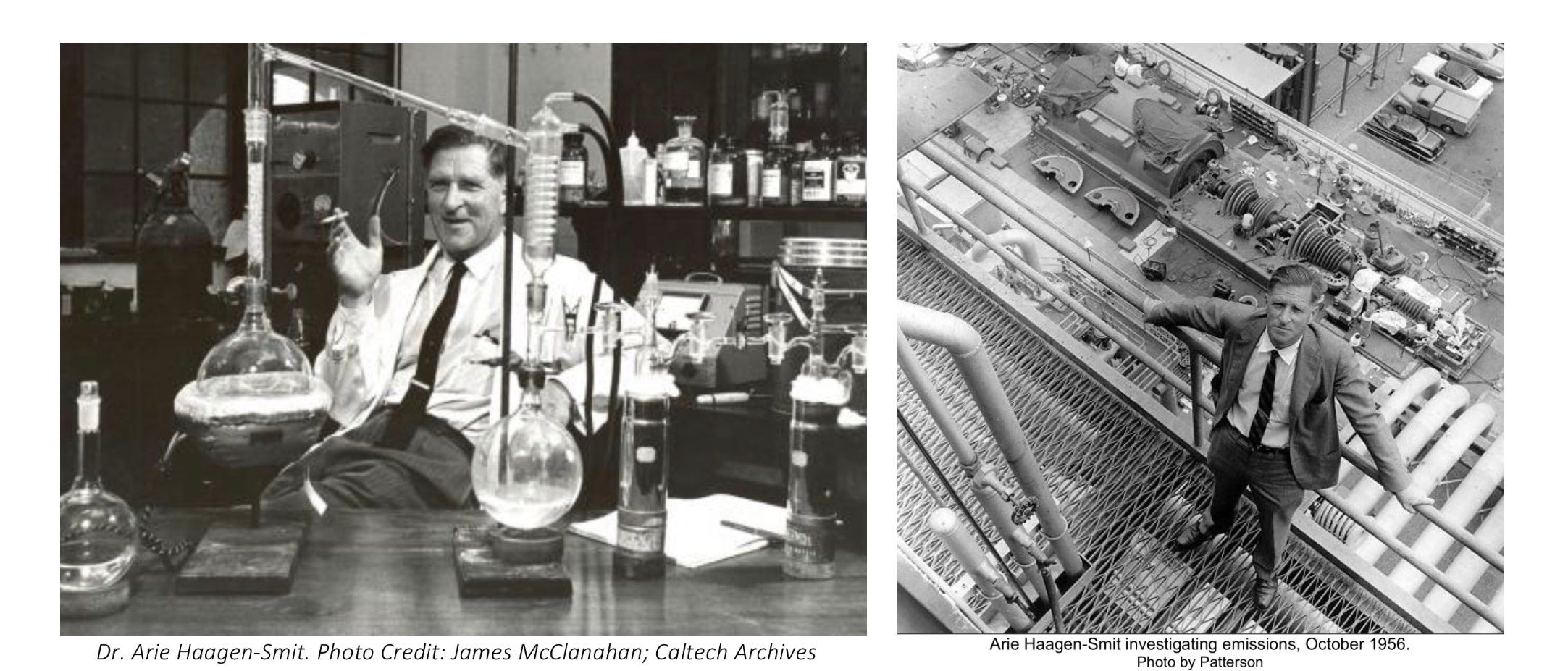
“Well I won’t back down. No I won’t back down. You could stand me up at the gates of hell, but I won’t back down.” — Tom Petty
As I discussed in my earlier post in this Smog-Climate Subseries, when the people of Los Angeles and its business and political leaders finally began to get serious about smog they had two basic problems: (1) no government had proper jurisdiction, and; (2) no one knew what made up smog or how it was created.
On June 10, 1947, California passed a law giving counties the authority to create Air Pollution Control Districts with enforcement powers. This was a major turning point. By October 1947 the LA Air Pollution Control District or APCD was up and running. With a budget of $178,000 and a staff of 47, it quickly became the best funded and staffed air pollution agency in the country.1
What Is LA Smog? Beckman & Haagen-Smit to the Rescue
But the second problem still hung over the effort. What exactly was LA smog? What made it up? How was it created? Who was responsible?
Incredibly, no one really knew – even though they thought they did. Just about everyone assumed it was the same smog that occurred in heavily industrialized areas of the East and Midwest. Experts from Pittsburgh and St. Louis were brought in to explain what smog was; sulphur dioxide was the culprit, they said, because that was true for those areas.
With the public clamoring for action, the first head of the new LA Air Pollution Control District, Louis McCabe, Ph.D., a former Army officer and an engineer by training, began negotiating with industry to reduce SO2. One of his key connections to the larger business community was Dr. Arnold Beckman, a longstanding member of the LA Chamber of Commerce and its designated smog point person since 1946.
The smog problem was not new to the LA Chamber. They had been working with local officials since 1944 out of a concern that a patchwork of local policies would unfairly target some areas and not others, leading to business costs that wouldn’t solve the problem and a frustrated public egged on by a “hysterical movement” (i.e., the activists) demanding even more be done. The Chamber sponsored research, encouraged its members to reduce pollution voluntarily, especially by increasing efficiency of equipment, and worked closely with elected officials to keep any needed policies as business-friendly as possible. This included providing draft ordinances put forward by local officials.2
In contrast to the Oil Industry, the Chamber was not running what I call The Denier’s Playbook. They had the entire economy and its diverse business interests to consider, and pollution was becoming a real problem for certain sectors. And so the Chamber found itself in the middle of the smog fight in more ways than one.
A group particularly hard hit were farmers, who had deluged the Chamber with concerns about unusual crop damage, which began showing up as early as 1944. They were losing about $250,000 a week when smog was bad, and eventually 10 types of vegetables would be eradicated from the area due to smog.3 In 1946 as the public became more and more aroused, and farmers and their own members were looking for answers, the Chamber turned to the Chair of its scientific committee, Arnold Beckman, for leadership.4
Inventor of scientific instruments and creator of his own company that sold such instruments, and former chemistry professor at Cal Tech, Beckman was perfectly situated to be the Chamber’s point person on smog.5 In this capacity he served as liaison to policymakers and civil servants like McCabe. An added bonus – Beckman and McCabe already knew each other, both having received degrees from the University of Illinois.6 Beckman so impressed McCabe and the Air Pollution Control District’s leadership that he was hired on as a scientific consultant (1948-52).7
As a chemist Beckman knew sulfur dioxide (SO2) when he smelled it, which has a distinctive odor even in small amounts. He was convinced the problem was not SO2, and that McCabe’s program would cost business plenty and not solve the problem. So he told McCabe flat out:
“Lou, for the love of Pete, you don’t have sulfur dioxide in the air. … Before you spend millions of dollars putting in recovery or replacement plants, you’d better find out what’s in the air.”8
“There’s no time for research,” McCabe replied hastily.9 But he eventually agreed to let Beckman pursue the matter, even as he moved forward on regulating SO2.
A seasoned microchemist was required, and Beckman knew where to find one: his former Cal Tech colleague, Arie Haagen-Smit.
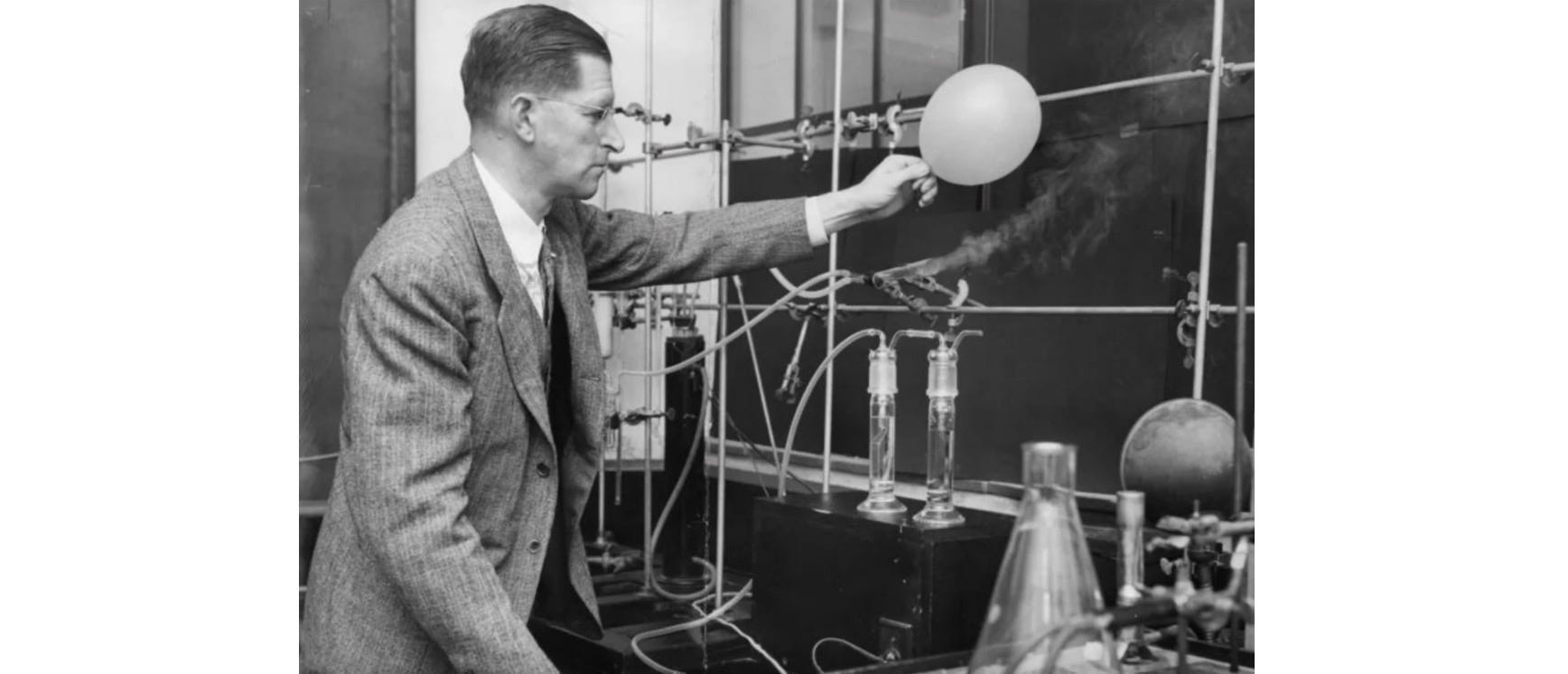
And so it was the Chamber’s point man, recently appointed as the regulatory agency’s scientific consultant, who launched Haagen-Smit’s career fighting smog.
It turns out that Haagen-Smit, his own scientific curiosity piqued one especially smoggy day in 1946, had already done a little poking around himself with his own equipment and techniques. He had begun to suspect that a major culprit was ozone.
One of the strange things happening in LA at the time provided a clue: tire manufacturers were reporting that rubber was cracking much faster than elsewhere. To begin to solve this mystery, Haagen-Smit and a friend, Dr. Charles Bradley, a retired chemical director from Uniroyal,10 began some very simple experiments exposing rubber tubing to various mixtures of polluted air. The more ozone there was, the quicker the rubber tubing cracked.11
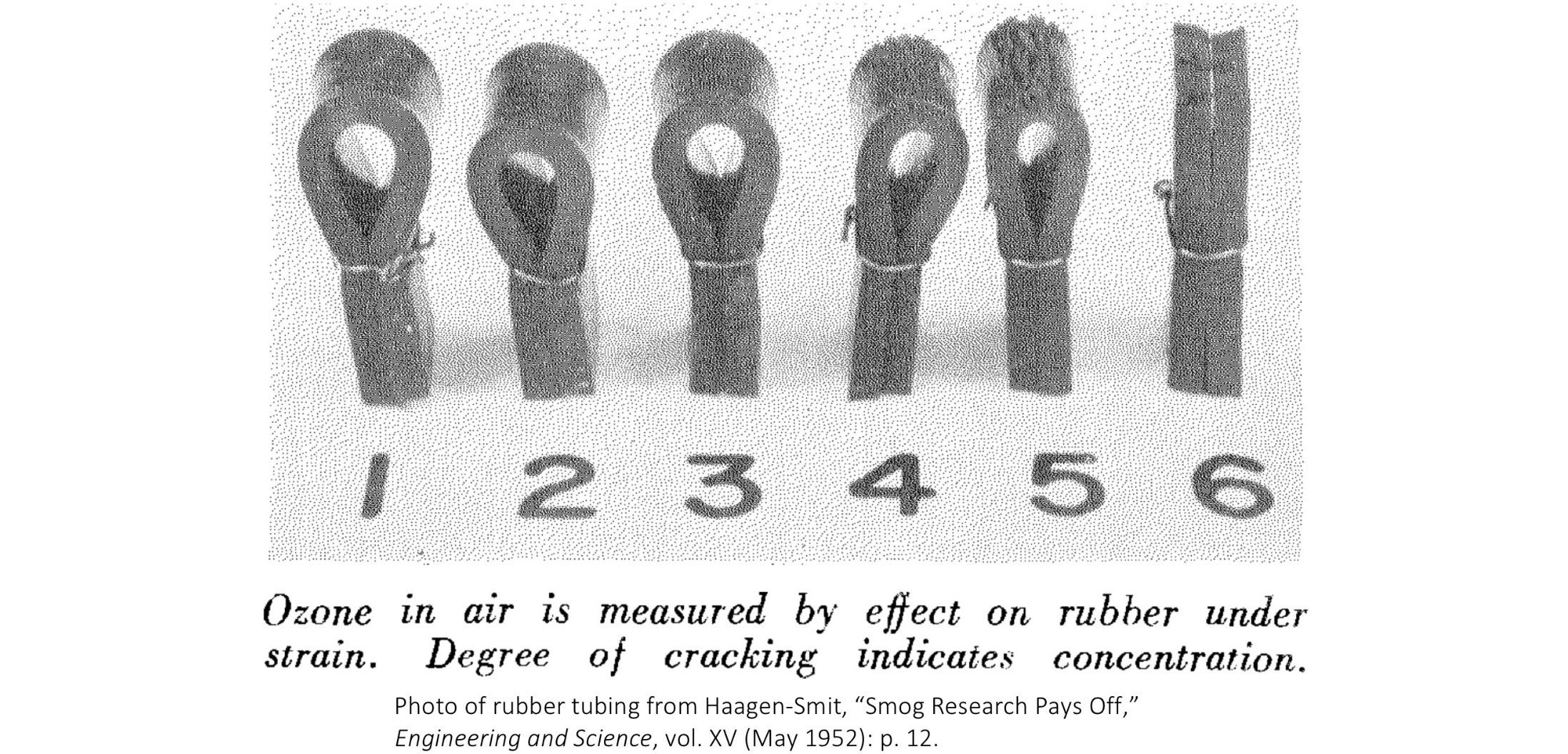
And so due to his own curiosity Haagen-Smit had begun to unravel the mystery of LA’s version of smog even before he was approached by Beckman.12
Curiosity is the driving force behind scientific discovery, and Dr. Haagen-Smit was first and foremost a scientist. Like Beckman, he was also a member of the LA Chamber of Commerce. In contrast to the activist types, he remained dubious of the respiratory health impacts of smog and died of lung cancer after a lifetime of smoking. His pathbreaking scientific articles on smog listed “crop damage, eye irritation, haze, smell” as the problems arising from it.13 Even years later he still had a blind spot when it came to the health effects. “Smog is an aesthetic and economic nuisance.” People shouldn’t “believe stories that death in the form of smog stalks the streets of Los Angeles.”14
With Beckman’s request Haagen-Smit was asked, basically, to do scientific pro-bono work. So between classes and his other projects, and utilizing his pineapple study equipment and techniques, in fairly short order Haagen-Smit discovered the basic ingredients of LA’s version of smog – and SO2 was not one of them.
While he didn’t have a complete understanding of how these basic ingredients became smog, he felt the results of his initial experiments were sufficient to begin to address the problem by reducing the pollutants that came together to produce it. He reported his results to Beckman in the latter’s capacity as scientific advisor to the Air Pollution Control District, which released the findings to the public.15. Haagen-Smit told Beckman he would be getting back to his real research.
Smog? Check. Done. Now back to the pineapples.
Ah, not quite.
Unfortunately for Dr. Haagen-Smit, his early volunteer work on smog would end up in the “no good deed goes unpunished” category, at least in these early years. The Oil Industry and SRI didn’t like his results. Up until Haagen-Smit came on the scene, SRI was the only real voice speaking with the appearance of scientific authority. He couldn’t go unchallenged.
And so in what would turn out to be a major turning point in our nation’s history of addressing pollution, Abe Zarem, the head of SRI’s LA office, gave a talk at Cal Tech where he attempted to discredit Haagen-Smit. Zarem, a brash 31 year old with a Ph.D. in electrical engineering from Cal Tech, was a rising star who the next year would be recognized nationally by the Chamber of Commerce as one of “America’s Ten Outstanding Young Men.” He would go on to a distinguished career and be elected to the National Academy of Engineering.16
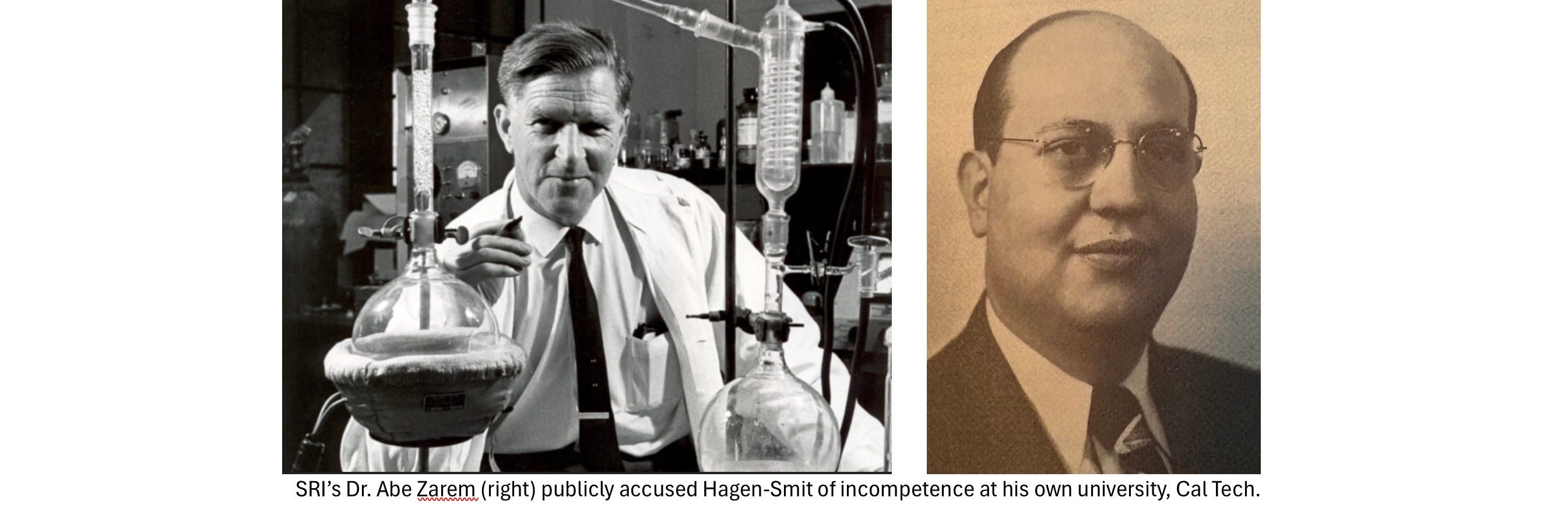
But on this day, nurtured as he was by SRI’s symbiotic relationship with their Oil Industry compatriots, he was suffused with misguided purpose as he participated in operationalizing The Denier’s Playbook against Haagen-Smit.
Beckman had invited Haagen-Smit to join him in hearing Zarem, and they sat together. As Beckman described it, Zarem asserted that Haggen-Smit’s theory was not consistent with what SRI had found. He thought it sad that Haagen-Smit would make such a serious mistake.17
In other words, at his home institution, in front of his colleagues and students, SRI’s man said Haagen-Smit didn’t know what he was talking about in an area utilizing Haagen-Smit’s expertise.
Thus, when it came to operationalizing The Denier’s Playbook, Zarem fulfilled Steps One and Two:
Hire scientific consultants (i.e. SRI) to do research, propose theories friendly to the Industry’s interests, and help proclaim the message of denial.
Attack and discredit legitimate scientists.
Haagen-Smit was furious. This former boxer, horse-piss tester, and pineapple flavor expert was the wrong guy to pick a fight with.
“‘I’ll show them who’s right and who’s wrong,’ he muttered as we left the room’” Beckman recounted.18
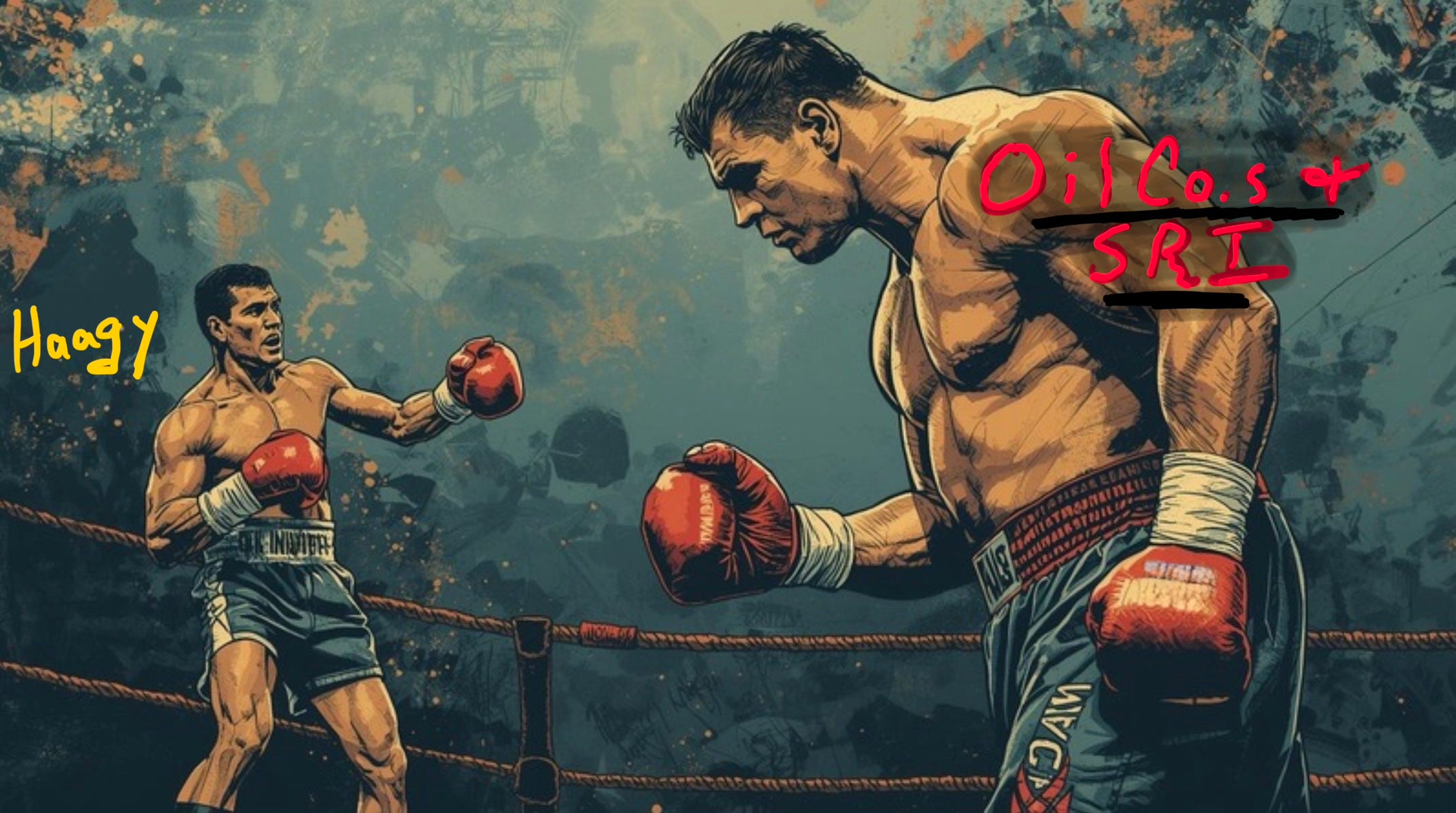
Thus began a feud between the Oil companies, SRI and Haagen-Smit that would last for years and linger for decades, even after Haagen-Smit’s death.19
Instead of returning to his pineapples, Haagen-Smit took a leave of absence from Cal Tech and devoted over a year to the study of smog. Steps were taken in March 1949 by the Air Pollution Control District to hire him as a consultant and they set him up in a lab a few months later.
Haagen-Smit Cracks the Smog Case
Beginning in the fall of 1949 Haagen-Smit teamed up with scientists from the University of California-Riverside who had been studying the damage crops were experiencing. It was during this time that Haagen-Smit’s personal breakthrough occurred in understanding the basic chemistry of smog formation.
Earlier when he had condensed down LA’s smoggy air he found oily organic substances, partially oxidized hydrocarbons from petroleum. He guessed that these hydrocarbons were being oxidized by ozone. When he exposed smog-sensitive plants to such a mixture they showed the same damage as those exposed to LA’s smoggy air. But where was the ozone coming from?
“Now Haagen-Smit remembered reading that organic material could be oxidized by air if initiation by light and nitrogen dioxide were provided. He tried such a system and found it to be successful in producing smog symptoms.”20
And so it all fell into place. As Beckman puts it:
“He painstakingly delineated the photochemical process by which organic materials in the air—mostly hydrocarbons—are oxidized through the combined actions of oxides of nitrogen and sunlight to become smog.”21
Understanding it is one thing. Convincing others is another. As we will see in our next post in this Subseries, it would take five years and a bruising battle with the Oil Industry and SRI before Haagen-Smit’s answers to the questions “What is LA smog and how is it created?” would carry the day.
Haagen-Smit’s courage and tenacity in standing up to the fossils and their flacks are the kind we need to have the staying power necessary to overcome climate change by creating a just and prosperous sustainability that enhances wellbeing for everyone and everything. Like Haagen-Smit, we have the truth, and the truth still matters. We must be steadfast on all of our Olympian Fields of Action until victory is ours. Join us!
If you are new here, check out our Intro Series, and other posts in the Our Story Together Series. If you like this post, please “like,” comment, and share. And thanks for all you’re doing.
Scott Hamilton Dewey, Don’t Breath the Air: Air Pollution and U.S. Environmental Politics, 1945-1970, Texas A&M University Press (College Station, 2000): p. 44.
Sarah S. Elkind, How Local Politics Shape Federal Policy: Business, Power, and the Environment in Twentieth-Century Los Angeles (University of North Carolina Press: Chapel Hill, 2011): pp. 59-63.
Chip Jacobs and William J. Kelly, Smogtown: The Lung-Burning History of Pollution in Los Angeles, Overlook Press (NY: 2008), pp. 50-51.
Arnold Thackray and Minor Myers, Jr., Arnold O. Beckman: One Hundred Years of Excellence (Philadelphia: Chemical Heritage Foundation, 2000): p. 220.
Thackray and Myers, One Hundred Years of Excellence, p. 220.
Thackray and Myers, One Hundred Years of Excellence, p. 220.
Thackray and Myers, One Hundred Years of Excellence, p. 220.
Thackray and Myers, One Hundred Years of Excellence, p. 222.
See “Zus (Maria) Haagen-Smit,” quoting Beckman in interview by Shirley K. Cohen, Archives, California Institute of Technology, Pasadena (March 16 and 20, 2000): p. 24.
Dr. Charles Bradley “was the retired head of chemical research for the United States Rubber Company and the first professional chemist ever employed in the rubber industry in the United States.” See James Bonner, Arie Jan Haagen-Smit 1900-1977: A Biographical Memoir (Washington, DC: National Academy of Sciences, 1989): p. 197.
A. J. Haagen-Smit, “The Air Pollution Problem in Los Angeles,” Engineering and Science (Dec. 1950): p. 13; James Bonner, “Arie Haagen-Smit: 1900-1977,” Engineering and Science (1977): pp. 28-29. (Ok, just wondering if human conception spikes on high ozone days due to cracking rubbers.)
Engineering and Science, “Arie Jan Haagen-Smit: Caltech’s Crusader for Clean Air,” (Feb. 1969): p. 21; Thackray and Myers, One Hundred Years of Excellence, p. 222; James N. Pitts, Jr. and Edgar R. Stephens, “Arie Jan Haagen-Smit: 1900-1977,” Journal of the Air Pollution Control Association, vol. 28 no. 5 (May 1978): p. 516; Jacobs and Kelly, Smogtown, p. 74.
A. J. Haagen-Smit, “Smog Research Pays Off,” Engineering and Science, vol. XV (May 1952): p. 14.
Jacobs and Kelly, Smogtown, p. 73.
Jacobs and Kelly, Smogtown, p. 73.
Thackray and Myers, One Hundred Years of Excellence, p. 223; “Zus (Maria) Haagen-Smit,” interview by Cohen, p. 25; “Arnold O. Beckman,” interview by Terrall, p. 61.
“Zus (Maria) Haagen-Smit,” interview by Cohen, Zus quoting Beckman, p. 25.
For example, SRI’s own published history of its first 50 years would include no mention of Haagen-Smit’s pivotal role in its own recounting of SRI’s smog work, as if Haagen-Smit didn’t exist. See Donald L. Nielson, A Heritage of Innovation: SRI’s First Half Century (SRI International: Menlo Park, 2006), pp. 9-18 - 9-20.
James N. Pitts, Jr. and Edgar R. Stephens, “Arie Jan Haagen-Smit: 1900-1977,” Journal of the Air Pollution Control Association (1978): p. 516. Haagen-Smit himself provides a nice description of how smog is created in “Smog Control – Is It Just Around the Corner?, Engineering and Science (Nov. 1962): pp. 9-11.
“Zus (Maria) Haagen-Smit,” interview by Cohen, Zus quoting Beckman, p. 25.
Great article. I look forward to the next installment.
“Haagen-Smit’s courage and tenacity in standing up to the fossils and their flacks are the kind we need to have the staying power necessary to overcome climate change by creating a just and prosperous sustainability that enhances wellbeing for everyone and everything. Like Haagen-Smit, we have the truth, and the truth still matters. We must be steadfast on all of our Olympian Fields of Action until victory is ours. Join us!”