

To achieve the climate dimension of justice we must do the three major actions of justice: stop bad stuff, set wrong right, and make things better. I will cover the first two in this post.
Stop Bad Stuff
For some, this is what we are about: eliminate climate pollution that leads to climate impacts at the speed and scale necessary. That’s a huge, huge lift in itself.
But eliminating the pollution that leads to impacts is not the only bad stuff we must stop. We cannot have a narrow carbon/GHG-centric view of climate justice. We cannot just be focused on those emissions.
We cannot pluck carbon out of the muck and say we’re done.
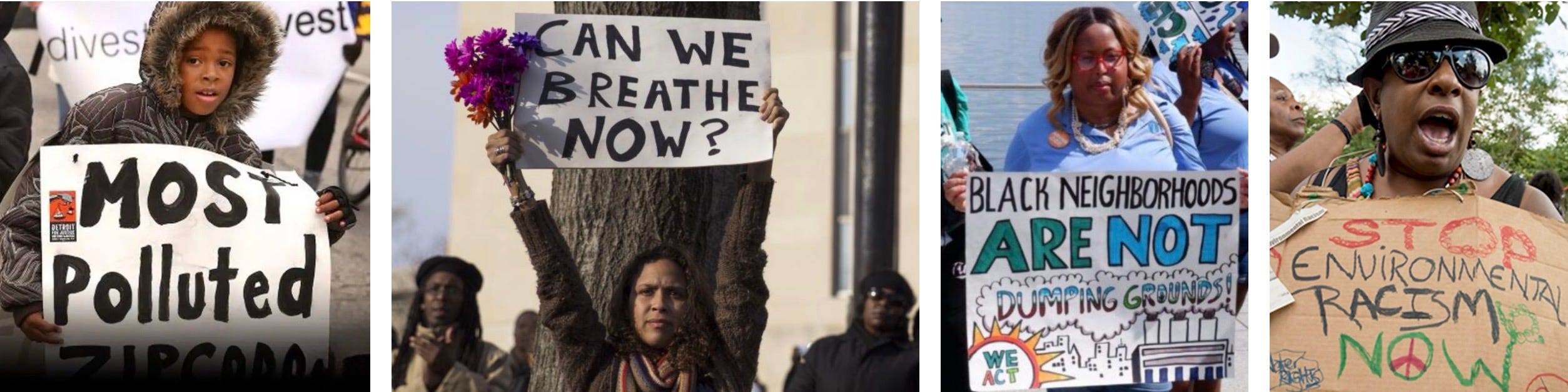
We must recognize the interrelated overlap of climate pollution with other dimensions of justice — distributive justice, environmental justice, justice for nature — as well as our vision, purpose, and Major Goal: to overcome climate change by creating a just and prosperous sustainability that enhances wellbeing for everyone and everything. Enhancing wellbeing includes addressing the human health impacts of fossil fuels and the impacts of environmental degradation on people and the rest of nature.
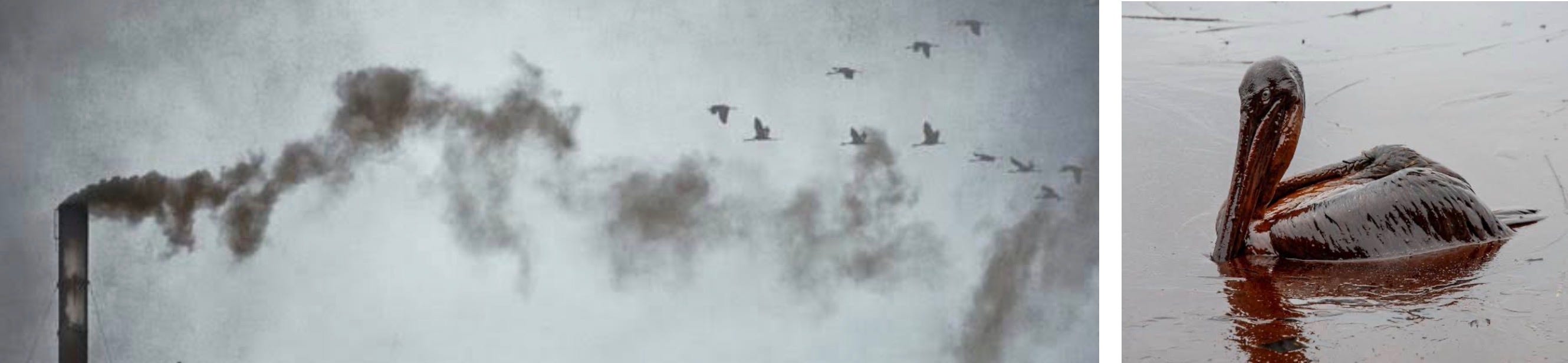
Some technological and policy solutions stop the bad stuff much more completely than others, such as electricity produced by solar, wind, and geothermal, as opposed to coal, oil, natural gas, and nuclear power. Others pluck carbon out and must be combined with other efforts, such as carbon capture that isn’t nature-based. Even nature-based sequestration must be done in a manner that promotes ecosystem health.
And, of course, stopping bad stuff isn’t the only action of justice. We must also set wrong right and make things better. The technological solutions already mentioned can help with these, too, if thought through from the start and implemented fully.
Set Wrong Right
What does it mean to set wrong right for those most harmed: the poor, the powerless and less powerful, the vulnerable, the marginalized, today’s children and subsequent generations, and the rest of nature?
Does setting wrong right in the context of climate justice mean holding those accountable in some way? Does it include what is called retributive justice, which usually involves some form of punishment? Fines? Penalties? Incarceration?
I personally don’t think retribution is a constructive response in keeping with all of our Movement Values.
If fines and penalties can be imposed through the courts that could serve as a deterrent. But it will never be near enough.
What if those accountable are no longer living? What if a Big Producer of Polluting Products goes out of business?
There are many instances where a nation has done things to set past wrongs right (e.g., reparations). This is one of those times.
Instead of retribution, what about the polluter pays principle? With climate change, polluter pays is different than, say, it is for toxic pollution. Instead of paying to clean up the pollution, the polluter pays to address climate consequences; that’s the mess to be cleaned up.
For nations and Big Producers who are accountable, to set wrong right is to clean up the mess you made. The climate version of polluter pays is a partial response, but not a complete one.
You must also make amends for the harm caused.

So in setting wrong right there are two interrelated steps: (1) clean up the mess; (2) make amends and help heal the harm.
More specifically, for the Big Producers of Polluting Products and countries primarily responsible for past emissions, setting wrong right means two basic things in the climate context.
1) Cleaning up the mess you made by paying for adaptation, funding “Loss and Damage,” and helping build resilience.
2) Making amends and healing the harm by making things better for those who have been wronged, including the rest of nature.
Precisely because we are dealing with justice and not charity, setting wrong right in these ways cannot simply be left to good intentions.
First, the nations and Big Producers primarily accountable must help those most harmed by funding and assisting with adaptation efforts and building resilience in its many forms: strong, innovative economies powered by abundant clean energy, good healthcare, high quality universal education, impact-ready infrastructure, food and water security, and species protection and ecosystem restoration.
Cleaning up the mess must also involve paying for what is called in the international climate negotiations “Loss and Damage.”
Conceptually this is rather straightforward. If you break something, you pay for it. If you have caused climate impacts, you pay for the loss and damage. Of course, given both the historic nature of climate emissions and the systemic aggregate nature of the problem, assigning accountability is incredibly complicated, let alone highly politically fraught. Nevertheless, it must be attempted, and some very modest progress has been made via the international climate negotiations concerning the relationships between and among nation-states.
But what about the Big Polluters of Polluting Products who are accountable for climate change?
Remember, climate accountability involves five classes:
Nations, or more specifically, national governments.
Upstream fossil fuel producers that are state owned (i.e., where the state has a controlling interest), or are state-owned-and-run enterprises.
Upstream fossil fuel producers that are investor-owned corporations (both public and private).
Midstream state owned and state-owned-and-run fossil fuel burning utilities.
Midstream investor-owned fossil fuel utilities.
The international climate negotiations are attempting to deal with the first class, and by extension the second and fourth classes. But what about three and five, investor-owned upstream and midstream Big Producers of Polluting Products, the oil companies and the fossil fuel utilities?
In the minds of many my third class are the really bad actors. They account for 31% of the fossil climate pollution from 1940-2022, and four are in the top ten from 1854-2023: Chevron, ExxonMobil, BP, and Shell.
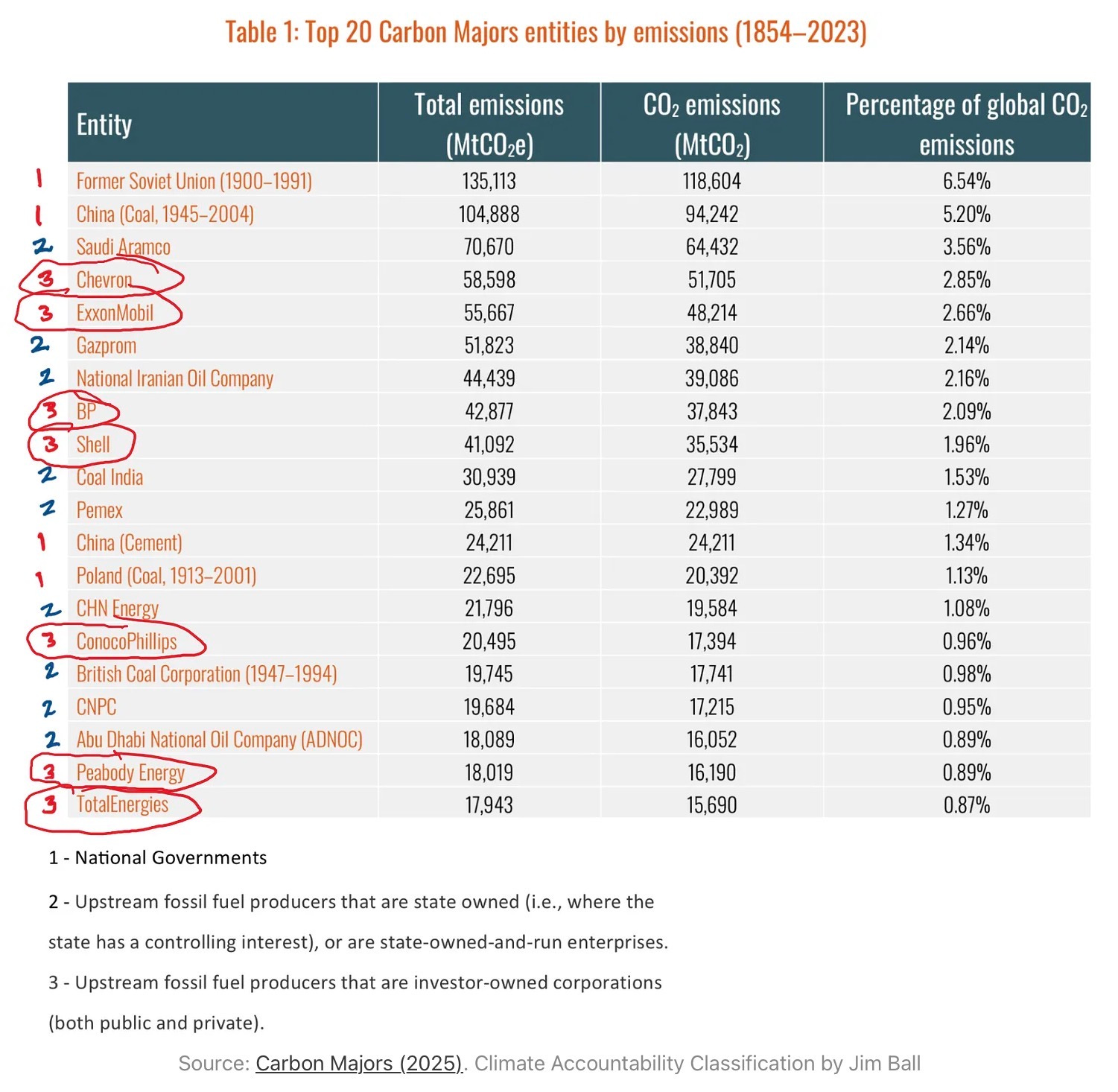
How much harm is each one accountable for? How much should they pay to set wrong right and clean up the mess they’ve made?
For example, a recent effort published in the journal Nature concluded that Chevron is accountable for between “$791 billion and $3.6 trillion in heat-related losses over the period 1991–2020.” More broadly, the study found that “extreme heat linked to greenhouse gas emissions from 111 companies cost the world economy $28 trillion.”
That’s just looking at one impact, extreme heat, over only 20 years.
Another study hot off the press (Mar. 25, 2026) by Burke et al in the journal Nature, shows that even after discounting future damages, i.e., making them worth less (which I consider to be immoral1), Big Producers of Polluting Products are accountable for mind-boggling amounts of loss and damage.
For example, as shown in their graph below, Saudi Aramco is accountable for $64 trillion in past and future damages based on pollution from their products between 1988-2015. ExxonMobil is accountable for $29 trillion. Without discounting it would and should be much more.
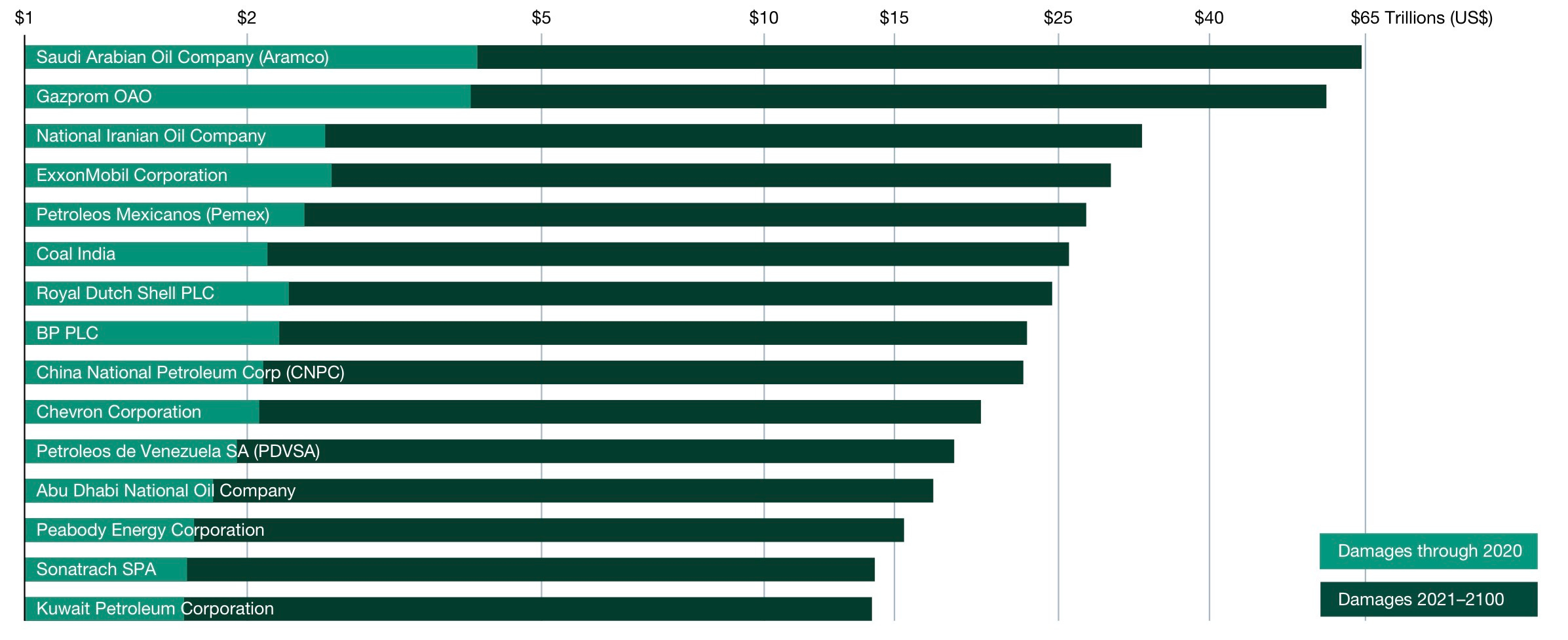
One thing Burke et al remind us of, which is captured in their graph: “estimated past damages will only account for a modest subset of the anticipated total damages that a historical emission will eventually cause. Settling debts for past damages will therefore not settle debts for past emissions (p. 961).” In other words, we are dealing with two harms: past harm (the light green part of the bars above) and future harm (the dark green). Again, the dark green has been discounted, which it shouldn’t be, meaning that the harm is even greater. But why future harm from past pollution? Because CO2 stays in the atmosphere trapping heat until it is removed through the carbon cycle or by carbon capture technologies.
Second, making amends by doing the third action of justice, making things better, can go a long way towards setting past wrong right— e.g., using climate solutions to create a just and prosperous sustainability that enhances wellbeing for everyone and everything, especially the poor, the powerless and less powerful, the marginalized, the vulnerable, children and subsequent generations, and the rest of nature.
These two actions of justice are not separate, they are united. We do both when we achieve our vision, purpose, and Major Goal.
More specifically, to set wrong right means that those most harmed are at the front of the line when it comes to enhancing wellbeing. It means we have a particular focus on ensuring that their lives are made better — and made better in a substantial way so that their wellbeing is in keeping with that of everyone else.

A rising-tide-lifts-all-boats approach simply will not do. There is no such thing as trickle-down justice — a dangerous and deadly sham. For those who have been, are being, and will be the most harmed we must be intentional about raising the level of wellbeing to that enjoyed by everyone.
For example, Sub-Saharan Africa, with many nations that will be hit by climate impacts, is projected to continue to be mired in energy poverty through 2050. We must not let that happen. Energy prosperity from generating their own power via renewables plus storage must be their future.
In the vast majority of circumstances setting wrong right will have to be accomplished by appropriate levels of government ensuring that it be done. This can certainly take place through climate policies but should not be limited to them. The Catalytic-4 must work together to achieve all of climate justice.
Setting wrong right, including for the rest of nature, cannot be the orphan of climate justice, or the forgotten step-child. Without it there isn’t justice.
“Gee, we always meant to do it; somehow we just never got there. Oops.”
For some in the Climate Movement, this is your Olympian Field of Action on which to lead the rest of us. For some CATS, this could be a major focus. We need you to go for Gold. We need you to direct us on when and how to weigh in at strategic moments to make setting wrong right a reality. There is no more important job.
Where’s the hope for climate justice in stopping bad stuff and setting wrong right? We’re the hope! We make hope happen by making justice happen. Join us!
If you are new here, check out our Intro Series, as well as other posts in the Hope & Justice Series. If you like this post, please “like,” comment, and share. And thanks for all you’re doing.
As I hope to discuss in future posts, I consider the use of discounting or a discount rate as immoral, treating people differently simply based on when they exist in time. For those of us who hold that all persons are created equal, discounting is a violation of this basic moral assertion. Discounting says people in the future are worth less than people in the present. Or, at a minimum, they are owed less simply because they are in the future. (And no, the Ramsey equation doesn’t address this, because it still discounts!) This is completely contrary to our Better Future Covenant, which states that what subsequent generations are due — i.e., what justice requires — is that they have a better future than we do in the present.