

I thought the story of Uruguay’s remarkable clean energy transformation was going to be quick and easy to create into a post.
Ah, no.
Not that simple.
But still remarkable. Still filled with lessons. Still filled with inspiration. Life is so much more interesting than a Hallmark card or a set of talking points.
An Unlikely Leader For Renewables
This story starts with a particle physicist, a university professor, an academic, a researcher studying how the Universe began, studying the tiny stuff is that makes up the Universe.
How did everything get here? What is it all made of? Small questions like that.
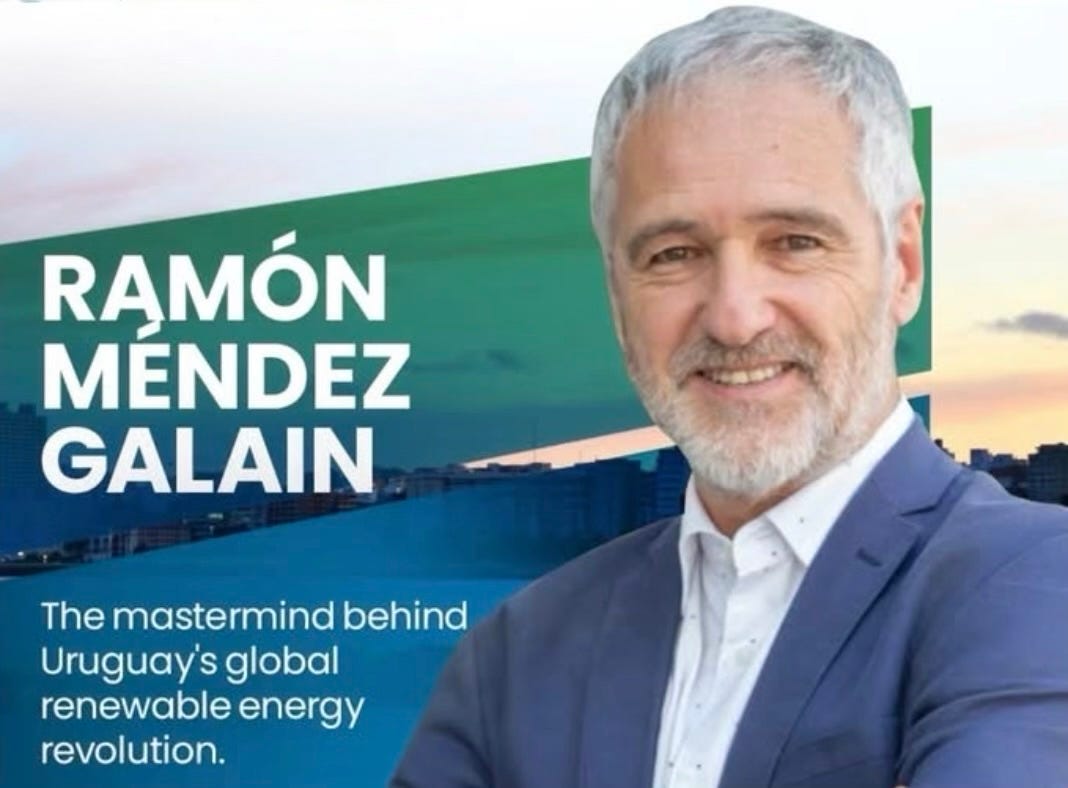
In a recent conversation with Dave Roberts of Volts, Ramón Méndez Galain reflects upon the unforeseen ways life can present us with opportunities to change the world.
I never imagined, you know, 20 years ago that I was going to be in the position I am right now. I never imagined that in life. Yes, I was just a university professor, a researcher, working in particle physics, working in a subject that is far, far away from real world, people life.
Uruguay’s electricity system was in a bad way and the country was thinking of going nuclear. In a country of about 3.4 million people, Méndez Galain was the closest thing they had to someone who knew anything about nuclear stuff. Particle physics and creating electricity from nuclear energy — the overlap is pretty small, so to speak.
But Ramon Méndez figured he’d take a look at this question. He interviewed people and researched the possibilities. And then he did what academics do: he wrote up a paper. Done. Back to the primordial mysteries of the Universe.
Not quite. The Universe had another trick up its sleeve.
You see, he didn’t go nuclear in his paper. He said the country should go with renewables instead, sketching out a plan to do so. The country’s president got wind of it and asked him to implement his plan. It began with a call from a senior official.
“He said, ‘Oh, hi Ramón.” I’ve been reading what you said. I’m talking with the president, and we wanted you to implement that strategy.’”
Bye bye academia. Hello national and international politics.
Today around 98% of Uruguay’s electricity comes from renewables.
Just Run the Uruguay Playbook? No and Yes.
Now we’ve got it! To overcome climate change all we have to do is run the Uruguay Playbook and we’re done!
I wish it were so.
- - - Pushed to Act, But Not By Climate - - -
First, they were pushed into acting, but not by climate concerns or a Climate Movement.
As Ramon Méndez explains:
“We didn’t start with climate targets. We started with the problem of cost and reliability. The environment was a positive side effect, not the reason. … Climate policies fail when they are disconnected from economics. The transition works when it saves money and creates jobs.
So what prompted them to act? Back in 2007 their electricity sector was in bad shape and they were starting to get desperate:
rates going up;
unreliability and blackouts;
hydro power, a major source, destabilized by climate drought, producing much less when things were bad.
The country’s economy was growing like gangbusters at 6-8% per year. Unreliable, expensive power could turn that sour. Leaders could read the writing on the wall.
A big chunk of that unreliable, expensive power was coming from imports, i.e., sources not under their control. This included burning imported oil to create electricity and bringing in electricity from neighboring countries.
Uruguay wanted to be in charge of its own energy and economic future, and not be jerked around by outside forces.
- - - No Fossil Opposition - - -
Second, they had no in-country fossil industry opposition, public or private. No coal-burning power plants. No coal mining. Next to no oil or gas drilling and no refining industries. So if we’re looking for an example for how countries with fossil-related industries can kick the fossil habit, Uruguay ain’t it.
- - - Urugay’s Size: An Example for Big Countries and Big Polluters? - - -
Finally, Uruguay is small. Its population is 3.4 million. With a worldwide population of 8.3 billion, 3.4 million is not very much. Compared to other nations, it ranks 134th in the world, and many of the countries with smaller populations are small island states.
It is smaller than the top ten metroplex areas of the US. It’s population is roughly the same size as Nevada.
Land mass-wise it is the second smallest country in South America. It’s about the same size as Virginia and West Virginia combined.
So Uruguay is a small country and was a small polluter. Can it really be an example for the major countries who are the biggest polluters?
Hmmm … A legitimate question. But is it the right question?
Still Wasn’t Easy
They had ingredients for change: folks starting to get desperate, recognizing change was necessary; no fossil opposition; a small country.
No sweat! A cake-walk!
Ah, no.
Today all over the world renewables are winning on profits and price and thus are going gangbusters.
Almost 20 years ago when Ramon Méndez wrote his plan, not so much. Renewables were still thought to be too expensive, too intermittent, would lose the country jobs, etc.
As Ramon Méndez said:
“No one believed we could do it. … Today, even members of that cabinet say to me: ‘When you were saying those things on TV in 2008, we were thinking, how are we going to explain this when we fail?’”
What’s more, the effort started under one president and continued under another of a different party, who charged everyone involved to create a plan around which all the political parties and all the sectors of society could get behind and stay behind for decades.
Ramon Méndez explains how they worked hard collectively to create an approach where everybody wins, making it better along the way:
And we build an ecosystem, a transformative ecosystem where everybody was gaining, and it was crucial. It was kind of adaptive governance in the way we were all the time discussing, all the time having interaction, learning from each other, mistakes both from the public and private sector, and doing learning curves and trying to correct mistakes, and trying to discuss… because we built an option that was, in principle, the best for all of us.
Creating something good with near universal buy-in is hard work even under favorable circumstances.

98% Renewables. Ok, Nice, Sure, Whatever. So What Else Did They Achieve?
All the stuff we like — reducing climate pollution to almost nothing, cleaner air and water — that was extra, a nice bonus, cute. So where’s the beef?
Here are the non-climate benefits that were the driving force in achieving the type of success we want all over the world:
$6 billion in renewable energy investments in 5 years; instead of sending money out of the country into a fossil black hole, they were bringing $billions into the country;
equivalent to 12% of GDP;
50K new jobs, or 3% of the labor force;
a 20% rate cut for customers;
fossil subsidies eliminated;
bankrolled by private investment due to long-term contracts with predictable returns;
reliability, stability;
more $$ for education and public services;
in control of their energy future instead of being jerked around by the price of oil.
In reaping all of these non-climate benefits Uruguay completely flipped the script on pollution and economic growth being intimately related, a co-dependency in many countries. Uruguay now has the highest per capita income and the lowest per capita emissions in South America. No co-dependency here!
So How Does Uruguay’s Story Help With Climate Action?
For us perhaps their greatest achievement is to show that renewables and economic prosperity go together.
Sacrifice? Nada
One thing Uruguay can help us in The Climate Movement understand is that pain and climate action don’t necessarily have to go together for the average person.
For some in The Climate Movement there can be an ascetic strain that can border on self-defeating self-flagellation. We’ve been bad. The planet is punishing us. So we must suffer by sacrificing. Our lifestyles are just going to have to take a hit. Oh, and we deserve it, too. There can even be a hope-stealing angle: the average person doesn’t have enough character or good will or love or sense of duty to achieve the required sacrifices so we’re screwed.
If sacrifice is part of one’s spiritual tradition, by all means live up to it as best you can.
But it’s not the formula for success for The Climate Movement.
My version of The Climate Movement’s vision, purpose, and Major Goal is this: to overcome climate change by creating a just and prosperous sustainability that enhances wellbeing for everyone and everything.
We can in fact have an even better quality of life than we do now, and one shared by everyone and everything. Some may think of this as a pipe dream. But it really isn’t.
To create it will require work and effort and struggle, and whatever progress we achieve will make the world a better place.
Along the way some of us may have times when we suffer. But that will be due to opposition and barriers and even misunderstandings and disagreements with friends — and not because we sought it out, considering it the means to achieving climate action. Suffering and even sacrifice may come our way, but it’s not the goal or the means to achieve the goal. If we sacrifice it is not because that’s what we want or even feel we deserve. It will be because of our values, most supremely the L-word, love.
Uruguay showed that lots of non-climate benefits can accompany and even drive action that helps us achieve our vision, purpose, and major goal where everyone and everything benefits.
We’re not the hair shirt movement. We are striving towards enhanced wellbeing for everyone and everything.
The Fourth Catalytic Source of Transformation
Uruguay is one of the best examples I’ve found of our Fourth Catalytic Source of Transformation, Governments-&-Markets working together.
The government led and set things up and the market took care of the rest. That’s exactly how it should work. Most of overcoming climate change is going to take place through markets. But the markets must be structured by governments to achieve the results we want. We need to get the incentives right. We need to have the profit motive working for us. Remember what Ramon Méndez said:
Climate policies fail when they are disconnected from economics. The transition works when it saves money and creates jobs.
But in contrast to Uruguay, in nearly all other situations we need all four of the Catalytic Sources of Transformation working together:
The Climate Movement;
Climate Action Supporters;
ARTC or the accelerating rate of tech change, and;
Governments-&-Markets.
We need 1 and 2 pushing 4, and these three helping 3 to play its part.
The US Context: Bottom Up
At the national level in the US, for the foreseeable future, there’s no way we’re going to have the political unity around a clean energy transformation achieved in Uruguay. The fossils and their political lackeys won’t allow it. The Trumpian Republican Party is completely against it, as are fossil-Democrats, with fair-weather Democrats completely unreliable.
But I do think, given its size, Uruguay’s lessons can inspire us at the level of cities, states, and even regions where common sense common ground can be found, anyplace where we can find the doers, the let’s get this done crowd. Instead of top-down, Uruguay says to the US: bottoms up.

At these levels let’s be inspired by Uruguay to build durable coalitions creating plans where almost everybody wins.
Two interrelated questions to guide us:
At what level can you and those you are working with have the greatest impact?
What’s the largest level you can achieve victory?
We have one clear advantage over the Uruguay case study. A climate movement was not a driving force. Climate benefits were extra, a climate bonus.
The Climate Movement and Climate Action Supporters, our First and Second Catalytic Sources of Transformation, can help lead the way with our three forms of power: moral power; people power, and; staying power. This is especially true for all the ways we can be together enough through organizations; campaigns; coalitions, alliances, and networks; businesses, and; Climate Action Teams or CATs.
But the federal level doesn’t have to be a complete loss. During the remaining Trump years we should find ways to:
stop giving the fossils unfair advantages and corporate welfare;
remove barriers to the advancement of renewables;
make it easier for cities, states, and regions to push the clean energy transformation forward.
With Power Comes Stupidity?
When at some point we have the people power to muscle through what we want, that won’t mean we should be stupid and arrogant. Power can corrupt in many ways.
Like they did in Uruguay, we should always be trying to find approaches where as many people as possible are included, where as many people as possible can win. We should find ways to do things that make good economic sense, that make money for folks who want to do well by doing good.
In other words, like Uruguay, we should strive to have policies and solutions be worth creating and implementing even without the climate benefits. The Uruguay transformation found a way to leverage other things people care about into reducing climate pollution. That’s a win for the climate any day of the week.
Uruguay’s Lesson For The Climate Movement
Uruguay is not providing us with a cookbook. All of our circumstances are different.
The lesson Uruguay teaches us is to look at the facts before us and then act to change the situation. Even “no-brainer” change takes a lot of work. Inertia is strong. We must not squander opportunities where people and their governments are open to change. And politically we must build the most durable and long-lasting approach we can without sacrificing our need for speed.
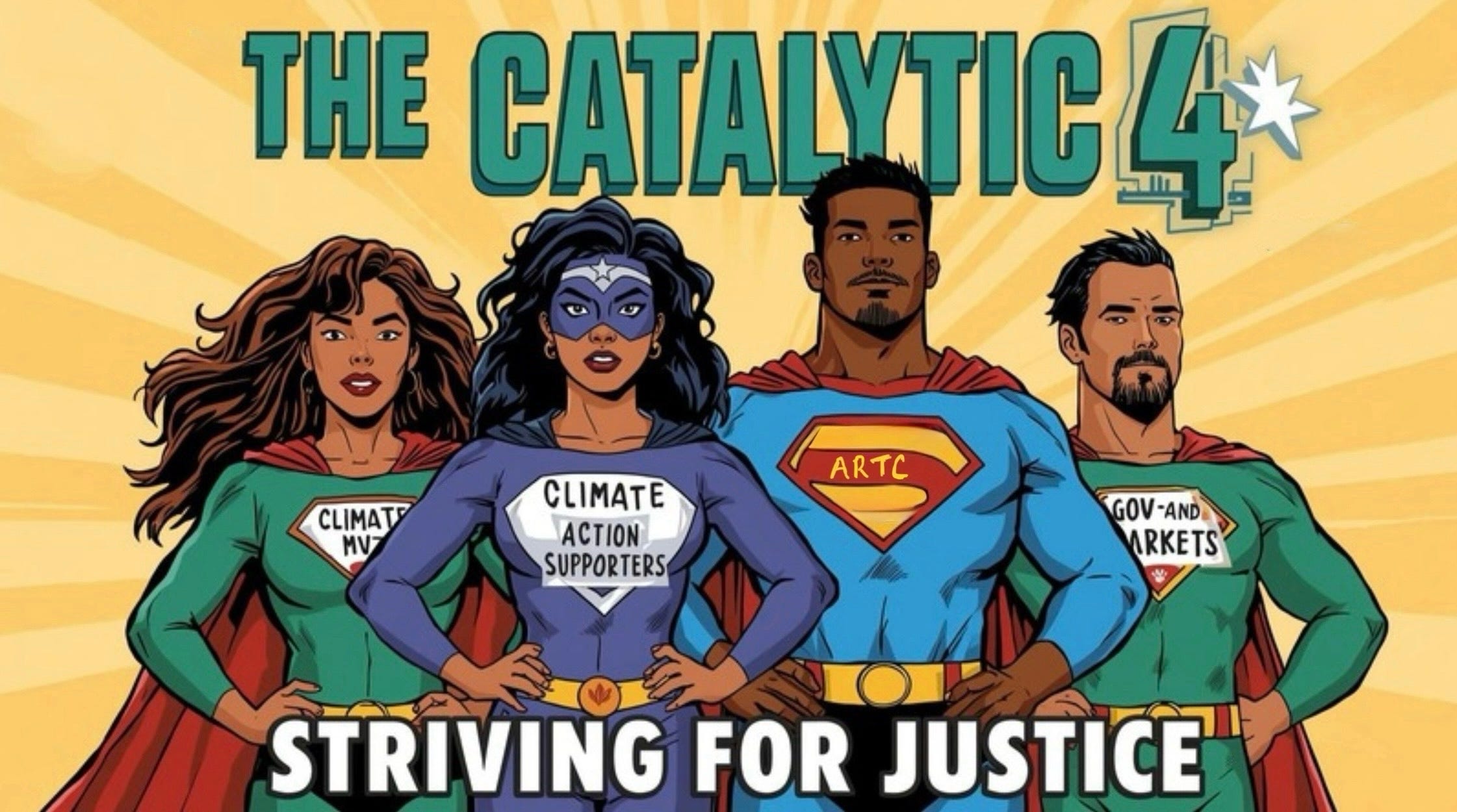
The Catalytic-4 Working Together
For most situations around the world achieving what Uruguay has done thus far cannot happen without The Climate Movement pushing to make it so. We have to continually create the conditions where the other three, Climate Action Supporters, ARTC, and Gov-&-Markets, are playing their part to overcome climate change by creating a just and prosperous sustainability that enhances wellbeing for everyone and everything.
Uruguay shows us this isn’t a pipe dream. We can make it happen. They didn’t have fossil opposition, sure. But they didn’t have The Climate Movement, either.
So the most important thing we can be doing right now is growing and improving The Climate Movement. And in coming together we must find the level — school boards, homeowner’s associations, cities, states, nations — where the groups we belong to can find common sense common ground upon which to make a difference right now working with the Let’s-Get-This-Done crowd. Join us!
If you are new here, check out our Intro Series. If you like this post, please “like,” comment, and share. And thanks for all you’re doing.
Great article. I want to point out that even if Uruguay is small (14m)- it doesn't detract from their success.
Size doesn't matter, because some of the largest US states - California and Texas- are leading in decarbonization. They are more than double the size of Uruguay.
The US has 48 other states ... most of which are smaller than Uruguay - and each state can replicate Uruguay's successful decarbonization if they chose to do so. Many states with bold climate leadership already are.
Size doesn't matter. Political leadership does.