


Question: Will the ability to forecast dangerous worldwide tipping points help with our sense of urgency, and bolster climate action? That’s what this post is driving towards.
But first, let’s put this in context.
Avoiding Tipping Points — A Big Part of What We’re About
“to prevent dangerous anthropogenic interference with the climate system.”
— Article 2, UNFCCC
The above quote is from Article 2 of the 1992 Rio Earth Summit climate change treaty, formally known as the UN Framework Convention on Climate Change (UNFCCC). It’s the stated objective of the treaty, which created the international climate negotiations. In other words, it is what the nations who have become parties of the treaty have agreed to do together.
Humanity has been discussing ever since what exactly this qualitative descriptive statement means.
But how to avoid whatever it means, well, that was quantified in the 2015 Paris Agreement in the form of a temperature goal:
“Holding the increase in the global average temperature to well below 2 °C above pre-industrial levels and pursuing efforts to limit the temperature increase to 1.5 °C above pre-industrial levels, recognizing that this would significantly reduce the risks and impacts of climate change.”
— Article 2 (a), Paris Agreement
Since Paris 1.5C has become the standard for all those trying to prevent dangerous human interference with the climate system.
Also since Paris a key concept has risen to the fore, the idea of global tipping points. I think any reasonable, fair-minded person not warped by fossil $$ or some type of ideological blinders would recognize that preventing dangerous human interference with the climate system includes avoiding global tipping points brought about by climate change. Dangerous interference is not limited to tipping points, but it certainly includes them.
And the relation to hope? In one of my first Substack posts I wrote this:
When people are tempted to despair it is because they aren’t sure we can stop the bad stuff in time to avoid the really bad consequences, the run-away, tipping-point consequences, the ones that will turn our planet into something outside the range of human experience.
The really bad consequences, the run-away, tipping-point consequences, if there’s anything we must avoid it is those. Otherwise, instead of hope we will breed “What’s the point?” despair.
Back Up: What’s A Tipping Point?
So what are we talking about? The UN’s Scientific Advisory Board on the subject does an excellent job of explaining what a tipping point is in their Brief, as illustrated in two quotes:
A defining characteristic of an Earth system tipping point is nonlinear, self-reinforcing change. …
Earth system tipping points are critical limits in the Earthʼs climate and planetary sub-systems (e.g. rainforests and ice sheets) where small additional changes can trigger major and potentially irreversible shifts that continue on their own. These shifts are driven by internal feedback processes and may be difficult or impossible to reverse on human timescales, even if the original pressures (such as greenhouse gas emissions) are reduced or eliminated. … the system starts to reinforce the change rather than resist it, so the change can speed up even if the original cause is reduced.
But a tipping point in one area isn’t just a one-off. Earth systems are interconnected.
As John Muir famously said:
“When we try to pick out anything by itself, we find it hitched to everything else in the Universe.”
Unfortunately, what this means for tipping points is that one can help bring about others. As the UN Scientific Advisory Board Brief puts it:
Changes in one subsystem can increase the likelihood of triggering others, creating cascading effects across systems.
To summarize, here are the characteristics of tipping points:
non-linear, self-reinforcing change;
uncertain thresholds;
irreversibility on human timescales;
cascading interactions.
Just a whole lotta bad news.
Current State of Major Tipping Points
An excellent resource on the current state of global tipping points is the Global Tipping Points Report 2025.
The figure below, from the UN Brief, adapts material from this report and its earlier 2022 version.
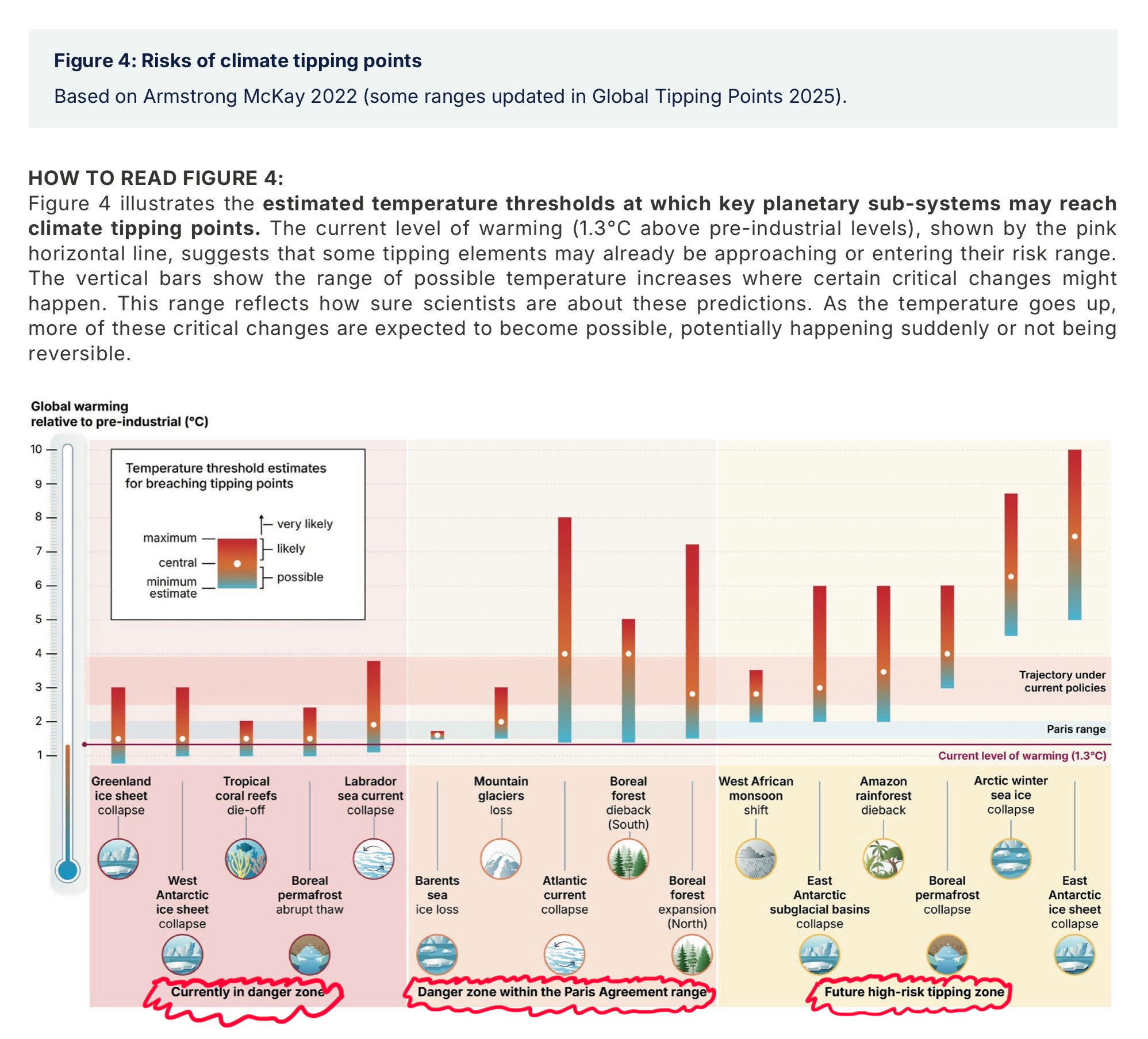
As you can see:
five natural systems are already in the danger zone for reaching their tipping points,
five could reach their danger zones in the Paris Agreement 1.5-2C warming range,
two more just above the Paris range,
two more at 3.5-4C,
the final two are possible if these others have helped produce runaway warming.
So if, according to the Paris Agreement goal, we do things right we still could have 10 major tipping points exceeding their thresholds. And given “cascading interactions,” these 10 could help tip the next two faster than they would have otherwise.
We’re now at 1.4C. We really need to work our butts off to keep things to 1.5, and any overshoot must be minimal and quickly brought back down.
Making Tipping Point Thresholds Less Uncertain Via Forecasting
It is uncertain thresholds, the second characteristic of tipping points highlighted above, that we turn to now. Can we make the uncertain nature of the timing of tipping points, when they will cross their point of no return, less uncertain? Can we even forecast them, or reduce the size of their timing windows?
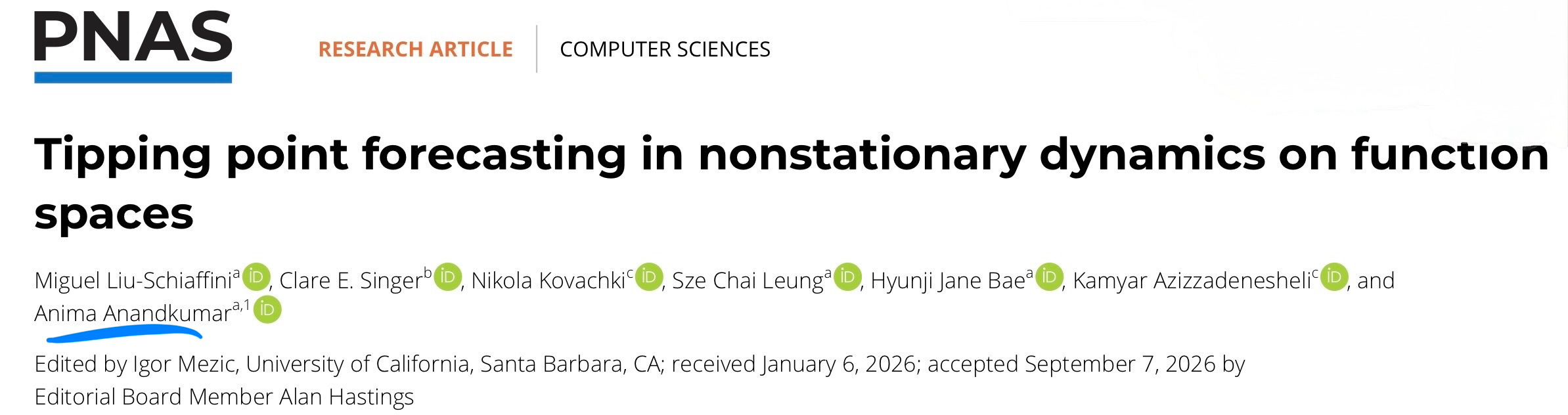
A just published scientific paper in one of the world’s most prestigious journals (Proceedings of the National Academy of Sciences) has demonstrated progress on how to forecast climate-influenced tipping points in nature.1
Until now climate modeling of tipping points has relied on how things have worked in the past.
One of the authors, Anima Anandkumar, of Caltech, explains:
"In the past, we used AI to learn mostly stationary systems that assume the weather from before will be the same as weather in future.”
In other words, the assumption is the past is the future. But, of course, tipping points are the exact opposite of that.
To help with this huge problem, their specialized version of AI utilizes what is called a “recurrent neural operator” or RNO, which has allowed them to make the advances in this paper. That’s because “RNOs are capable of learning the dynamics of nonstationary chaotic systems …”
As another Cal Tech coauthor, Jane Bae, described it:
“What is exciting about this work is that the model can recognize when the physics it has learned no longer adequately describes what is happening, providing a warning that the system may be approaching a tipping point.”

It’s as if the humans are saying to their AI:
“So, AI, when today’s observed reality gets so out of whack that what you’ve been taught goes out the window, alert us so we know that a tipping point is close to happening.”
When our reality becomes so different from the past that things stop working like they normally used to, this AI can extrapolate and project when a tipping point could occur.
As Anandkumar said:
“This work lays the foundations for characterizing tipping points and predicting when they might occur in the future.”
In the study researchers tested their model on a specific scenario “in which low clouds over the oceans rapidly disappear due to rising carbon dioxide levels—a situation that has been predicted to occur in the future but has not yet been observed.” Their AI program was able “to look more than two years ahead of the expected tipping point in the simulated data and predict its timing with an error of about 11 days.”
Hopefully researchers will be able to stretch this two years significantly to give us a much longer timeframe. Two years won’t do us much good when it comes to reducing and eliminating the causes, but it could be helpful in adapting to the consequences.

Urgency for Action
When it comes to climate action, both uncertainty and a forecasting ability must push us towards the speed and scale of transformation needed to avoid tipping points. Both must bolster our sense of urgency that leads to action.
Tipping points can occur at any level, such as their example of low clouds over the oceans disappearing. While the researchers say their model is scalable, my guess is that it will take awhile before researchers will be able to forecast tipping points of very large more complex systems.
But in the meantime, with uncertainty at larger levels and forecasting ability of smaller ones, the combination will boost urgency more than either one separately.
Urgency today also must come from the prospect of “too little too late.” That’s one of the most important characteristics of tipping points: they reach a point of no return. We don’t want them to!
But if forecasting of a smaller system suggests a tipping point is imminent, and then it occurs, we must redeem such failure by trumpeting it far and wide as a disturbing wake-up call that can spur us towards speed and scale.
This is what realistic hope looks like. We face the reality of our situation squarely and we use the truth to spur action that forestalls dangerous human interference with the climate system in the form of major tipping points. In keeping with our Movement Values, especially wisdom, justice, and the L-word, love, we act in a way that overcomes climate change by creating a just and prosperous sustainability that enhances wellbeing for everyone and everything.
If you are new here, check out our Intro Series. If you like this post, please “like,” comment, and share/restack. And thanks for all you’re doing.
One of the paper’s authors, Anima Anandkumar of Caltech, is also on the UN’s Scientific Advisory Board that produced the Brief I’ve been utilizing in this post.