


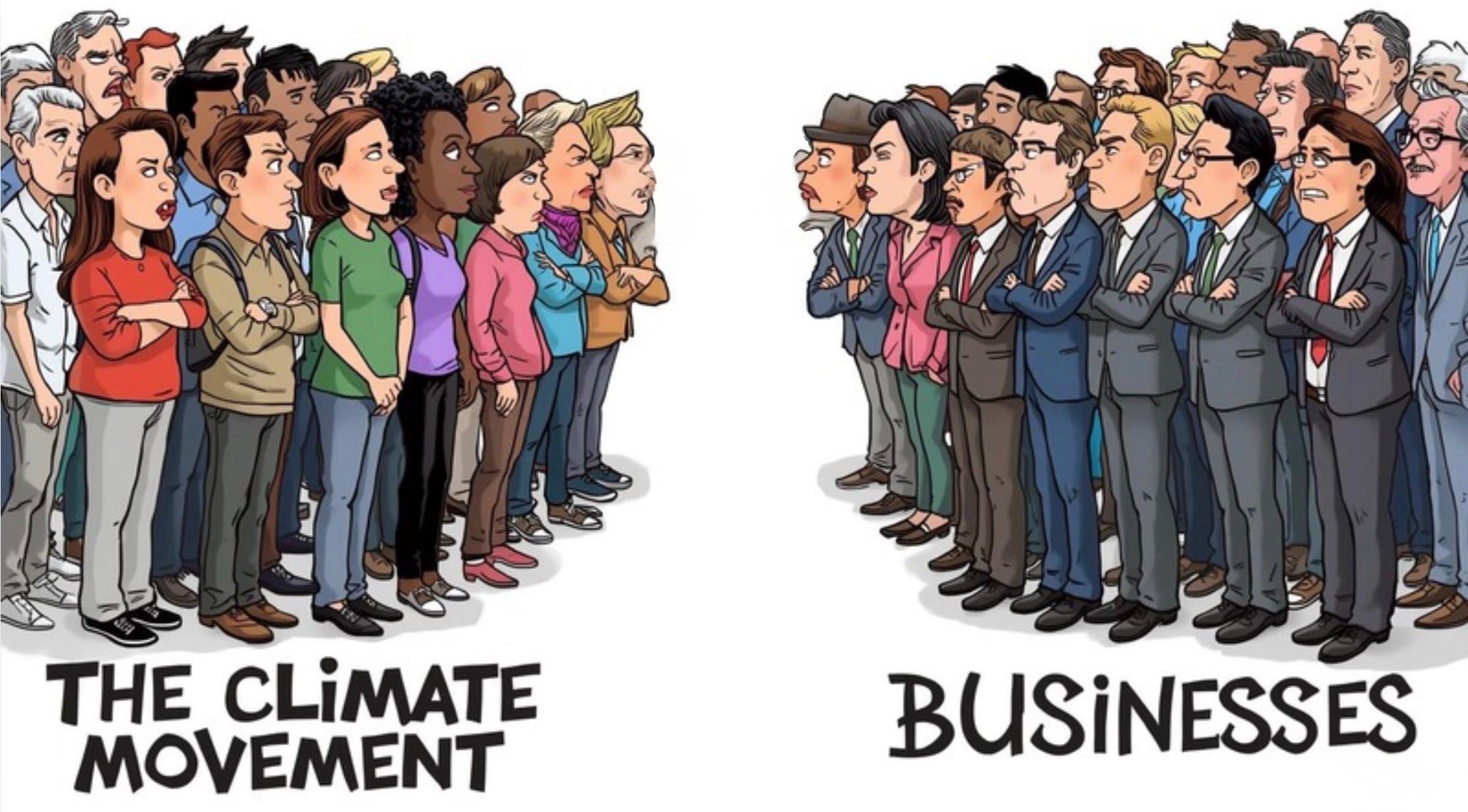
This is the first in a two-part series on climate change and businesses and how some can help us be together enough, our sixth Climate Movement characteristic/imperative/goal.
Hold it. Back up. I’ve been assuming something. Can businesses be a part of the Climate Movement?
For some Climate Movement Artist-Athletes the answer may be No. For them, businesses are too much a part of the problem: they say they are going to be a part of the solution, but there’s too much hope-stealing Grifter greenwashing going on — especially by businesses who are Big Producers of Polluting Products.

This is true. To think of, say, ExxonMobil, as a potential part of the Climate Movement is, frankly, obscene, given they are not only one of the biggest polluters, but have also funded climate denial — even after they said they stopped. They have lied and denied and attacked Climate Movement Athletes for decades. If ExxonMobil were considered part of the Climate Movement we would lose all credibility; we could no longer claim to be a moral movement.
Long ago ExxonMobil lost the benefit of the doubt. That hasn’t stopped them from running ads touting climate action. Even if they said they would commit to collective action over time to achieve our Major Goal, their words and promises are not to be trusted. The same holds true for any other business that is a big producer of polluting products.
But we shouldn’t paint all businesses with this brush. There are many other businesses out there that are not big proucers of polluting products or who haven’t been bullied or enticed into going along with them. Indeed, there are a growing number of businesses who are climate-friendly and potential allies. We need them.
Distinguishing Business Foes and Friends
Here are two things to look for when thinking about whether we should consider a particular business a friend or foe of the Climate Movement:
§ profit-motive;
§ ideology, or more broadly, behavior-shaping ideas.
The profit-motive is usually going to be the deciding factor. But ideology cannot be overlooked.
The rest of this post is focused on business foes, while business friends will be covered in part two of this Subseries.
Business Foes
If a business’s profit motive is tied to climate pollution in a significant way, then words and promises must be backed up by action over time — years. No benefit of the doubt. But neither should we rule them out definitively. If they say they will work hard and stay the course to achieve our vision, purpose, and Major Goal they should start off on probation. Of course, for those who violate their terms of probation over and over should not be worked with.
We must be ever mindful that the profit-motive for big polluters provides a powerful incentive for Grifter hope-stealing greenwashing, where businesses want to appear climate-friendly for PR purposes to enhance sales and burnish their image.
In the end it doesn’t matter whether those in the company are cynical or naïve about what they have promised.
For example, over 20 years ago some employees of British Petroleum may have genuinely thought BP was moving “beyond petroleum,” as their ad campaign said. But it turns out that was just marketing. As one of the disillusioned advertising gurus who came up with their campaign ruefully concluded: “They didn’t go beyond petroleum. They are petroleum.” While BP continues to try to position themselves as an oxymoronic green oil company, we’re not falling for it this time.
In 2022, when Democrats controlled the House of Representatives, the House Oversight Committee released a huge amount of internal oil company documents, including those of BP.
Here is my unvarnished interpretative summary of BP’s messaging and corporate strategy based on these documents.
Wring out every last drop of profit from fossil fuels before the hammer falls, i.e. before societies get serious about restricting fossil emissions in a carbon-constrained world.
Position BP in public consciousness as a climate action ally; occupy this Big Oil-climate-friendly market niche.
Slow down the climate action transformation to a “low-carbon transition.” Delay the hammer falling for as long as possible while implementing the wring-out strategy, positioning BP as an energy business in a carbon-constrained world.
And this is the “green” oil company. As the CEO of BP America said in a memo to the Board on May 23, 2019: “We continue to balk at taking accountability for the emissions of our products.” (As if their customers were going to do anything other than burn the oil company’s gasoline to power their vehicles.) But as a Big Producer of Polluting Products we won’t let them get away with pushing their accountability onto individual consumers. We won’t let them redirect their accountability to us with their individual carbon footprint scam.
We must also cast a wary eye at any collective effort — a coalition, alliance, campaign, initiative, etc — that includes Big Producers of Polluting Products. As posted earlier, the Climate Leadership Council (CLC) includes a number of them, but so far it doesn’t seem like they have co-opted the CLC. However, just having these people in the room changes things.
Beginning to see them as colleagues changes things even more. This includes academic initiatives like Princeton’s Carbon Mitigation Initiative (CMI), which if not co-opted, has been sadly compromised to the point of untrustworthiness, as founding co-director Bob Socolow’s swan-song email to his BP colleagues (below) makes clear. As he stated: “I appreciate so very much the ways each of you has welcomed me into your world.”
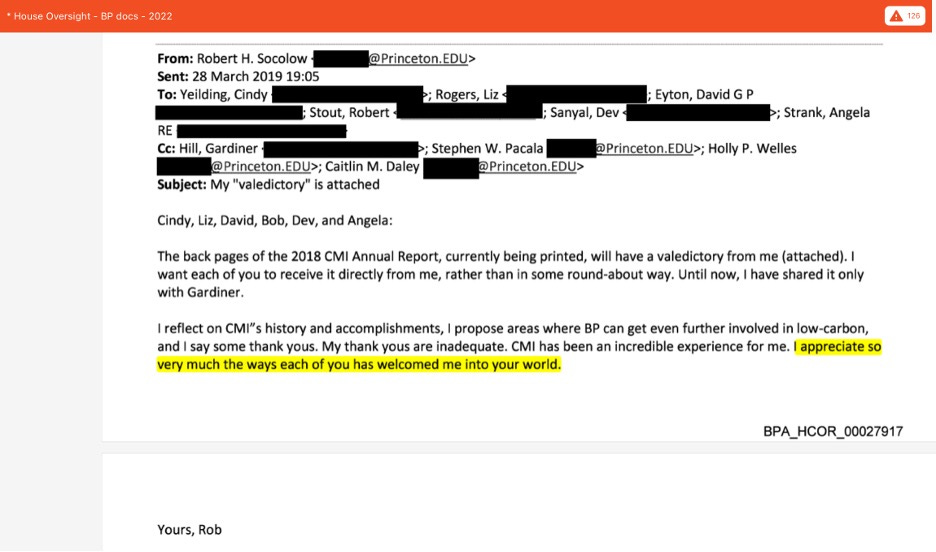
In his “Valedictory” mentioned in his email, Rob Socolow gave BP advice on how to take advantage of mitigation. (See pp. 46-51 in CMI’s 2018 Annual Report.) They could lean into nature-based solutions and create systems that pair fossil and renewable energy — which could allow them to lengthen their wring-out strategy (i.e. wring out every last cent of fossil profit).
As The Daily Princetonian reported in an excellent piece in 2023, nothing changed after Socolow stepped down.
Companies like BP have issued “net-zero” by 2050 pledges. But many of them are scams that don’t offer any real commitments in the near term. And oil companies, including BP, have reneged on “green” pledges whenever it conflicts with their profits.
It should come as no surprise that big fossil CEOs are pushing back on a near-term transition to clean sources.
“We should abandon the fantasy of phasing out oil and gas, and instead invest in them adequately” said Amin Nasser, CEO of Saudi Aramco, the world’s largest oil producer. Another CEO remarked that discussions about a clean energy transformation at the speed and scale necessary have “become emotional. And when things are emotional, it becomes more difficult to have a pragmatic conversation” — as if it were “rational” to ignore the science, as if we can’t be “rational” and “emotional” at the same time.
Reneging on “green” pledges when they conflict with profits is also true of Wall Street financial firms like JPMorgan, Blackrock, and Bank of America. The first two were a part of Climate Action 100+, an alliance of businesses. JPMorgan has pulled out of Climate Action 100+ and backtracked on not funding climate polluting projects, while BlackRock has scaled back its involvement. Bank of America has reneged on a commitment to stop funding fossil fuel projects. Things have gotten worse since Mr. Trump resumed office again, with the six largest banks in the US quitting the international “Net Zero Banking Alliance.”
So if a business’s profits are derived from causing the problem, we should be highly skeptical of anything they say, including any commitments they make about being a part of the solution. Even if they were to agree on paper with our vision, purpose, and Major Goal, they are not to be trusted for years until their promises match their actions.
This also goes for any collective effort of which they are a part whose pledges rely on the commitments by business members who profit from producing pollution products. Whatever part of a coalition’s pledge, such as Climate Action 100+, that relies on polluters keeping their promises is not to be trusted. The strategy of big polluting profiteers in such circumstances may have been to forestall legislation or regulations that would have required action, borrowing the climate-cred of their coalition partners and arguing that requirements are not needed because voluntary efforts are getting the job done.
Our lack of trust in these situations is not because we should have an inherent bias against business, but because the profit motive makes us cautious to start with and because their own behavior makes them untrustworthy. It is wise to be cautious.
The other thing to consider when determining whether a business can be trusted is ideology. By this I mean the beliefs held by the most powerful person or group of persons in a business concerning the relationship between government and markets. These beliefs can be communicated in political language and contexts, or primarily using market and economic terms and economic belief systems, or some mixture of the two. Such ideologies are assertions that may not have any relation to facts and evidence. They can be the dominant part of the worldview of such individuals.
Ideology can become so powerful that it even overrides the profit motive or leads to magical thinking that one’s ideology will lead to profits when all evidence is to the contrary. And, of course, such ideologies — e.g. a free-market ideology — can also have magical thinking when it comes to major problems facing society, asserting that free markets and property rights will cure all ills, including pollution, environmental degradation, bad breath, an annoying personality — whatever. It’s the magic elixir. Those having some version of free-market ideology believe that the only role for government in relation to the markets is to enforce an absolute bare minimum of rules to ensure a “free” market, especially the protection of private property rights, and that the Invisible Hand solves nearly all societal problems.
This free-market ideology is completely antithetical to achieving our vision, purpose, and Major Goal, regardless of any espoused magical thinking by adherents to the contrary.
Why?
When it comes to systemic aggregate problems like climate change, the market cannot police itself because of the five Ps.

Its chief, overriding motive for producers is Profit.
Profits within a competitive market system are driven in large part by Price.
Profits and price are focused on the Present, not the future.
Polluters and Producers of Polluting Products don’t
Pay anything for the pollution, dumping it into our environment for free, thus not reflecting the full cost in the price paid by consumers, depriving them of the information they need to make an informed choice.
When they work together in a system stacked in favor of fossils the five Ps make it impossible for the market to make a meaningful contribution on its own to achieving our Major Goal.
The so-called Invisible Hand — i.e., how the market via profit and price can turn self-interest and even greed into good things — may help create jobs and wealth and beneficial products; it may help to allocate scarce resources efficiently. But The Invisible Hand is crippled when it comes to climate, rendered impotent by its focus on the present and because polluters don’t pay. Too many of its footsoldiers only see profit and price and are blind to the damages its activities bring about.
That’s why the government must do its number one job — protecting its citizenry — by curtailing climate causing market activities and/or redirecting market activities into climate-friendly pursuits.
But such curtailing and/or redirecting is exactly what free-market ideologues fear. It strikes at the very heart of their worldview, which is why many of them fight it so fiercely. And yet fossil energy is not now, nor has it ever been, a “free market.” Free market ideologues either blithely ignore or deny this fact.
As such, businesses controlled by free-market ideologues are not to be trusted.
Business foes, driven by profit or ideology or both, are some of our most entrenched and powerful opposition.
But, when it comes to businesses we cannot say “a pox on all your houses.” We need those in the business sector who are our friends, something I will explore in part two of this Subseries.
Most of the implementation of climate mitigation will take place in the market. Thus, thinking clearly about both business friends and foes is essential. Knowing who is our opposition and who is our ally is a key part of overcoming climate change by creating a just and prosperous sustainability that enhances wellbeing for everyone and everything. Having such clarity brings hope. Join us!

If you are new here, check out our Intro Series, and our other posts in the Olympian Fields of Action Series. If you like this post, please “like,” comment, and share. And thanks for all you’re doing.