

Please Note: This is the second in a 3-part Post-Midterms Series, Climate AND Affordability+. Part One was focused on our Affordability+ frame. This post provides a strategic overview in broad brushstrokes. The final post will delve into the details.
Power
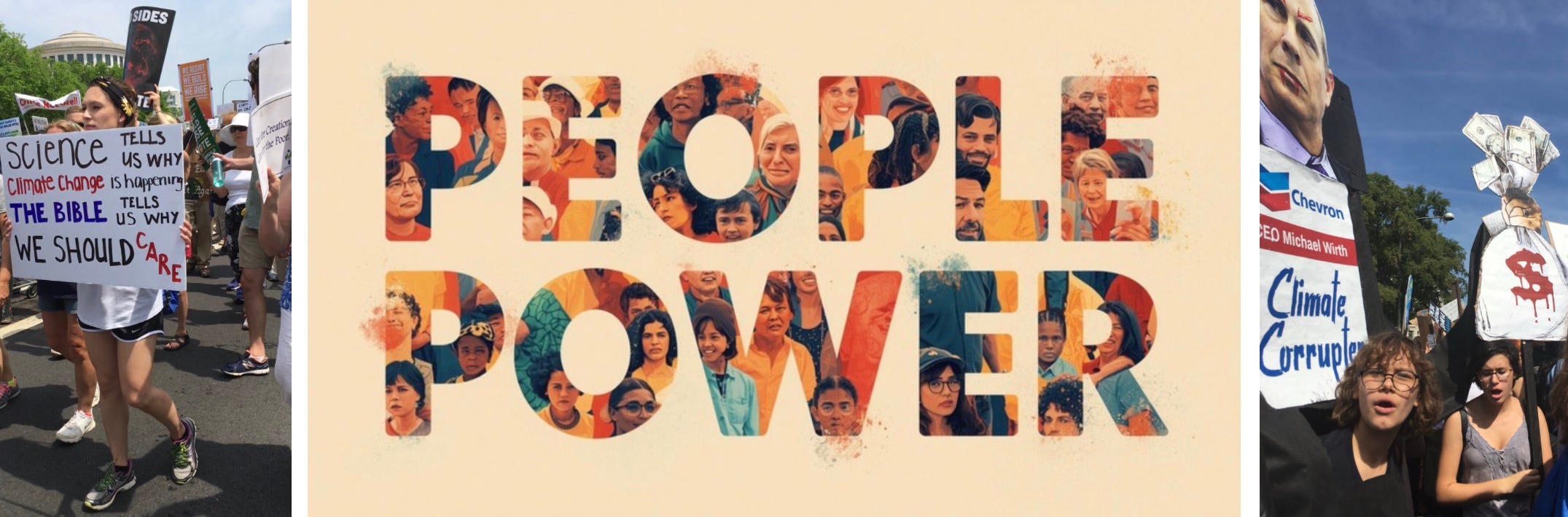
The first thing we must discuss is power. If we want to create change, especially big long-lasting change, we must have the power to do so.
For nearly all of us in The Climate Movement we don’t have the obvious trappings of power. We’re not rich. We don’t have positions of power. We’re not famous or influential. We don’t have bodyguards, intimidating-looking people with sunglasses and earpieces whose presence announces someone with power is here, someone of importance. No entourage. No fanfare.
We’re just us. Just you. Just me.
But together as The Climate Movement we do have power. Indeed, we have three forms of power, our P3: (1) moral power; (2) people power; (3) staying power.

Our moral power comes from the inherent, intrinsic rightness of our cause. It’s simply the right thing to do. Period.
Our people power comes from our numbers. This means combining our two forms of people power, aka, our First and Second Catalytic Sources of Transformation.
The first is our Climate Movement numbers, with our goal being 5% of the population or 16 million in the US by 2030 (remembering that 3.5% can create major change).
The second is our Climate Action Supporter numbers, with that goal being 80% support for climate action among the broader public as measured in polls.
Our staying power comes from our long-term commitment to climate action. This is included in the commitment I suggest people make to affirm they are part of The Climate Movement, the Climate Movement Promise: “To all I hold dear I make a sustained commitment to collective action over time to overcome climate change.” A sustained commitment to collective action over time. That gives us staying power that politicians and allies can rely on, staying power to outlast our opposition, staying power to help keep politicians who aren’t champions in line, staying power to have us pushing hard on climate action for the next two decades and beyond.
All three of our forms of power need each other. We don’t need to do anything to have moral power. In this sense, it is simply a gift to us. But the simple truth is this: in the political “stadiums” where as Climate Movement Artist-Athletes we compete on our policy Fields of Action, moral power doesn’t get us very far.
Staying power comes from remaining faithful to our values and our commitment, something we must support one another to achieve. Just like moral power, on its own staying power can’t achieve much.
Nor will moral power and staying power together achieve what we need. They must have people power to realize our vision, purpose, and Major Goal: to overcome climate change by creating a just and prosperous sustainability that enhances wellbeing for everyone and everything.
At the same time, without our sense that this is the right thing to do, we don’t have a movement. It’s that simple. Without moral power, without our undergirding values, especially love and justice and beauty and sustainability, we simply can’t grow our numbers to what they must be. Nor, without moral power, will we have the power to stay the course long enough to bring about the speed and scale needed and to keep at it once we have become big and broad and active enough, our first characteristic/imperative/goal.
For us to achieve what is right, our moral power must be actualized through people power. Our moral power is a gift. We didn’t have to do anything to create it. We must not squander it.
People power, however, is something we must actively grow. Without sufficient people power we simply won’t achieve the speed and scale of transformation needed in time.
That’s why our #1 priority continues to be growing and improving The Climate Movement. Besides efforts focused primarily on making us big and broad and active enough, growing our people power should be a part of everything we do, including our two types of political efforts: policy-political and electoral-political.
When we start thinking political, and then we start thinking strategically — and by that I mean marshaling our resources at key places and times to maximize our chances for victory — we start thinking targets. If it’s a policy, the normal approach is to pour our resources and efforts into pushing/supporting swing-vote persuadables.
In all this very important, very serious policy-political and electoral-political strategic thinking and implementation — did I mention how serious it is? oh, it’s super series, stupendously serious — we can forget that we need to grow our Movement.
Some can even continue to denigrate movement-building as something for volunteers, amateurs — the kids table. I can’t tell you how profoundly stupid such an attitude is.
Let me put this as plainly as I can: nothing is more important than growing and improving our Climate Movement.
An absolute essential part of being strategic is thinking through how to secure the resources we need — which in our case is people — and then obtaining them. If we don’t have sufficient resources to achieve victory, then all the fancy planning, all the in-depth legislating and policy-formation in the world won’t get us there.
You want to talk about strategic targets? Who do you have the most influence with? Family, friends. How many are in The Climate Movement? Those who aren’t, and you feel are persuadable, they’re your targets.
In the policy-political and electoral-political spaces in the US, do we wait until we have achieved our goal of 16 million before we engage? Of course not. It’s a both/and, not an either/or. We do both simultaneously. We grow The Climate Movement while we also are active in these political spaces. They can and must be complementary to one another. The bigger and broader and active we are, the greater will be our ability to get things done over the next two years.

Everything We Can, When We Can
For us, “politics” involves two types: (1) policy-political (i.e. passing laws, creating and implementing regulations) and (2) electoral-political.
As The Climate Movement we must be involved with both types.
In these two political spaces, there are two extremes we must guard against: (1) self-righteous purity, and; (2) giving away the store.
In the US over these next two years we must achieve everything we can, when we can.
Sometimes, in keeping with our value of pragmatism, it is best to settle for a half of a loaf today and fight for the rest the next day and the next. This is where our staying power comes into play. We’re not one and done.
We’ve got to achieve as much as we can in the near term, and that can mean compromise. We can’t wait and let all the action come in the future. We must push hard till time is up and then secure the best deal we can, with our value of wisdom, undergirded by our values of love, justice, sustainability, and success, as our guide. At this point we can’t let the perfect become the enemy of the good.
But that old saying can be used as an excuse to accept less than what we could achieve by hanging tough. Again, we must achieve everything we can, when we can. We must avoid following the prophetic narcissists and self-righteous purists on the one hand who push to hold out and end up with nothing, and the let’s make a deal folks who fold too soon for crumbs instead of a real slice of the pie.
Policy-Political
Our Affordability+ approach should be pursued at all levels of government in the US — federal, state, and local.
This should come in two basic kinds:
Affordability+Strong — affordability that includes substantial climate action, and;
Affordability+Friendly — affordability that is climate-friendly.
The first is designed from the beginning to help move us towards 1.5C while simultaneously achieving our affordability goals.
The second doesn’t increase climate pollution but rather reduces it somewhat, like affordability legislation where climate action folks say, “Hey, what if we tweaked it this way to make it climate friendly and still achieve affordability?”
As for Affordability+Strong some might think, “Oh, this is where we have to get tough. We’ll have to jettison all the Affordability+ stuff. Ambition requires sacrifice.”
NO! As I said in the first part of this Post-Midterms Series, overcoming climate change by creating a just and prosperous sustainability that enhances wellbeing for everyone and everything includes Affordability+.
Affordability isn’t something we do for political expediency. It’s part of our values. It flows out of love, justice, beauty, freedom, creativity, pragmatism, wisdom, sustainability, and success.
At the federal level we have to contend with the fact that Trump is still president. What can we get done through bills that must pass to keep the government running called Appropriations bills? What can we get done that Trump could see as part of his legacy?
It shouldn’t all be small-ball. We should pursue Affordability+Strong legislation to put politicians on record and distinguish climate champions and climate wimps, and to tee up bills in keeping with 1.5C to be quickly passed in 2029 when we have a new president.
There’s plenty that can get done in states and localities, especially where Democrats now have a trifecta, i.e. where they control the governorship and both chambers of the legislature. (I’ll say more about this in the next post in this Series.)
Electoral-Political
The next general election is two years away. But the first presidential contest for the Democratic nominee is in South Carolina on January 22, 2028 — little more than a year away. For some of us, there’s no rest for the weary. We’ve got to be thinking about 2028 now. Whoever wins the nomination, we must ensure that they are a climate champion.
The place where we will have the most leverage is in the primaries.
At the presidential level we must be engaging candidates early — this year.
Before South Carolina we must work to have climate action rise up in intensity in polling of Democratic primary voters. So that means such voters, not just presidential candidates, are our targets.
The best way to achieve that is our Affordability+ framing. If climate action + affordability is in the top three of primary voter concerns, candidates will be tripping over themselves to be strong climate champions.
We must also, as Climate Movement Member-Athletes, make our presence known via our votes in the early primaries, where, in a crowded field, our numbers can make a real difference.
Both our efforts to (1) spread the Affordability+ message more broadly to impact pre-primaries polling and (2) to have our Member-Athletes make a strategic difference in early primaries can help ensure that our next President will be a strong climate champion.
That’s what we must aim for this year to influence the presidential contest, which means we’ve got work to do!
For Congress, state houses, and governorships, we must elect champions and vote out climate wimps. This means wherever you are, your vote and your work for climate champions is strategic — not just in those districts and states dubbed “swings” by politicos and journalists, or in the early primary states. In fact, the strongest climate champions will probably come from the bluest districts and states. If these have climate wimps, we definitely need to vote them out!
But to vote them out and do all that we need to do we must grow The Climate Movement into the greatest and most long-lasting social change movement in the history of the world.
This is our kairos moment. It’s time to say Yes to our destiny. Together we make the impossible possible and the possible actual and the actual beautiful and our future come faster.
That means we need you! So join us!
If you are new here, check out our Intro Series. If you like this post, please “like,” comment, and share. And thanks for all you’re doing.