

As I’ve explained in earlier posts in this Series, for The Climate Movement, Climate Action Supporters, and our allies, a key way to frame our post-midterms policy efforts is Affordability+. We are for affordability that (and here’s the +) also helps to overcome climate change while simultaneously creating a just and prosperous sustainability that enhances wellbeing for everyone and everything.
I distinguished between Affordability+Strong and Affordability+Friendly. The former is where strong climate action is included from the beginning, while the latter is where affordability policy is tweaked so that it helps a bit with climate action.
Affordability+ Pledge for Politicians
For both policy-political and electoral-political goals we need a brief, plain language Affordability+ Pledge for Politicians for them to take. It should articulate the principles and goals of Affordability+, and make clear what achievements politicians will be held accountable for by voters. It will be a policy To Do list and election score card.
Affordability+ will be driven by clean energy, and by that I mean energy efficiency plus energy produced by renewable sources (and absolutely, positively, NOT natural gas, the fossil fuel the industry has tried to paint green).
Here are some initial thoughts to spur our creativity.
Immediate Impact: We must concentrate on making clean energy affordable right away for the consumer. For example, instant rebates instead of tax credits on EV and household purchases, and subsidizing clean energy options provided by one’s utility to make the monthly bill significantly cheaper.
Pocketbook-Affordable & Investment-Affordable: With clean energy we are talking about two kinds of affordable: Pocketbook-Affordable and Investment-Affordable. The first cuts family expenses to make daily living more affordable. One way this could be achieved is through subsidizing Energy Service Companies (ESCOs) that own the rooftop solar array on a house and get paid back via the energy savings. Result? A customer’s bill is reduced with no up front cost. They can also bundle batteries, efficient appliances, HVAC upgrades, etc.
The second kind of affordable, Investment-Affordable, makes clean energy investments by families, communities, and local businesses — e.g., so-called “distributed energy” like rooftop solar, community solar, microgrids, etc. — so cheap in terms of both purchase price and zero-interest loans they become too good to pass up.
Affordability+Strong: Collectively, policies must make a significant contribution to achieving our vision, purpose, and Major Goal: to overcome climate change by creating a just and prosperous sustainability that enhances wellbeing for everyone and everything.
Everyone Must Benefit regardless of financial ability or whether they are homeowners.
Affordable+ Finance: One of the things America is good at is finance. Let’s get creative at both the state and federal level when it comes to financing that makes clean energy Pocketbook-Affordable and Investment-Affordable. A good place to start are the “Green Bank” policies of the Inflation Reduction Act (e.g. the EPA’s Greenhouse Gas Reduction Fund), sadly frozen and repealed by Trump and congressional Republicans. Let’s make any needed improvements to ensure they are Pocketbook-Affordable, Investment-Affordable, and benefit everyone.
Policy-Political
The “Blue Tsunami” or Bluenami didn’t occur because the voters who switched and made it happen fell in love with the Democratic Party. If they don’t see progress on affordability, we’ll see another whipsaw.
But we are also up against the climate clock. We are running out of time to get going in a big way. We must achieve speed and scale.
Affordability+ is designed to achieve both imperatives. We need the strongest Affordability+ action we can muster at both the federal and state levels.
Affordability+ at the Federal Level
The Climate & Community Institute has done an excellent job of identifying Affordability+ new and returning Members of Congress by scoring them on what they call “Green Economic Populism.” In this new Congress there will be 33 Representatives and 6 Senators — Abdul El-Sayed (D-MI), Troy Jackson (D-ME), Peggy Flanagan (D-MN), Ed Markey (D-MA), Jeff Merkley (D-OR), Cory Booker (D-NJ) — who can be strong champions for our Affordability+ agenda.
While what can be accomplished at the federal level will be constrained by the Trump Administration, there may be small bits of common ground to be found. Congress can also use the power of the purse to leverage Affordability+ concessions and other pro-climate actions through the Appropriations bills process.
Here are possible areas of focus:
unlock Inflation Reduction Act (IRA) funding still held by Trump Administration;
restore IRA clean energy consumer tax credits, but make them instant rebates;
restore climate science funding and clean tech R&D funding;
support increasing distributed energy (e.g. residential solar; microgrids; community solar);
have data centers generate all of their own electricity via their own clean electricity microgrids;
pass Affordability+Strong legislation to put politicians on record and distinguish climate champions and climate wimps, and to tee up bills in keeping with 1.5C to be quickly passed in 2029 when we have a new president.
Strong Climate Action & Affordability+ at the State Level
A great deal more can be accomplished at the state level, where politicians must also take the Affordability+ Pledge for Politicians.
To get things moving quickly, we must create Affordability+ legislation for states to tailor to their circumstances. One place to start is The Model Climate Laws Initiative, which already has more than 2,000 ready to go. I’m sure those involved would be more than happy to make sure Affordability+ is part of the package.
Democratic Trifectas: 6 New, 22 Total, 53% of the Population
A “trifecta” is where a party controls the governorship and both chambers of the legislature.
Where Democrats now have a trifecta is where our climate pollution ambitions can be realized, where Blue states can lead. We must push hard for bold climate action, including Affordability+Strong.
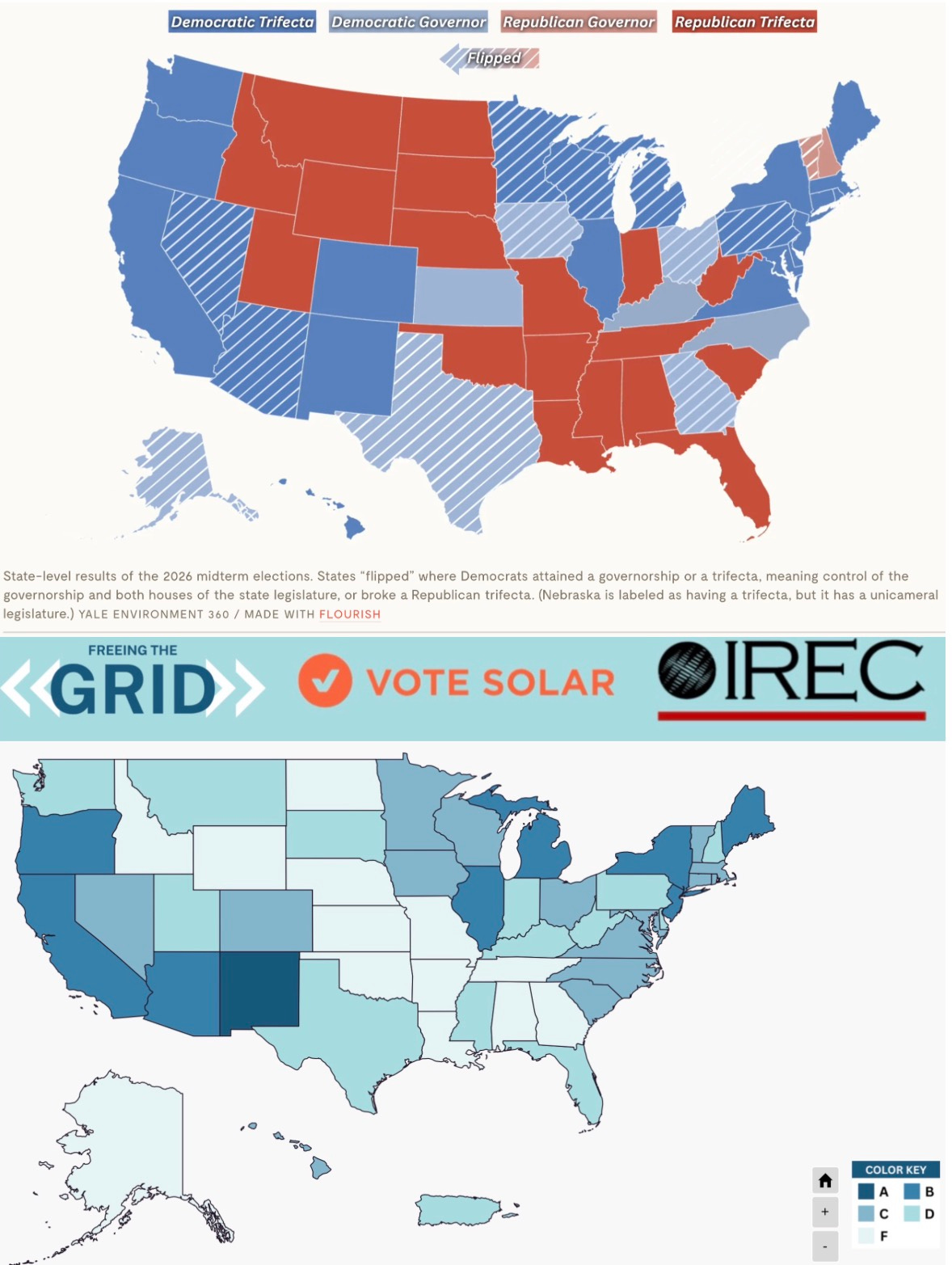
As you can see in the first map below, Democrats claimed six new trifectas in Arizona, Nevada, Minnesota, Wisconsin, Michigan, and Pennsylvania. They now have 22 total, representing about 53% of the US population. New York, California, and Illinois are now an even deeper blue with legislative pick-ups.
We must press our Affordability+Strong agenda in all 22, especially the six new ones and the deeper blue ones.
Bipartisanship on Affordability+
There’s no reason bipartisan common ground can’t be found on Affordability+ and clean energy. It’s to every politician’s benefit to cooperate on these politically popular proposals. This election creates new opportunities for bipartisanship where six Republican trifectas were broken: Texas, Georgia, Ohio, Iowa, and New Hampshire. All elected Democratic governors, except New Hampshire, where the legislature was flipped.
In Texas, Democrats “won every other statewide executive office on the ballot, and took the Texas House for the first time in more than two decades. Republicans kept their 19-12 Senate majority, but a Democratic lieutenant governor will preside over it.”
In Georgia, Democrats also flipped the House with a narrow majority, while the Republicans retain a slim 2-seat majority in the Senate. (Dems now also control the public utility commission; more below.)
And in Kentucky, Kansas, and North Carolina Democrats retain the governorships. In Kansas Republicans lost their supermajorities and won’t be able to override vetos, thus requiring compromise with the governor. In North Carolina Republicans lost the House and only have a two-seat majority in the Senate.
Republican Trifectas — Progress Even Here
There is no reason the 18 states in red in the map above that have Republican trifectas can’t make progress on our Affordability+ agenda. Clean energy has many selling points conservatives will like if they can see past the smokescreen put up by fossil utilities and fossil companies. It’s freedom incarnate. It is literally home-grown, decentralized energy whose sources — sunshine and wind — are free. It’s pollution-free and helps free us from foreign oil and the wars that come with it. If you own your own system, it helps free you from a state-sanctioned monopoly. Geez!
One example of low hanging fruit is passing Plug-In Solar bills, first pioneered in ruby red Utah with a simple no-fuss-no-muss one-page bill. Plug-in Solar legislation allows consumers to buy small solar arrays that can be literally plugged into the wall like an appliance. Skip the costly installation and permitting and red tape!
In South Carolina a Plug-in Solar bill is advancing, while in Indiana, Missouri, Oklahoma, and Idaho the bills have been deferred until 2027. What are we waiting for!
Public Utility Commissions
Public Utility Commissions (PUCs) can be enemies or allies for our Affordability+ agenda. In many states the commissioners are appointed by the governor, as is the case in Texas, Ohio, Iowa, Nevada, and Alaska where Democrats won.
Some states elect Commissioners, as is the case in Georgia, where Democrats now hold a 3-2 majority for the first time in decades.
We must seize upon these opportunities, especially where legislative victories and PUC rulings can be combined to enhance Affordability+.
Freeing The Grid & Affordability+
A way for us to get a quick sense of where states are on one aspect of advancing clean energy is the status of distributed energy policies. Freeing The Grid, an initiative by the Interstate Renewable Energy Coalition and Vote Solar, gives each state a grade, A-F, on a suite of policies that remove roadblocks to distributive energy like rooftop solar, community solar, and microgrids. (They nicely provide a fact sheet on each state.)
As you can see above, I paired their map providing color-coded grades of each state, with the midterms results political map so we can make visual comparisons.
Now, there is only one state, New Mexico, that received a grade of A. Every other state can make improvements on their scoring criteria.
However, their grades do not include affordability per se. While the policies will make distributed energy more available and less expensive by removing roadblocks, they will have to be paired with other Affordability+ policies to make them truly Pocketbook-Affordable and Investment-Affordable.
Thus, we want all states to achieve a Freeing The Grid grade of A as we simultaneously have them achieve Affordability+. As you can see, the six states where we have new Democratic trifectas, PA, MI, WI, MN, AZ, and NV, can all do better, with PA needing the most improvement.
One state where we could achieve a great deal of improvement is Georgia. They have a grade of F. But with the election Georgia now has a Democratic governor, a Democratic House, a slim two-seat Republican majority in the Senate, and a PUC controlled by Dems 3-2.
Plenty To Do!
This post has only scratched the surface on what we all can be doing with the gift of the midterms.
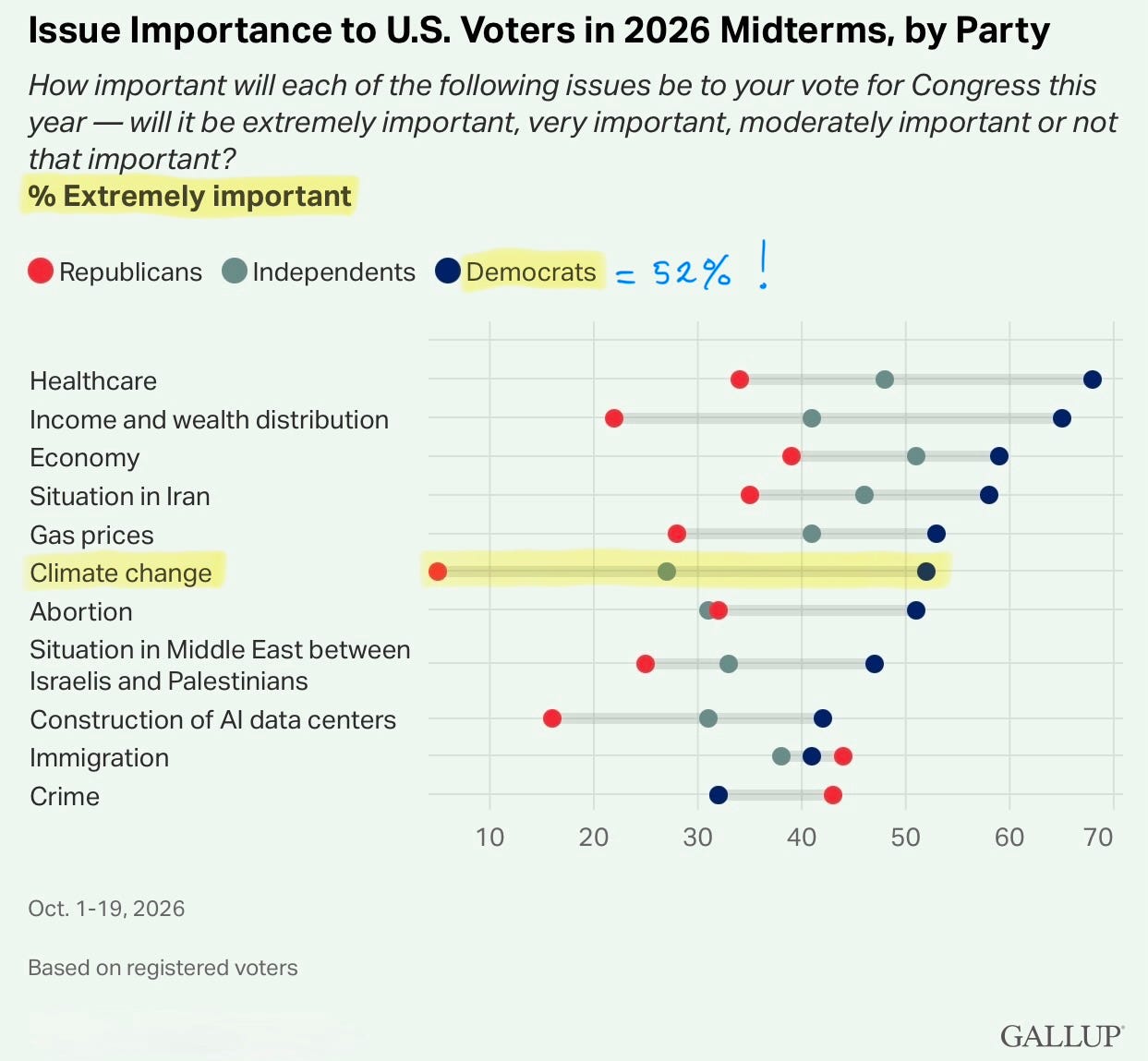
Now I know there are whiners and naysayers out there who’ll say, “But climate wasn’t mentioned that much during the campaign.” Well, some of our politicians may have “hushed” themselves on climate action, but poll after poll says large majorities of Americans want action on clean energy and climate change. They want both affordability and climate action. Indeed, a recent Gallop poll showed that 52% of registered Democrats said climate action would be “extremely important” in deciding who to vote for.
So there is tons of political support for our Affordability+ agenda.
Our job, as The Climate Movement and Climate Action Supporters, is to support our Affordability+ Champions and push the rest. We exist to make the impossible possible and the possible actual and the actual beautiful and our just and affordable future come faster. So join us!
If you are new here, check out our Intro Series. If you like this post, please “like,” comment, and share/restack. And thanks for all you’re doing.
Excellent post for how to leverage the Blue Tsunami into tangible climate progress that also advances affordability.