


Hope Is Everywhere
Now some of you who are faithful readers might be thinking to yourself, “Geez, this guy finds hope everywhere.”
Well, that’s because it is everywhere!
But not in some “Turn that frown upside down” kinda way. Ugh. Hate that.
Nor in a Steve Jobs-like “Reality-Distortion-Field” kinda way. If we’re relying on a charismatic leader to will us into his future we’re toast. Ain’t gonna happen.

Hope is not as if a character named Smiley-Face-Fate sprinkles hope pixie dust on our future whether we like it or not.
Climate hope comes from …
Climate hope comes from the recognition of the potential for climate action and the realization of that action.
Two Sources of Hope-Potential Waiting on Tippy Toes
We can think of hope-potential existing in two sources: human and non-human (e.g., natural carbon sinks like trees; technologies that can reduce climate pollution).
Human hope-potential is short-lived if it doesn’t become real. And yet for a time, until its time runs out, human hope-potential is still within, waiting on tippy toes as it hopes for the person within whom it lives to wake up and see what’s possible and join others in common cause.
Non-human hope-potential also waits like someone at a party hoping to be asked to dance. We must see such climate hope-potential and work with others to make it come alive.
… waiting for freedom to set it free … waiting for us
Climate hope-potential from both sources is on kairos-time, waiting for freedom to set it free, for freedom to make it a reality, to make it into the fullness of freedom for the benefit of all humanity and every creature that lives upon the Earth.
Hope-potential is all around us, waiting … for us.
But hope-potential’s kairos time won’t last forever. Kairos-climate-time tells us Now Is The Time.
It’s the hope-potential/freedom combo, answering the call of kairos-climate-time, that turns potential into reality, making our reality more beautiful.
Ok, but wouldn’t a hope-scarcity model make it more valuable? Won’t volume make it cheaper? Am I just adding water to the soup?
That’s not how hope works. Hope is thick and rich with potential, and adding more hope makes it richer and verdant. Hope is a catalyst for action, which creates more hope-potential.
Hope + Action => More Hope & More Action.
But more than this. It’s not simply additive. Hope’s growth can be exponential if we turn it into action. So not scarcity but multiplicative fecundity, thick with potential, rich with beauty and justice.
Hope-Potential and Supply Chains Sacrificing Improvements in Workers’ Conditions For Sustainability
Now what got me started on this riff about hope-potential is a recently published report from the World Resources Institute (WRI) that studied nearly 700 large corporations and their supply chains.
For many of these large corporations, “80-90 percent of their greenhouse gas (GHG) emissions are linked to suppliers’ extraction and production processes.” So if they want to make efforts on climate, it has to happen through their supply chains.
But here’s the problem. Basically the large corporations studied are telling their suppliers to achieve sustainability goals while eating the costs associated with doing so — which could even put them out of business.
In many instances this is sucking up any money small/medium-size suppliers could use to improve things for employees, something the large corporations are not prioritizing. As such, “only 12 percent of large companies have people-centered supply chain goals” such as investing in “conditions and safety; investing in reskilling, entrepreneurship, and education; supporting workers’ and communities’ well-being; and increasing supplier diversity.”
Instead of working together to figure out how to combine sustainability with improvements for workers, large corporations are telling suppliers to do sustainability if they want their business. For some, the choice is between doing it, going out of business, or having workers in unsafe conditions.
From a justice perspective — stopping bad stuff, setting wrong right, making things better — this is like taking one step forward and then one or two steps backward.
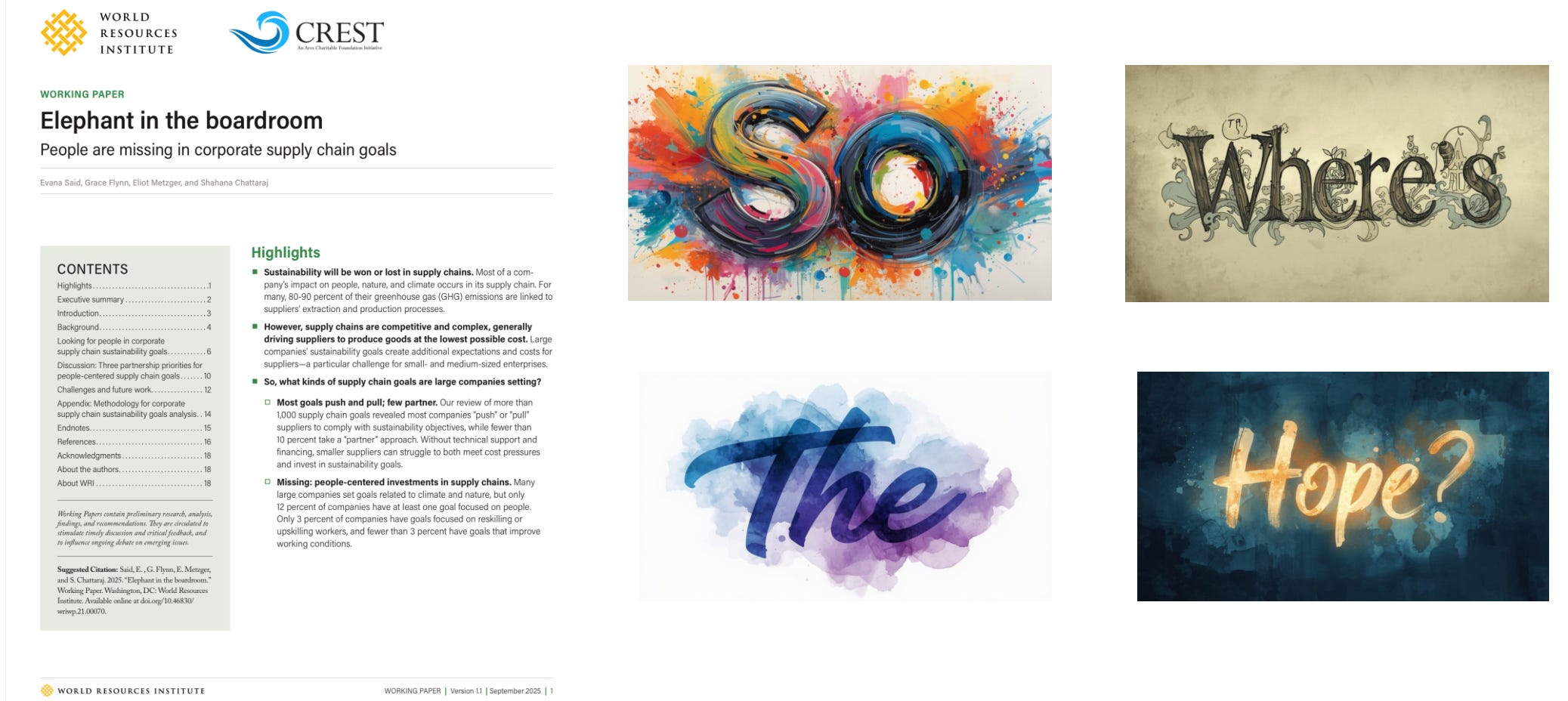
All right, where’s the hope-potential waiting on tippy-toes? Hard to see hope here.
Hope-potential can’t become real if we can’t see our current reality. You can’t change what you don’t see. We must first recognize a problem before we can solve it. You gotta see it to solve it.

So are there large businesses trying to solve it?
WRI’s report does include case studies where see-it-solve-it is happening, where the three actions of justice — stopping bad stuff, setting wrong right, and making things better — are being pursued together instead of played off against one another. I’ll highlight two of their three examples.
IKEA
“IKEA has helped 491 suppliers (44 percent of all direct suppliers) procure renewable electricity, representing more than 91 percent of supplier electricity-related CO₂ emissions.” They did so by working to make it easier and affordable.
Mars
India grows 80% of the mint in the world. Climate consequences are making it harder for farmers to grow mint. Mars has a program in India that meets both sustainability goals and improving the lives of workers. It “has doubled yields, reduced water consumption by approximately 30%, and increased smallholder mint incomes by 156 percent.” The program has also led to “more than 400 self-help groups for women members.”
As the WRI report points out, whether businesses will do both climate action and improve conditions for their workers “depends largely on whether there is support (and pressure) from investors, governments, consumers, and civil society.”
In other words, in stopping bad stuff, setting wrong right, and making things better, the Climate Movement must create the conditions in society where climate action and better working conditions and opportunities for workers are achieved together, including through supply chains for large corporations. We cannot simply count on other large corporations following the lead of IKEA and Mars. That’s a fool’s hope, given that only 12% of the nearly 700 businesses WRI studied are doing so.
So where’s the hope?
Hope’s rich potential is in each one of us, in our gifts and our values. You have hope-potential within you every moment of every day. You have the power to make climate hope a reality by tapping into both human and non-human hope-potential sources: yourself, others, technology, and nature.
Now that we see the supply chain problem, we can solve it. For some of us, supply chains are one of your Olympian Fields of Action where as a Climate Action Artist-Athlete you can earn Gold.
There are Olympian Fields of Action for each and every one of us where hope-potential is waiting for us.
And the way for us to maximize the hope-potential within us and before us is by joining together to create moral-power and people-power. We are the hope we’ve been waiting for. As I said, it’s the hope-potential/freedom combo, answering the call of kairos-climate-time, that turns potential into reality, that leads us to the fullness of freedom.
So exercise your freedom and join us in pulling our destiny into the present as we make the impossible possible and the possible actual and the actual beautiful and our future come faster.

If you are new here check out our Intro Series. If you like this post, please “like,” comment, and share. And thanks for all you’re doing.