

Loss
“It’s just stuff.”
Sometimes that’s what we hear people say who’ve been devastated by natural disasters.
I hope that helps.
But the truth is, stuff has memories attached. A structure is not just a building, but a home, or one’s business or place of employment where we have spent the majority of our time to provide for our families, where we forged friendships with coworkers and customers.
Buildings are places with memories. Buildings shelter relationships. Buildings help to create neighborhoods and communities.
In the course of time we may leave them.
But to have them taken from us, that’s a different thing. To see them reduced to a pile of rubble, or ash, or ruined by flood waters — that’s an emotional blow, something that shakes our sense of wellbeing, or sense of security; it can overwhelm us.
Families, neighborhoods, communities, businesses — when the buildings that facilitated these relationships are destroyed it means they will never be the same. Sometimes those relationships are gone forever; sometimes they don’t recover.
Such “stuff” can be replaced. We can build things better. We can work to create new memories, strengthen relationships, forge new ones. All true. All necessary. All what we must strive to do.
But there still is loss.
And, of course, there are losses even more profound, the loss of loved ones, neighbors, community members, coworkers.
There are no words.
Silence speaks.
And then words, deeply felt, remember. Survivors speak for those whose voices have been lost.
Not everyone can take these losses and redeem them. With loss some become lost. We must help them find their way back into the light if we can.

From Loss to Action: Extreme Weather Survivors
That’s why I’m so grateful that there’s a fairly new group out there called Extreme Weather Survivors.
They’ve chosen to redeem their loss from what many of them call “unnatural disasters” intensified by climate change.
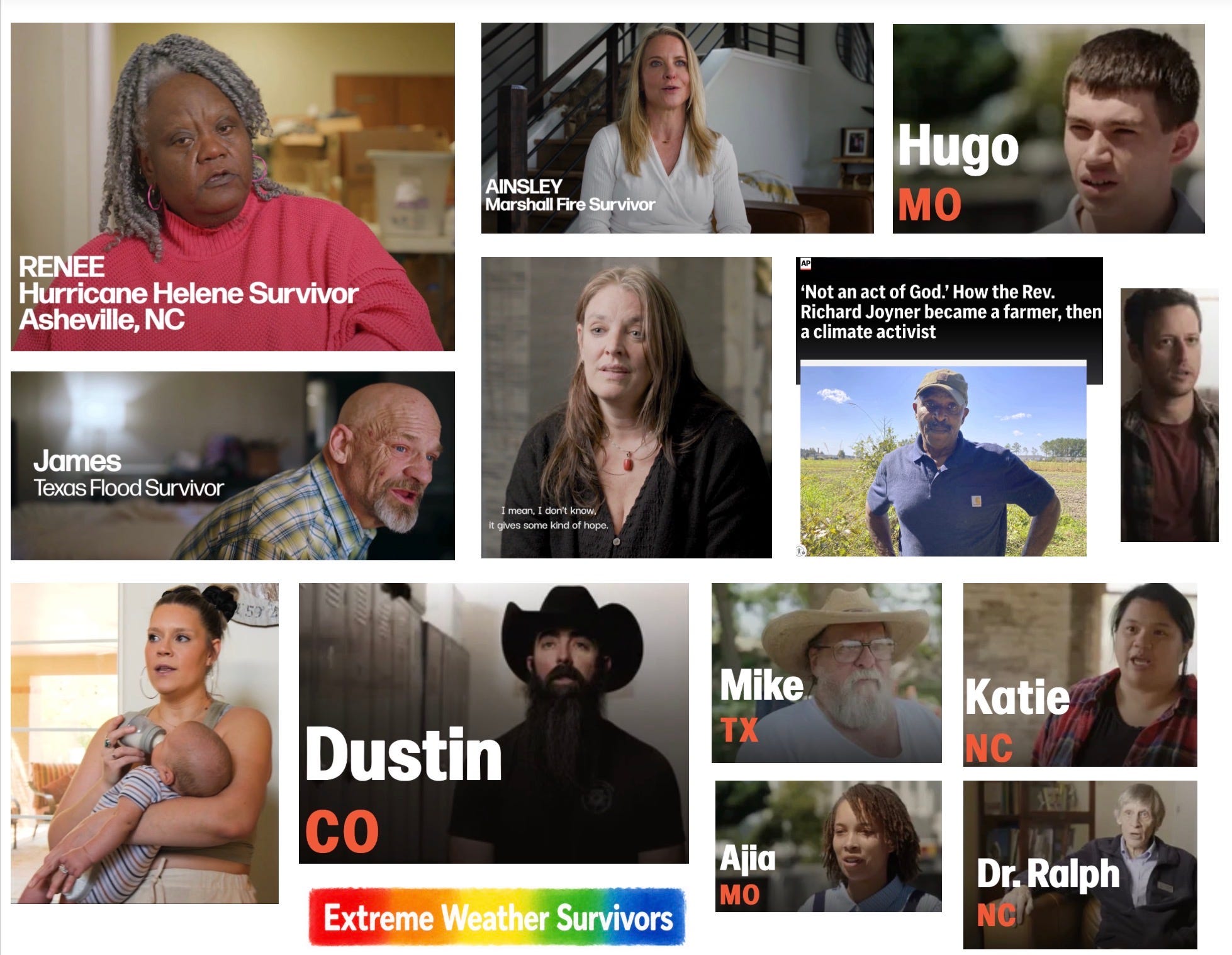
Here are a few of them, in their own voices.
I think it’s important that people share their experiences … because maybe that will help another community, maybe that will help another city, maybe that will help another state to realize the impact that these storms can have, realize the challenges you are going to face if you should have to go through this, and realize that we have to come together and help each other. That’s what this world should be about. That we, in the time of need, stand up for each other, and do whatever we can to help each other, and spread, love, peace, and joy.
— Renee
Hurricane Helene Survivor
Asheville, NC
(pictured above, top left)
It’s just gotten hotter and hotter every single decade. … When you bring a baby into the mix, you have a responsibility to make sure your child is safe, at all times. And the fact that I’m in the parking lot of a grocery store, absolutely sweating, trying to get the air on as quick as I possibly can, so that my kid doesn’t overheat in the back of the car on a five minute drive, is insane. And that is a huge thing in Arizona that you just can’t get away from.
Shea,
Arizona
(pictured above, bottom left)
Our government? Wake up. Really take a look around at the people that got hurt and the people that are still hurt. And where are y’all at?
James,
Texas flood survivor
(pictured above)
My heart is open more to other people going through these crises. And they’re happening more and more, whether its fire or its heat, whether its flooding, whether its hurricanes, whether its tornadoes, whether its mudslides. Whatever it is, I feel like I’m hearing about it more and more and more and more. And anyone that’s going through that, it’s so traumatic to lose your home, to lose your business, to lose your town, to lose people you love. And, it’s very lonely. We just like, we need to help each other through it. We need to wake up to what’s happening. We need to, like, just work together. And there’s something about the feeling, like, talking about it and finding ways to work together as humanity that makes it not as terrifying. I mean obviously our world is going to go through something more and more. And it’s scary to think about that and what that’s going to look like. But it also gives me hope; people are coming together and talking about it and trying to make change where they can. … It gives some kind of hope.
Melissa,
Vermont
(pictured above, center)
People moved to Asheville, NC, because it was supposed to be safe from global warming. But then Hurricane Helene from the Gulf of Mexico, which made landfall about 500 miles away, brought torrential rainfall and flooding to this mountain community.
One person impacted, Alex Webber, had also suffered through Hurricane Katrina in New Orleans.
I was in shock when this happened to me again but I’m not the only one affected by multiple events. … A lot of politicians were paraded downtown, it was like disaster tourism and we felt like zoo animals. Then they disappeared and we are just old news now. … We can’t keep delaying. We have to solve this, it has to stop being a partisan issue. But there’s nowhere safe now. No one is immune from this.
Alex Webber,
Asheville, NC
The Climate Movement & People Power
I don’t know what all of them think about “The Climate Movement,” but from my perspective they’re all a part of us. I hope many of them think so as well, and that each one has made a sustained commitment to collective action over time to overcome climate change (which is my definition of who is in The Climate Movement).
They are beginning to claim our three forms of power or P3 : moral power, people power, and staying power.
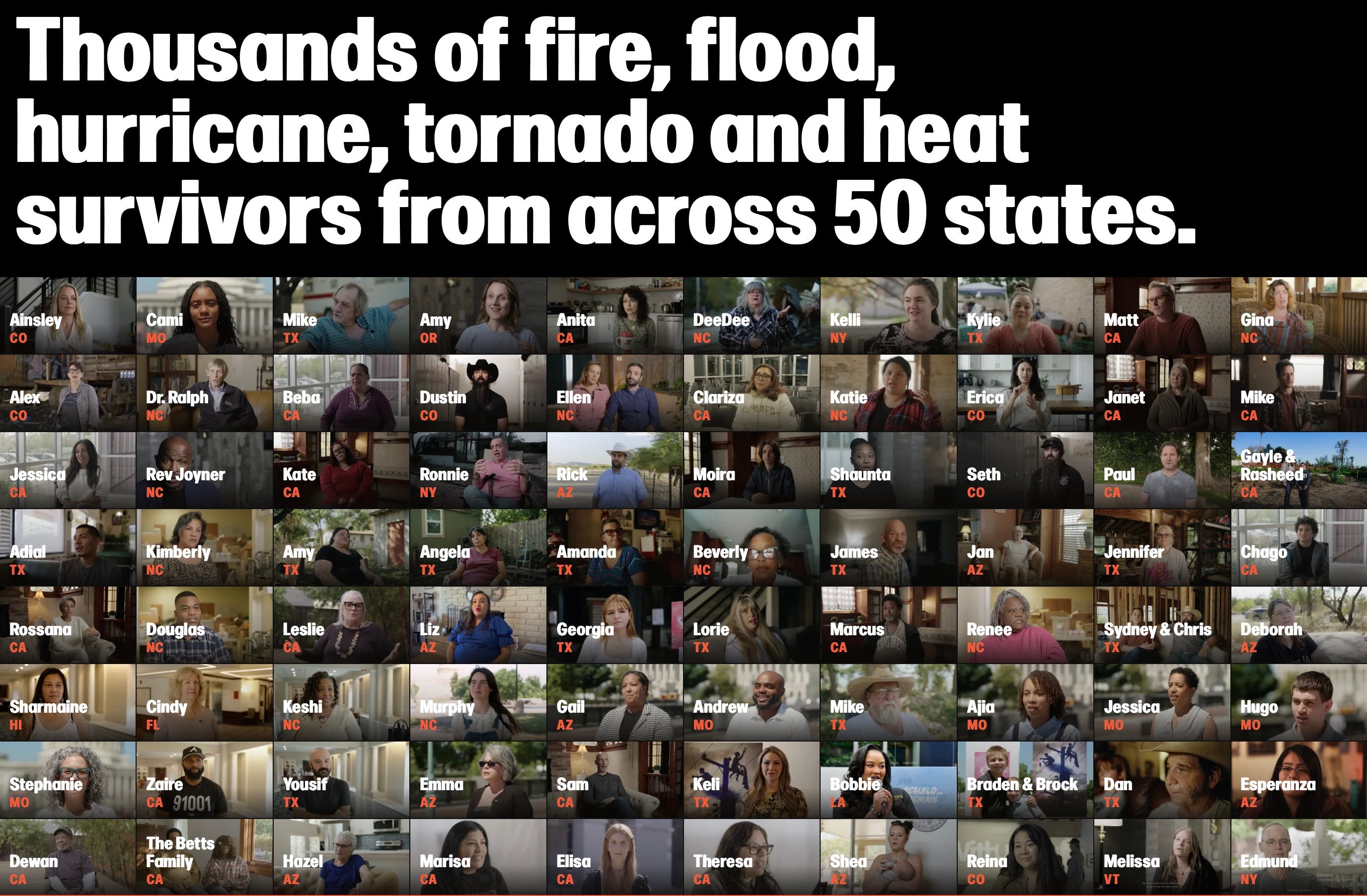
In telling their stories and sharing their experiences and values with others, these extreme weather survivors are uniquely qualified to help us grow The Climate Movement and fulfill our destiny to become the greatest and most long-lasting social change movement in the history of the world. We must become big and broad and active enough, the first characteristic/imperative/goal of The Climate Movement.
Big enough? Social science research has shown that 3.5% of a population can bring about major changes in a society. However, given the nature of our challenge, I believe we must be bigger: 5% by 2030 and 10% by 2040. This means we must be 16 million in the US and 400 million worldwide by 2030.
Broad enough? This means The Climate Movement all around the world must look like the nations from whence they spring.
In the US, we must look like America, and extreme weather survivors are helping us become so. That’s because climate change doesn’t care what your politics or your socio-economic status or your race or your beliefs are, or whether you think climate change exists, as was the case of Mike Malcolm from Texas (see below). No one is safe.

To help illustrate our breadth, my dominant metaphor for The Climate Movement is the Olympics. As Artist-Athletes we must use our specific talents in the particular places we live, our Fields of Action, to join together with our teammates to achieve victory for our nation and the world.
As Renee and Melissa emphasize in their comments above, we also must be together enough, our sixth characteristic/imperative/goal. There are many ways we can be together enough, as I explore in a whole series of posts.
One of the ways is through organizations like Extreme Weather Survivors, which has 2,500 participants thus far. Another is through Climate Action Teams or CATS. These are small groups, primarily self-organized, that do three things together: meet, support, act.
Political Power
As part of our people power, some extreme weather survivors are beginning to claim their political power. This is crucial to our ability as The Climate Movement to play our role.
“I just didn’t care about politics. I never thought I’d be doing this … It radicalized me to see my community devastated,” said Kylie Nidever, a former preschool teacher who saw what flooding did to her hometown in Texas.

To have political power we must grow The Climate Movement into a force that cannot be ignored. We must organize ourselves such as Extreme Weather Survivors is doing and by forming Climate Action Teams or CATS on all of our Olympian Fields of Action.
The #1 thing for all of us to do is grow and improve The Climate Movement into the greatest and most long-lasting social change movement in the history of the world. Together we make the impossible possible and the possible actual and the actual beautiful and our just future come faster.

As Melissa said, coming together creates hope. That’s because we are the hope we’ve been waiting for. We make hope happen.
If you are new here, check out our Intro Series. If you like this post, please “like,” comment and share/restack. And thanks for all you’re doing.