

Note: This is the first post in an 7-part Subseries on Climate Justice.
Preamble: Three Things to Keep In Mind
Before we begin our exploration of the climate justice dimension, let me remind us of three quick points concerning the relationship between hope and justice more broadly.
First, remember that hope and justice are a virtuous circle. Because justice is what we hope for, achieving justice creates hope, which in turn inspires more efforts to create justice.
Second, part of achieving justice is finding clarity on what we mean by each of the five dimensions of justice, in this case what we mean by climate justice. Such clarity helps us see what we are striving for, allowing us to figure out how to achieve it, generating hope in the process.
Third, the Climate Movement is a moral movement; we are about right and wrong. It is this combined with our numbers that give us power to make change. Justice is at the very center of this right-and-wrong understanding of who we are. Justice is moral power. Understanding what makes us powerful, claiming and realizing our power to create a better world and help make our just future come faster, creates hope to carry us forward.
And now for our discussion about climate justice.
Climate Justice: One of Five Dimensions
For some in the Climate Movement the words “climate justice” cover all five dimensions of justice we are discussing:
Generational
Distributive
Environmental
Climate
Nature.
In other words, for these folks wherever climate intersects with justice, that’s climate justice.
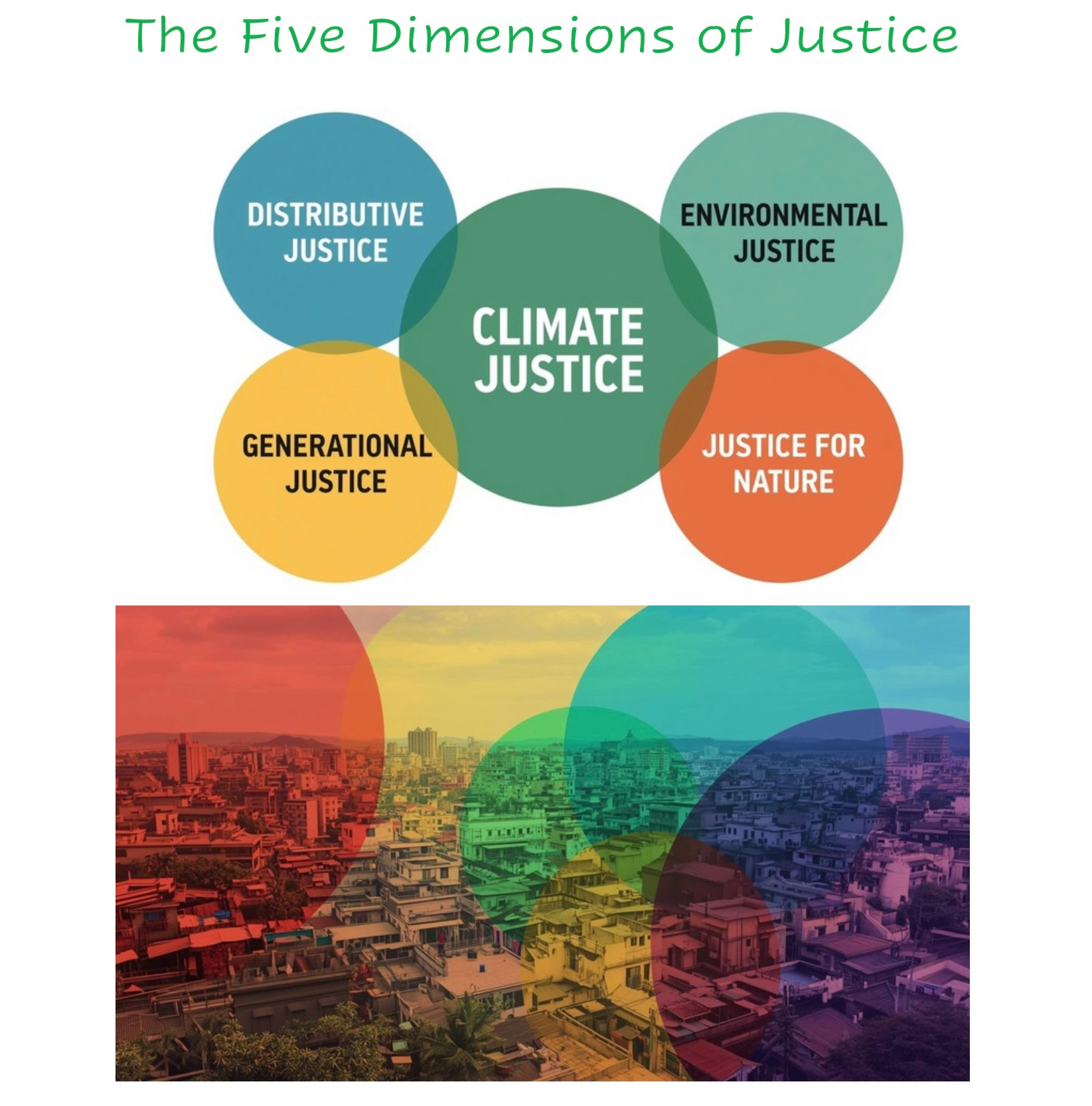
However, for others of us it means something more specific. That’s why, in this justice context, I use the term “climate” for one of the five dimensions, keeping in mind that they are all interrelated, and that when we say we want a just and prosperous sustainability, all five dimensions of justice are included.
As I have previously discussed, to achieve the desires and demands of justice through these dimensions we must do the three actions of justice on our Olympian Fields of Action:
stop bad stuff,
set wrong right,
make things better.
There is no Field of Action where we are not striving for justice. As such, on every Field we are creating moral power.
Climate Justice: Five Distinctive Aspects
But before looking at how we must work to achieve climate justice through the three actions of justice, we must summarize five distinctive aspects of climate change that discussions about climate justice must address:
so-called legacy emissions that become legacy pollution;
the systemic aggregate nature of the problem;
the simultaneous erasure of margins of climate safety, such as the destructive momentum built up in the oceans;
tipping points;
the unjust distribution of consequences.
While all five of the dimensions of justice are interrelated, it needs to be highlighted here that all five of these distinctive climate justice aspects have strong intertemporal and intergenerational ties.
Viewed more broadly, these aspects, while distinctive, are not unique to climate change. But the consequences they help create certainly are unique in the history of humanity. Tipping points are especially worrisome, creating a specter of the greatest injustice ever perpetrated on subsequent generations and the rest of the natural world.


Finally, as with all five of the dimensions of justice, with climate justice we must always keep in mind who has been, is being, and will be treated unjustly: the poor, the powerless and less powerful, the marginalized, the vulnerable, and today’s children and subsequent generations. These are the ones for which justice demands that we stop bad stuff, set wrong right, and make things better as we make our future come faster and our world more beautiful. (See my posts on The Who of Justice for a fuller discussion.)
Exploring climate justice involves a deep and rich conversation. To give you a sense of my contribution, here’s the outline of this Subseries:
Post #8.0 — Climate Justice: Introduction (this post)
Post #8.1 — Legacy Emissions, Legacy Pollution, and the Systemic Aggregate Nature of the Problem
Post #8.2 — Erasure of Margins of Climate Safety
Post #8.3 — Tipping Points
Post #8.4 — Unjust Distribution of Consequences
Post #8.5 — Achieving Climate Justice by Stopping Bad Stuff and Setting Wrong Right
Post #8.6 — Achieving Climate Justice by Making Things Better
Remember: hope and justice are a virtuous circle. The five distinctive aspects of climate justice help give us clarity on what we are joining together to overcome. Ours is a time for regular folk to become heroes together. Nothing less than greatness is our calling. Join us!

If you are new here, check out our Intro Series, as well as other posts in this Hope & Justice Series. If you like this post, please “like,” comment, and share. And thanks for all you’re doing.