

An Unfavorable Political Climate Even As Market Conditions Are Trending Our Way
It’s a tough time these days for some of those at the business-climate nexus, especially in the finance sector. The New York Times just published an article with the title, “How Wall Street Turned Its Back on Climate Change.” Here’s the article’s subtitle:
“Six years after the financial industry pledged to use trillions to fight climate change and reshape finance, its efforts have largely collapsed.”
Snap!
As the article notes, due to pressure from opponents of climate action the retreat started soon after big splashy commitments were trumpeted in 2020.
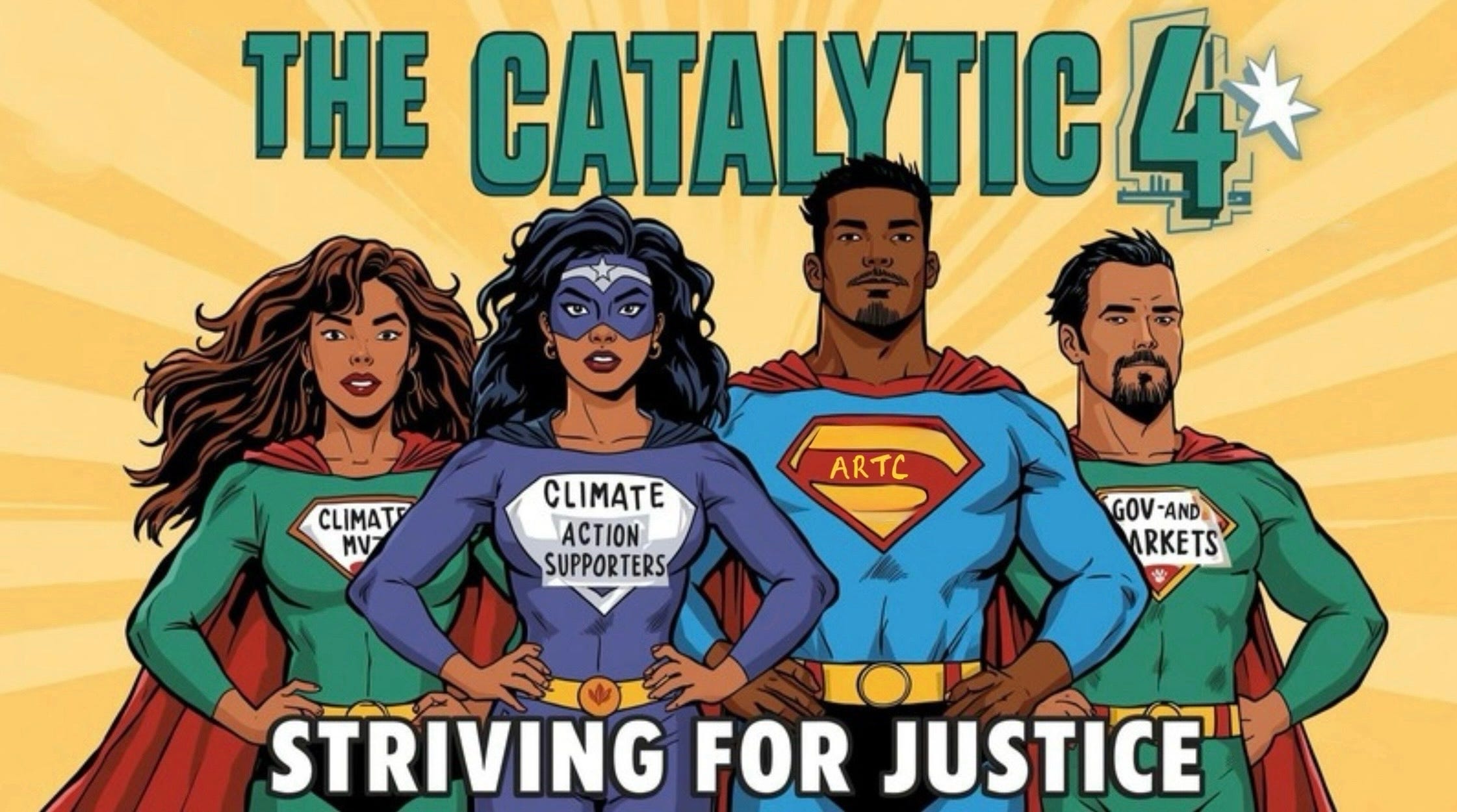
Even as the political climate in certain countries is hostile right now, as I recently argued we already have the market conditions we need for climate victory. The Market didn’t do this itself because it can’t. So how? As I put forward, it has been a Catalytic-4 affair:
Climate action and clean energy advocates and supporters of both, ARTC, and governments have worked for decades to create these market conditions in the present. It certainly has been a patchwork and a somewhat irregular affair. But they’ve gotten us here. Kudos to all those who have worked long and hard to have markets working for us instead of against us.
The kudos include all the groups that are a part of the next coalition we are exploring.
We Mean Business
In the midst of this mixed bag there are coalitions and efforts out there in the business space striving to make a difference, like the We Mean Business Coalition, another example of how coalitions can help us in The Climate Movement be together enough, our sixth movement characteristic/imperative/goal.

In our exploration of coalitions this one raises the question: can an effort focused mostly or even exclusively on reducing climate pollution be considered a part of the Climate Movement?
For some that may be a confusing, even absurd, question. Isn’t reducing climate pollution to avoid the really bad stuff what we’re all about?
For me, and many others, no. Remember our vision, purpose, and Major Goal as I have articulated them: to overcome climate change by creating a just and prosperous sustainability that enhances wellbeing for everyone and everything.
The We Mean Business Coalition (WMBC) has seven founding partners: BSR (formerly Businesses for Social Responsibility), CDP (formerly Carbon Disclosure Project), Ceres, CLG Europe, Climate Group, The B Team and WBCSD (the World Business Council for Sustainable Development). The organizations themselves are all focused on helping businesses become better on climate, and sustainability more broadly. That is their niche. To that end, they report that “20,000 companies have committed to bold climate action through WMBC initiatives.”
So what is the We Mean Business Coalition about? It is:
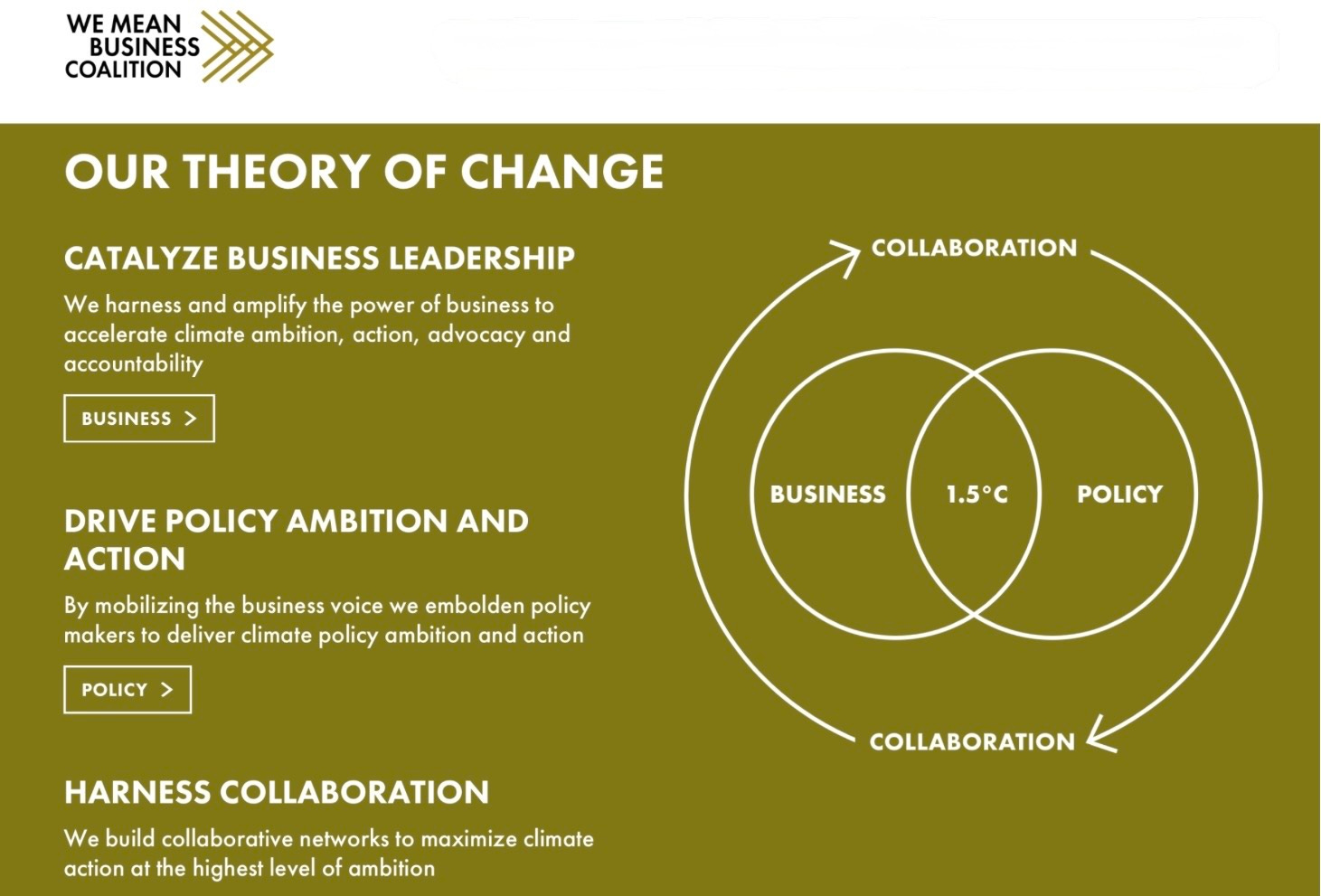
a global nonprofit coalition working with the world’s most influential businesses to take action on climate change. Together, we catalyze business and policy action to halve global emissions by 2030 in line with a 1.5C pathway.
WMBC is definitely in sync with overcoming climate change by reducing greenhouse gases. As seen below, their “Theory of Change” diagram has 1.5C right in the center. Their Annual Reports describe terrific work being done, driven by their approach of “making commitments and setting targets” — all of which is vital and to be applauded.
But what about creating a just and prosperous sustainability that enhances wellbeing for everyone and everything?
WMBC is working to “accelerate an inclusive transition to a global net zero economy by 2050,” which is how they articulate their own overarching goal. In their 2022, 2023 and 2024 Annual Reports, they state that their vision is “A world economy on track to limit global warming to 1.5C in ways that deliver sustainable economic growth and shared prosperity.”
However, while their mention of an “inclusive transition” and “shared prosperity” sounds encouraging, I found nothing in the remainder of these Annual Reports or most of their website that discusses what this might mean or describes any progress towards a “shared prosperity.” Honestly, it’s a rhetorical flourish they hope will be a nice byproduct of the clean energy transition — trickle-down prosperity.
Thankfully, in 2023 WMBC began to educate the corporations and businesses they work with about the need for a “just transition.” Unfortunately, I haven’t found any discussion on this since 2023.
Be that as it may, what do they mean by a just transition? Here is their answer:
According to the International Labour Organization (ILO), a just transition means “greening the economy in a way that is as fair and inclusive as possible to everyone concerned, creating decent work opportunities, and leaving no one behind.” A just transition can maximize economic and social opportunities for workers and communities through a process rooted in social dialogue, engagement, and partnership.
The ILO’s definition of a just transition is in keeping with how I have articulated our vision, purpose, and Major Goal: a just and prosperous sustainability that enhances wellbeing for everyone and everything.
But, in practice, the lens of “just transition” can narrow the focus of a just and prosperous sustainability that enhances wellbeing for everyone down to workers, and perhaps their communities, whose industries will incur job losses. Further, in their pitch to businesses, WMBC has a strong emphasis the corporate bottom line.
A company’s social license to operate will come to depend on how it factors a just transition into its corporate planning, so it is also increasingly seen by investors as an indicator of long-term profitability and a sustainable business model. By co-designing climate solutions with affected stakeholders, creating green and decent jobs across the value chain, and preparing people for the future of work, companies can play a positive role in the net zero transition – while seizing its economic opportunities. It is both a moral imperative and good business.
You can see here the focus on workers and what’s best for the company — both of which are good in and of themselves. This can work as long as the “moral imperative” they mention at the end — in this case the ILO’s fuller definition of a just transition — is not lost.
Towards this, their excellent resource for businesses provides a step-by-step plan that includes serious dialogue with workers and communities, the development of measurable objectives and key performance indicators, transparency, and advocacy for a just transition.
Advocacy is crucial for broadening the focus beyond workers and impacted communities. Achieving our vision, purpose, and Major Goal includes a major focus on poor countries and the people and communities within them. This includes:
shifting people from energy poverty to energy prosperity via climate-friendly sources;
having rich countries help them adapt and become more resilient to consequences they didn’t cause;
compensating them for loss and damage;
working with them to protect their forests, and;
addressing the debt issue by pausing or forgiving payments, providing low-interest loans to begin with, and coming up with creative solutions like debt-for-nature swaps, so these countries, communities, and peoples can make the needed investments.
WMBC, and businesses more broadly, must be advocates for these aspects of a just and prosperous sustainability as well, even as they concentrate on a just transition for workers and communities.
Given, until recently, their complete focus on 1.5C, and a lack, since 2023, of any discussion that I could find of a just transition, does this mean we shouldn’t consider the We Mean Business Coalition as part of the Climate Movement, until, say, they have more of a track record on our fuller vision?
Absolutely not.
We all have our roles to play on our particular Fields of Action. The We Mean Business Coalition is part of the Climate Movement as long as they are supportive of our efforts to overcome climate change in ways that help create a just and prosperous sustainability that enhances wellbeing for everyone and everything.
To be blunt, while we hope they will become more involved, we don’t need the We Mean Business Coalition to be leading the charge on a just and prosperous sustainability. They’ve made clear it’s not their primary Field of Action. While their talents and experience lie elsewhere, there is no reason they cannot learn to perform on other Fields of Action, like the gymnast Simone Biles who has mastered the vault, balance beam, uneven bars, and floor exercise. While we all cannot be champions in multiple events, we can become competent on those Fields of Action where we can make a difference.
While we might consider them a part of the Climate Movement, they may not see themselves that way or want to be viewed as such.
But you don’t have to think of yourself as a participant in the Climate Movement to be a part of it. You are free not to, even as you strive towards the same goal(s) as we do. No one has the authority to rule coalitions in or out. There is no formal membership in the worldwide Climate Movement. If you have made a sustained commitment to collective action over time to achieve our vision, purpose, and Major Goal, then you are a part of this movement, however quixotic and ambivalent such a recognition might feel. You may go so far as to disavow that you are part of any movement, even as you work with us.
C’est la vie.
The Catalytic Four Must Work Together For Business Potential To Be Realized
A final note on the precariousness of business coalitions, especially when pressured by hostile governments or government bodies, as exemplified by another coalition that We Mean Business helped organize, one of investors called the Climate Action 100+. Unfortunately, over 70 companies left Climate Action 100+ in 2024, including Goldman Sachs, JPMorgan Chase, and Blackrock (who transferred membership to a smaller international entity), in part due to House Republican investigations. Climate Action 100+ acknowledges these departures, but states that “hundreds of investor signatories remain committed to ensuring 170 of the largest greenhouse gas emitters reduce emissions, improve governance, and strengthen climate-related financial disclosures.”
As I have argued and will do so in upcoming posts, businesses must be significantly involved in achieving our vision, purpose, and Major Goal. When they form a constructive positive symbiotic relationship with government, i.e., when they are part of our Fourth Catalytic Source of Transformation, i.e., Governments-&-Markets, then will their essential contribution begin to be realized.
Much of the implementation will take place through markets. But unless government is not hostile and is at least somewhat supportive, business involvement at the speed and scale needed will never happen.
Without the Climate Movement and Climate Action Supporters encouraging and pushing both governments and businesses to work together, to become a climate-action-Governments-&-Markets symbiosis, we will not succeed.
One thing must be stated plainly. Given the need for speed and scale, the well-worn tactic of having voluntary business goals designed to forestall stringent but needed efforts mandated by governments must not be allowed to stand. In other words, a business-government symbiosis cannot work towards weakening efforts.
Furthermore, we must not settle for the false hope of trickle-down prosperity. We are working towards a just and prosperous sustainability that enhances wellbeing for everyone and everything.
This is why the Climate Movement and Climate Action Supporters are our first two Catalytic Sources of Transformation, and why Governments-and-Markets working together — where Government pushed by us is in the driver’s seat — is our fourth.
Thanks in part to coalitions like We Mean Business and others who have worked for decades to make sustainability business-friendly, including those in the ARTC space who have made clean tech through invention and innovation the clear business choice, we now have the market conditions necessary to overcome climate change. And such conditions will only get better. But now things must happen faster as we simultaneously pursue justice.
Even with these better conditions, the fossils aren’t giving up their profits without a fight, delaying needed speed and scale as long as they can, pushing us further into dangerous and deadly territory.
That’s why we must become the greatest and most long-lasting social change movement in the history of the world. Together we are making the impossible possible and the possible actual and the actual beautiful and our just future come faster. Join us!
If you are new here, check out our Intro Series, as well as other posts in this Olympian Fields of Action Series. If you like this post, please “like,” comment, and share. And thanks for all you’re doing.