

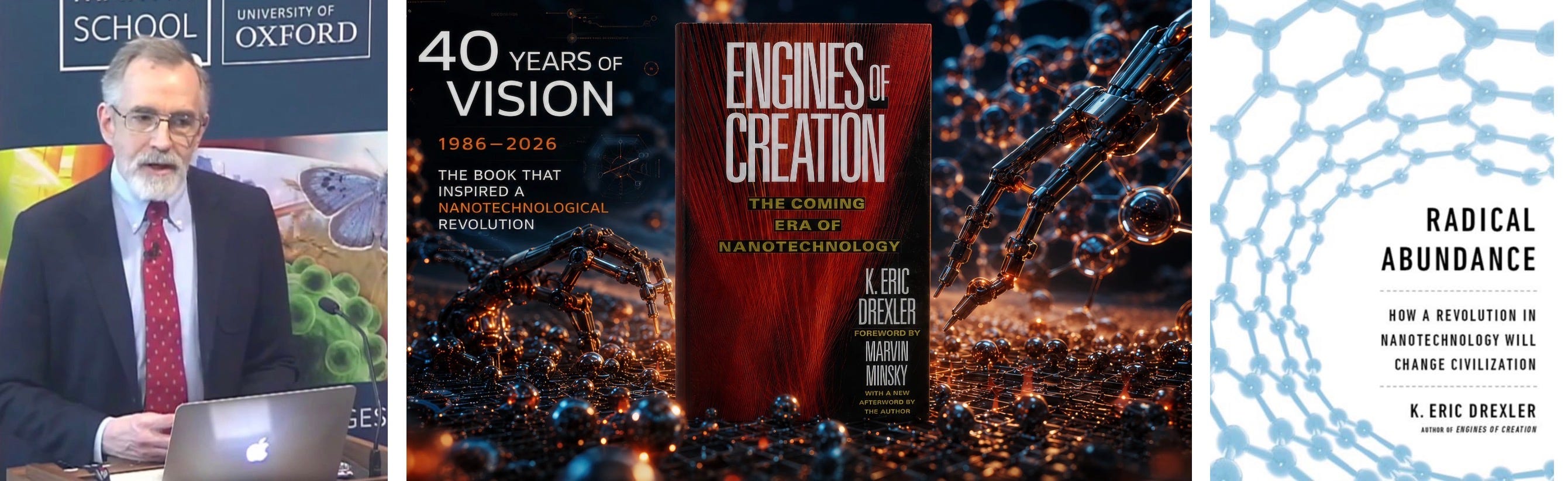
Drexler Has a Vision
In 2013 Eric Drexler, dubbed by some “the godfather of nanotechnology,” wrote a short piece titled “Is Climate Change a Manufacturing Problem?” It was basically taking a distillation of his book published that year, Radical Abundance: How a Revolution in Nanotechnology Will Change Civilization, and then applying it to climate change. This book, in turn, was an update and refinement of his first one in 1986, Engines of Creation: The Coming Era of Nanotechnology, that helped launch the field of nanotechnology.
As his book titles suggest, Drexler doesn’t mind swinging for the fences.
What got Drexler interested as a young man in engineering more broadly were environmental problems.
“It was the early environmental movement that infused me with a sense of mission. … Rachel Carson’s 1962 bestseller, Silent Spring … This kind of reading had its effect and in April 1970 I joined others (in a minor, high-school way) in boosting the first Earth Day.
Two years later I encountered a book that changed my view of the world more profoundly: Limits to Growth. …
[Trying to think about solutions led him ] to explore the potential of technologies in the nanoscale world” (Radical Abundance).
So, for Drexler, applying his mature work to climate change was coming back to home base 40 years later.

The key driving concept in Radical Abundance is Atomically Precise Manufacturing (APM), and in his short piece he sketches how it can be a solution to climate change.
APM will provide the ability to make atomically precise structures that range from billion-processor tablet computers, consumer goods, and aerospace components, to high-performance thin film photovoltaics, delivered in rolls of tough material suitable for resurfacing roads and rooftops.
Global material economic development is in the end a problem of making things, a problem of manufacturing. The scope, resource frugality, and cost structure of APM can make global wealth accessible within the constraints of Earth’s limits [italics added, harkening back to Limits to Growth].
To reverse (not merely slow) the rise in atmospheric CO2 is an immense task that seems beyond the capabilities of the industrial technologies that created the problem. The productive capacity of APM, however — access to terawatts of low-cost solar power and means for efficient CO2 capture — could eventually enable draw-down of excess greenhouse gas levels on a decadal time scale. …
The path to APM-level technologies will not be short, but can be seen as a natural outgrowth of progress in atomically precise fabrication
So, via APM we’ll be able to make stuff much better, faster, and cheaper to boot — stuff that can eliminate and suck up climate pollution.
However, that last statement, that the creation of APM “will not be short,” is an important clue for how we should approach its possibilities.
Some of the reviews of the time for Radical Abundance were not kind, effectively implying Drexler was off his meds:
“Delusions Of Grandeur: Author insists ‘atomically precise manufacturing’ will transform civilization, but he’s not dealing with reality. … He just doesn’t understand that his conception of nanotechnology is a fantasy.”
Drexler is casting a vision, and visions are indeed fantasies if no one tries to make them a reality.
Should we try? My answer is Yes.
Atomically Precise Manufacturing — What Is It?
But before we continue we must describe what Atomically Precise Manufacturing is supposed to be.
At its simplest, it is creating products at the atomic level by precisely arranging atoms so that there are no gaps, missing atoms, defects, or impurities, leading to zero structural defects for resulting products.
In other words, if you want a chair, an APM chair will be a righteous chair.
It’s as if Plato said, “Make me an ideal chair.” And, poof, APM obliges. You actually get to sit on the essence of chairness. APM is the matchmaker between the ideal world and the material world, the incarnation of the essence of things.

David Forrest, a leader in the field since the mid-1990s, including award-winning stints at the Department of Energy (DOE) with a focus on APM, was recently asked in an interview what difference precision makes.
“Because that extra amount of precision changes the performance of materials by something like a factor of 50.”
Ok, atomically precise, great.
Manufacturing? How’s that going to happen?
Here again is Drexler casting the vision:
Imagine replacing an enormous automobile factory and all of its multi-million dollar equipment with a garage-sized facility that can assemble cars from inexpensive, microscopic parts, with production times measured in minutes (emphasis added). Then imagine that the technologies that can make these visions real are emerging—under many names, behind the scenes, with a long road still ahead, yet moving surprisingly fast (Radical Abundance).
This comes about via manufacturing at the atomic level, “manufacturing using machinery based on nanoscale devices.”
“The key is to apply atomically precise nanotechnologies to build the machines we use to make things. Large scale, high-throughput atomically precise manufacturing is the heart of advanced nanotechnology, and in the coming years it has the potential to transform our world.
APM is a kind of manufacturing, but it isn’t industrial manufacturing. The differences run from bottom to top and involve replacing enormous, polluting factories with clean, compact machines that can make better products with more frugal use of energy and material resources” (Radical Abundance).
As Forrest puts it:
If you want to make cars and laptops and skyscrapers to atomic precision you need nanofactories with assembly lines that have trillions of molecular machines. That’s how life on earth works, too, by the way. Our biosphere grows and is sustained by vast numbers of molecular machines.
So nano-machines and nano-factories making righteous stuff, the essence of its stuffness in a useable product.
Nano-machines making righteous stuff, the essence of stuffness in a useable product.
Doable? Hmmm …
So APM sounds good!
How? That’s the trillion dollar question.
Ok, the basic idea of atomic precision is fairly straight forward, and, as such, seems doable to a layperson like me.
It’s the nano-manufacturing part, the “molecular assemblers” part, where it gets a bit vague and incredibly complicated.
But peer-reviewed journal articles report on specific progress in certain areas, such as: “Frontiers in Atomic-level Manufacturing: Atomic-scale Electrochemical Deposition (2025); “Enabling Novel Device Designs, Scalable Manufacturing, and Rapid Prototyping with Direct Atomic Layer Processing (DALP™)” (2025); “Machine Learning-Assisted Precision Manufacturing of Atom Qubits in Silicon” (2024); Atomically Precise Manufacturing of Silicon Electronics“ (2024); and “A Molecular Assembler that Produces Polymers” (2020).
A good summing up is provided by a key federal agency, NIST (the US National Institute of Standards and Technology): Atom-scale Devices: Engineering, Metrology and Manufacturability. And several scholars in the field have produced a fairly recent take of where they think things stand: A Comprehensive Analysis of the Future of Atomically Precise Manufacturing (2024).
All a bit head-spinning. What the rest of us need is an “APM For Dummies.”
Tim Ventura, who, admittedly is a bit of a booster, recently wrote a 40-year retrospective on Drexler’s vision, first articulated in Engines of Creation in 1986.
As Ventura summarizes at the beginning:
Nanofactories remain a long-term goal, but molecular machines, DNA origami, atomic-scale fabrication, and AI-designed proteins show how far the science has advanced.
Later Ventura compares progress to date to rungs on a ladder:
Science has learned to observe individual atoms, reposition them, pattern surfaces, program molecular self-assembly, construct artificial motors, guide sequence-specific synthesis, predict protein structures, generate new molecular designs, and automate experimental feedback. The higher rungs — continuous operation, broad chemistry, integrated control, error correction, massive parallelism, and multiscale production — remain ahead. But the lower and middle rungs are no longer imaginary. The path hasn’t been completed, yet considerably more of it is visible than it was in 1986.
As for the next 10 years, Forrest was asked what he would like to point to as a contribution from APM. His answer:
“Atomically precise membranes. Because they could be used for cleaning toxins from water, cleaning blood to eliminate kidney dialysis, mining valuable minerals from seawater, and cheaply removing greenhouse gases from the atmosphere.”

Always on the Horizon? The Ultimate Techno-Magic Dodge?
Ok, in 2013 Drexler says “The path … will not be short.” Just a couple of weeks ago Ventura says “Nanofactories remain a long-term goal,” and “The path hasn’t been completed …”
Will it ever? Is APM always on the horizon, a vision that never quite makes it in reality? I don’t think anyone can really say.
But there has been progress that in and of itself is worthwhile, and I believe it’s a vision that continues to be worth pursuing.
Bottom line: it should be getting more public R&D funding.
But could this be a trap? Not by Drexler, but used as one by others? A diversion, despite Drexler’s climate concern and his concern for Earthly limits more broadly?
For decades politicians and others who didn’t want to do serious action on climate change have employed what I call the markets-and-techno-magic dodge: we don’t need to do serious climate policies because just at the right time markets and techno-magic will create the solutions we need. Poof! Society just needs to continue to support basic science and the market will take it from there.
Total BS.
Is Drexler’s vision the ultimate in techno-magic? If all we did was put all our eggs in the APM basket, or even R&D more broadly, then yea, it would be.
But that’s not what we’re doing. It’s not what we’re going to do. It’s not some binary either/or situation. It’s a both/and.
APM could really help us — or not. But it’s worth supporting, even as we push to employ today’s helpful tech as big and as fast as possible. We must take some big risks to mitigate climate risks. We must take risks to overcome risks.

For some of you, APM is your specific Field of Action. Great!
But for APM and other promising tech like self-driving labs to get the public funding they need, for strategic ARTC of both kinds, broad-based and targeted, to come into its own as our Third Catalytic Source of Transformation, all of us in The Climate Movement must continue to grow and improve our movement so that our three forms of power — Moral Power, People Power, and Staying Power — are enough to get the job done. Join us!
If you are new here, check out our Intro Series, and others in our ARTC series like this. If you like this post, please “like,” comment, and share/restack. And thanks for all you’re doing.