

I love salt. I’ll never forget the day my doctor told me to add salt to my diet. I was thirsty all the time and yet I was drinking water constantly. Solution? Salt.
Well, we just may need a little sodium in our energy diet. Or maybe a lot of sodium. It’s “salt-shaker-storage” time, so to speak.
This is the second of a two-part ARTC Series on energy storage focused on batteries. Part One contextualized the Series in our broader conversation about our Third Catalytic Source of Transformation, the accelerating rate of technological change or ARTC, and then focused on lithium ion batteries with their falling costs, rising sales, and increased volume.
This post starts our continuing conversation about the future of energy storage focusing on what’s ready to take off: sodium-ion batteries.
Sodium-ion batteries are very similar to lithium-ion batteries. They are competitors in many of the same market niches for stationary and mobile energy storage needs. They store electrical energy as chemical energy so it can be turned back into electricity when needed.
The MIT Technology Review calls sodium-ion batteries one of their “10 Breakthrough Technologies for 2026.” Why? Because sodium-ion batteries
offer potential cost reductions of more than 30%, improved performance in extreme temperatures, and reduced supply chain risks associated with lithium mining.
Whereas lithium is only available in a few countries (Chile, China, Australia) and its mining is environmentally damaging, sodium is 1,000 times more prevalent and is found all over the world.
Bottom line: when it comes to EVs and energy storage for electricity, lithium is the present, but sodium will be a big part of the future.
When will sodium’s future arrive? It’s just beginning.
EVs
When it comes to EVs with sodium-ion batteries, three Chinese companies are leading the charge:
BYD, the world’s largest EV manufacturer and second largest battery manufacturer;
CATL, the world’s largest battery manufacturer, and;
BAIC or the Beijing Automotive Group, China’s sixth-largest automobile manufacturer.
These three are pushing each other to get better.
Recently BAIC announced a prototype vehicle with the following specs:
fully charged in 11 minutes;
a 280 mile range based on an energy density of over 170Wh/kg, and;
can operate in -40F to 140F (extreme temps are an achilles heal of litium).
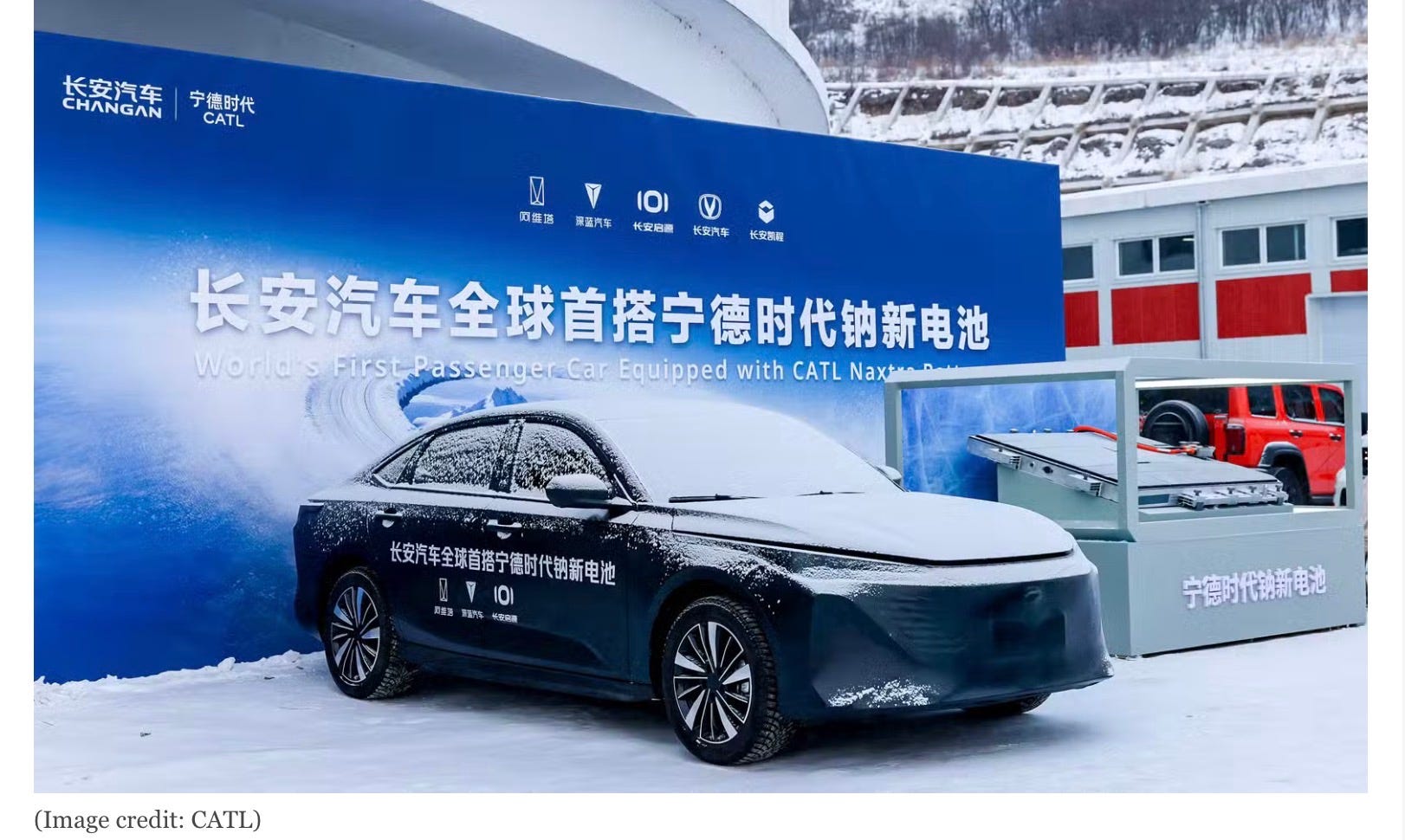
This summer CATL will introduce the first mass-produced EV with sodium-ion batteries and around a 250 mile range. They have also announced a sodium-ion battery with 175 Wh per kg, which also allows for around a 280 mile range. These batteries also “demonstrate high safety, passing tested under tough conditions including crushing, drilling, and sawing without smoke or fire while maintaining continuous power supply.”
Goodby:
the overhyped “range anxiety”;
charging time concern;
decreased performance in lower temperatures;
safety concerns.
Hello market share.
Stationary Energy Storage Systems (ESS)
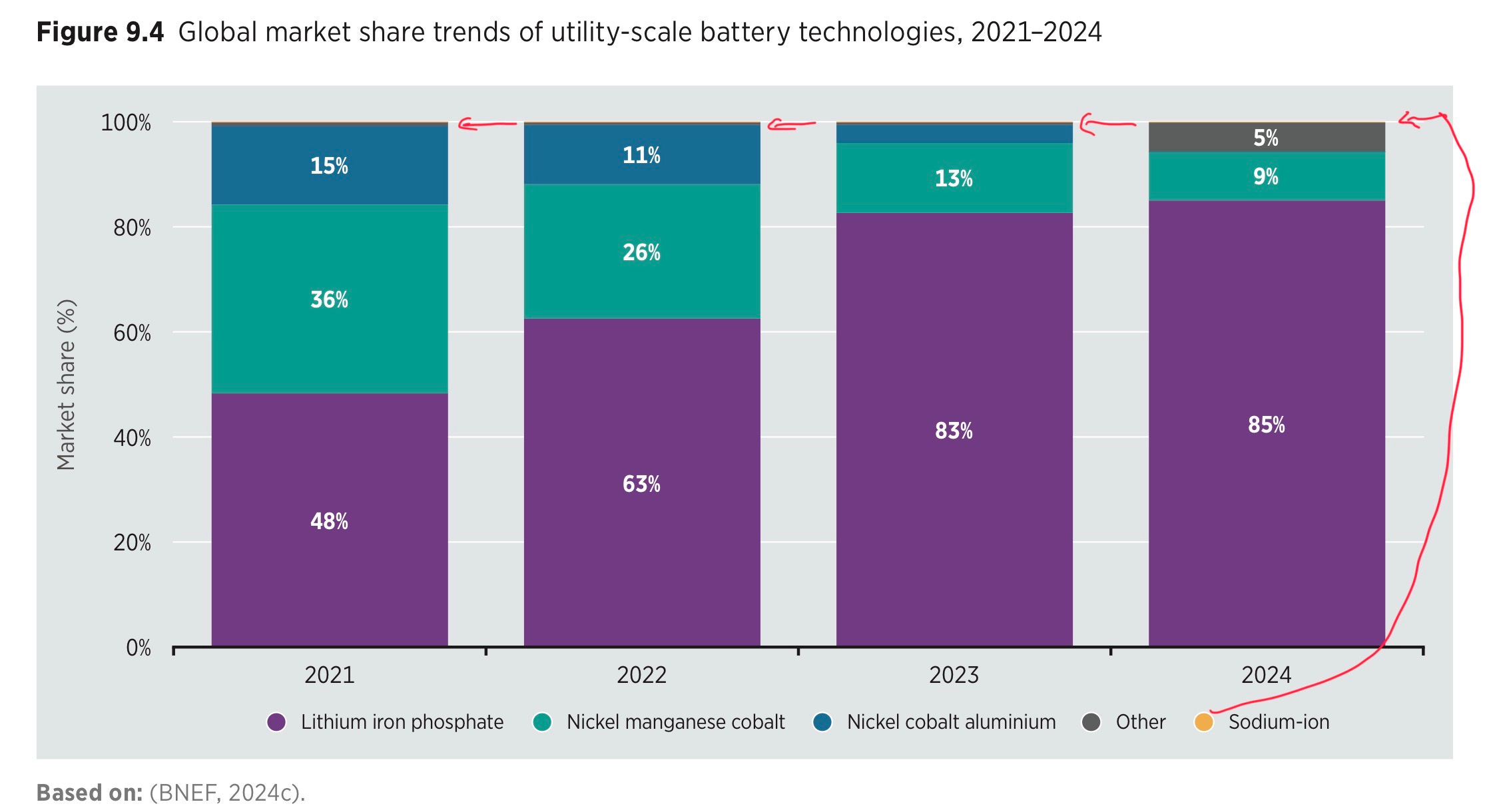
Currently Sodium-ion batteries are a teeny tiny fraction of the utility-scale battery market. The IRENA graph below tries hard to picture this. Is there some yellow up at the top representing Sodium? Squint hard. Even if you can’t quite see it, it’s supposed to be there.
Even so, analysts are bullish about sodium-ion’s future. A key factor: sodium’s abundance and geographical spread make it a much cheaper input than lithium.
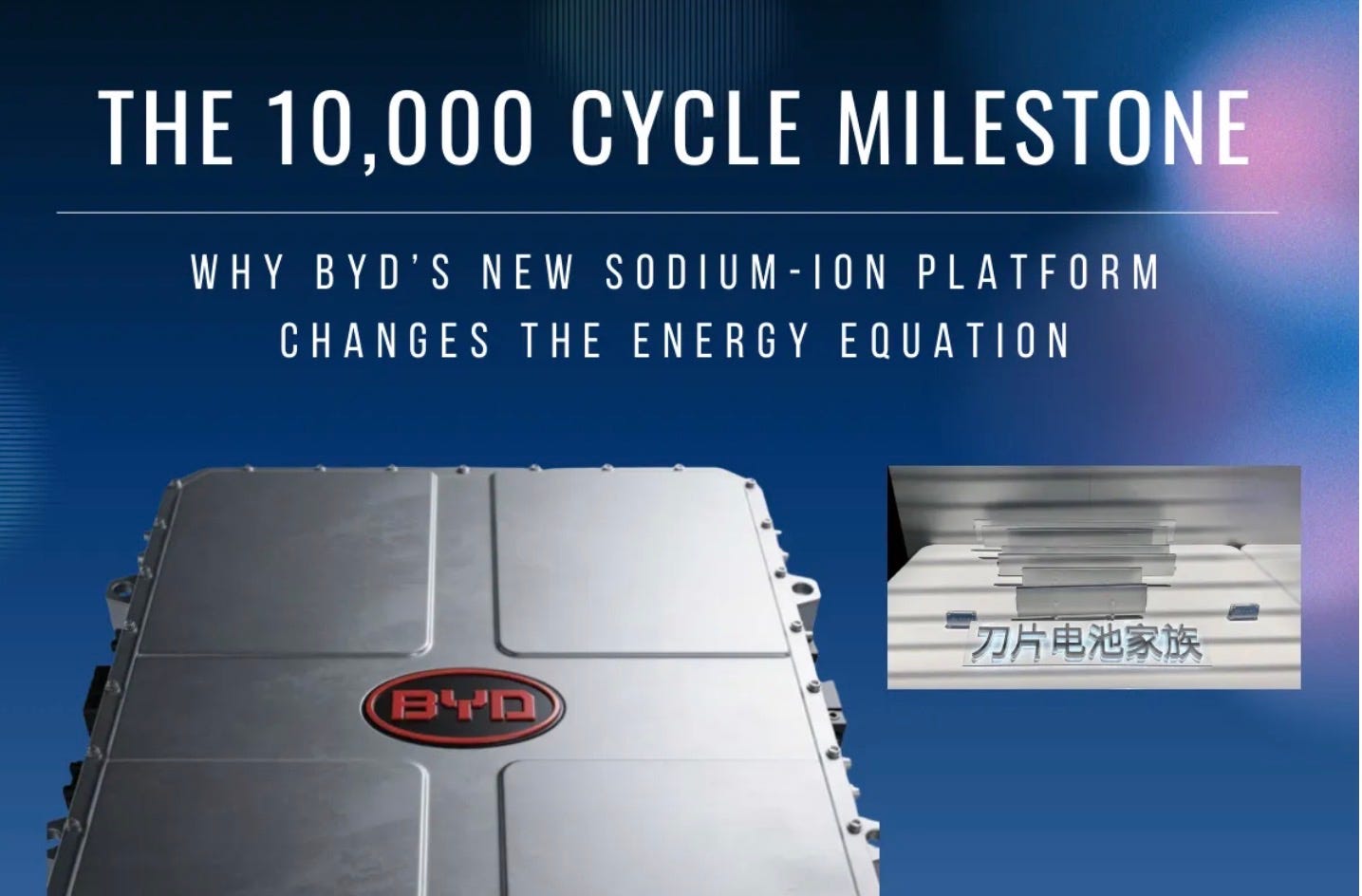
A recent announcement about a potential game-changer has them even more excited. BYD has developed a sodium-ion battery with a 10,000 charge life cycle, which equates to 20-30 years or more.
When looked at from the Periodic Table, both lithium and sodium are light elements — but sodium is three times heavier. This allows for greater energy density in lithium batteries. For EVs this means longer range and greater efficiency because lithium batteries weigh less for comparable performance.
For stationary situations, this weight advantage doesn’t apply.
Thus, sodium-ion’s advantages for stationary systems start to add up:
a cheaper input;
superior performance in extreme temperatures;
systems lasting 20-30 years or longer;
weight and energy density less of a factor or even a non-issue.
BloombergNEF projects that by 2030 sodium-ion battery systems could account for 23% of the stationary energy storage market. And if economies of scale kick in sooner, uptake will go faster.
Two years ago sodium-ion’s characteristics and potential led one analyst, Auke Hoekstra, to pen this speculation:
Sodium batteries will become ridiculously cheap. That in turn will revamp our electricity grid: local demand response will be key, resilience and grid stability will improve, grid reinforcements will become less of a costly bottleneck, and solar and wind will thrive. In terms of our energy system, batteries will change everything. … And all of a sudden we will put stationary batteries everywhere.
We’re not there yet. But we could be.
With lower costs and better performance for both lithium and sodium batteries, and with hybrid systems combining them for the best of both, such energy storage will transform the electricity sector:
renewables + batteries = zero climate pollution from energy generation, storage, and utilization;
bye-bye fossils;
more freedom from the grid, less dependency on monopolistic utilities, more off-grid systems, and less need for new grids or expensive grid upgrades paid for by consumers.
In sum: clean, climate-friendly, cheap, and reliable.
The Battery Future Ain’t Either/Or
The beginning of the rise of sodium-ion batteries doesn’t mean the fall of lithium batteries anytime soon. It’s not one or the other, but one and the other.
Lithium battery manufacturers and researchers are continuing to innovate, e.g. improving energy density that increases EV range, and performance in very cold weather, as well as reducing full charging times to as little as 5 minutes.
One analyst sums up the situation for stationary energy storage:
Forecasts suggest sodium-ion shipments could expand rapidly over the next five years, moving from early GWh-scale deployments toward meaningful grid-level penetration by 2030. The trajectory points toward diversification, not displacement.
Lithium will remain critical.But sodium has crossed a psychological and technical threshold.
The 10,000-cycle benchmark signals that sodium-ion is no longer a fallback technology — it is a strategic pillar in the global energy transition.The future of batteries will not be singular. It will be multi-chemistry, application-optimized, and supply-chain resilient. And sodium has officially entered the core conversation.
The Catalytic-4 Must Deliver Speed & Scale
The International Energy Agency (IEA) loves to throw water on tech market penetration by up-and-comers like sodium-ion batteries, and do so here as well:
Relying on potential disruptive breakthroughs is a precarious foundation for business success, and especially for broader industrial strategy. In the absence of an efficient, competitive battery manufacturing ecosystem, even promising advances may struggle to reach commercial scale quickly enough to deliver real benefits.
Of course, the IEA consistently underestimated how quickly renewables would ramp up. So there’s that.
Still, we can’t afford for them to be right on any up-and-comers who can make a strategic difference.
In general, outside of speciality niches, it will take a few years before sodium batteries are cost-competitive, and then have a cost-advantage.
However, price doesn’t always win, at least in a timely fashion. Intransigence, ignorance, inertia, wanting to milk what will become stranded assets — these barriers and others can slow the uptake of sodium-ion batteries.
What this means for us is simple: for any promising tech that will help us overcome climate change, The Catalytic-4 must work together to deliver speed and scale. That means The Climate Movement must play its strategic role and push their other three to play their roles. If things aren’t moving fast enough, we must push until they are.
So where we see that sodium-ion batteries — or any other promising tech — can help us achieve our vision, purpose, and Major Goal we must push their uptake and utilization.

If you are new here, check out our Intro Series, and other posts in our ARTC Series. If you like this post, please “like,” comment, and share. And thanks for all you’re doing.