

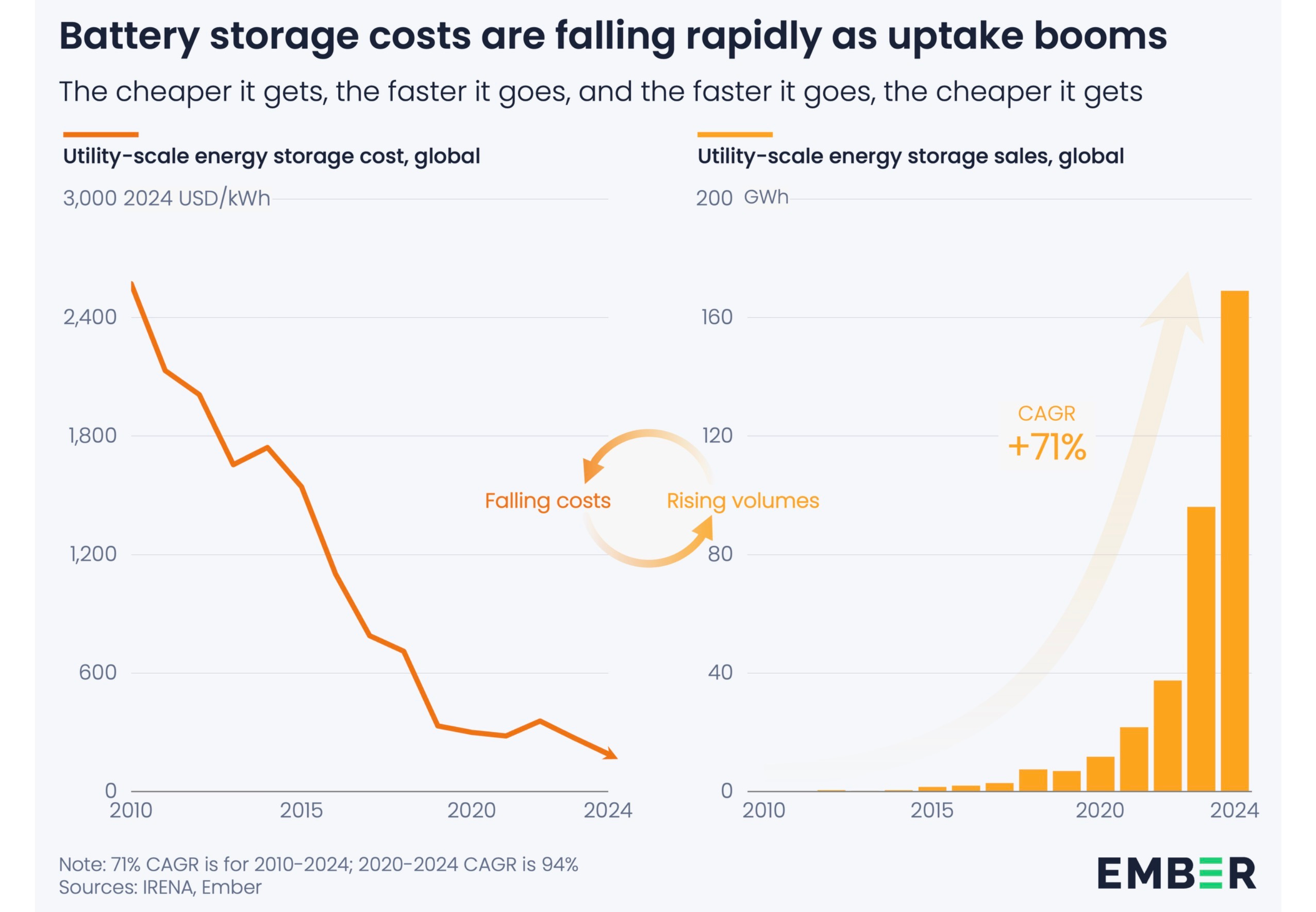
This is the first in a two-part Series on batteries, or, more broadly, energy storage. This post, Part One, does two things: (1) contextualizes this conversation in our third Catalytic Source of Transformation, the accelerating rate of technological change or ARTC, and then (2) looks briefly at our current situation with batteries and energy storage. Part Two will look at future possibilities.

ARTC For Climate’s Sake
In the 19th Century in France there arose a slogan, “Art for Art’s Sake,” that was subsequently taken up by American artist James McNeill Whistler and others. It represented the view that art does not have to be reduced to some deeper moral purpose or narrative. Beauty is its own justification. In the early part of the 20th Century a Latin translation was put above the lion’s head in the MGM logo.

But when it comes to ARTC, Climate Movement Artist-Athletes (i.e. everyone in The Climate Movement) cannot go along with a slogan “ARTC for ARTC’s sake” — at least not all ARTC.1
No, we have a moral agenda. We want to make ARTC, our third Catalytic Source of Transformation, work for us as we overcome climate change, to stop bad stuff, set wrong, right, and make things better, to create a just and prosperous sustainability that enhances wellbeing for everyone and everything.
Our goal: strategic ARTC for climate action. ARTC for humanity’s sake. ARTC for Creation’s sake.
But Is Tech Change Accelerating?
But is tech change actually accelerating? I have briefly made the case for this (and will say more in future posts). To illustrate ARTC, I’m relying on powerful graphic visual representations. One of the most important comes from the work of Ian Morris.
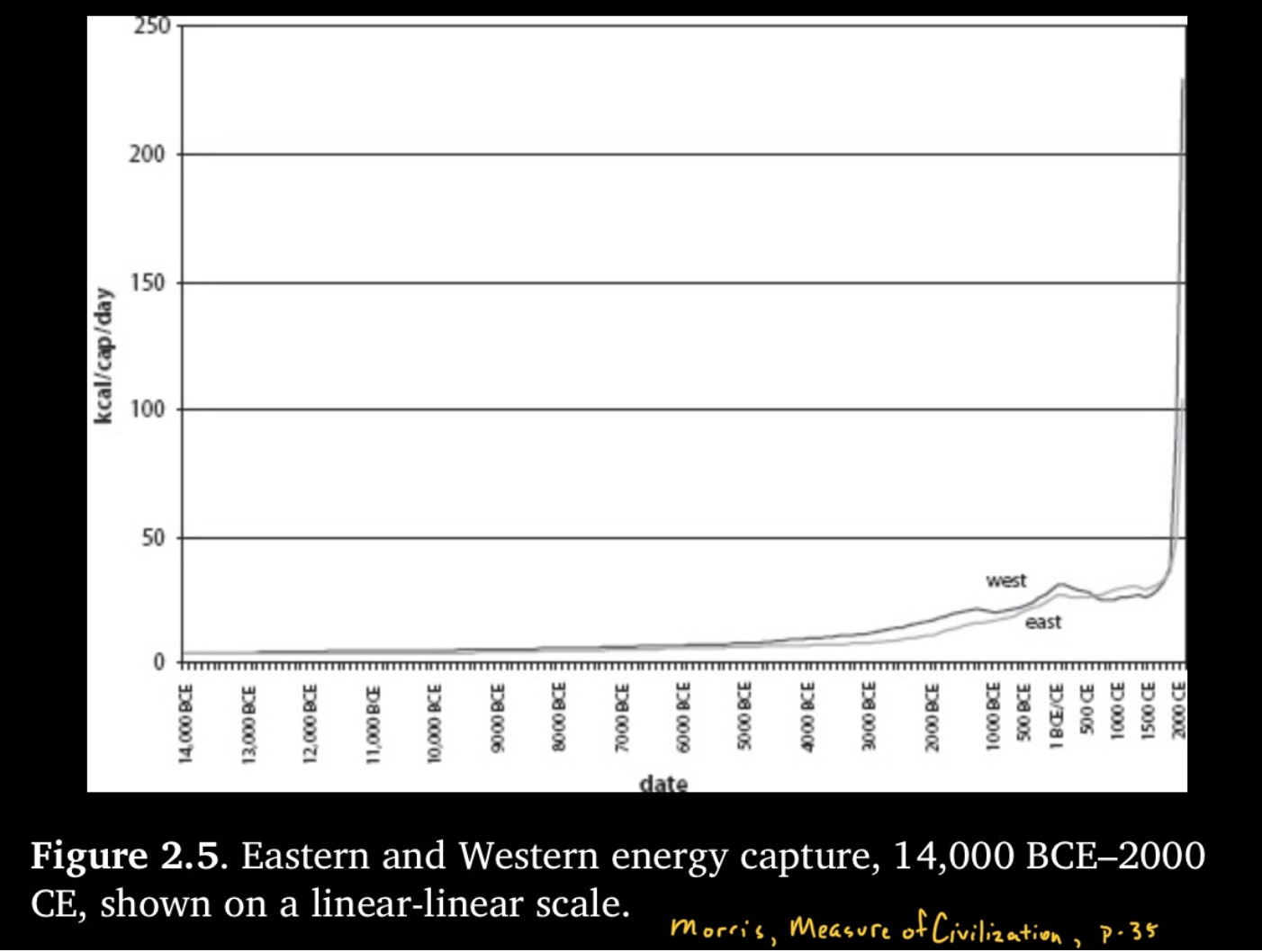
Morris has measured the ability of humans to capture and use energy over time — including calories from food. As can be seen in the above graph showing energy capture from 14,000 BCE to the year 2000 CE, tech change connected with energy capture has not progressed gradually or consistently over time. Over thousands of years it barely budged. In the West it even declined during the Middle Ages. But beginning with the Industrial Revolution it has shot up like a rocket and hasn’t slowed down since.
Fossil fuels have been around as long as homo sapiens have. So why did we suddenly start capturing and releasing the stored fossil energy with the Industrial Revolution?
It is the combination of fossil fuels and tech change that made energy capture, and the economic wealth that went along with it, shoot straight up. Why?
As I have discussed briefly earlier, I believe Nobel prize-winning economic historian Joel Moykr, Nobel prize-winning economist Paul Romer, and others have explained the various pieces of the puzzle.
I’ve combined these pieces and boiled it down to this: ARTC happened and keeps going due to the continual production of useful knowledge generated by what I call the “ARTC-Combo”: (1) specialization; (2) nonrivalry of knowledge, i.e., its endlessly copyable and useable nature, and; (3) market competition.
But now the energy storage source of the Industrial Revolution is killing us and the planet and it’s well past time to switch from this dirty, limited energy storage source to clean renewable forms of energy capture. ARTC-and-fossils haven’t painted a pretty picture when it comes to the environment and human health, and now the climate scourge.
The time of the fossils is over, as is their paring with ARTC. The ARTC-Combo has found ways to divorce ARTC from dirty old fossils and their death dealing.
Not ARTC for fossils’ sake. ARTC for humanity’s sake; ARTC for Creation’s sake.
We are on the cusp of not just an energy transition, but an energy revolution, driven forward by ARTC, the accelerating rate of tech change.
It’s our job as The Climate Movement to ensure that ARTC in this new revolution in energy production, storage, and utilization helps achieve our vision, purpose, and Major Goal: to overcome climate change by creating a just and prosperous sustainability that enhances wellbeing for everyone and everything. To achieve this we must have speed and scale of transformation the likes of which the world has never seen — and ARTC plus The Climate Movement, indeed, all of The Catalytic-4, can make that happen.
ARTC & Batteries
One of the ways ARTC is allowing us to capture energy for our use are new approaches to energy storage, particularly batteries.
Like me, the folks at Ember are also adapting the work of Ian Morris. They have created their own graph below showing energy capture, storage, and utilization over time. Employing alliteration with the “F” sound, they break things down into four eras: Foragers, Farmers, Fossils, and Photovoltaics. Just as the Agricultural Revolution, i.e., the move from Foragers to Farmers, brought about a 100-fold increase in energy capture per hectare of land, so the move from fossils to clean energy systems, primarily photovoltaics plus storage, will create another 100-fold leap in useful energy, what they call “energy abundance.”
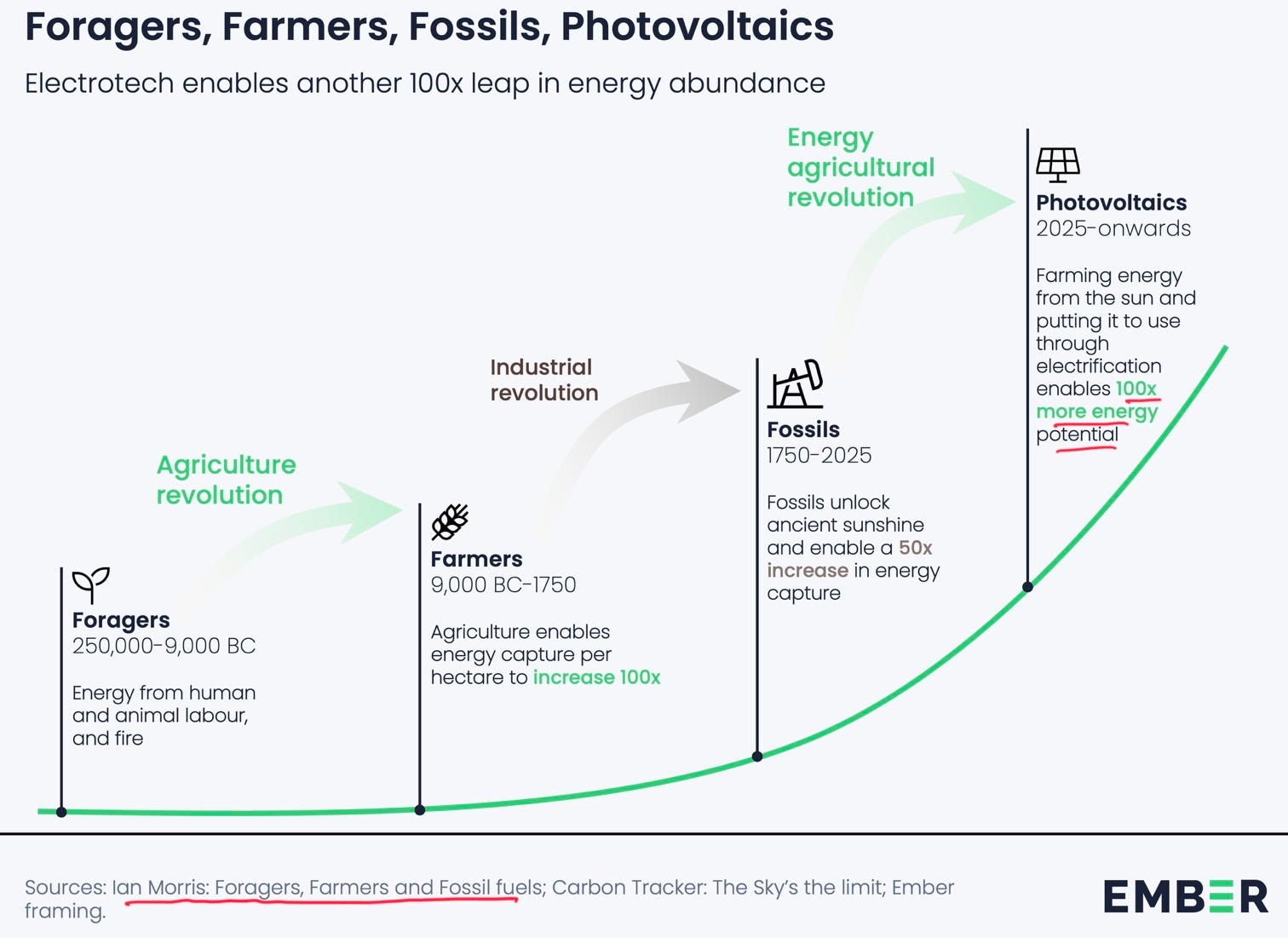
As a recent Ember report framed it, comparing the Agricultural Revolution with this new one:
The shift to renewables represents an agricultural revolution for energy, moving from searching and extracting scarce fuels to harvesting abundant sunlight in place. Much as granaries and refrigeration transformed food markets, storage will turn electricity from perishable to persistent, unlocking a new era of energy abundance (emphasis added).
Ember calls what’s coming “the electrotech revolution.” They mean that our future will be run on electricity, including the transportation sector.
Right now and for the foreseeable future useful electricity cannot be stored as electrical energy. It must be utilized when it is created. It’s a use-it-or-lose it kinda situation — unless you can find a way to store energy from electricity.
When you do so cheaply and reliably, when you create “silos for sunshine,” in Ember’s phrase, everything changes. But it’s the type of change that humanity has accomplished before. As Ember states:
Renewable electricity may be a new kind of harvest, but the challenge of storing it, and the system-wide shifts it sets in motion, go back to the dawn of agriculture. The technologies may be new, but the dynamics are as old as civilisation.
Energy Storage and the Present
Today, one key way to store electrical energy as chemical energy is with batteries. The most common form are lithium-ion batteries, which turn electrical energy into chemical energy that can be stored until electricity is needed and the chemical energy is turned back into electrical energy.
What’s going on right now is the outgrowth of the continual production of useful knowledge via the ARTC-Combo funneled into learning curves and economies of scale. This process has dramatically but predictably driven down costs. The International Renewable Energy Agency or IRENA reports that
Between 2010 and 2024, the costs of battery storage projects declined 93% … This cost reduction was driven by technological chemistries, advancements materials in battery efficiency improvements, manufacturing scale-up and optimisation, as well as increased market competition (emphasis added).
In other words, ARTC at work.
As their graph shows, as battery prices go down, capacity goes up.
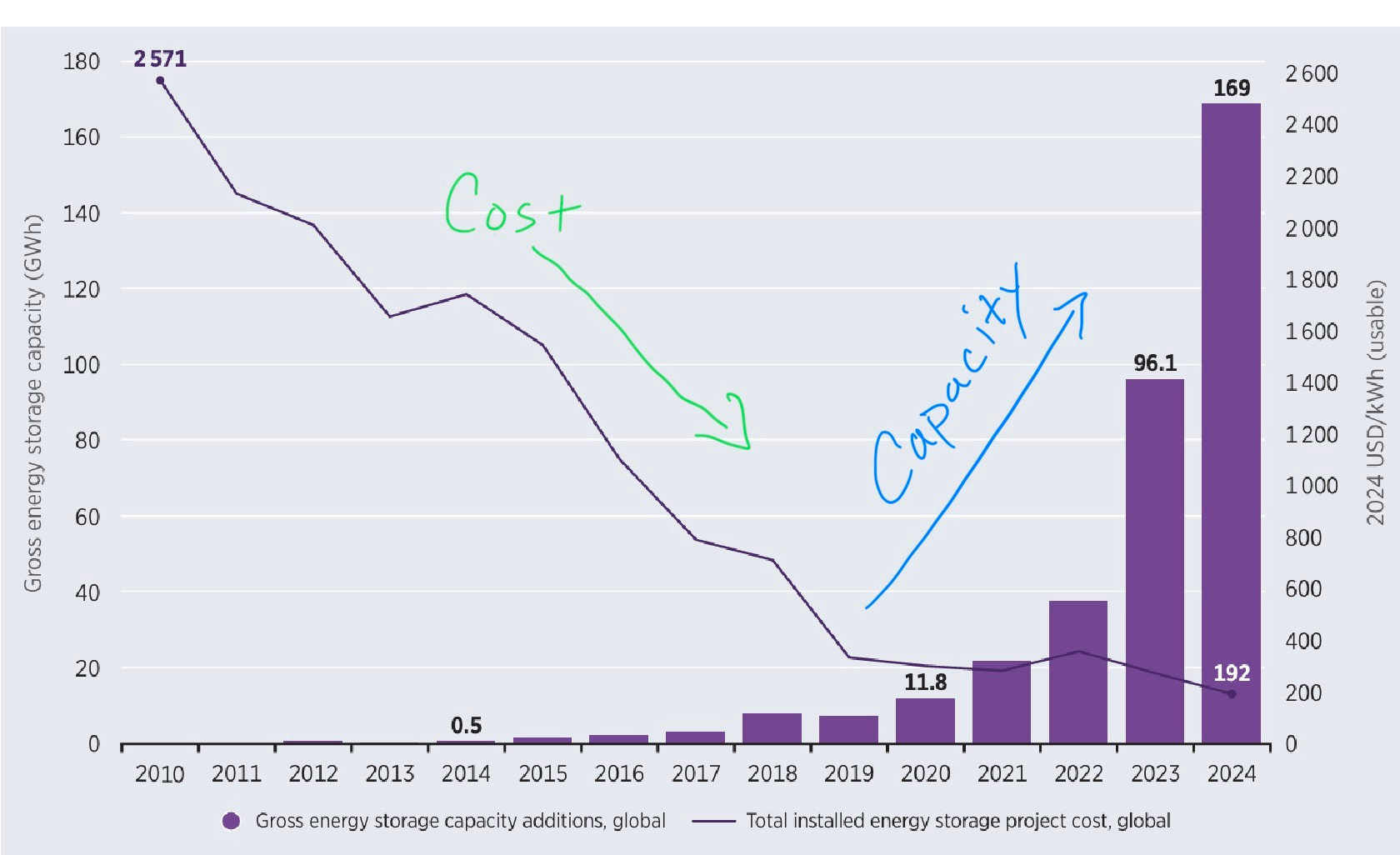
BloombergNEF also has a nice graph below.
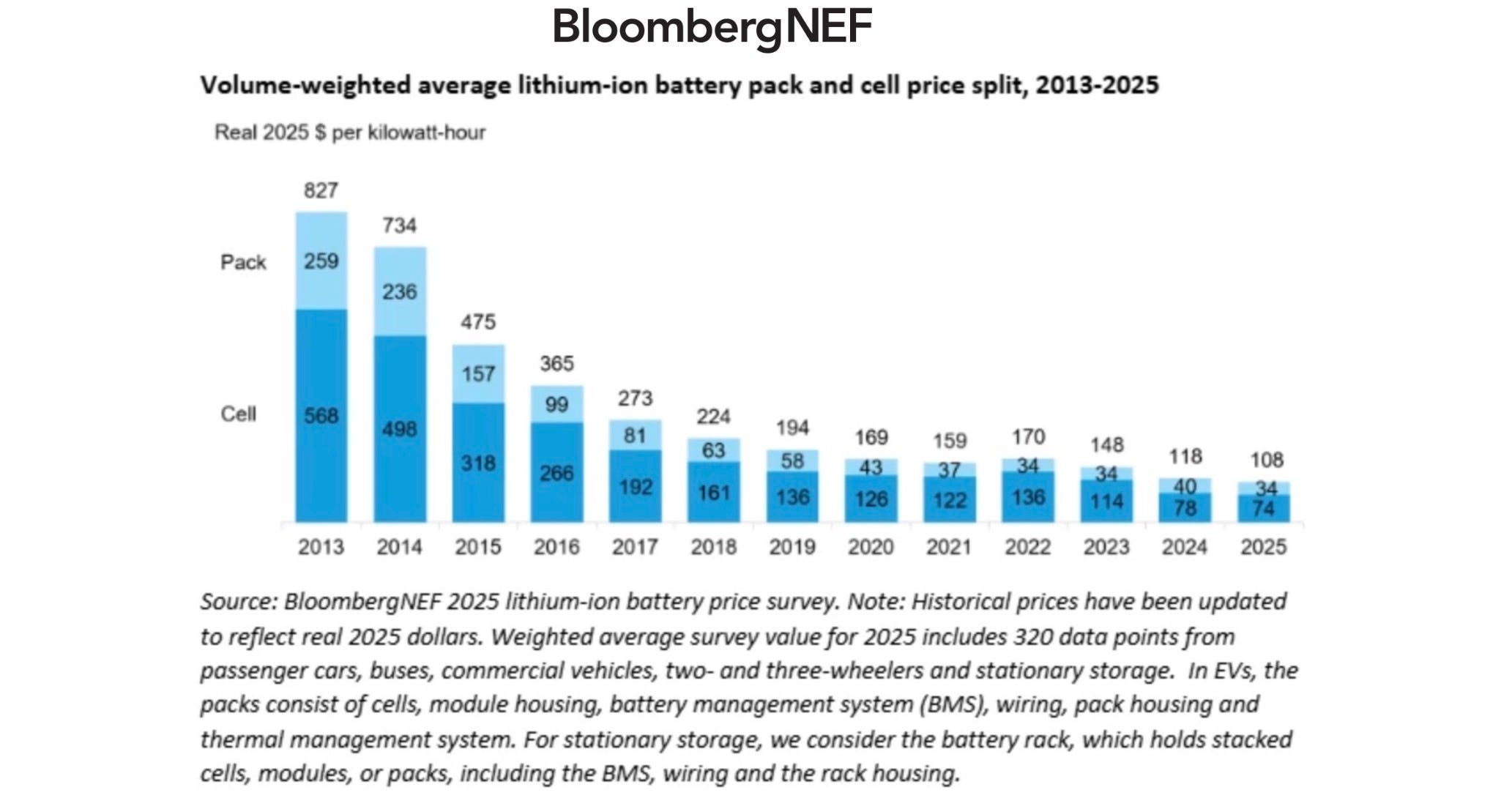
As Evelina Stoikou, the head of BNEF’s battery technology team, remarked:
Cut-throat competition [part of the ARTC-combo] is making batteries cheaper every year. This is an important moment for the industry, as record-low battery prices create an opportunity to lower EV costs and accelerate the deployment of grid-scale storage to support renewables integration around the world.
The cheaper current battery storage gets, the more batteries are bought. The more bought, the cheaper it gets. And that’s just with lithium batteries. Even cheaper ones are on the horizon. (See Part Two, forthcoming.)
And where are these batteries being produced? Well, for those of us in the US we can take pride in a highly successful effort by the Biden Administration to boost the domestic battery industry. As Canary Media recently reported:
“For the first time, the United States now has the capacity to supply 100% of domestic energy storage project demand with American-built systems,” said Noah Roberts, executive director of the U.S. Energy Storage Coalition. … “That is a fundamental shift from where we were just a year and a half ago, when the majority of battery storage systems were imported.” … The development of U.S. grid-battery manufacturing has happened at a dizzying pace. Roberts called it “one of the fastest industrial scale-ups in recent American history (emphasis added).”
This is a clear example of what The Catalytic-4 can do together to create speed and scale.
But we must broaden our horizons here and not be so myopic. Ember and others who are looking at energy storage holistically see a completely different picture — “the batterization of everything,” as Gerard Reid put it — than those who only think about batteries as storage for “dispatchable” electricity created by a utility. In the future, just about any tech that needs energy may come with its own storage, meaning it won’t have to stay tethered to the electric grid.
And where will the energy come from in the first place? From the power of the Sun captured by renewables creating useful energy in the form of electricity. In other words, a climate-friendly energy system.
Our job as The Climate Movement, as Climate Artist-Athletes together in common cause, is to ensure that the speed and scale of this transformation helps us overcome climate change by creating a just and prosperous sustainability that enhances wellbeing for everyone and everything. We must channel the power of The Catalytic-4 towards this purpose.

We must make ARTC strategic, which includes making it just. Join us!
If you are new here, check out our Intro Series, and other posts in our ARTC conversation. If you like this post, please “like,” comment, and share. And thanks for all you’re doing.
This is not to suggest we shouldn’t be supportive in general of a type of “ARTC for ARTC’s sake,” i.e., basic science R&D designed to explore scientific frontiers. We need such research. The same holds true for supporting inventions whose full contribution is not yet visible to us. Michael Faraday, inventor of the electric motor, when asked about the usefulness of it, is reported to have replied, “What good is a newborn baby?” Faraday invented the electric motor in 1821. It took over 50 years before it became useful. ARTC helps ensure that the usefulness of inventions and scientific discoveries comes much faster today.