

He Changed the World by Revolutionizing Scientific Instruments
As we saw in our previous post (#2.4) in this Smog-Climate Subseries, Dr. Arnold Beckman was a key figure in the LA smog fight.
While grateful for his leadership on smog, his most significant contribution to society was his ability to make scientific instruments and the creation of companies to sell such instruments.
As James Watson, of Watson-and-Crick double-helix fame, said in the Foreword to Beckman’s biography:
“Our pursuit of the chemical underpinnings of biology has depended as much on the invention of new instrumentation and experimental procedures as on the generation of new experimental results and new ideas. Arnold Beckman’s contribution to science and to society came, in part, from his rare talent for creating these new instruments …”[1]
Such instruments could be the difference between genius realized and genius squandered. As Nobel Prize winning economic historian Joel Mokyr has observed, Leonardo Da Vinci had thousands of pages of ideas that could not be realized because:
“the gap between the visionary who saw what might be done and the craftsmen whose material and tools limited what could be done was too wide to be bridged.”[2]
Beckman’s inventions would bridge such gaps.
That’s exactly what he did in the smog fight — bridge gaps.
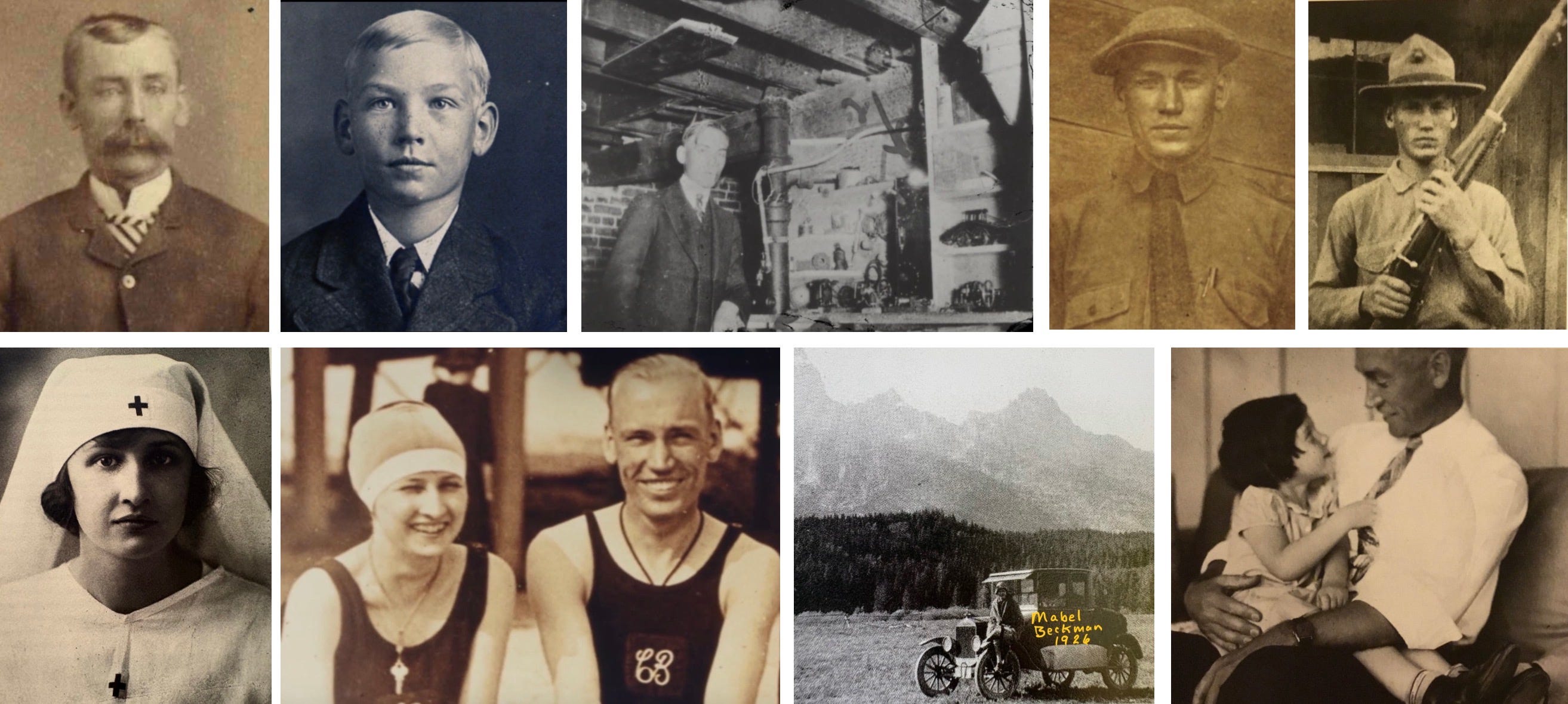
A Blacksmith’s Son and Budding Chemist
The son of a blacksmith who grew up making his own toys in the farm village of Cullum, Illinois, there never was a time when he did not understand that the proper tools helped one create things that mattered – and also made a profit.[3]
His love of chemistry began when he was just nine years old. Rummaging through the family’s attic one wintry day looking for something to do or read, he came across an introductory chemistry book that once belonged to an aunt. It had instructions for doing some basic experiments, “and that intrigued me, and in this little town I tried to carry out these experiments.”[4] For his 10th birthday his father built him a small shed to use as a laboratory. A few years later when he was 12 he had his first job as a chemist. Using sulfuric acid and a hand-cranked centrifuge, Beckman measured the cream content of dairy products brought in by local farmers.[5]
By the time he was in high school the family had moved to Bloomington, IL. When a freshman, Beckman convinced the principal to let him take advanced chemistry courses at the local college instead of Latin; he eventually graduated with over two years of college chemistry credits.[6]
To keep his interest kindled, his college professor while he was in high school encouraged him to start his own consultancy, and even found him his first client, Union Gas and Electric. Beckman had a closet in the family’s Bloomington home, his “lab,” where he did his chemistry work. He had business cards printed up for “Bloomington Research Laboratories” with his title being “Chief Scientist.”
He almost burned the house down several times – literally throwing an experiment on fire out the window on one occasion – but otherwise things went well.[7]
His consultancy involved a problem familiar to our story: sulfur. The coal Union Gas and Electric used had high concentrations, and they devised a procedure to get rid of the smell. Beckman’s work was part of that process.
As we have seen, years later he would put his finely honed chemist’s sense of smell to good use, declaring to Lewis McCabe, the head of the LA Air Pollution Control District, that sulfur dioxide wasn’t the real culprit in LA’s smog. It was this conviction, combined with his businessman’s desire to forestall any more costly regulations that wouldn’t solve the problem, which kept him on the case, and led to McCabe approving the hiring of Haagen-Smit to do the necessary research that quickly ruled out SO2.
“Hoot” Beckman Improvises
During his high school years, 1914-17, Beckman, or “Hoot” as he was known, not only had his chemistry business. He also was a pianist and organist for the local movie theater, where every night he accompanied silent films. As he watched the film he had to improvise music on the spot to help create the proper mood. In addition, Hoot had his own group, “The Beckman Orchestra,” complete with business cards and publicity photos, that played at parties, dances, and events.[8]

His talent for improvisation – which involved both invention and innovation – demonstrated a quality he would display his entire life: the ability to quickly size up a situation, see the possibilities, and marshal his gifts and resources to create a high-quality, successful product. He would do the same with smog.
By the time he was 18 and had graduated as valedictorian, Beckman was a successful scientist, entrepreneur, musician, and businessman. As his biography remarks, “he already exemplified Louis Pasteur’s maxim, ‘Chance favors the prepared mind.’”[9]
A Marine and His Sweetheart
Upon graduation from high school Beckman joined the Marines to fight in World War I. After boot camp at Parris Island in South Carolina, and a few days before the war’s end, Beckman was at the Brooklyn Navy Yard awaiting transport to a theater of operations. He missed by one spot leaving on a ship bound for Russia and two years of fighting the Red Army. As Beckman himself said, if not for this one place in line, “my life would have been completely different.” With the armistice signed on Nov. 11, Beckman was in Brooklyn for Thanksgiving when he met a 17 year old Red Cross volunteer serving food to the soldiers, Mabel Meinzer. Six years later they would be married.[10]
Theirs was a long-distance romance, as Beckman returned to his home state to earn in four years both a Bachelors and Masters degree in chemistry from the University of Illinois.
After one year of Ph.D. work at Cal Tech, Beckman missed Mabel too much, and left California on the cheapest transport he could find, an old steamer that sailed down to the Panama Canal and up the East Coast.
Bell Labs Sets the Stage
He felt he couldn’t ask Mabel to marry him without a good paying job, yet he had no prospects lined up before he left Cal Tech. He arrived in New York hoping he could find something quickly. In just one day he had two offers, one at Bell Labs made possible by a Cal Tech friend, which he accepted. He spent two years there before being enticed by Cal Tech to return to finish his Ph.D.[11]
Although he didn’t know it at the time – after all, he came to New York for love, not to further his career – these two years at Bell Labs would prove crucial to the great successes of his life as an inventor, entrepreneur, and CEO.
First, he was introduced to the electronics revolution, and much of his career would be about combining electronics and chemistry. As he later recounted, “If I’d never gone to Bell Labs, I might not have developed any interest in electronics.”[12]
Second, he learned first hand about the need for quality control in the production process to ensure real life reliability and customer satisfaction. Phones were complex pieces of new technology that had to be simple to use and rugged enough for everyday wear and tear – exactly the qualities that Beckman infused in his inventions and products.
Third, he learned that a company based on cutting edge technologies must do the necessary research and development to remain competitive.
Finally, his boss, Walter Shewhart, showed Beckman that dealing with the facts in front of you was good business. As Beckman would later recount:
“I’ve often said that one important thing, whether in science or business, is to have intellectual integrity. Don’t allow yourself to have wishful thinking. And that was what Shewhart did” (emphasis added). [Thackray & Myers, One Hundred Years, p64]
This, of course, is exactly how Beckman dealt with the problem of smog – in sharp contrast, as we have seen, to the Stanford Research Institute (SRI) and the Oil Industry.
An Inventor of Scientific Instruments Comes Into His Own
By the time Dr. Beckman became involved in the smog fight in 1946 he had already been a professor of chemistry at Cal Tech, an inventor and innovator of scientific instruments, the founder and CEO of several technology companies, and a prominent member of the Chamber of Commerce.
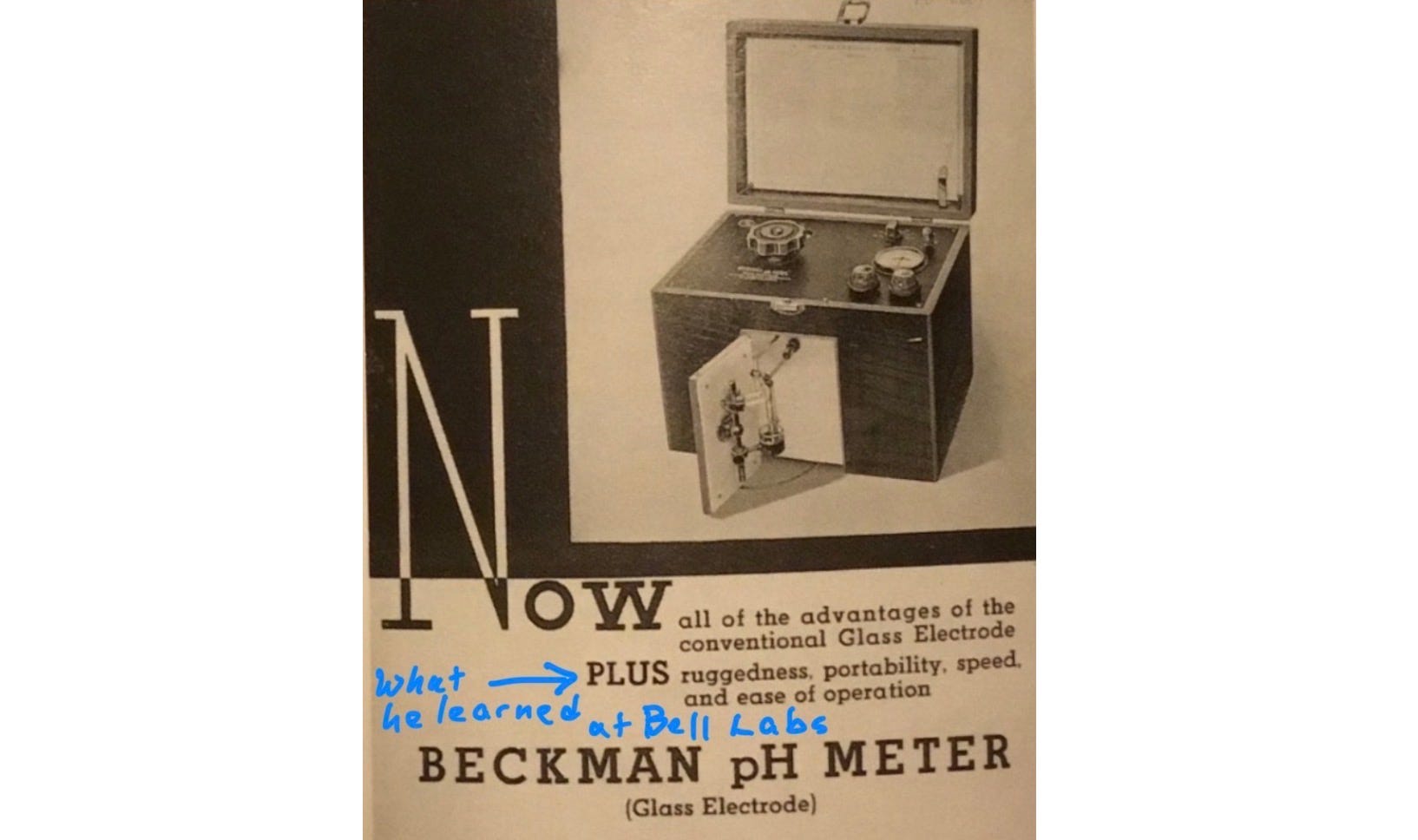
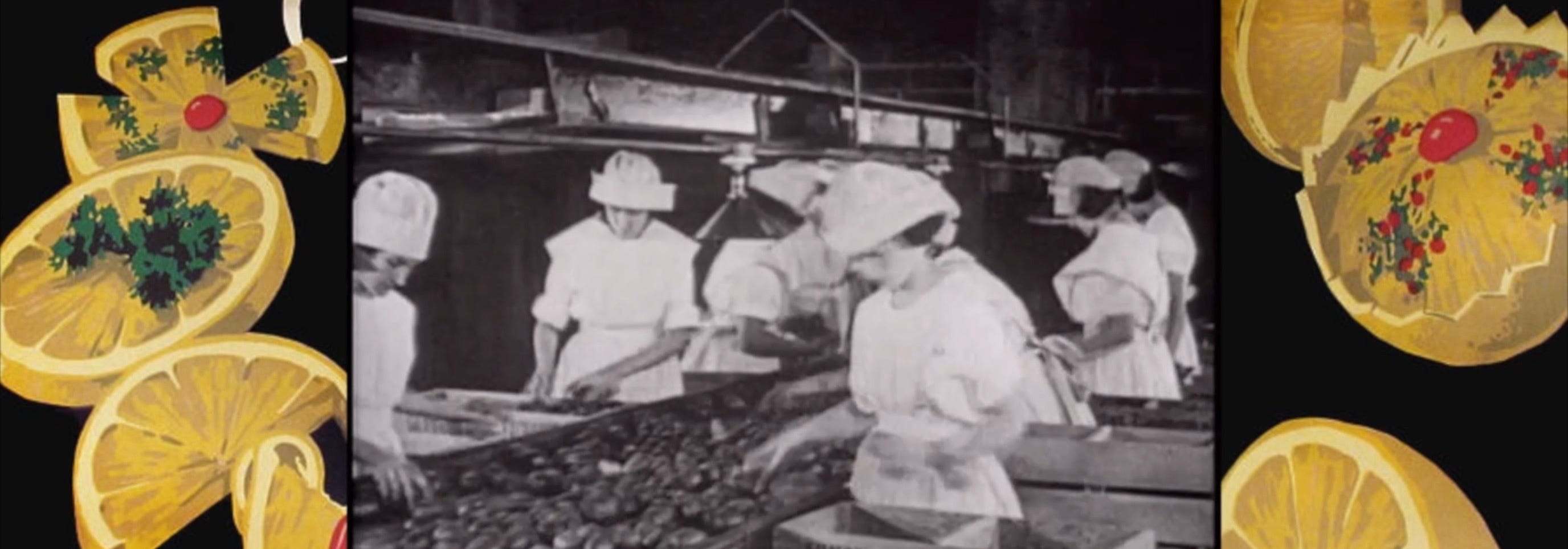
Beckman came into his own as an inventor and innovator in 1935 with his pH meter. As was typical of so many of his innovations, it began with a friend and colleague asking him for help with a problem. A chemist from his Illinois days, Glen Joseph, was working for the California Fruit Growers Exchange. Knowing a fruit’s acidity was essential to determining what it could be used for, whether it deserved the Exchange’s Sunkist label, or conversely whether it would be processed into various by-products, such as pectin or citric acid.
The problem: there wasn’t a reliable instrument to determine this. His time at Bell Labs introduced him to various electronic instruments, and out of this experience he was able to see how to solve the problem.
He created “the first chemical instrument with electronic technology at its very heart.”[13] Before this time, individual chemists had adapted electrical equipment for their own uses. But there were not “electric instruments a chemist could buy in the marketplace – complete, assembled, and ready to answer chemical questions by analyzing the electrical properties of matter.”[14] Beckman’s pH meter helped to change this.
“Now a scientist could purchase a precision instrument and start making quick, simple, and reliable measurements. The frustrations of assembly, then measurement, then mathematical calculation all vanished … the instrument itself required of its users no special expertise in either electron-chemistry or electronics: the expertise was in the box” (emphasis added).[15]
Beckman’s pH meter was the first commercial scientific instrument in the “instrumentation revolution” of the 20th Century, a revolution that has contributed significantly to the explosive growth of scientific knowledge.
Beckman’s subsequent creations and products would bear the qualities of his pH meter: reliability, precision, simplicity, elegance of design, efficiency, and cost-effectiveness, all of which he learned at Bell Labs.
These same attributes Beckman displayed in the smog fight and his other civic and political activities. The man and his creations and activities were one and the same.
Beckman’s first real company had $11,700 in sales in 1935. By 1948 when he recruited Haagen-Smit to work on smog it was $3.6 million. Sales climbed to $21.4 million by 1955, the year before he became President of the LA Chamber of Commerce. A decade later it was over $100 million.[16]
Beckman’s success in business was in finding “those sweet spots where academic knowledge, technological possibility, and commercial opportunity meet …”[17] The same qualities he demonstrated in high school while improvising music for silent films in the hometown movie house came into play in his business career.
Over and over again, this led Beckman and his team to see how an innovation of their inventions could lead to a new product for a completely different use and market, be it top secret components for radar during World War II,[18] or for the Mars Viking lander, or for centrifuges that made it possible to understand DNA reproduction, or a protein sequencer that quickly separated, identified, and recorded amino acids, or the synthesis of highly specialized chemicals that cost $10 million an ounce, or medical instruments to measure blood sugar and cholesterol.[19]
With Haagen-Smit and Smog, Beckman Gets Crafty
Beckman’s businesses were able to grow for another reason. He would find the right person for the job and then get out of their way. He did the same thing with Haagen-Smit and smog. But when Haagen-Smit wanted to return to his regular research, Beckman once again improvised, showing his craftier, shrewder side.
As mentioned in Part Two of the Haagen-Smit smog story, the turning point in Haagen-Smit’s career as a smog researcher and leader came when SRI’s Abe Zarem gave a lecture at their home institution criticizing Haagen-Smit’s smog work.
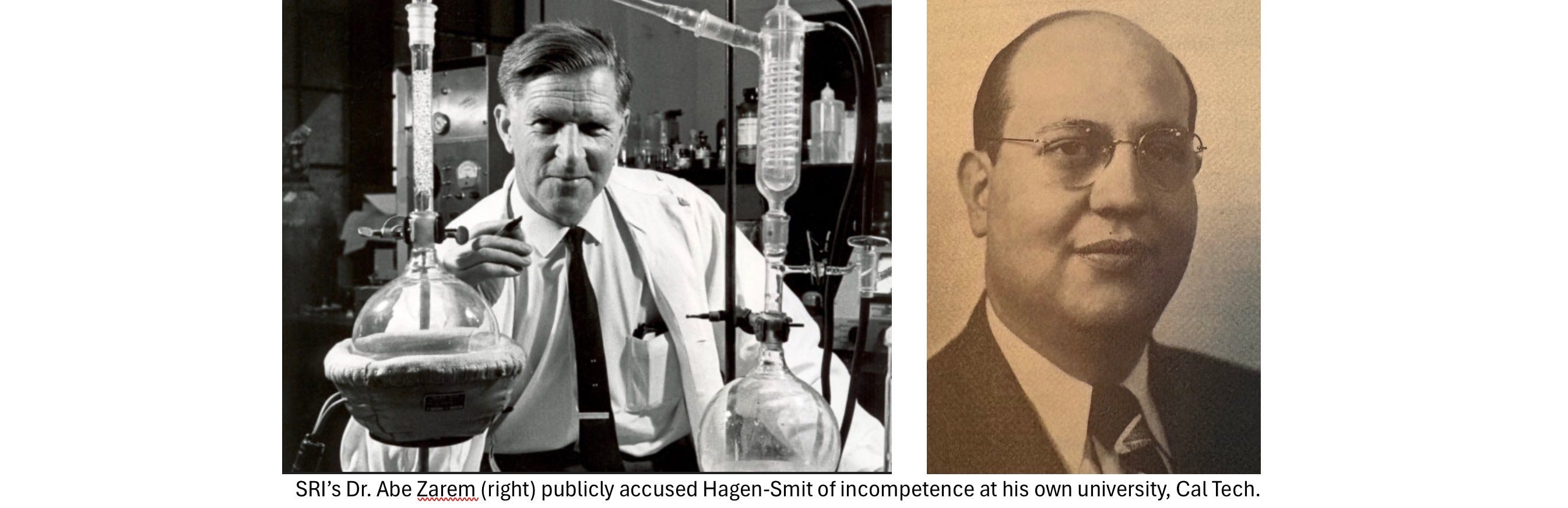
What I didn’t mention was that it was Beckman who arranged for Zarem to speak. Then he sat beside Haagen-Smit and waited to see what would happen.[20]
As Beckman recounted years later:
“Well, this got his dander up. He didn’t want to work in this [smog] before, because he was working on isolating the flavor constituents in pineapple, working on root-growth hormones, auxins, things like that. He didn’t want to get involved in this stinky political mess. But Abe’s remarks got under his skin enough that Haagie agreed to work on it.”[21]
Beckman was in a position to recruit Haagen-Smit because of an interlocking web of powerful relationships. As a businessman and longstanding member of the Chamber of Commerce, he became their point person on smog in 1946. As an acquaintance of Lewis McCabe, the head of the newly created regulatory agency, from their days at the University of Illinois, he became a consultant to the agency and in that capacity recruited Haagen-Smit.
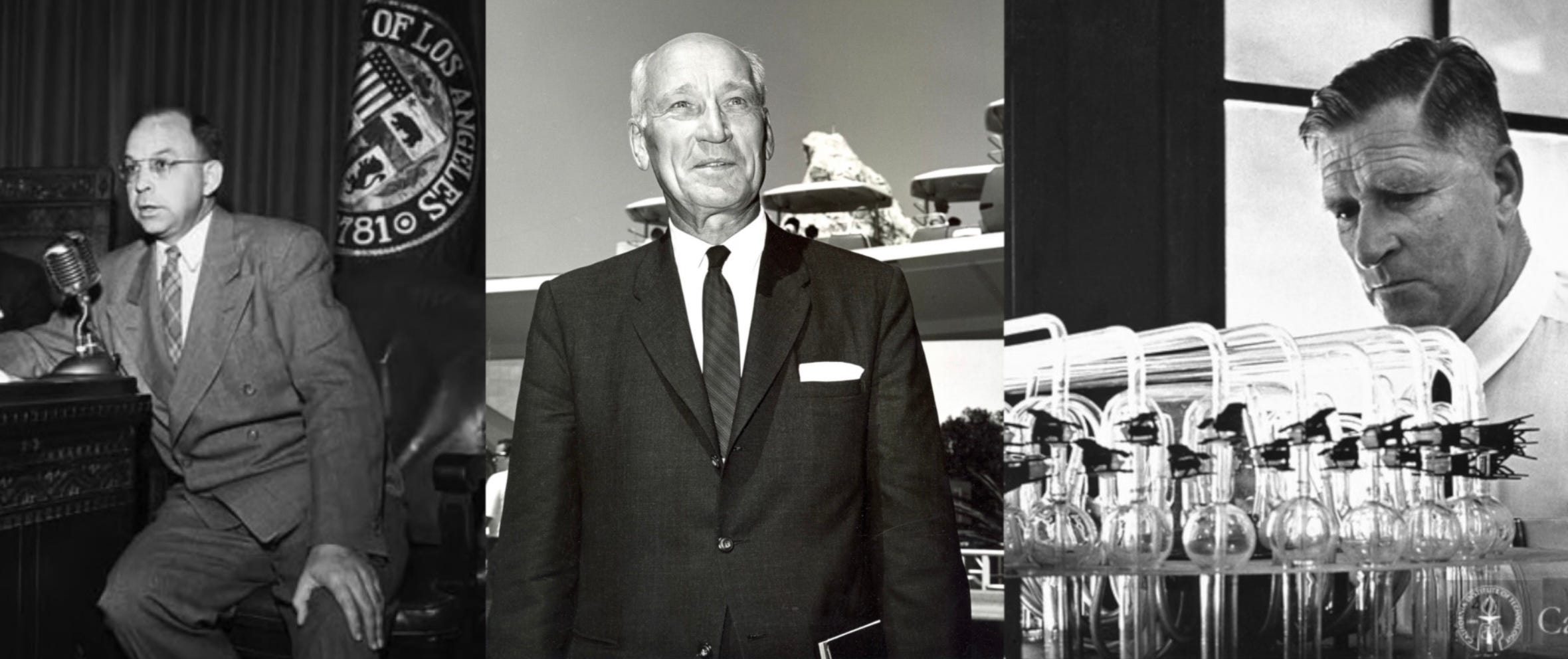
Beckman was trusted by Haagen-Smit, trusted by the Chamber, trusted by McCabe, and trusted by the political community, as evidenced by his appointment by Gov. Goodwin Knight (R) to Chair his Special Committee on Air Pollution in 1953.[22] The Committee’s report became known as “the Beckman Bible,” whose recommendations guided the government’s response for years to come.[23]
From his Chairmanship Dr. Beckman was able to affirm Haagen-Smit’s scientific explanation of smog, which sealed the fate of SRI’s “we don’t know” message.
But there would have been no explanation of smog from Haagen-Smit if Dr. Beckman hadn’t created a situation calibrated to keep him on the case. With Haagen-Smit, Beckman had been wise as a serpent and innocent as a dove.
Well, maybe not quite innocent. All the same, if Hoot were ever to have told Haagy, I bet they would have had a good laugh together.
Crafty for good. Sometimes that’s what we have to be in The Climate Movement.
Stay tuned: more of the Beckman story and the Smog-Climate Subseries to come!

If you are new here, check out our Intro Series. If you like this post, please “like,” comment, and share. And thanks for all you’re doing.
[1]Arnold Thackray and Minor Myers, Jr., Arnold O. Beckman: One Hundred Years of Excellence, (Chemical Heritage Foundation: 2000) Forward, p. x. Go here for an excellent one hour documentary The Instrumental Chemist, on Dr. Arnold Beckman, available on the Scientific History Institute’s website. Here’s their description:
This one-hour documentary highlights six of Beckman’s groundbreaking scientific instruments and features interviews with experts from such diverse fields as art conservation and oyster farming speaking about how their work benefitted from Beckman’s inventions and philanthropy.
[2] Joel Mokyr, The Lever of Riches: Technological Creativity and Economic Progress (Oxford: New York, 1990): p. 72.
[3] Thackray and Myers, One Hundred Years of Excellence, pp. 3, 9. Years later, reflecting upon his creation of scientific instruments, Beckman said: “I’ve always liked to work with my hands. My father was a blacksmith; I guess that’s where I inherited that. At home I was always making things, always had my own little shop.” “Arnold O. Beckman,” interview by Terrall, p. 31.
[4] “Arnold O. Beckman,” interview by Terrall, p. 2.
[5] Thackray and Myers, One Hundred Years of Excellence, pp. 9-10, 13.
[6] Thackray and Myers, One Hundred Years of Excellence, p. 20; “Arnold O. Beckman,” interview by Terrall, p. 4.
[7] Thackray and Myers, One Hundred Years of Excellence, pp. 21-22.
[8] “Arnold O. Beckman (1900-2004),” interviewed by Mary Terrall, Archives, California Institute of Technology (Pasadena: October 16-December 4, 1978): pp. 4-5; Thackray and Myers, One Hundred Years of Excellence, p. 24.
[9]Thackray and Myers, One Hundred Years of Excellence, p.27.
[10] “Arnold O. Beckman,” interview by Terrall, p. 7; Thackray and Myers, One Hundred Years of Excellence, pp. 32-34. Here is Beckman’s fuller reflection upon this turn of events: “I’ve often thought about how little matters often determine the course of a person’s life. In this case, I got the last bunk on the second deck. If I’d been one bunk later, and gone to the third deck, my life would have been completely different, because the people who were assigned to the third deck were shipped over to Vladivostok not long after that. As it was, I stayed there in the Brooklyn Navy Yard. I was there on Thanksgiving Day in 1918. Well, we had our Thanksgiving dinner in the barracks, and then we were ordered to eat another dinner. It turned out that a Red Cross chapter located in the Brooklyn YMCA was having a dinner for wounded marines coming over from Chateau-Thierry and Belleau Wood [in France], and there weren’t enough marines to fill the places. So we were ordered to go there and eat another dinner right on top of our own dinner! Well, fortunately, I was only eighteen years old, and I had the appetite of a teenager, so I could do that. Well, the important thing about the dinner is that one of the girls helping out at the tables is now Mrs. Beckman. If it hadn’t been for this unusual double-dinner experience, I wouldn’t have met her.” “Arnold O. Beckman,” interview by Terrall, pp. 7-8.
[11] Thackray and Myers, One Hundred Years of Excellence, pp. 59-61; “Arnold O. Beckman,” interview by Terrall, pp. 12-24.
[12] “Arnold O. Beckman,” interview by Terrall, p. 26.
[13] Thackray and Myers, One Hundred Years of Excellence, p. 129.
[14] “Arnold O. Beckman,” interview by Terrall, pp. 28-29.
[15] Thackray and Myers, One Hundred Years of Excellence, p. 130.
[16] Thackray and Myers, One Hundred Years of Excellence,, pp. 192-193, 208, 227, 267.
[17] Thackray and Myers, One Hundred Years of Excellence, pp. 266-267.
[18] Concerning radar, Beckman tells the story of how he was asked whether he could modify one of his products for the rigors of military use: “‘They’ll have to meet military specs. Can you do that?’ I said, ‘Yes, we’ll develop one that will.’ Well, when I came back, I found that ours was absolutely worthless from a military standpoint, because if you hit the Helipot sharply, the sliding contact would spring off of the coiled resistance winding, causing a momentary open circuit, which they couldn’t permit. So it meant that we had to start from scratch. … That’s when our research people just refused to work on the problem. They were working on a complicated Rube Goldberg device that I’d like to forget. So this was one of the times in my life when I did lose a little sleep. I began getting telephone calls from the military, particularly from the navy: ‘Where are the Helipots? We have ships ready to go, but the radar gear is incomplete because we have this potentiometer.’ One sleepless night I finally figured out how to do the job. Next morning I went down to our shop and talked to a mechanic, Ralph Stalder. I knew that if I put the design through our regular design department, it would be months before it came out, because they would keep it on the back burner. So I went to Ralph and with a penciled sketch said, ‘Ralph, make this part. When you get it done, bring it up to my office and we’ll take the next step.’ In two days, we had a working model of this Model A Helipot potentiometer, of which we’ve made tens of millions. As a matter of fact, from a business standpoint, in our first twelve months of operation after we produced it, that little Helipot made 40 percent of our total profit, more than our spectrophotometers.” “Arnold O. Beckman,” interview by Terrall, , p. 40.
[19] “Arnold O. Beckman,” interview by Terrall, pp. 39-40, 52-53; Thackray and Myers, One Hundred Years of Excellence, pp. 173-175, 262-263, 268.
[20] Thackray and Myers, Thackray and Myers, One Hundred Years of Excellence, p. 223; “Arnold O. Beckman,” interview by Terrall, p. 61.
[21] “Arnold O. Beckman,” interview by Terrall, p. 61.
[22] “Arnold O. Beckman,” interview by Terrall, p. 63; Thackray and Myers, One Hundred Years of Excellence, p. 225.
[23] Thackray and Myers, One Hundred Years of Excellence, p. 225.
“Crafty for good. Sometimes that’s what we have to be in The Climate Movement.” Yes!