

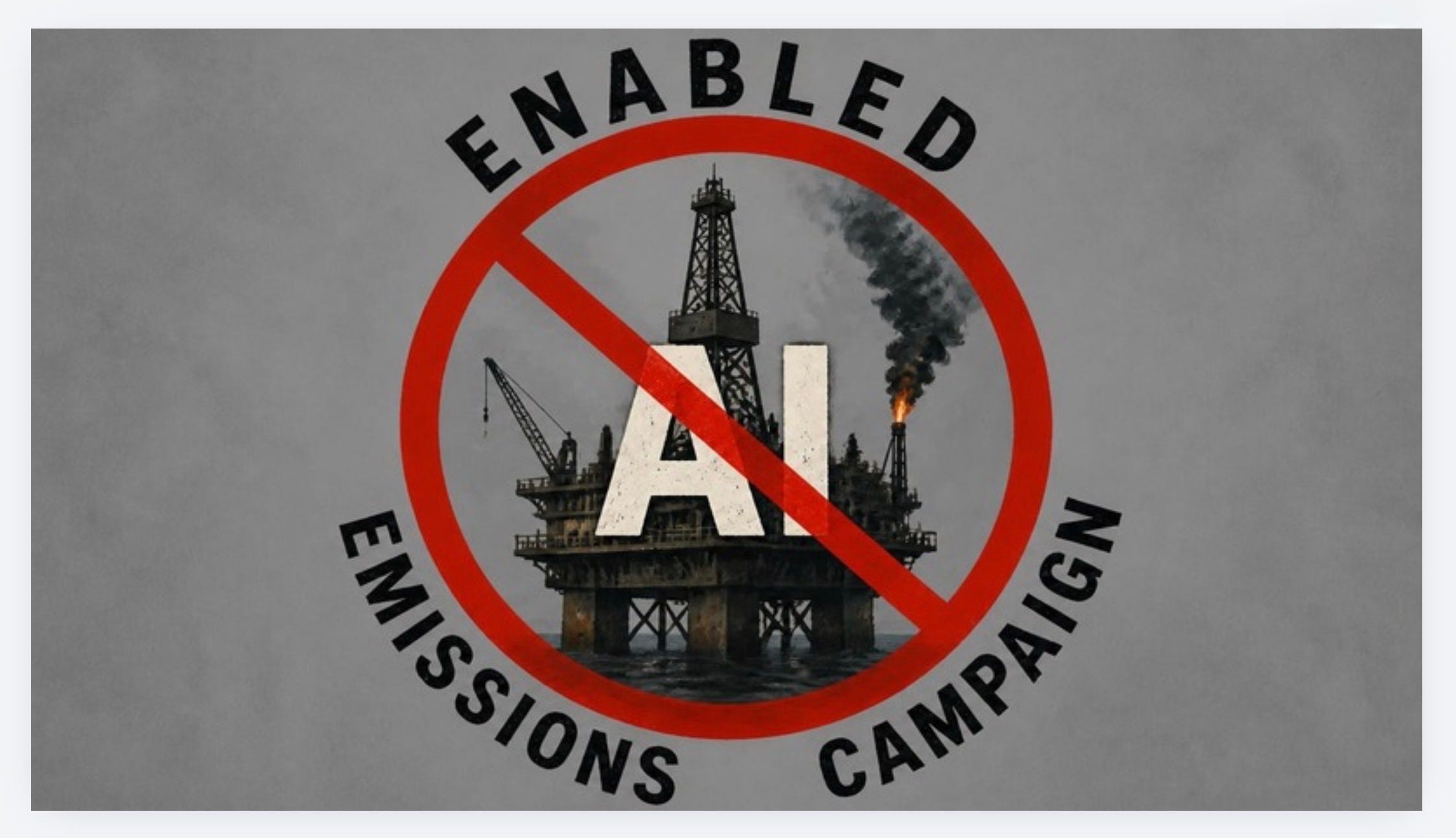
I’ve already mentioned some of the downsides to AI, and I’ll be writing more on the potential upsides.
But in this post we are traveling deeper, from AI’s downsides to its dark side. AI’s climate dark side is significantly worse than what we’ve already covered. It has the potential to do much more damage than any good AI could do for climate. It’s way out of balance in the wrong direction.
Man, does this suck.
The answer is not to say “Pull the plug on AI!” That’s impossible. The answer is to get it right.
Climate Movement Heroes vs Big Tech’s Grim Reapers
Thankfully, there’s a group that’s working on this to help the rest of us in The Climate Movement stay abreast of this dark turn and how we can challenge it.
This campaign was founded by two Climate Movement Heroes, Holly and Will Alpine, who left Microsoft once they saw that much more needed to be done. So they created the Enabled Emissions Campaign.
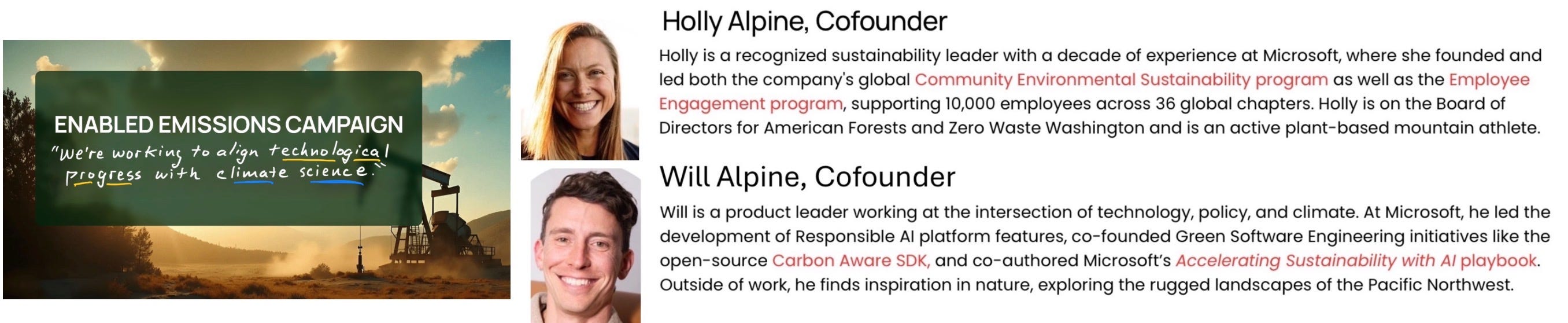
As Holly put it:
I painfully quit a job I loved … I could no longer reconcile Microsoft’s strong public environmental sustainability stance with its assistance to the oil and gas industry—a partnership that was dramatically increasing global emissions. I realized that internal pressure alone wasn’t going to shift the incentives; the public and shareholders needed to know what was happening (emphasis added).
It’s not just Microsoft, as Holly Alpine explains in an interview with Emily Atkin for her Substack, Heated:
There are teams of engineers and salespeople at these tech companies that are explicitly for the fossil fuel industry ... There are engineers writing code explicitly in partnerships with oil majors to expand production (emphasis added).

Big Tech teams working with and writing code for Big Oil and the other fossils, actively selling these death products, and those in leadership cutting and approving and championing these deals — they are intensifying the last big hurrah of the fossils before clean energy finally turns out their lights. Given that air pollution kills millions and climate change that is not overcome will harm billions and kill millions, these programs are The Grim Reapers of Big Tech.
This is what the Enabled Emissions Campaign is striving to defeat. In other words, it’s Climate Movement Heroes vs. The Grim Reapers of Big Tech and their allies, Big Oil.
Enabled Emissions
Now what the heck are “enabled emissions.” Well, don’t let anybody try to fool you by telling you it’s laughter-induced flatulence. Because it’s not. At least as far as we’re concerned.
But these emissions do stink to high heaven because they are turning something we’re trying to keep on the straight and narrow, AI, into a potent tool for our opposition. In this case, AI is helping the fossils find more fossil fuels, like a demented fossil dating site whose offspring are misery and death, thanatos on steriods. They are enabling emissions that might not have occurred otherwise.
… like a demented fossil dating site whose offspring are misery and death, thanatos on steroids.
As the campaign says on its website:
Enabled emissions are the additional greenhouse gases released when advanced technologies (AI, IoT, and high-performance/cloud computing) make fossil fuel production economically viable. … Across exploration, extraction, refining, and logistics, AI applications are lowering costs and sustaining the economic viability of otherwise marginal resources.
Microsoft and other Big Tech companies and their allies are making billions of dollars helping Big Oil cook the planet. Microsoft tries to hide this even as they trumpet sustainability. The Enabled Emissions Campaign is putting a big search light on these death deals in the dark.
A Trillion Barrels of Oil
Another of Big Oil’s allies, Wood Mackenzie, a research and consultancy firm, also trumpets sustainability. But as you can see below, they aren’t trying to hide their AI abilities to help Big Oil squeeze profits from every last drop. We’re talking an additional trillion barrels they can help the fossils capture.
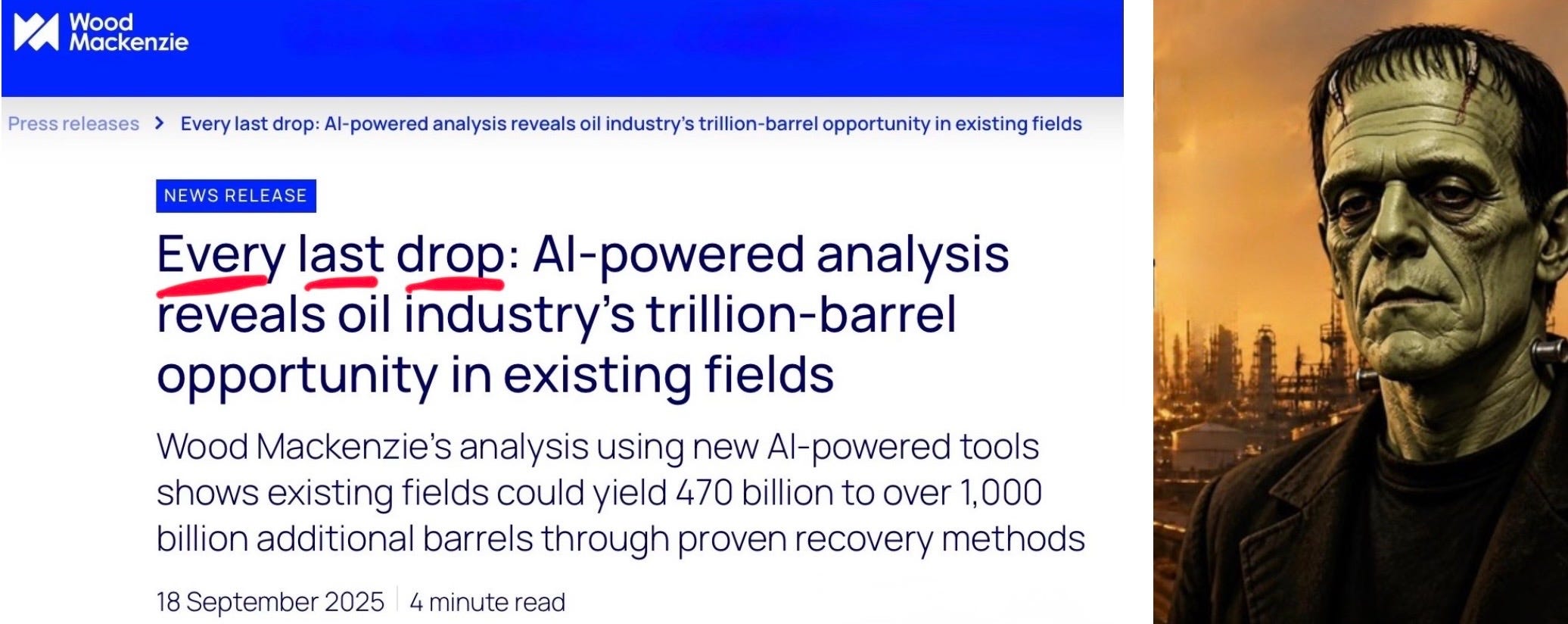
They state:
Wood Mackenzie’s proprietary Synoptic AI-powered analysis of oilfield performance shows existing fields are far from exhausted. … better recovery from producing fields could yield an additional 470 billion to over 1,000 billion barrels. This potential only requires the application of established best practices already deployed successfully across the industry, not unproven technologies.
Proprietary AI — They built a Frankenstein, utilizing science and technology to help bring a trillion barrels of fossilized dead matter back to life only to bring death like a plague. Their every-last-drop gluttonous glee is, frankly, pitiful.
The Really Bad News: Model Suggests AI-Fossils Trounce AI-Renewables
So to figure out how big a problem we’re dealing with, Holly and Will Alpine teamed up with a couple of researchers and used a computer model to get a handle on this question. Their results have recently been published in a peer-reviewed journal article.
Here’s the bottom line: “Renewables gains must exceed fossil gains by 4–5× to reach breakeven.”
So our AI-renewables teams must be 4 to 5 times better just to score a tie.
Below is their graph visualizing this catastrophe.
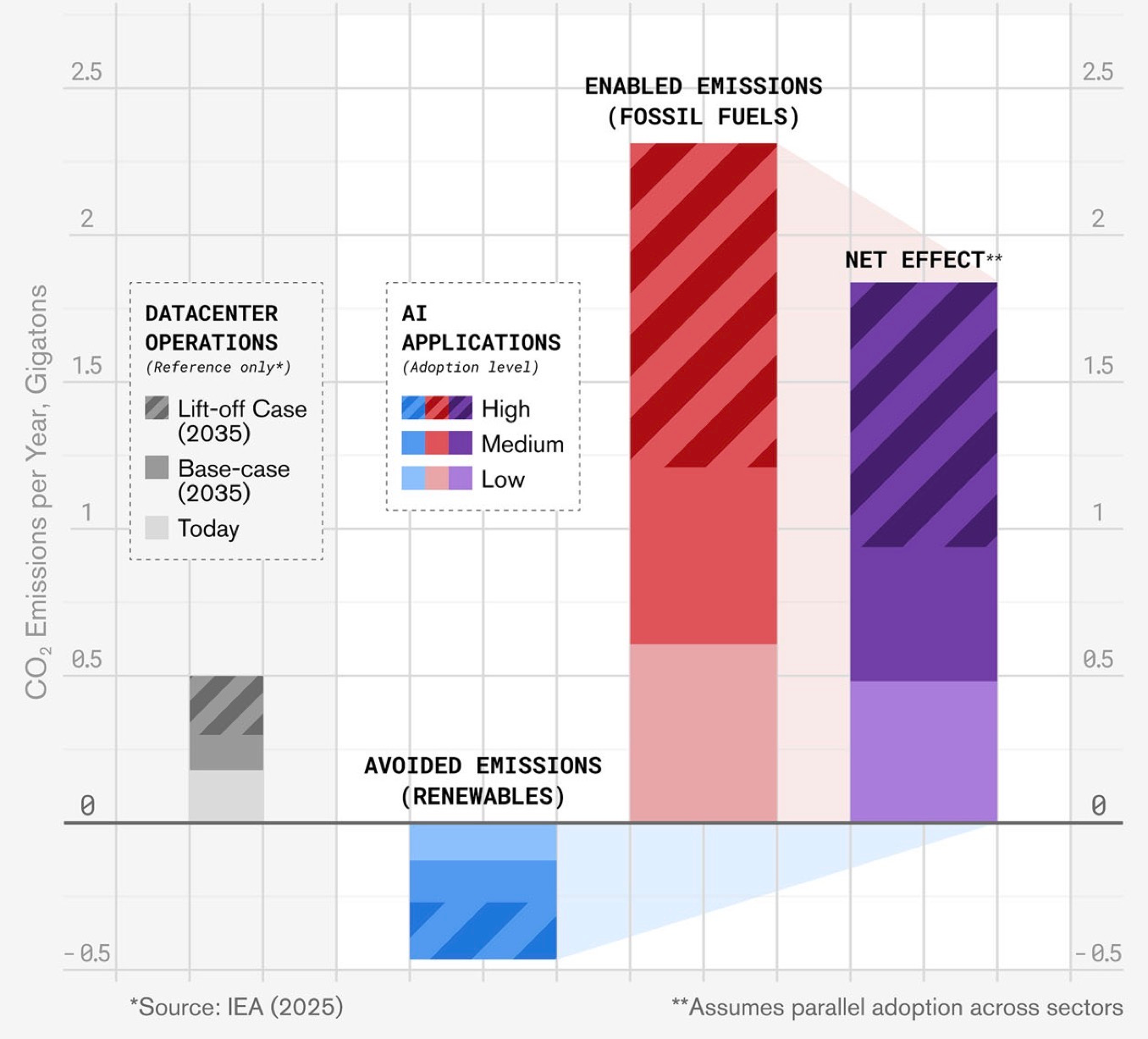
To get the net or purple color on the right you subtract the blue from the red. (Notice, too that avoided pollution from renewables helped by AI doesn’t even equal those from AI data centers, the grey bar on the left.)
AI-fossils increase climate pollution equivalent to Mexico on the low end, and Russia on the high end (who is the fourth largest polluter).
While their study conservatively estimated that the fossils and the renewable industry would take up AI at the same pace, that’s not what’s happening on the ground.
As Holly Alpine told The Guardian:
“Fossil fuel applications are already happening at scale today – real contracts, real deployment, with evidence from industry operators and financial analysts,” she said. “Renewables applications are still largely at the pilot or academic-study stage – more speculative, more dependent on deployment barriers like permitting and interconnection getting resolved.”
In other words, things are even worse than their study suggests. Our folks must be 4-5 times better just to break even, but many are not even out of the starting blocks while the AI-fossils are half way around the track already.
We’re Facing Two Goliath’s, Not Just One
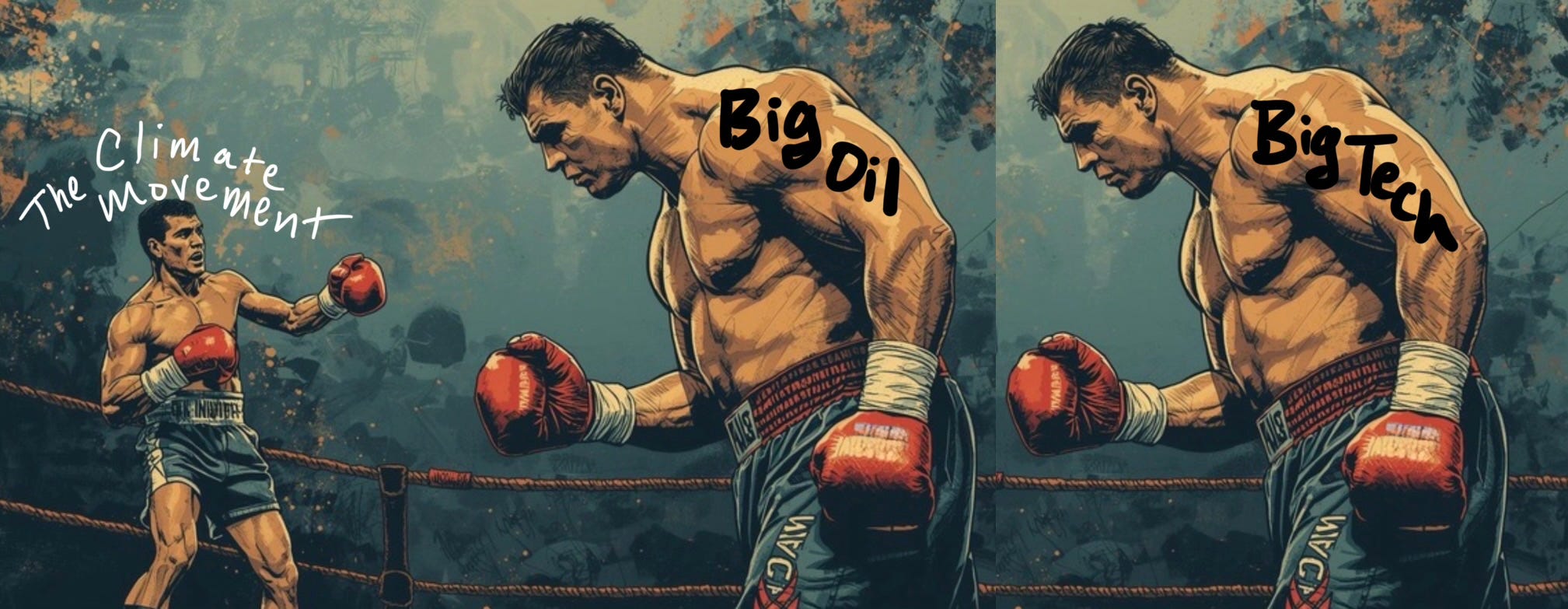
When we’re talking about facing Big Oil and Big Tech together, we’re talking about the biggest and richest corporations in the world.
And what have we got?
We’ve got the P3 — Moral Power, People Power, and Staying Power. If you’re wondering where the hope is for meeting the challenge of these Goliath’s, it comes when we join together. We are the hope we’ve been waiting for.

Our moral power is a constant: our cause is just. Climate impacts are a wrong that must be made right. With AI-fossils, Big Tech is on the wrong side of justice, the wrong side of humanity’s most basic values, the wrong side of history. To change course they must do the three actions of justice: stop bad stuff, set wrong right, and make things better. Truth is, there are many people in Big Tech who want to do the right thing, who want to be on the right side. We must find a way to tap into that.
Our people power must grow significantly — 16 million in the US and 400 million worldwide. We must become big and broad and active enough to become our destiny: the greatest and most long-lasting social change movement in history. The more we grow, the better our chances become to transform this situation. Another reason why growing and improving The Climate Movement is the most strategic thing we can do right now.
Our staying power is crucial. We cannot fade as has happened over the last few years. We must get strong, stay strong, and get stronger still.
The Destructive Alliance of Big Tech and Big Oil Must Be Ended Immediately
Back in 2024, the year she resigned, Holly Alpine wrote this in Fortune:
While we were at Microsoft, my colleagues and I never advocated for the company to sever its ties with the fossil fuel industry; we understood we were still operating in a world dependent on oil.
Dependent? That’s just it. We don’t have to be. We’ve got the tech now to do the transformation. And a positive use of AI can make it better and faster. Big Tech has absolutely no excuse.
I hope her view has changed since leaving Microsoft. Her own peer-reviewed study about AI’s potential shows that the only way to have AI-fossils pollution start to be reduced is for AI-renewables to stay on the field while AI-fossils are taken completely off it. As their “plain language” summary of their study puts it:
Across every adoption scenario tested, net emissions fall only when AI’s fossil fuel gains are zero.
In other words, the bottom line is this:
No AI help for Big Oil and the other fossils. All Big Oil relationships with Big Tech and others like Wood MacKenzie need to end now.
This is what the position of The Climate Movement should be ( and I hope this is now the stance of the Enabled Emissions Campaign).
I would encourage others to consider the following actions against Microsoft, etc, until this is accomplished:
constant public protests at their offices and other strategic locations;
boycotts;
related earned media and social media efforts;
lawsuits;
state laws making it illegal.
We will need legal mandates in the end, because left to themselves in a market system some company or companies will always take the dirty money from the fossils.
Is AI-fossils your Field of Action? If so, we need you on it! I strongly encourage you to create CATS (or Climate Action Teams) to support one another.
Others of us must keep going on the various Keep It In The Ground efforts. And we must continue the EV and renewables transformations at break neck speed, so that in the end no one will want their death product.
We’ve got a lot of work to do. Let’s get going!
If you are new here, check out our Intro Series. If you like this post, please “like,” comment, and share. And thanks for all you’re doing.
Jim, thanks for pointing out the destructive alliance between Big Oil and Big AI, where AI hyperscalers get the power they want and Big Oil gets many new gas generations plants—sometimes “behind the meter” that they can keep selling gas to for decades just as we’re running out of time to get GHG emissions down significantly.
The situation is something of a good news/bad news joke.
If there is any silver lining here, it is that all the proposed or wished-for gas generator plants are a practical fantasy. The supply chain for large gas turbines means wait times for new ones are numbered in years (3-6 years, depending on the analysis). I took a look at this issue again in January of this year, in a Substack post called “AI is Giving Me Gas: The Collision of Tech Hype and the Carbon Budget: We are scraping the bottom of the 1.5°C carbon budget. Big Oil’s response? Build 252 gigawatts of new gas power to feed the AI boom.” That post referenced a post from a while back, on my website: “New Gas Generator Plants and the Plan to Flood the (Electricity Demand Growth) Zone.” In this website post there’s a link to an AI analysis I did in a report called “The Future of U.S. Natural Gas Power Generation: Projections, Accuracy, and the Confluence of Limiting Factors to 2030. A lot of the proposed centers are just that, proposed, as hyperscalers scramble to find places and power sources, an effort akin to throwing spaghetti at the wall to see if any stick. Big Oil is the chief cheerleader for this, of course, because of the ensuing hysteria of the hyperscalers and the panicked sense that we’re short of electricity is good for business.
The bad news is that many hyperscalers are turning to even worse generation sources, including—as in the case of Musk’s big xAI facility in South Memphis—big diesel generators and inefficient older jet engines reconfigured as turbine generators.
A piece of good news is that many of these hyperscalers are morons when it comes to public relationships, as the public is pushing back against the data center concept within communities and sites. As for now, some breathing room (sorry) has been gained. Hopefully better sense will become the norm, not the exception, for would-be hyperscalers and their use of clean energy.
What should be another piece of good news is that solar/wind/batteries are cheaper and faster to build out than gas generators these days is, unfortunately, this fact is too often ignored, perhaps in part due to the anti-clean energy thinking of our current administration. Another potential piece of good news is that grid enhancing technologies exist and could be implemented by utilities to, among other benefits, make available more of the current capacity of the grid. Unfortunately, utilities, based on a notoriously conservative business model, have little legislative compulsion to serve the public by doing things differently.