

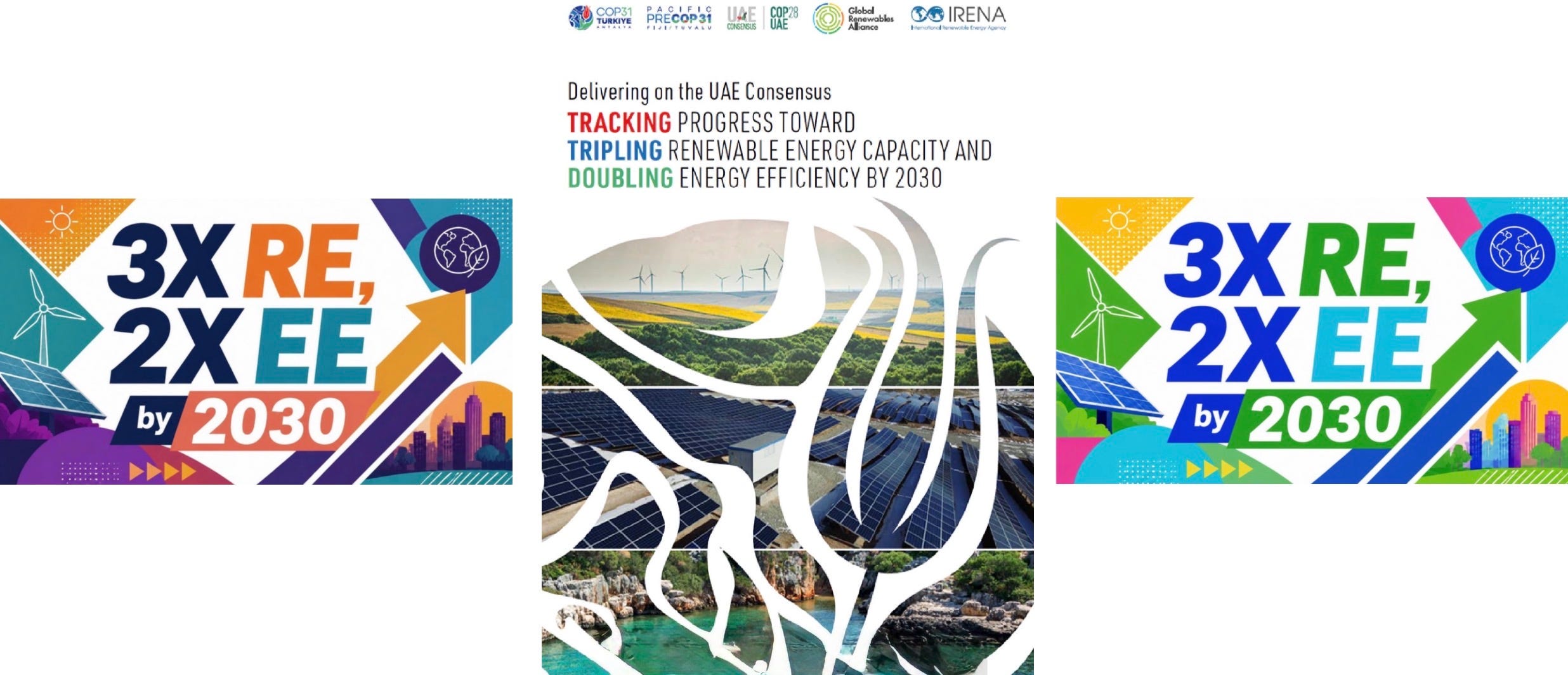
Climate Week in NYC and the run-up to the international climate negotiations (COP) are helping to push out lots of reports.
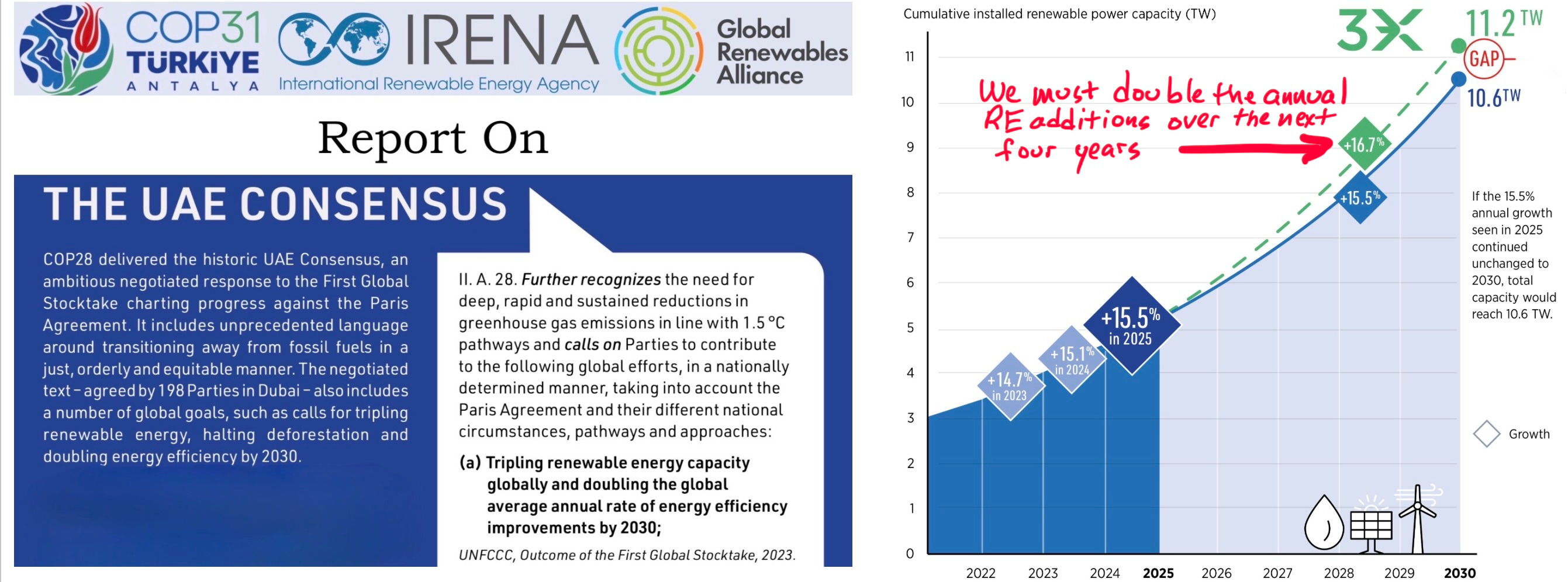
One of the best is an update on the where things stand with the goals agreed to in December 2023 at COP 28 in the UAE to triple renewable energy (3XRE) and double energy efficiency by 2030 (2XEE). (You can see the text of the goal in the image below in the white call out box.)
The report is a continuing joint project by three entities: the International Renewable Energy Agency or IRENA, the Global Renewables Alliance, and those heading up the upcoming COP 31 in Antalya, Turkiye. Basically, it takes the findings from IRENA, plus a few other sources like Bloomberg New Energy Finance (BNEF), and uses them to help us see where things stand on 3XRE & 2XEE.
3XRE
The bottom line: We’re within striking distance of being on track with renewables, as the graph above shows. We had 15.5% growth in capacity in 2025. We need that to be 16.7% (the green dotted line in the graph) over the next four years.

As Ben Blackwell, Chair of the Global Renewables Alliance puts it:
“To meet the 3X target, we must double annual additions of renewable technologies over the next four years. This is achievable: the manufacturing capacity exists and the economics are irrefutable; but deployment must accelerate now, particularly in emerging markets and developing economies, where financing costs and policy barriers remain stubborn obstacles” (emphasis added).
2xEE
On the energy efficiency front, we’re not doing as well.
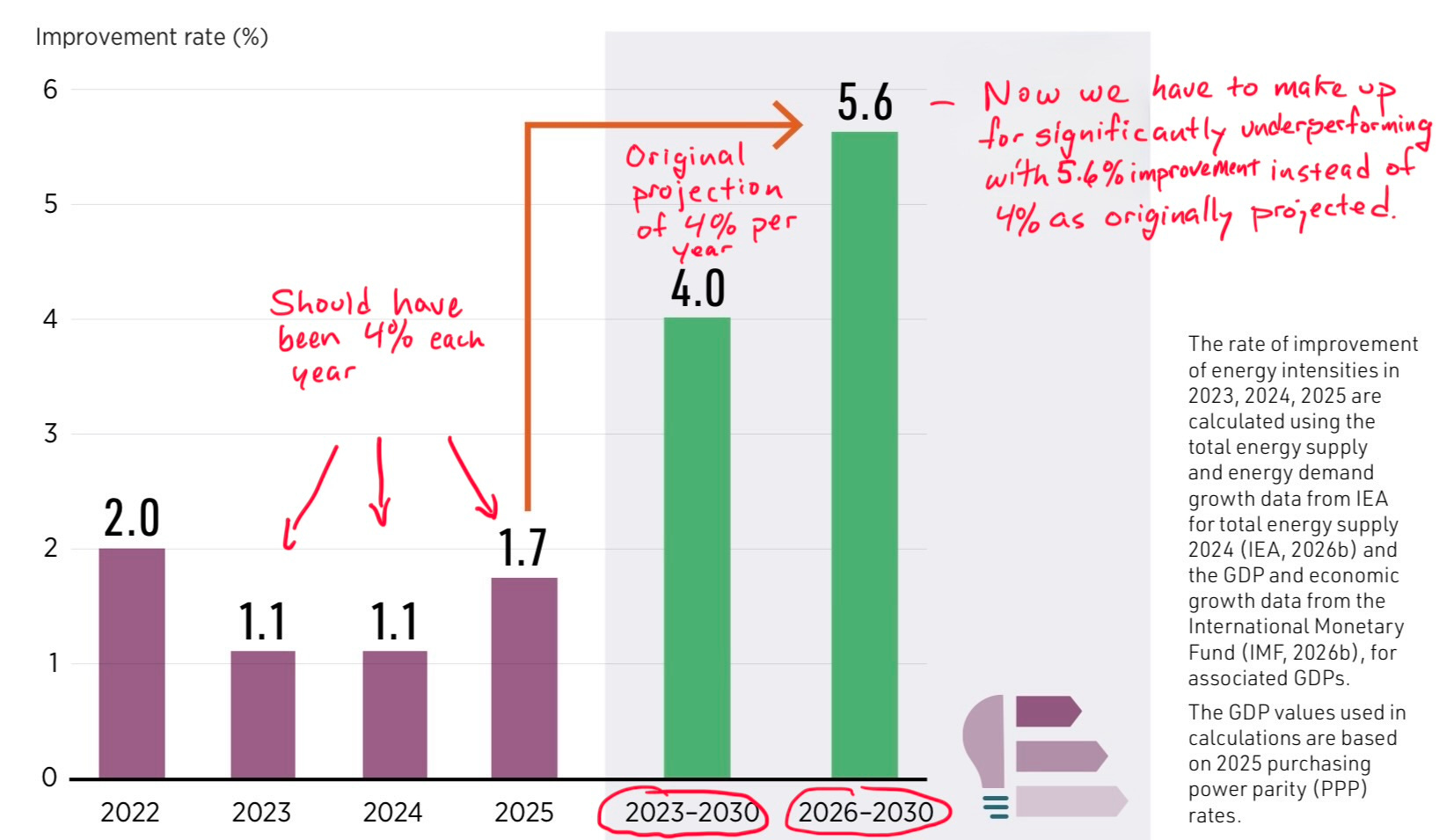
As you can see in their graph above, modified by me, EE progress has been anemic to say the least: about 1% improvement in 2023 and 2024 and a slight increase to 1.7 % last year. For all three years it should have been 4%. So now, this year and through 2030 it needs to be 5.7%.
The key way we’re going to improve efficiency is by electrifying everything, or as much as we possibly can. Why? Because electric tech is much more efficient. As their report notes:
Electric vehicles convert over 77% of electricity into power at the wheels, compared with internal combustion engines that convert 12-30% of the energy contained in gasoline … Modern heat pumps can reduce electricity consumption by more than 50% compared to traditional heating systems and achieve efficiency gains exceeding 300% by moving heat rather than generating it (p. 41).
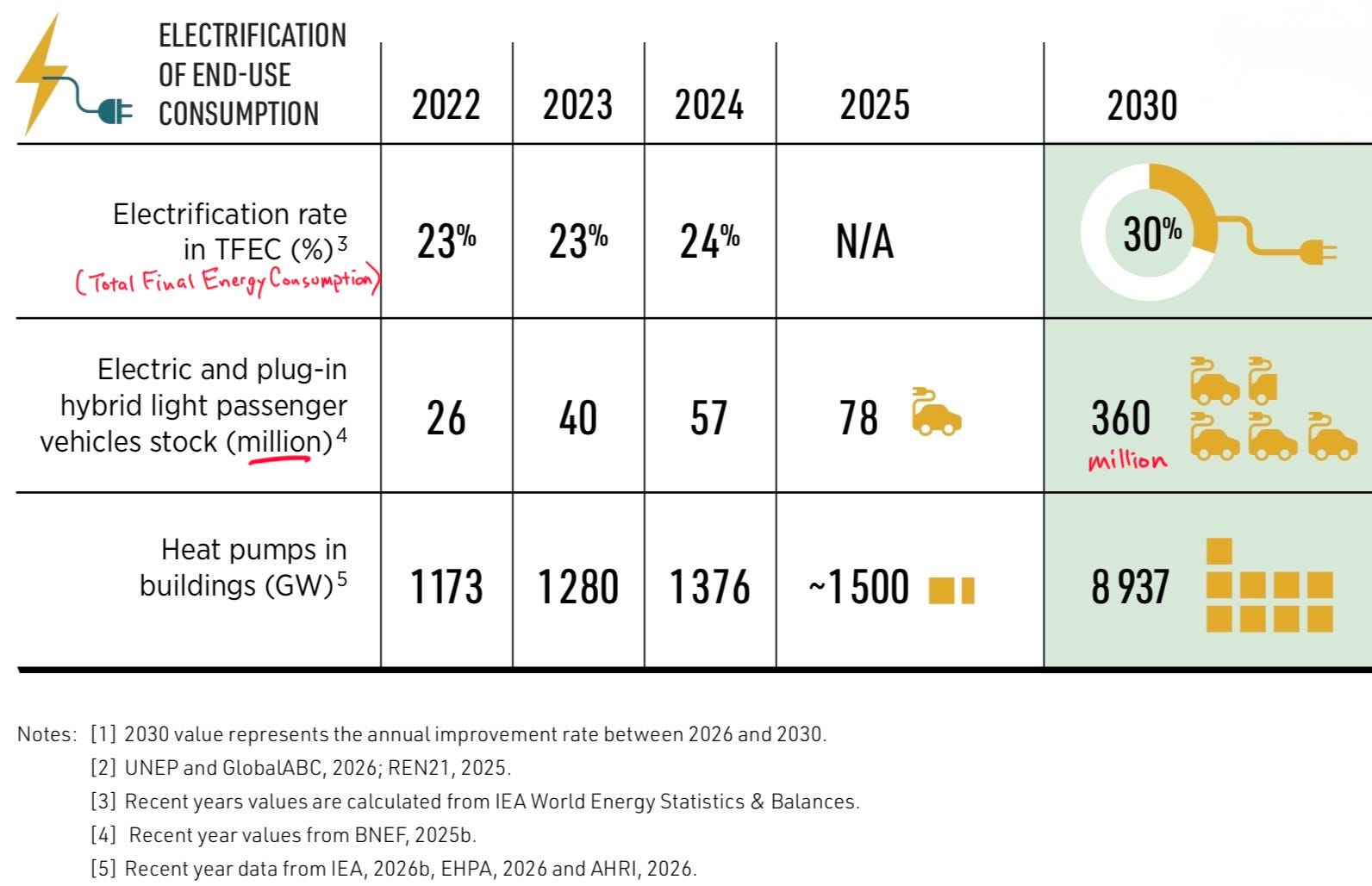
Their Table below shows what we need to do. As you can see, the total electrification rate needs to go from 24% in 2024 to 30% in 2030. EVs need to go from 78 million to 360 million, and heat pumps from 1,500 GW to 8,937 GW.
Summing Up
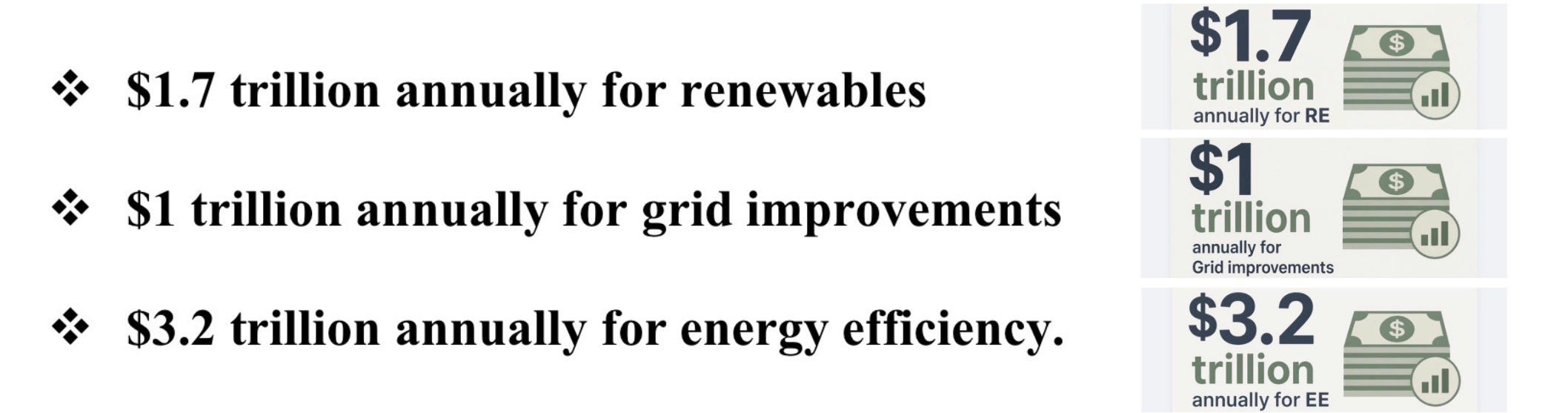
To achieve 3XRE & 2XEE by 2030 will require investments in 2026-2030 of:
Our Response
Here’s the deal. These 3XRE & 2XEE by 2030 goals that most of the nations of the world have endorsed are good ones. But as the International Energy Agency (IEA) noted when these goals were affirmed in 2023, they represent “only around 30% of the emissions gap that needs to be bridged to get the world on a pathway compatible with limiting global warming to 1.5 C.”
As The Climate Movement and Climate Action Supporters we must push for better than this. The international negotiations set the floor (and sometimes the basement!) for climate efforts. Our Ten Movement Values (see below) and our vision, purpose, and Major Goal — to overcome climate change by creating a just and prosperous sustainability for everyone and everything — are calling us to do better, including improving on 3XRE & 2XEE by 2030.

And the only way we’re going to do better is by becoming our destiny: to be the greatest and most long-lasting social change movement in the history of the world.
We must grow our worldwide Climate Movement to 400 million strong by 2030. In doing so we will be able to bring our three forms of power — our P3 — to bear: (1) moral power; (2) people power, and; (3) staying power. Only then can we push our societies, especially our political leaders, to achieve the speed and scale of transformation that’s needed.

But not just speed and scale. Justice, too. We’re throwing around lots of big numbers, a trillion here, a trillion there, which are abstractions. We must never forget that people and places and other creatures are behind all of these numbers. All of this has consequences for people — particular individuals and families and communities. It impacts the rest of nature — particular species and places and ecological communities.
Who is helped and who is left behind and forgotten and ignored? Who gets clean energy and less pollution that kills people, and who is stuck with old fossil dirty hand-me-downs or no energy at all?
We can’t just let our societies forget those around the world with less power or no power, the poor, the vulnerable, the marginalized, future generations. It’s our job to work with them and add our voices to theirs. It’s also our job to speak for the other creatures and the rest of nature.
As Murat Kurum, President-Designate of the upcoming COP in Antalya, Turkiye, highlights in his preface to the report:
“Progress remains unequal … the high cost of capital in emerging and developing markets is still stifling investment.”
In the body of the report we find this:
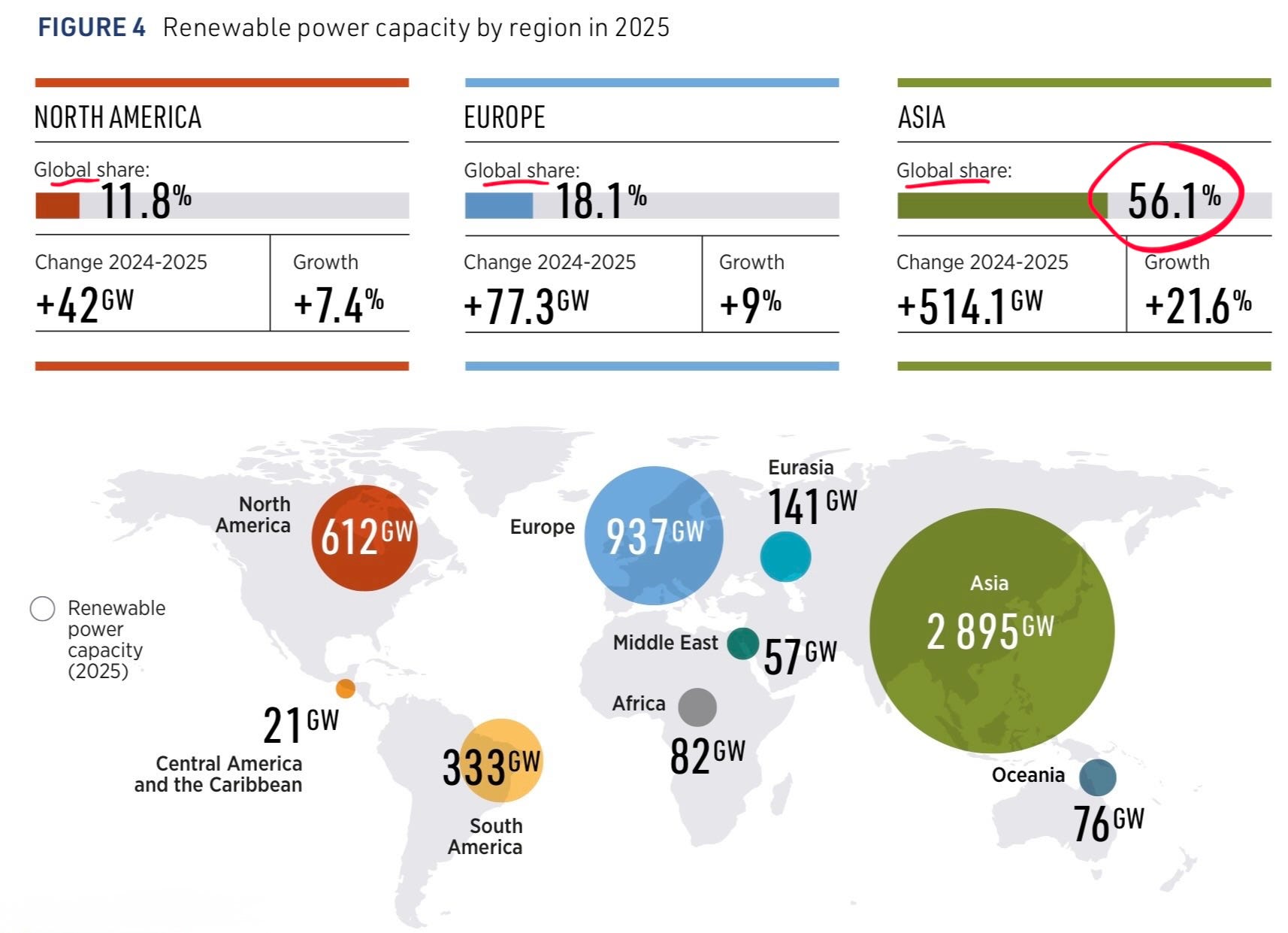
“The geographic deployment of renewables remains highly uneven, with Asia [mainly China], Europe and North America accounting for 86% of installed renewable power capacity at end-2025. The remaining 14% was shared by Africa, Central America and the Caribbean, South America, Eurasia, the Middle East and Oceania” (p. 29).
Their Figure below visualizes the disparities.
So we’re behind on 3XRE & 2XEE by 2030, we’re behind on making sure the poor benefit, and we must push the world to do even better. The good news is, we can — because we are the hope we’ve been waiting for. So let’s grow our people power and make this happen. Join us!

If you are new here, check out our Intro Series. If you like this post, please “like,” comment, and share. And thanks for all you’re doing.