

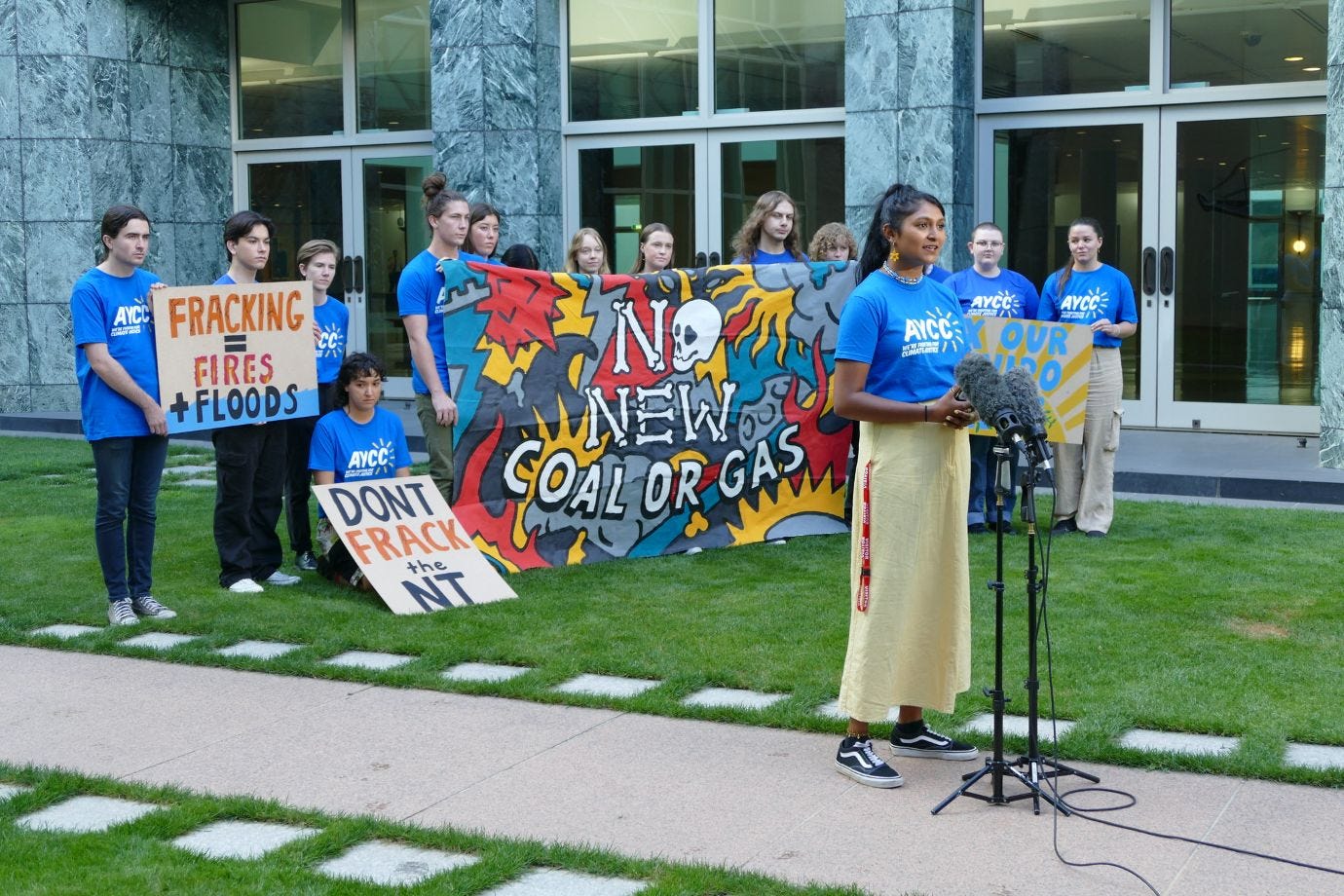
Readers: This is the first in a Series on Australian women climate leaders. Why do this series? Because they’re offering damn good leadership, that’s why!
For nearly a decade Grace Vegesana has been a climate action leader as part of the Australian Youth Climate Coalition (AYCC) — the country’s largest climate justice organization run by young people, and the oldest youth-led climate organization in the world, established in 2006.
Although she’s only 26 years old, Vegesana is already a seasoned veteran and AYCC’s National Director, and along the way has completed degrees in Law and also in Environmental & Climate Science. She is also a graduate of the Democracy in Colour’s “Thriving in Colour” Program. She’s on the Boards of the Foundation for Young Australians and the Australian Conservation Foundation. Vegesana also previously worked “with Future Super, Australia’s first fossil fuel free superfund, to instigate the Not Business as Usual Alliance where 3000+ Australian businesses striked for the September 20, 2019 Climate Strike.”
Vegesana grew up in a loving family, but one she describes as right-wing climate deniers.
She tells how the death of one of her neighbors from the heat awakened her to climate justice.
“It was growing up in my community of Western Sydney — where summers get up to almost 49C [120F] on the ground — that I discovered who I was in the context of the climate crisis. I have personally witnessed my neighbor dying from heat stroke in Western Sydney, simply because she was older and couldn’t afford to turn on her air conditioning.”
This led her to see the connection between climate and justice:
“Climate justice is naturally intertwined with gender justice because of who is disproportionately impacted, but also because those closest to the problem are also closest to the solutions.”
Vegesana saw the injustice quite early when she was around 14, but it took time to make sense of it through sheer force of will. A profile in Australian Geographic tells the tale:
High school did little to answer her questions. Climate change appeared only once in her curriculum – a 20-minute aside in Year 9 science class that left her unsettled. The silence that followed pushed her to dig deeper, learning from books and online communities. Slowly, she pieced together an understanding that would guide her adult life: the people most vulnerable to climate change are rarely those responsible for it. …
“My science teacher was like, ‘There’s this thing called global warming. It’s caused by greenhouse gases and it’s pretty bad.’ And then we moved swiftly along.
“And I was like, ‘Wait, what do – what do you mean?’ I’ve just heard this 20-minute end-of-the-world segment from my science teacher, and then we never talked about it again.”
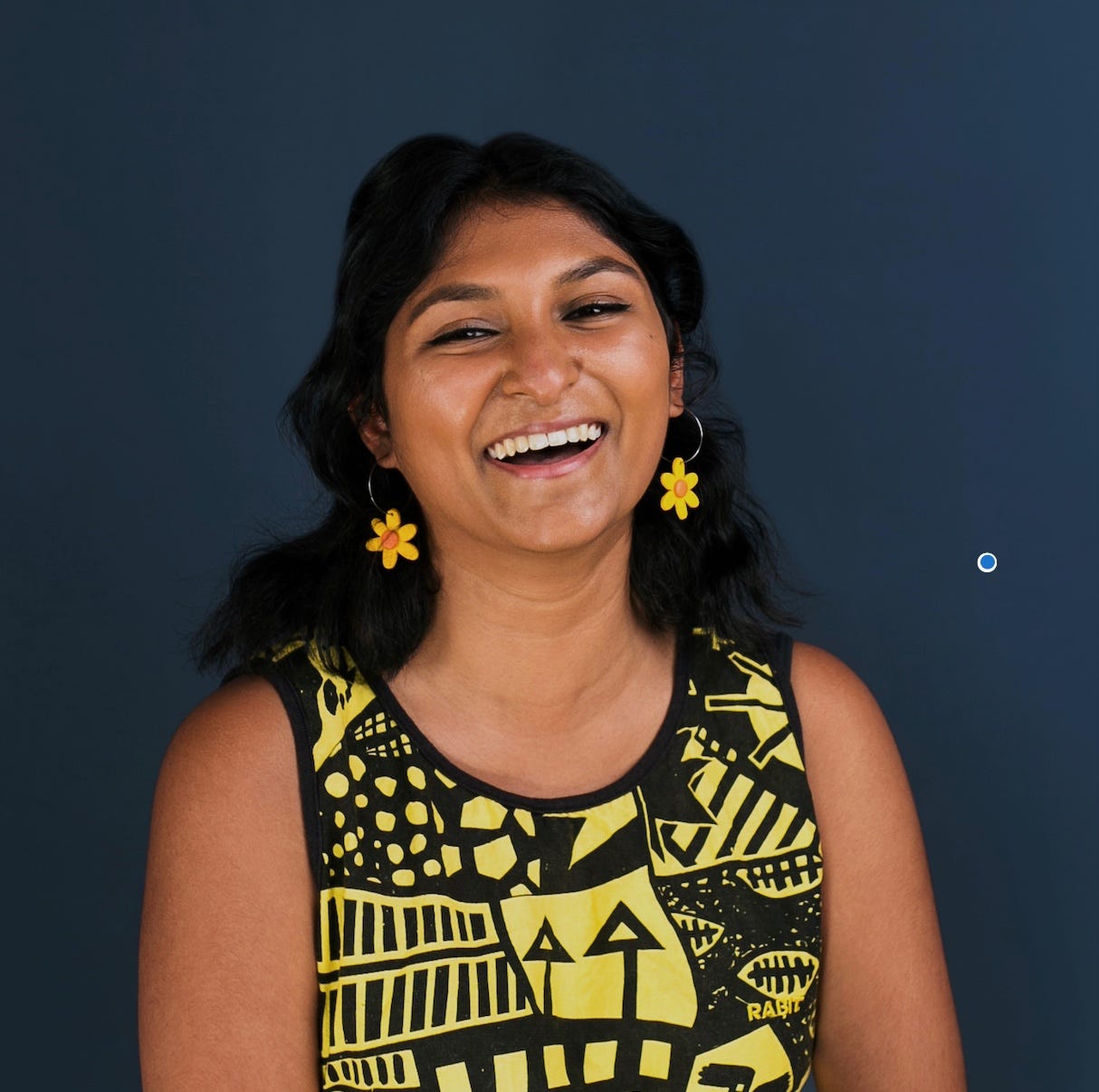
She found the AYCC when Googling climate change looking for answers.
“I remember the first thing I saw was the [AYCC] About page, and it was talking about climate justice. And I was like, I have no idea what those words are, but it’s like a bit of an explainer of climate justice being about the people who are affected the worst have done the least to cause the problem.”
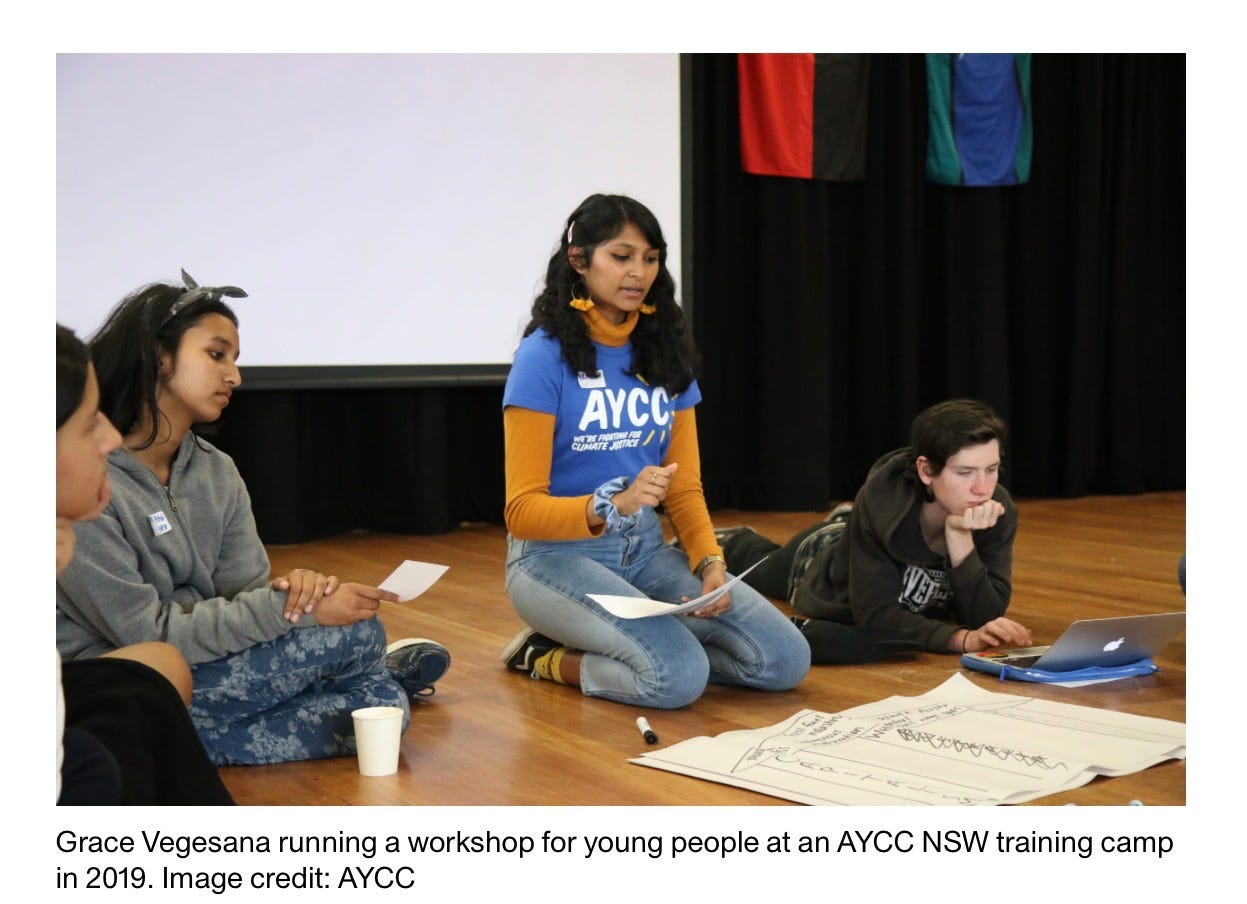
She signed up immediately to attend one of AYCC’s weekend Training Camps in 2017. It changed her life.
“It was genuinely the first opportunity I’d ever had to be in a room full of young people where you can be yourself, bring your own experiences, be in a space of learning and unlearning the climate crisis and what we know about the world. That was my introduction to social movements and theories of change that revolve around collective power, and I’ve never really looked back” (emphasis added).
When the problem of climate refugees came up in the training, Vegesana could relate it to her own family:
“I was like thinking of my family back in Botswana and the forced desertification that happens and the way that animals and water actually migrates when the climate is changing, and weather patterns change and people can’t live on the places that they originally called home. I was thinking about my family in the coast of India and the way that banana farming is not actually super viable because the way that environmental conditions have actually shifted across the country means that our family’s ancestral farming practices aren’t actually relevant anymore.”
This was almost too much for her to take in, and she thought hard about quitting and not going to the next day’s training. But she stuck it out and learned how young people in Australia could make a major difference worldwide:
“I remember hearing about how Newcastle Coal Port was like one of the biggest coal ports in the world and was literally a two-hour drive from where we were. And it was the concept of Australia actually fueling all of this damage that is happening all across the world. And our role in stopping that was something that I think really stuck with me and really transformed my ability to recognise that we really need to take our role in what we’re doing, in exporting, in burning fossil fuels and producing it in this endless cycle of destruction to make sure that actually we can stop those problems here right now. And it has such a huge global impact.”
By 2019 Vegesana was participating in a Parliament sit-in:
“I remember feeling scared at first and worried about what this looked like. I’d seen photos on social media of actions like these, and I thought they were so incredibly powerful, but I couldn’t ever imagine myself doing that. That’s not me,” Grace says. “But I went along and we staged what would be one of the longest ever Parliament House sit-ins. … “I met some of my best friends and even my bridesmaids through that action. It solidified so many of the beliefs I had in who should be leading, and what leadership looks like,” Grace says (emphasis added).
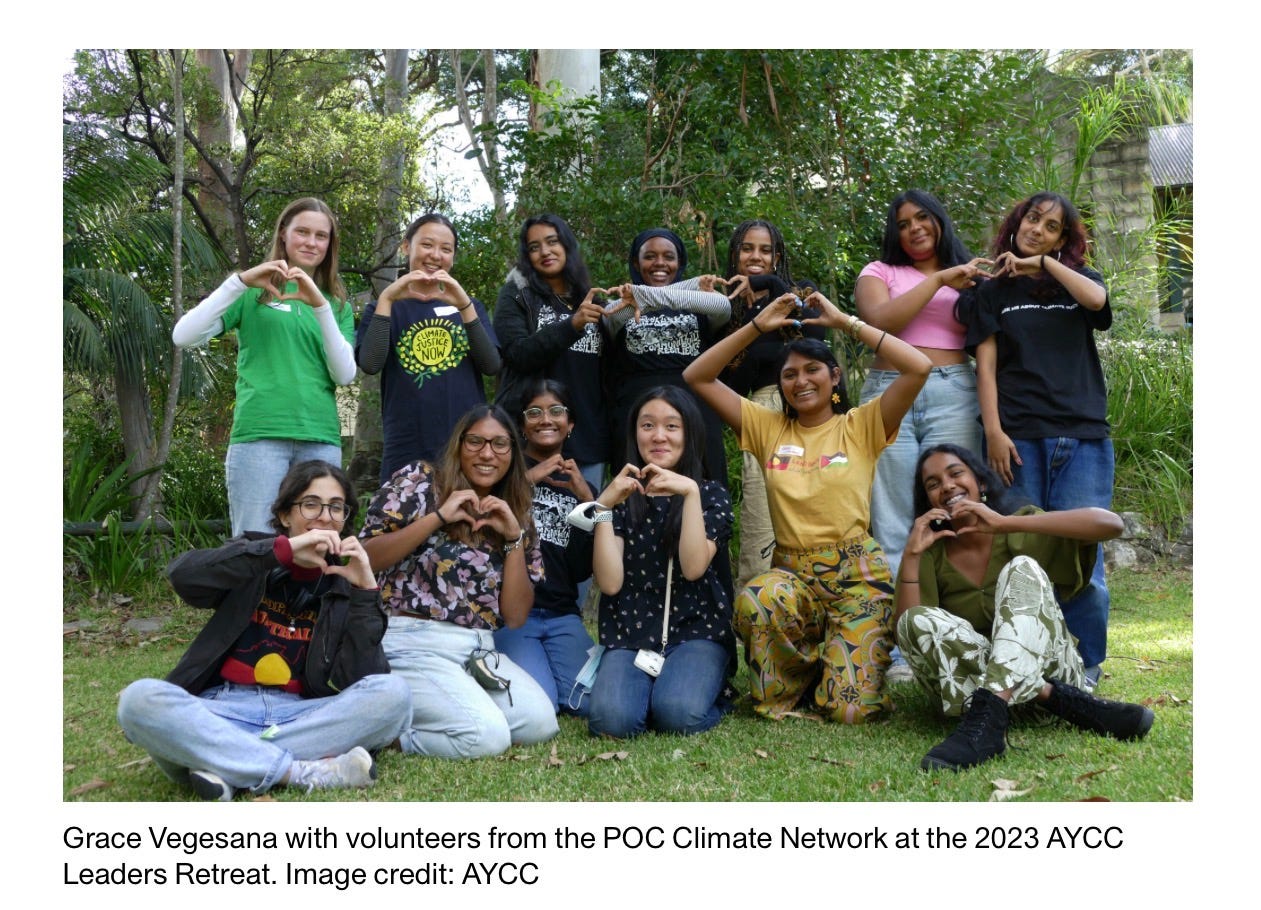
In a few years, when she turns 30, Vegesana will age out of AYCC. Soon to become a lawyer, I can’t wait to see what’s next for her as she continues with her leadership in The Climate Movement.
How about following Grace’s lead? Join The Climate Movement!
If you are new here, check out our Intro Series. If you like this post, please “like,” comment, and share/restack. And thanks for all you’re doing.