


I’m very glad to see the clean energy and climate leadership being provided by Virginia Governor Abigail Spanberger, especially since she’s my governor and I voted for her and supported her campaign. It’s a welcome change from the previous pathetic pro-pollution Administration of Glen Youngkin.
But the honest truth is, it’s not enough. Being better than her pro-pollution predecessor is not enough. Youngkin doesn’t set the bar for Gov. Spanberger.
Nor does current law in the form of the Virginia Clean Economy Act that passed in 2020. That’s not the bar she must clear in her governorship.
We can take some hope from her current leadership. We can take more from our own. Combine them and we can create even more hope from what Gov. Spanberger could become with our support.
The Challenge
The figure below shows electric generation by source in Virginia. As you can see, in 2024 solar only makes up a small portion, with natural gas and out of state coal producing the largest shares. (Most of the “imports” from other states are from coal.1)
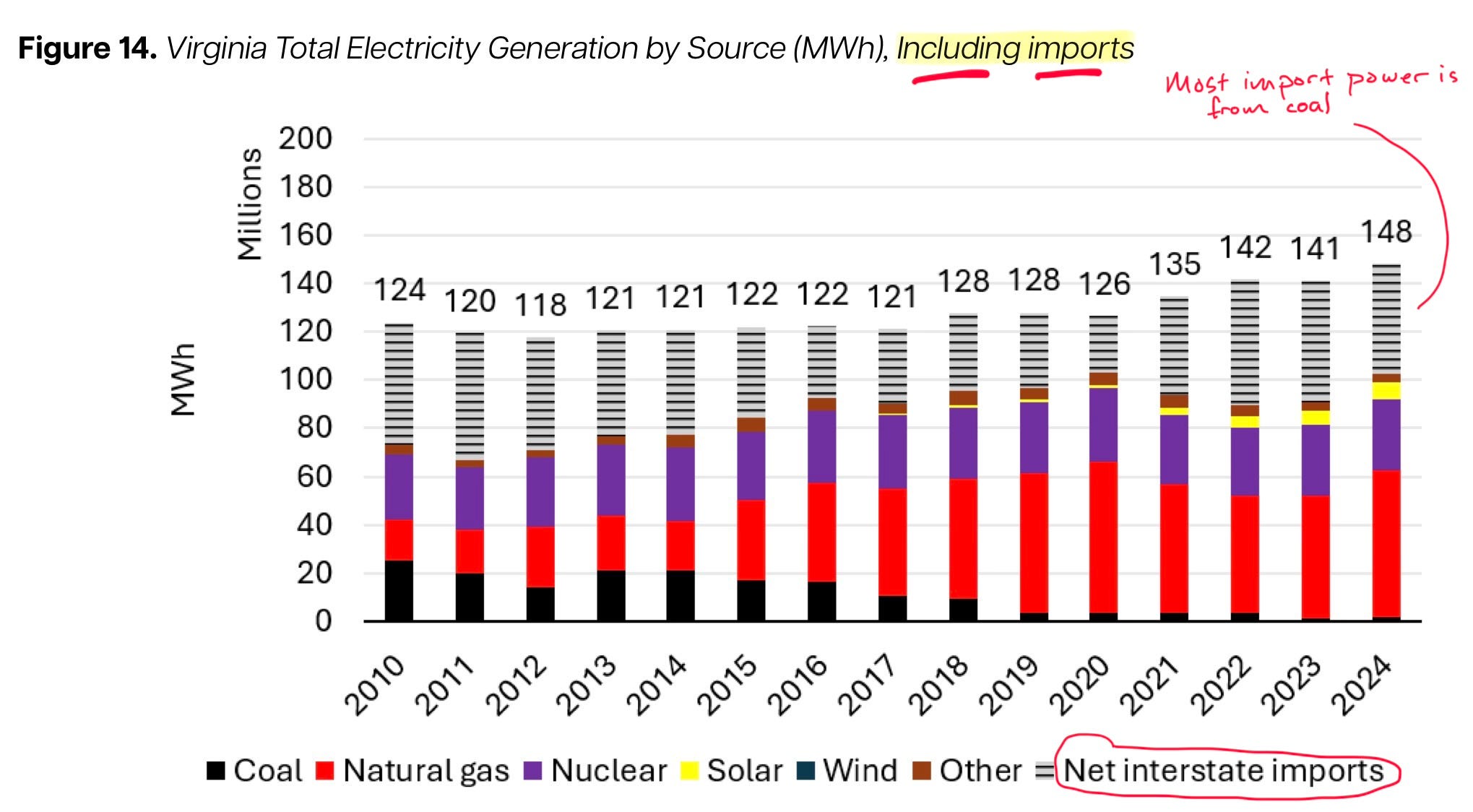
But 2024 is the past, and so is that energy mix dominated by the fossils. While we’ve got a lot of work to do, the future is clean. And we must clean out the old.
Gov. Spanberger’s Leadership Thus Far
In her first year Gov. Spanberger has already begun to change things in the right direction. Here are highlights from Gov. Spanberger’s leadership to date.
+ Rejoined the Regional Greenhouse Gas Initiative (RGGI). This 10-state program reduces climate pollution and funds Virginia programs in energy efficiency for low-income households, climate resilience, and flood protection.
+ Signed a slew of climate-friendly bills to:
streamline permitting for rooftop solar;
allow plug-in/balcony solar;
expand shared solar programs and small-scale solar projects on schools, churches, parking lots, landfills, and brownfields;
increase energy storage to lower peak pricing;
reduce energy bills for vulnerable Virginians; and
require utilities to develop demand flexibility programs for large users.
+ Issued the Virginia Data Center Accountability Framework as an Executive Order (EO). It lays out five accountability “pillars”:
Engage transparently with communities.
Protect our Environment.
Improve Affordability.
Advance clean energy and grid reliability.
Deliver a better deal for our workforce.
I hope there will be forthcoming legislation that codifies this into law, but in the mean time this EO provides help to local communities in how to deal with data center proposals and says to those proposing data centers that they need to achieve these goals if they want to do business in Virginia.
+ Just released the Virginia Energy Plan. Now this one I want to dig into a bit.
The Virginia Energy Plan: Net-Zero Is The Standard
Every four years the state of Virginia is required by law to issue an energy plan. This Virginia Energy Plan fulfills that requirement.
But instead of putting together something that aligns with the common understanding of a plan (what they call a “prescriptive” approach) where one lays out how to achieve the goals, her Administration instead put forward four modeling scenarios, creating something of a plan/scenarios hybrid that, frankly, doesn’t quite cohere.
Oy vey. I wish they hadn’t done that.
In general, there are a ton of problems with modeling scenarios and climate action, and this post is not the time for me to lay that out. So I’m punting on that for now. Here I’m focusing on what the scenarios have in common.
One of the scenarios is current policies only — which includes some good stuff, the Clean Economy Act of 2020 and RGGI — but not any new proposals.
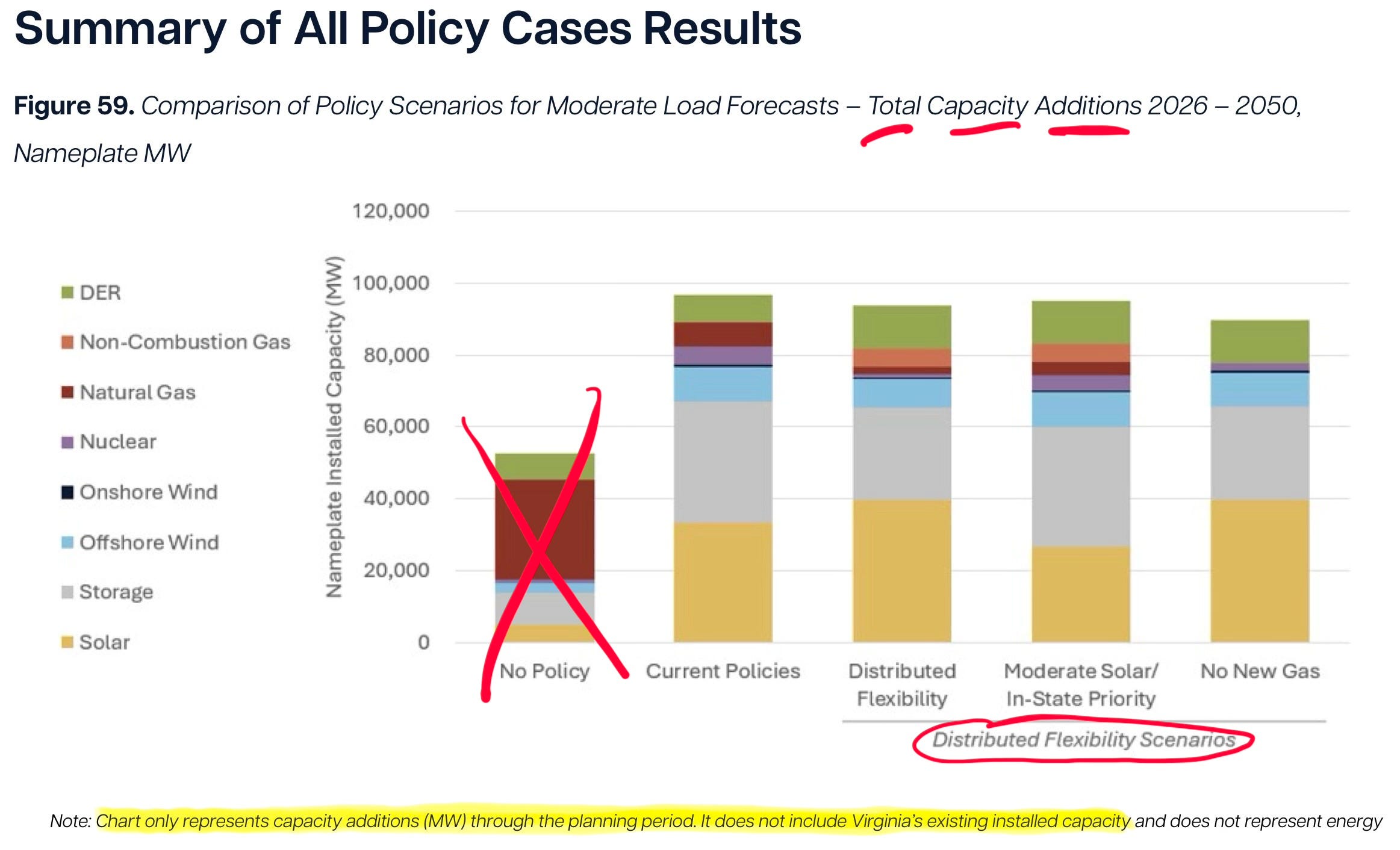
The other three scenarios with new stuff have a good deal of commonality and achieve shared major goals, as pictured in the chart below. Note that this isn’t what all electric generation will look like. It is only picturing what the new stuff could look like. Current generation isn’t pictured.
As you can see below in their “Summary of All Policy Cases Results” figure, distributed tech dominates — which they define as “distributed solar … battery storage, smart appliances … and managed EV charging” (p. 33). It’s such a major factor they label the three scenarios that have new policies as “Distributed Flexibility Scenarios.”
To let them sum things up, here’s a quote from the “Executive Brief” document of the Plan.
Virginia can meet rising electricity demand, protect affordability, and stay on a path towards net zero by building a more flexible, reliable, and locally beneficial electric system. The Plan’s Clean-First, Least-Cost approach starts with solutions that can be deployed relatively quickly and cost-effectively—energy efficiency, solar, storage, distributed energy resources, virtual power plants, demand flexibility, and better use of the existing grid—while advancing the transmission and clean firm resources, including advanced nuclear, nuclear fusion, offshore wind, and long-duration energy storage, that Virginia will need for the decades ahead. … Virginia can reduce land impacts by prioritizing solar and storage on rooftops, brownfields, agrivoltaics, parking canopies, and other dual-use sites. These investments can strengthen local economies, modernize infrastructure, and create significant jobs in every region of the Commonwealth (p. 12).
So there’s lots of good stuff in there. Net-zero is the meta goal.
Big Boost for Distributed Energy
As the chart above shows and my fellow Substacker Elsa Wood pointed out in an excellent post, distributed energy like rooftop solar — i.e., not centralized power plant energy — plays a major role.
“Positioning distributed energy as a key piece of the answer to Virginia’s power supply crunch — rather than a niche resource — it calls for scaling customer-sited solar, batteries and flexible load.”
Wood supplies a positive quote from Mary Rafferty, executive director of Common Charge, a pro-local energy group
“For the first time in Virginia history, a governor is leading with the benefits of a more distributed, local energy system in the Commonwealth’s energy plan.”
This emphasis in distributed is absolutely terrific. The problem is, we need more, faster.
To sum up: basically, this plan/scenarios hybrid is saying to Virginia’s legislative branch and interested stakeholders: Here’s some ways we can go about achieving a Virginia energy system that is reliable, affordable, flexible, locally beneficial, and on a net zero path.
The biggest problem for overcoming climate change? Net-zero isn’t good enough.
From Good to Great
Here’s the deal for those of us in The Climate Movement and others who want climate action, i.e., our Climate Action Supporters. We can no longer simply elect good leaders and then think we’ve checked the Climate Action Box.
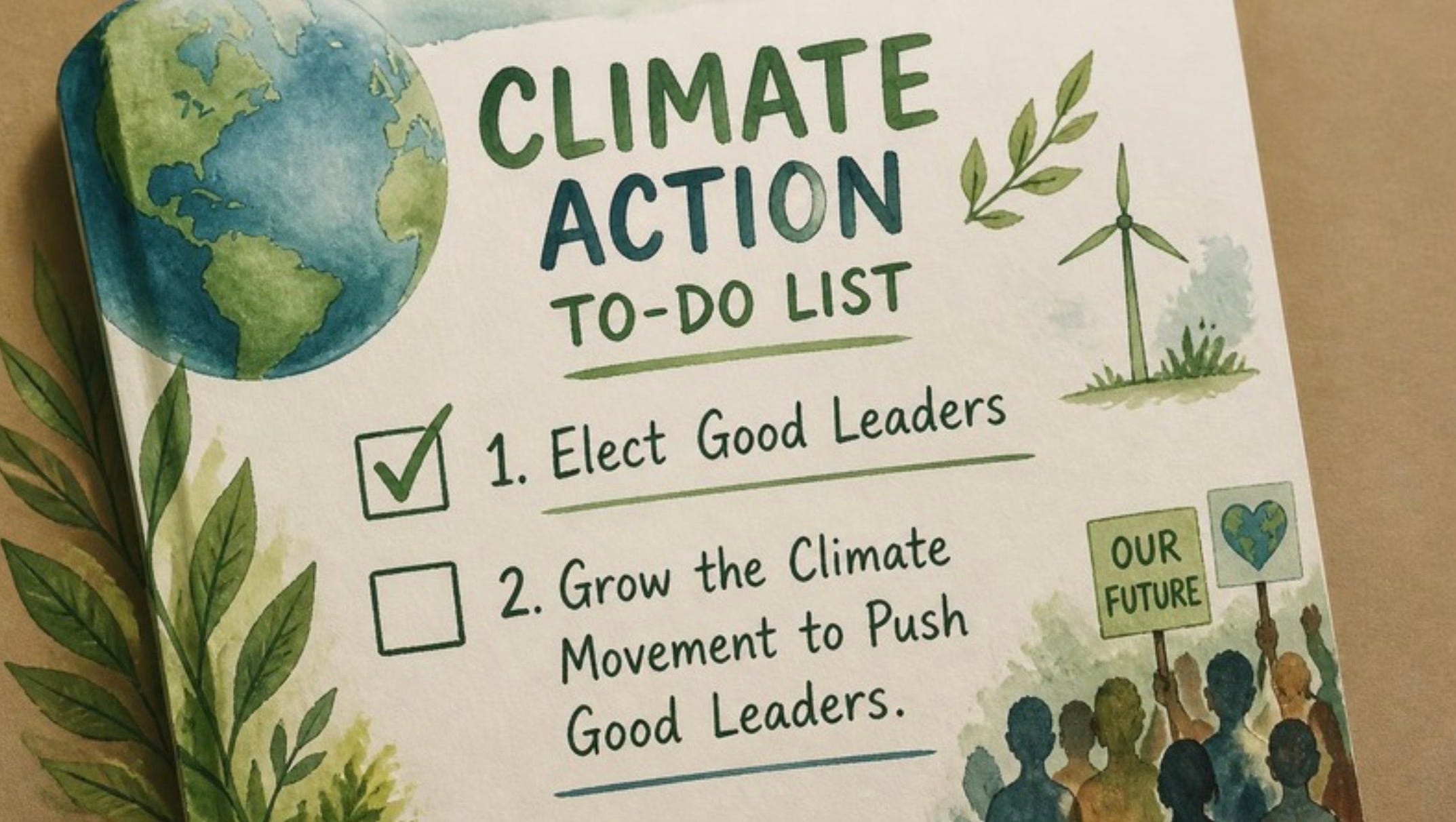
Nope.
We must continue to grow The Climate Movement so we can both support and push good leaders to become great ones: from good to great.
Gov. Spanberger is good. We must help her become great. She mustn’t settle for good enough. Good enough just ain’t good enough.

The plan/scenarios are all shooting for “Net-Zero” by 2050, which is required by current law, the Clean Economy Act of 2020.
Well, net-zero isn’t good enough because not every state and nation is committed to achieving it in a timely manner. Others game the system by mouthing the rhetoric of net-zero while their plans have questionable actions or push any serious action to 2045 or later, cooking the planet in the process. Net-zero commitments are supposed to give us a good shot at keeping warming to 1.5C. But right now we’re not on track for 1.5.

The truth is, good must be better. Good must be great. Our champions like Gov. Spanberger must set their sights higher and achieve real results faster. They must show others that being forward-leaning isn’t just the right thing to do. It reaps rewards.
Gov. Spanberger should be aiming to be better than current law. This isn’t some strange request to make of a governor. It’s why new laws are passed and signed. Changed circumstances require changed policies.
It’s not 2020 when net-zero became the goal. It’s 2026 and we need more.
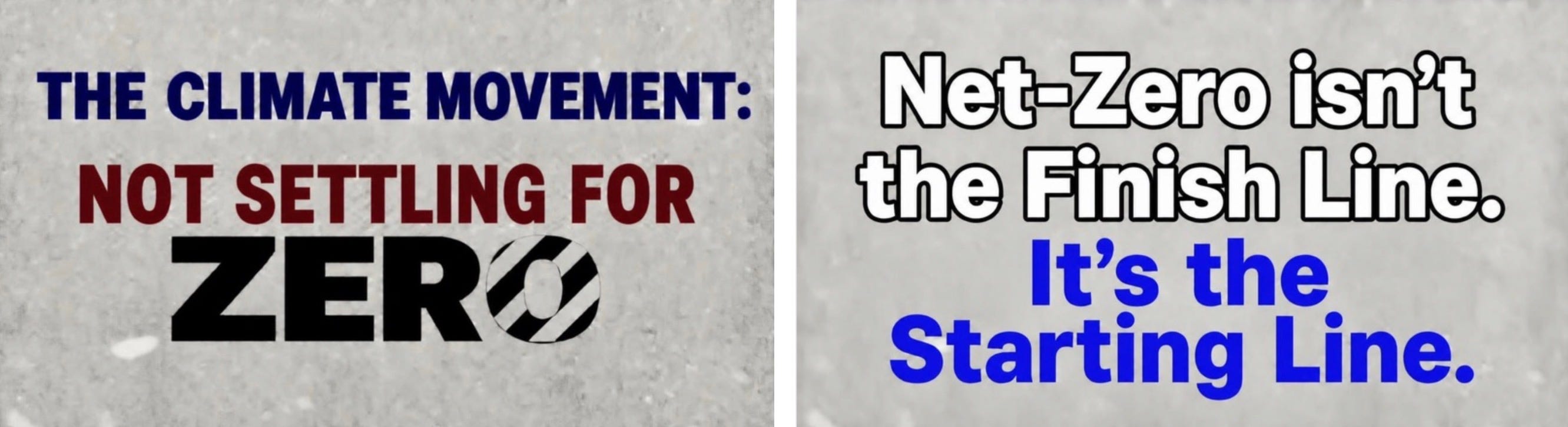
For The Climate Movement and Climate Action Supporters, we’re no longer settling for (net) zero. We must do better, and we must do better faster.
For Virginia, and all other states and nations, net-zero is not the finish line. It’s the starting line.
It’s Up To Us To Push For More
Every time someone friendly to our cause, an erstwhile ally, says we’re asking for too much, what they’re really saying is, “When you change the political dynamic to make this possible, get back to us.”
We must take it as a kick in the pants to grow our movement into the greatest and most long-lasting social change movement in the history of the world. That’s our destiny.
You see, it’s our job to make the impossible possible and the possible actual and the actual beautiful, our world more just, and our future come faster.
So when friendlies say “That’s not possible,” our response is simple: “No worries. We make the impossible possible.”
And that’s exactly why we need you. Join us!
If you are new here, check out our Intro Series. If you like this post, please “like,” comment, and share. And thanks for all you’re doing.
“In 2023 Virginia imported the most electricity of any state … Virginia’s electricity imports are largely powered by coal in West Virginia and legacy fossil-fuel facilities across PJM [the regional grid], largely in Pennsylvania and Ohio.” See Virginia Energy Plan, p. 29.
Great article! I love the climate action todo list image! That could be a whole separate article.