

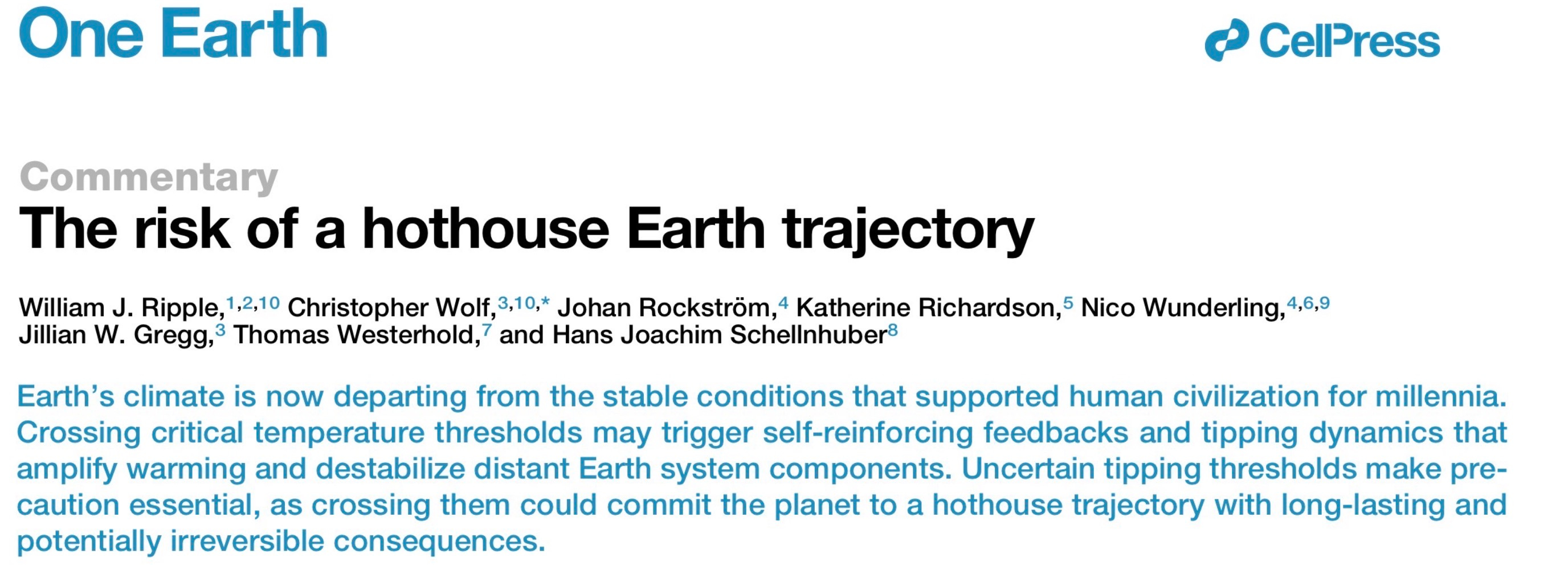
Ok, you see that text above in aqua blue. Read it and let it sink in. It’s from a just-published peer-reviewed journal article by eight prominent climate scientists who work in the US, Germany, Denmark, and Austria.
When I talk about “overcoming climate change,” this is what I’m wanting to get us as far away from as we possibly can. I don’t want us anywhere “uncertain tipping thresholds.” I don’t want us crossing them and committing us “to a hothouse trajactory with long-lasting and potentially irreversible consequences.”
Yea, we don’t want that.
That’s why for years I have defined overcoming climate change as this: to keep warming to 1.5C above preindustrial levels, or with minimal overshoot that is quickly brought back down; we then continue to reduce beyond 1.5C to a level that is natural for our time.
The 1992 Rio Climate Treaty, from which all of the international negotiations or COPs flow from, said we are working “to prevent dangerous anthropogenic interference with the climate system.”
That means avoiding what the text in aqua blue above says we’re starting to do. We’re starting have the climate depart “from the stable conditions that supported human civilization for millennia.” This is a profound violation of our Better Future Covenant with our children and subsequent generations.
Concerning the three actions of justice — stopping bad stuff, setting wrong right, and making things better — this GHG/temperature goal is focused exclusively on the first, stopping bad stuff.
I have argued that we should do the first action of justice, stopping the bad stuff, stopping the aqua blue stuff, in ways that help us do the second and third actions of justice, set wrong right and make things better. (For more on justice, see my Hope & Justice Series.)
We definitely can’t achieve justice if we are not stopping the bad stuff. That means stopping the release of greenhouse gases (GHGs) from fossil pollution and deforestation that will help stop the temperature increase driving climate impacts so that we stop those consequences.
The Findings of Ripple and Colleagues and the Tipping Point Window
According to these prominent scientists here’s our current situation:
Today, global temperatures are as warm as, or warmer than, any period in the last 125,000 years and it is likely that carbon dioxide levels are higher than at any time in at least the past two million years.
And
the Paris Agreement formalized the aim of limiting warming to 1.5◦C above preindustrial levels, yet global temperatures have recently breached this limit for 12 consecutive months, coinciding ,with record-breaking heat, wildfires, floods, and other extremes. … climate model simulations suggest the recent 12-month breach may indicate th[e] long-term average is at or near 1.5◦C.
And
A central concern is the activation of climate tipping elements … Tipping may already be underway or could occur soon for the Greenland and West Antarctic ice sheets, boreal permafrost, mountain glaciers, and parts of the Amazon rainforest. These processes could raise global temperatures, accelerate sea-level rise, release vast stores of carbon, and destabilize ecosystems. The precise threshold temperatures remain uncertain, but research shows that crossing one or more of these thresholds could trigger self-reinforcing processes … If one element tips, it can trigger a cascade effect, pushing other systems past their thresholds. Such tipping cascades have the potential to drive self-sustaining climate change adding to the risk of triggering a hothouse Earth trajectory (emphasis added).
And
In short, we may be approaching a perilous threshold, with rapidly dwindling opportunities to prevent dangerous and unmanageable climate outcomes.
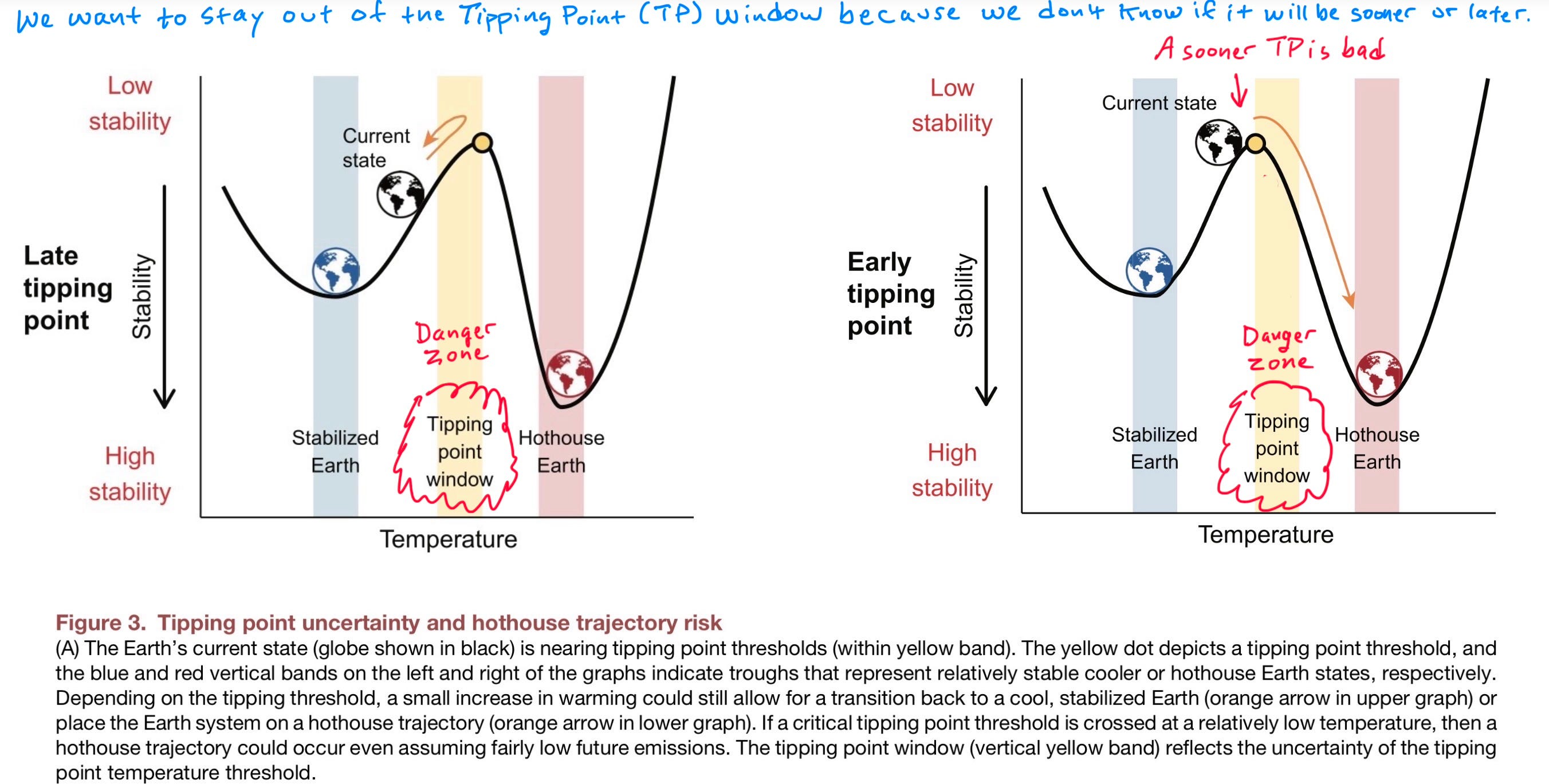
Their two graphs above from their Figure 3, which I’ve written on and modified by placing these two possibilities side by side, illustrates that we are moving ever closer to a “Tipping Point Window” — something we don’t want to enter into. That’s because we don’t know where a tipping point that could create a cascade of tipping points is in this Tipping Point Window.
In this case, as pictured in the graph on the right, sooner is bad. A cascade-causing-tipping-point happening sooner would push us into a “Hothouse Earth.” But, if we’re lucky, a later one gives us time to back out of the Tipping Point Window danger zone and return ourselves to a safer climate zone.
So, let me sum up:
more bad stuff is happening now,
we may already be at or near our temperature avoidance goal of 1.5C,
we may be closer than we thought to tipping points we don’t want tipped and a runaway train of climate consequences we don’t want to imagine in a hellscape they call Hothouse Earth.
Yikes.
Bottom Line: We want to stay out of the Tipping Point Window altogether because we don’t want to be playing Russian Roulette with our future, hoping we get lucky even as we put more bullets in the gun.

Climatic Pasts, Possible Futures
Let’s take a look at their Figure 1 pictured below, modified by me. It shows over one million years of global temperature history, with 275 future years out to 2300 tacked on over on the right. As you can see, the development of agriculture and human civilizations took place during a period of very stable climate in comparison to preceding climates.
But we’re pushing ourselves and the rest of nature out of this stable zone that is colored yellow. Over on the right, we’re currently in the orange shaded area, instead of in the safe yellow area where we should be.
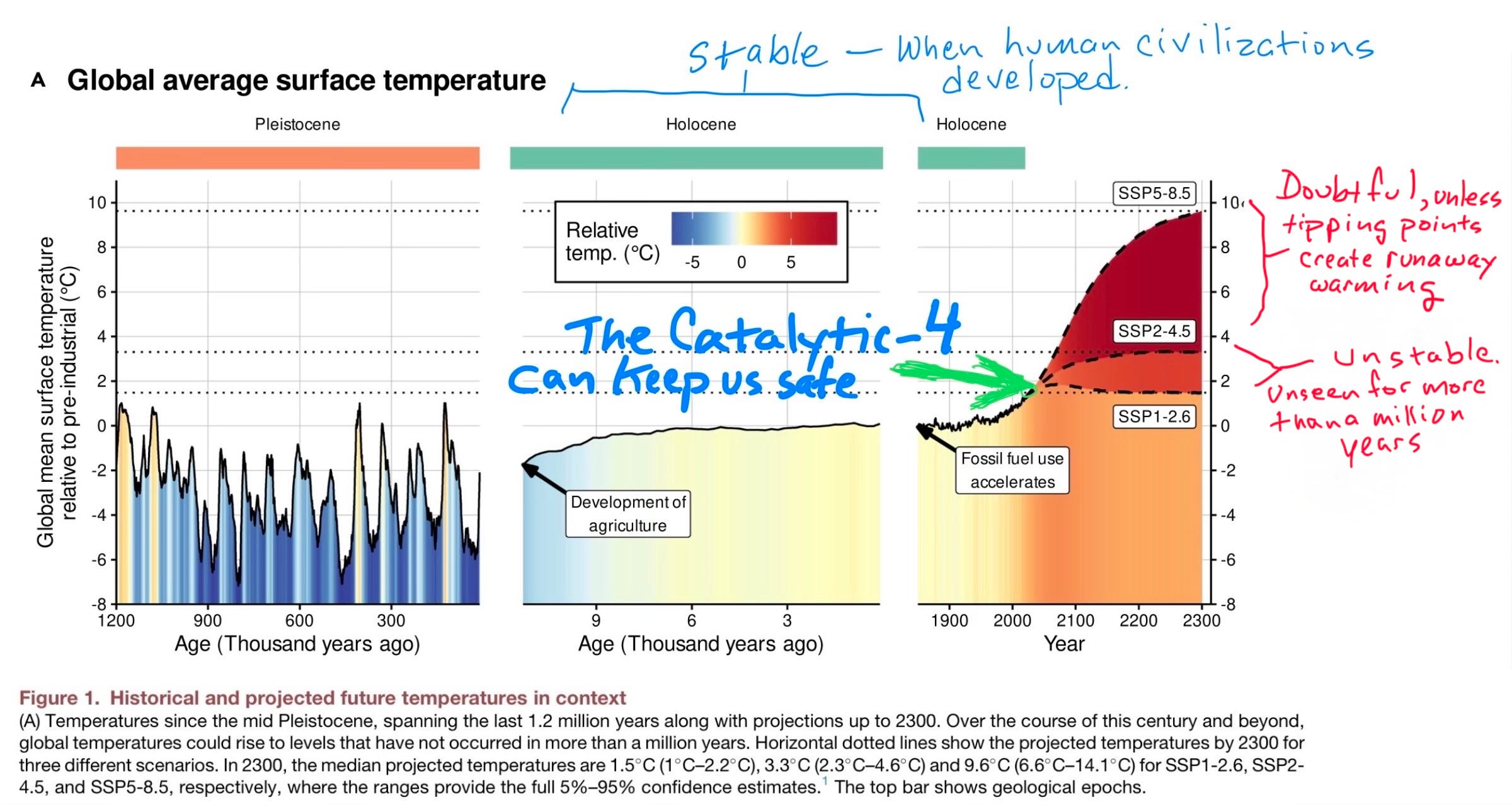
If it were just about temperature increases from GHGs we release, then I’m confident we won’t see the temp increases in red. Not gonna happen.
But it isn’t just about a linear GHG-temp calculation. We’re tampering with non-linear, dynamic, interrelated ecological/geological/climate systems that create a variety of tipping points. The wrong combination could create a self-propelled tipping point cascade.
And then we’re no longer in charge of our future. We won’t avoid the red zone in the graph, above, that Ripple et al call a “Hothouse Earth.”
Well, screw that.
Realistic Hope and Urgency
Some of you may be thinking: “Geez. With all this bad news, where’s the good news? Ok, hope-guy, where’s the hope? Where’s one of your snappy one-liners to make me feel better?”
I’m not here to give folks a feel-good hope fix.
As I said in my second post, what I’m offering is realistic hope. Only on realistic hope can we build our Climate Movement. If we don’t have a realistic understanding of our situation, what we’re faced with, we can’t change it. We gotta see it to solve it.
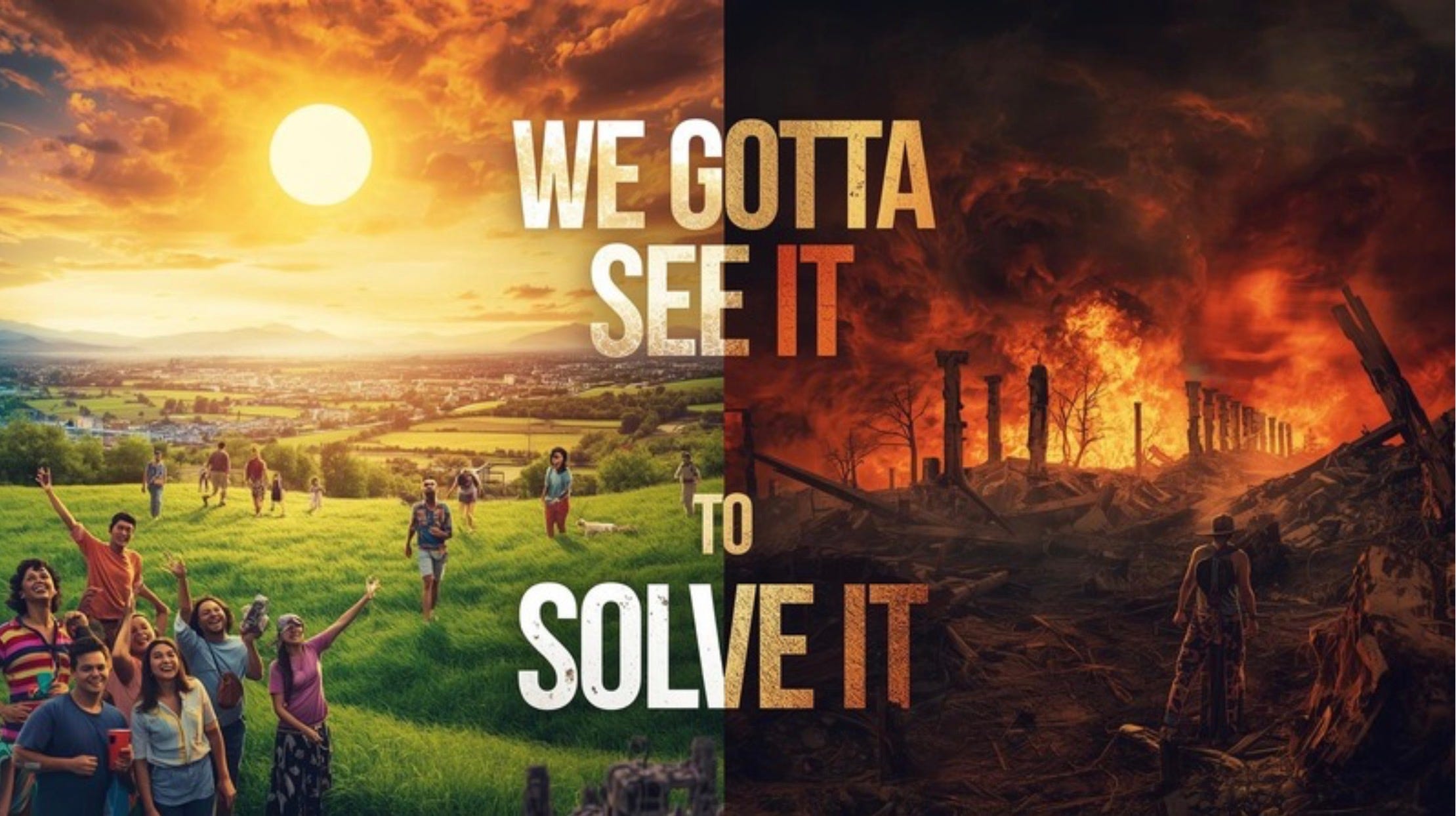
We must understand the urgency for us to make our future come faster at the speed and scale necessary to overcome this threat by creating a clean energy transformation and a relationship of balance and harmony with the rest of nature that keeps us out of the Tipping Points Window.
Creating Our Vision: The Catalytic-4 Can Lead the Way
We don’t want our future to be based on luck, with the odds loaded against us. We want to stay away from that.
We want it based on our vision, purpose, and major goal: to overcome climate change by creating a just and prosperous sustainability that enhances wellbeing for everyone and everything.
Even though time is running out, we still have time to stay out of the Tipping Point Window.
Where does our realistic hope come from? Given our reality, where’s the hope?
Let’s zoom in on my modified version of Ripple et al’s Figure 1:

You can see that I’ve drawn a green arrow. It’s pointing to where we are right now, our current point in time. I’ve also written, “The Catalytic-4 can keep us safe.” From our current point in time Ripple et al’s graph has three black dashed lines representing three possible temperature trajectories. The lowest one keeps us in the orange, the second has us going from orangish-red to red, and the third is all red.
The lowest one is the only one of their trajectories that will keep us out of the Tipping Points Window, the Danger Zone.
How do we stay safe? The Catalytic-4, working together, can keep us safe — even have us moving back towards the yellow. I’ve illustrated that by adding a fourth trajectory represented by green dashes. This is our Catalytic-4 trajectory.
As a reminder, The Catalytic-4 are:
The Climate Movement
Climate Action Supporters (i.e. popular support for climate action)
ARTC or the accelerating rate of tech change
Governments-&-Markets.
As I’ve discussed before (e.g. here and here), 2-4 are already poised to play their roles.
In most countries support for climate action is above or close to our goal of 80% popular support.
ARTC has already created most of the tech we need.
Governments-&-Markets have created conditions where profits and price are working in our favor.
It’s The Climate Movement that must up its game. The Climate Movement is indispensable for ensuring speed and scale, accomplished by pushing the other three to fulfill their climate action potential and by creating Catalytic-4 Strategic Synergy.
Social science research has shown that 3.5% of a population can create social change. Well, given our challenge, by 2030 I think we need 5%, or 400 million worldwide and 16 million in the US.
So if we want to stay out of the Tipping Points Window and follow the green dashes and get us back into the yellow, The Climate Movement must pull our destiny into the present and become the greatest and most long-lasting social change movement in the history of the world. And we must do so sooner. And we can.
That’s why the most strategic thing we can be doing right now is growing and improving The Climate Movement.
In the section of their article titled “Moving Forward,” Ripple and colleagues write:.
While the exact risk is uncertain, it is clear that current climate commitments, which have us on track for roughly2.8◦C peak warming by 2100, are insufficient and greater climate mitigation efforts are needed.
No kidding.
That’s why, together, we will make the impossible possible and the possible actual and the actual beautiful and our future come faster. Ours is a time for regular folk to become heroes together. Join us!

If you are new here, check out our Intro Series. If you like this post, please “like,” comment, and share. And thanks for all you’re doing.