

Ok, yea, sure, China is adding renewables. But they’re just adding it to their #1 polluter fossil stuff. Right?
Fossil flacks and climate action opponents just don’t want to give up their “Oh, but China!” dodge.
I guess we’ll have to throw them a pity party.
China Has Turned The Corner On The Clean Energy Transition: It’s Clean-Up Time
This is the year China has turned the corner. They’ve been saying what they are doing for years. In 2021 China’s leader, Xi Jinping announced the principle to guide their transition from dirty to clean: “build before breaking”.
Basically it’s the idea that before we ditch the old stuff let’s get the new stuff online; build the clean stuff before breaking with the dirty stuff.
Now do we need China to move faster? Sure. But they’re now doing a hell of a lot better than the US, and many other countries, for that matter.
You don’t have to take my word for it. You can read all about it in Ember’s latest “Emberiffic!” report on China.

So at what point is China’s transition? Ember’s response:
“So where does China stand in this [build before breaking] process today? Is it still primarily expanding the new system alongside the old, or has the new system begun to put more direct pressure on the fossil-fuel system it is intended to replace?
Developments in 2025 and early-to-mid 2026 point to a deeper shift. The new system is beginning to take over functions long performed by fossil fuels — across power generation, system balancing and the wider economy” (emphasis added).
The report articulates six takeaways that point to this deeper shift towards clean and green and away from dirty old fossils.

1. Clean Up, Coal Down. A Trend, Not a One-Off
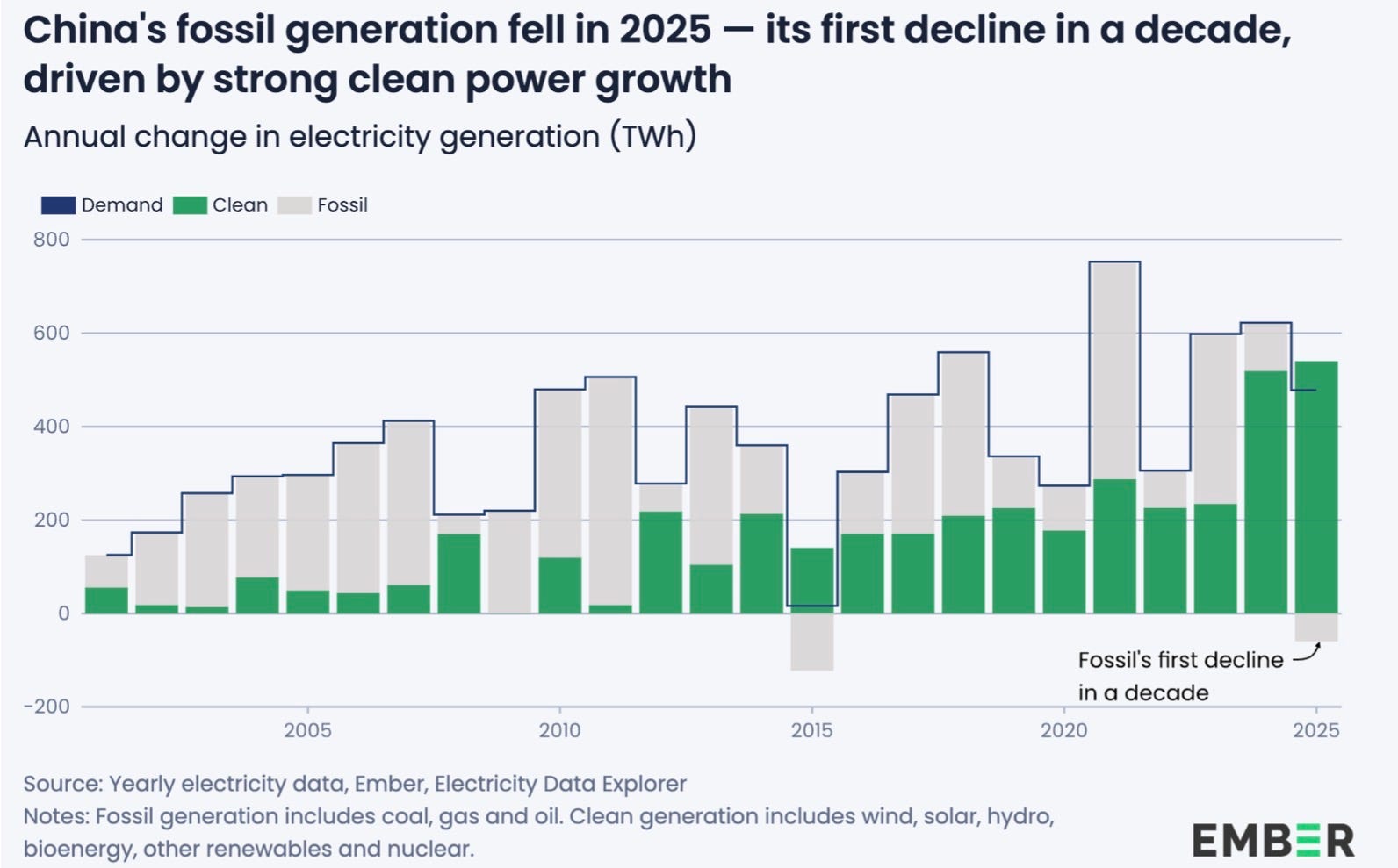
“Clean power met all demand growth in 2025, and coal generation fell for the first time in a decade. … coal generation has been flat … since early 2024, following years of continuous expansion.”
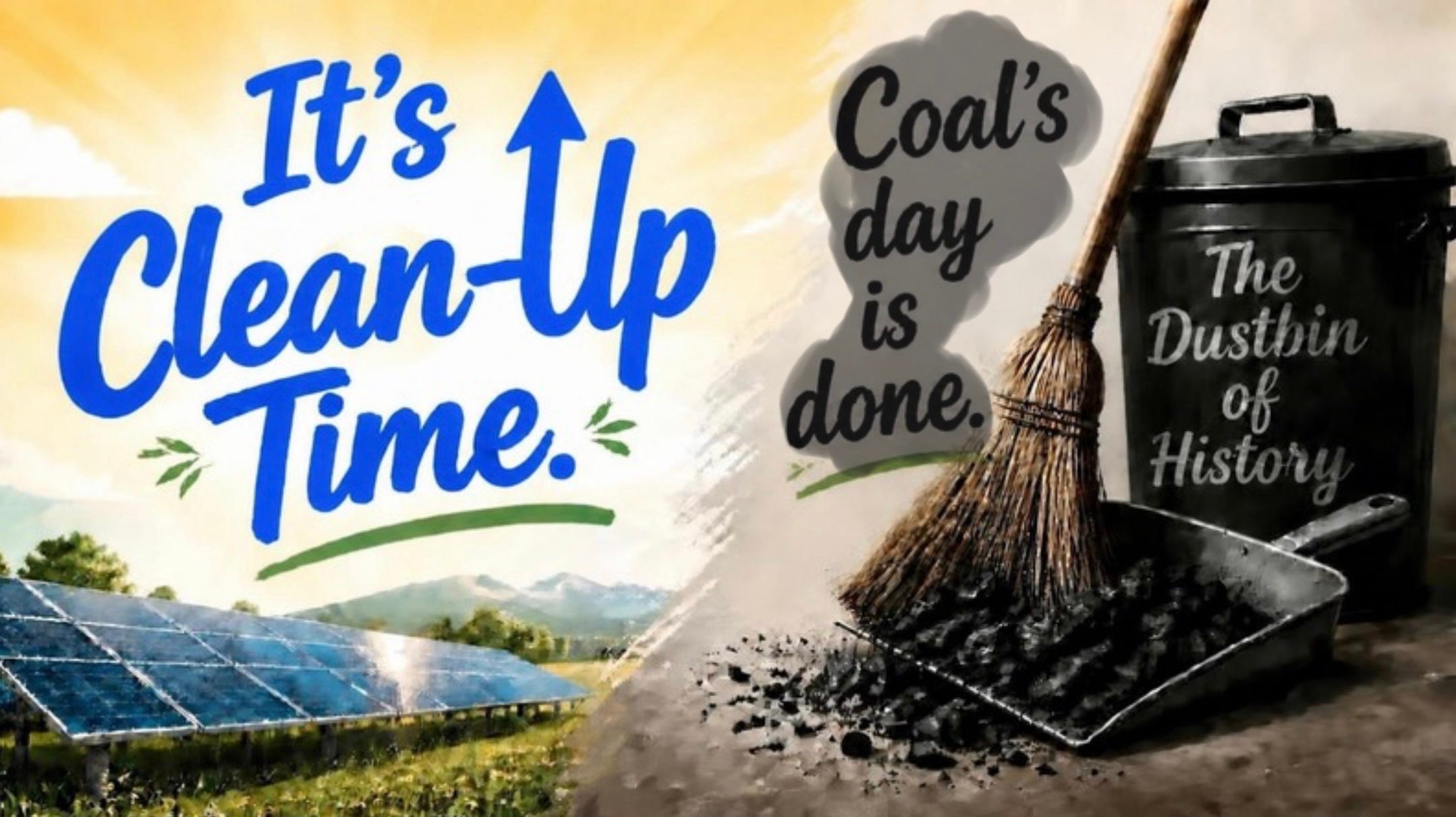
As the report shows, this is a realignment away from the fossils, not a one-off. It’s clean-up time. Coal’s day is done.
2. Energy Storage Is Becoming Baseload, Filling the Generation Gaps
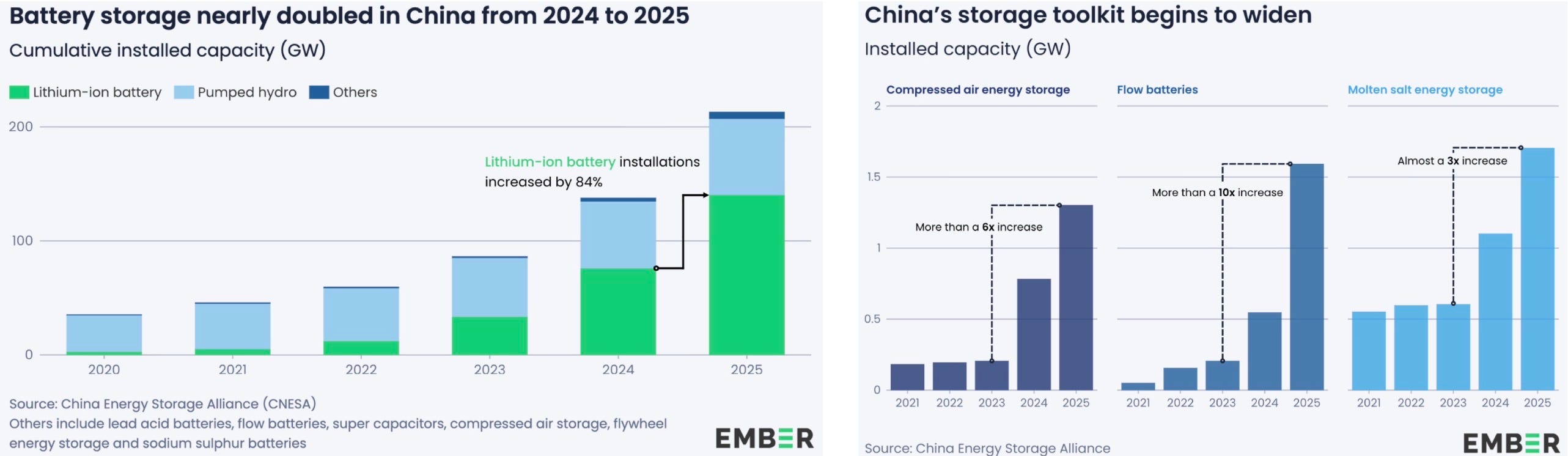
When clean can’t meet demand, energy storage from batteries and other tech is stepping in and filling the generation gaps, beginning to displace coal. New replacing old. New displacing old. China now makes up 60% the world’s battery market, and its installed storage capacity for electricity grew 84% in 2025.
But other storage tech is also advancing rapidly, as seen in the graph on the right, below.
3. Industry Is Electrifying The Hard Stuff
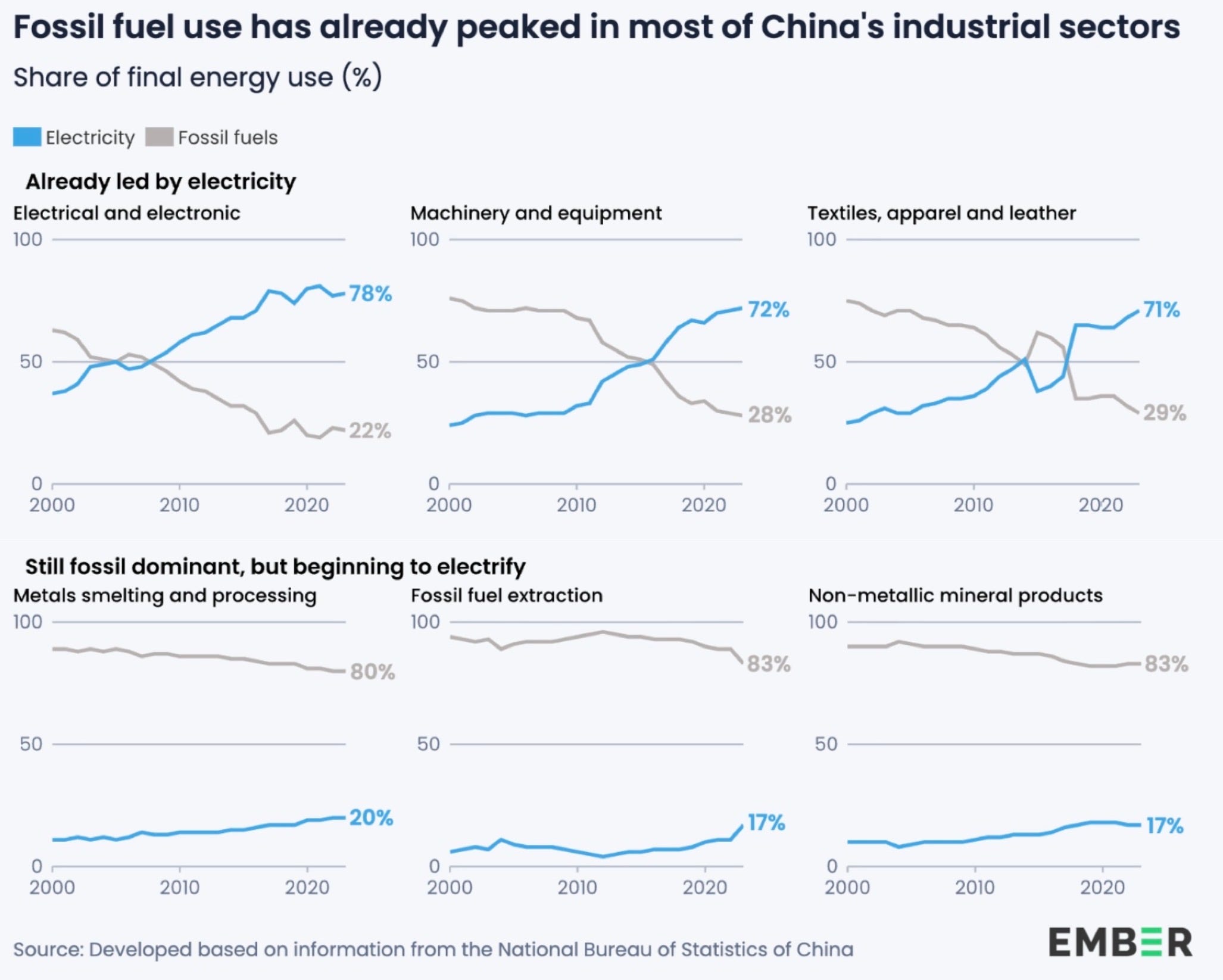
As seen below, industry continues to electrify the lower-hanging fruit and now supplies a large majority of the energy for light manufacturing of machinery (78%), equipment (72%), and textiles (71%). But the hard nuts are starting to crack as well, such as metals smelting and non-metallic minerals.
While electrotech is much more efficient, needing less power, we want that power to be clean. We want both clean and efficient.
4. Trucks, Too, Not Just Cars: Keep On EV Truckin’
Passenger EV sales continue to go like gangbusters, making up over 65% this year. But that’s not the only good news. They are starting to take off in the more difficult terrain of trucks. Sales doubled in 2024 and again in 2025, with their share reaching 26%, as pictured below (modified by me). This year the upward trend continues. In June this year EV trucks reached nearly 45%.
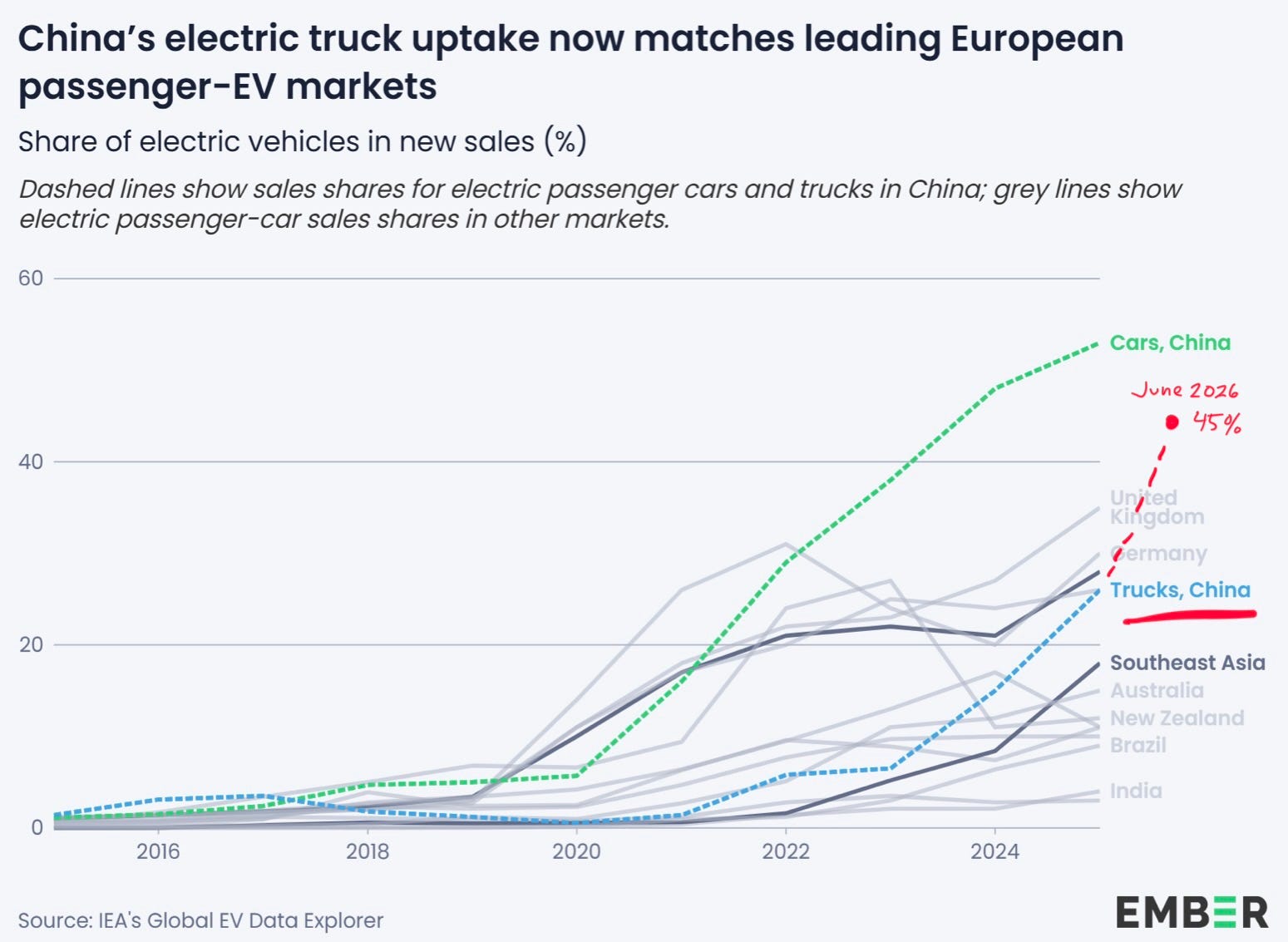
Ember explains why this is so impressive:
Trucks are more difficult to electrify because of tighter requirements around payload, range, charging time, route reliability and operating cost.
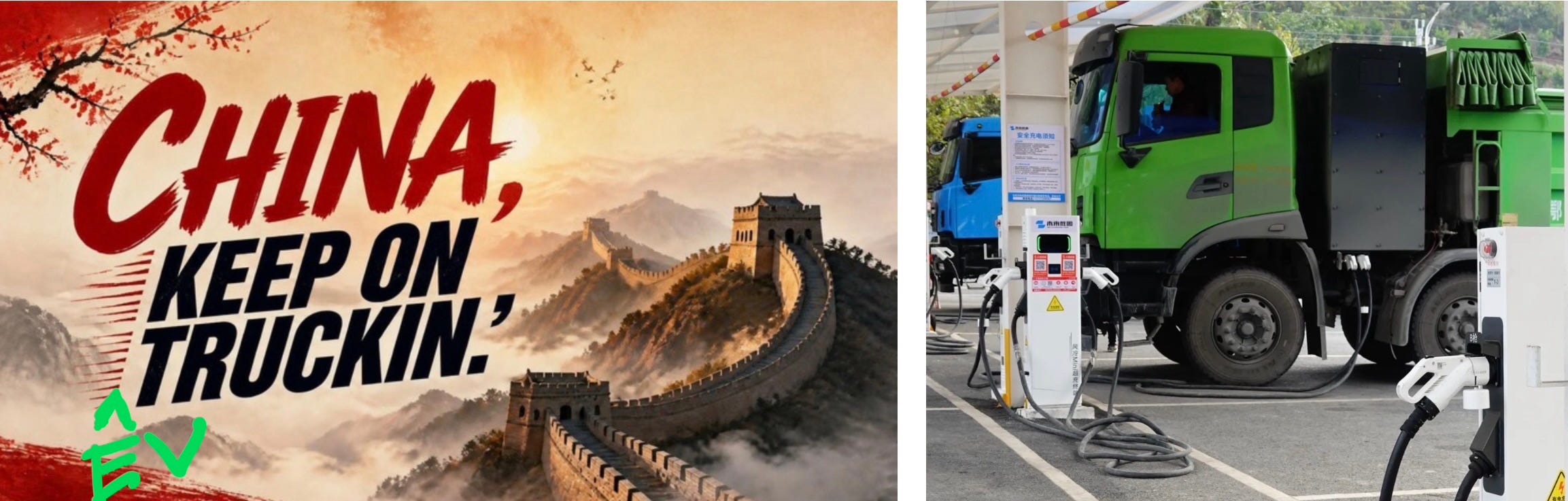
So, China, keep on truckin’ — EV truckin’, that is.
5. The Fossils Are Flat-Lining & Declining Across Most of China
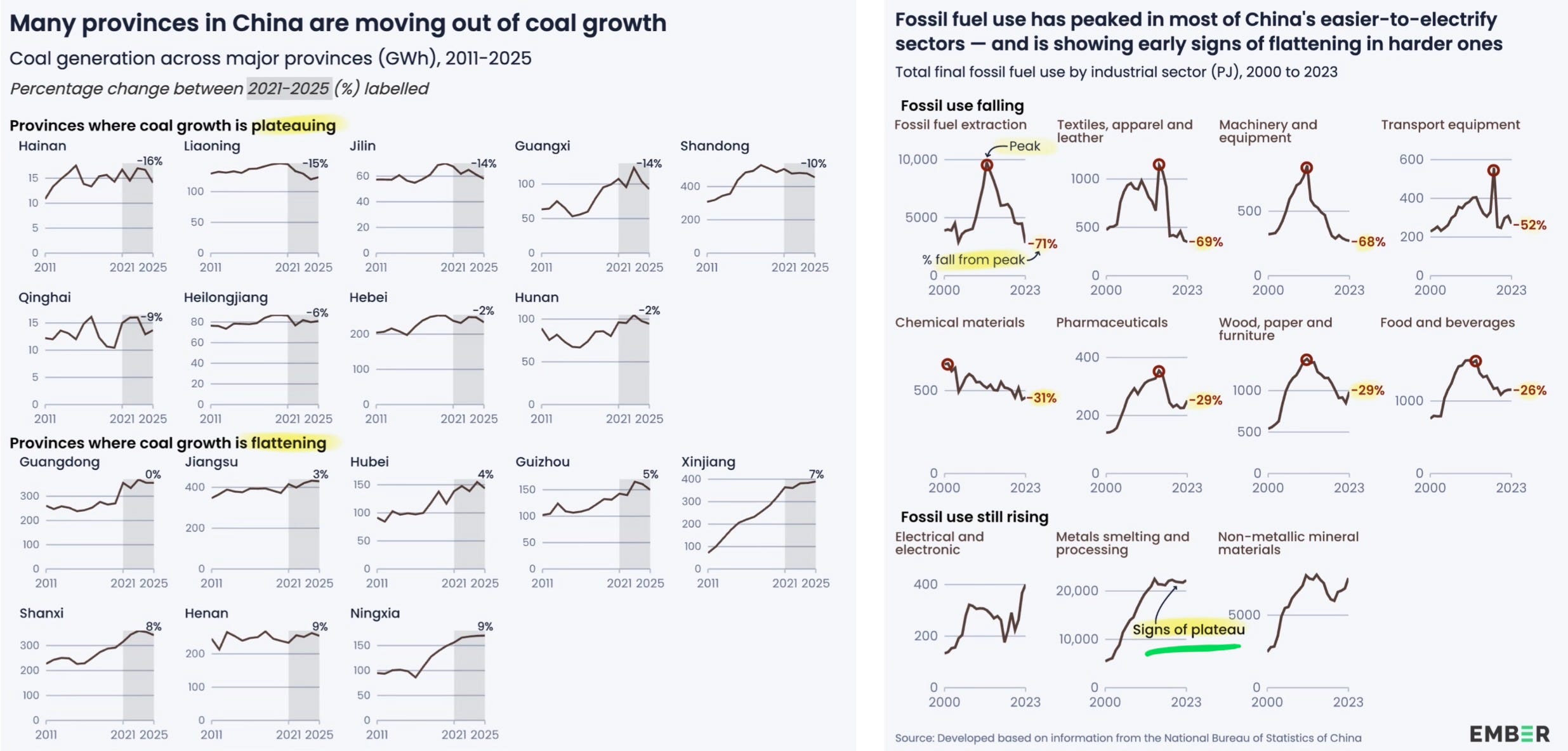
As seen below, coal power generation is declining or flattening in half of the provincial regions or divisions in China, representing about half of coal use. In the rest of the economy, the fossils have declined significantly in the easier to switch sectors, ranging from 26% to 71%. In the harder ones, e.g., metals smelting and processing, there are signs that the plateauing process may have begun.
6. Clean is Making China’s $Growth$ Green, Strengthening Its Energy, Economic, & National Security
EVs are putting a big dent in one of China’s largest threats to its economic and national security — its oil dependence. Currently over 1.5 million barrels of oil a day are being displaced by EVs. This is helping China not only go green, but also helping it to be weaned off foreign oil and easily weather the Iran War storm: green; weaned; strong; clean.
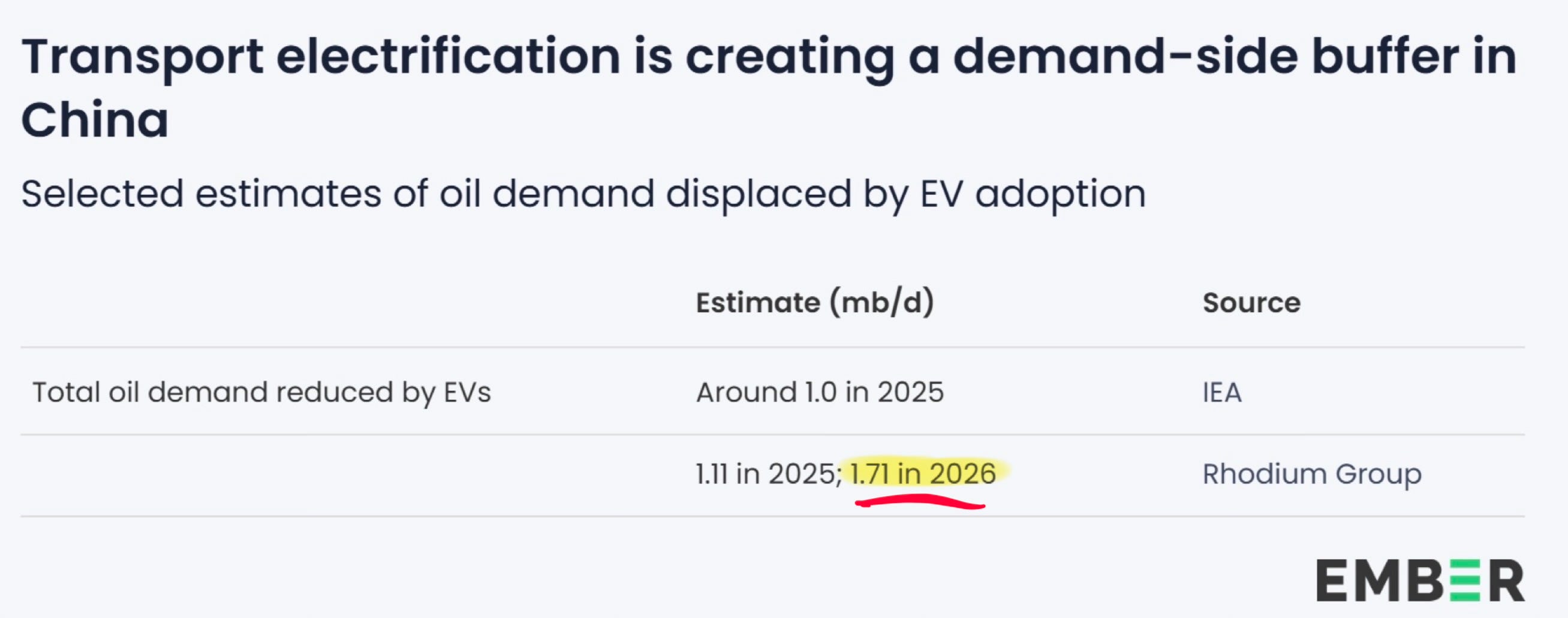
But this has wider international ripples as well. As the NYT reports, this, along with its oil reserves and refining capacity, has
allowed the country to slash oil purchases by 23 percent in the first six months of the war with Iran compared with the same period the year before … China’s ability to throttle oil imports caught nearly everyone in the oil industry by surprise. And it’s a big reason crude oil prices have not risen nearly as much as most energy executives and analysts thought they would once Iran severely restricted the passage of ships through the Strait of Hormuz. As of late August, crude oil cost roughly $10 a barrel less than it would have had China continued buying at prewar levels, according to Daan Struyven, who leads oil research for Goldman Sachs.
“This is a power that nobody thought China had,” said Erica Downs, a senior research scholar at Columbia University’s Center on Global Energy Policy.
So who’s the big “winner” in the Iran War thus far? China. All of this has tremendous geopolitical ramifications we have not begun to fathom.
Ok, reducing dependence-inducing, insecure, destabilizing imports: CHECK.
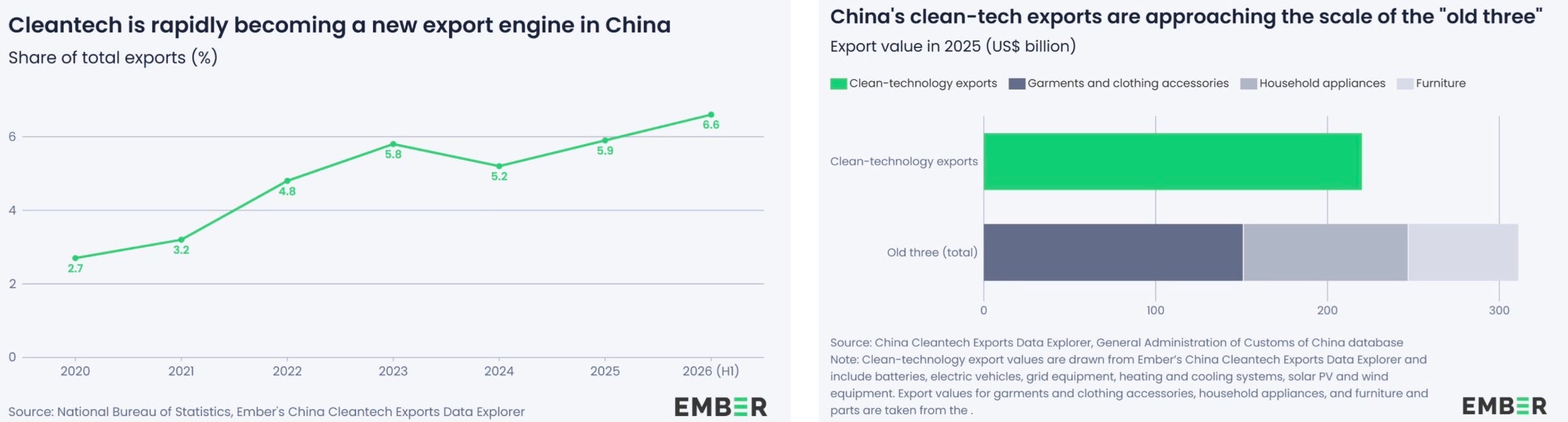
Now what about exports? For China, more good news.
As you can see below, clean tech exports have gone from 2.7% of the total in 2020 to 6.6% in 2026. Clean tech is now greater than clothing, appliances, and furniture, and is closing in on being more than these “old three” combined.
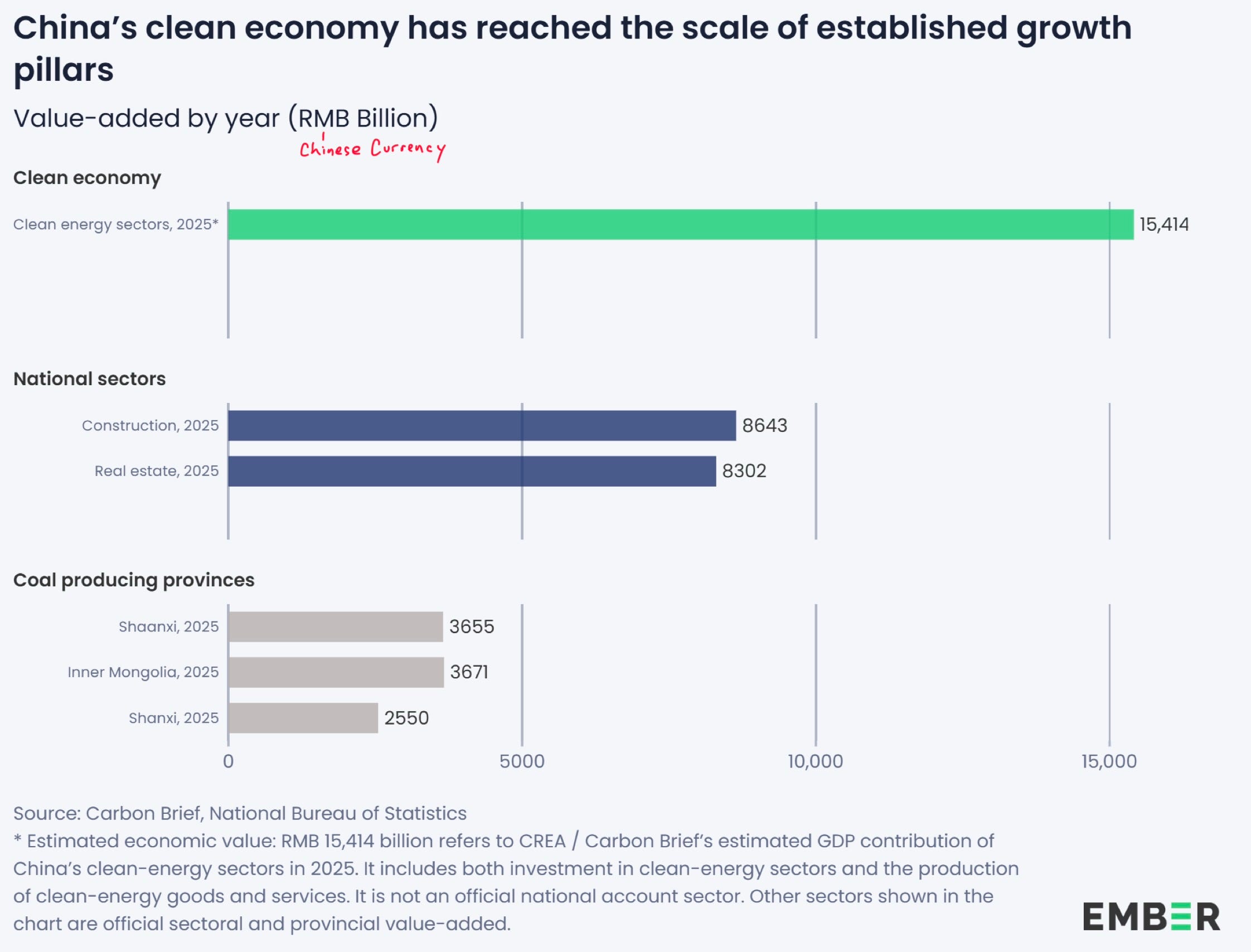
More broadly, clean energy is now a major contributor to China’s economic growth and wellbeing overall, when looking with a wide lens at investments, manufacturing, and supply chains. As you can see below, combined it is larger than real estate and construction, and is greater than all of the three largest coal-producing provinces put together.
China’s clean energy economy has been “on the road” for years and has now made it to Broadway, so to speak; it’s hit the big time.
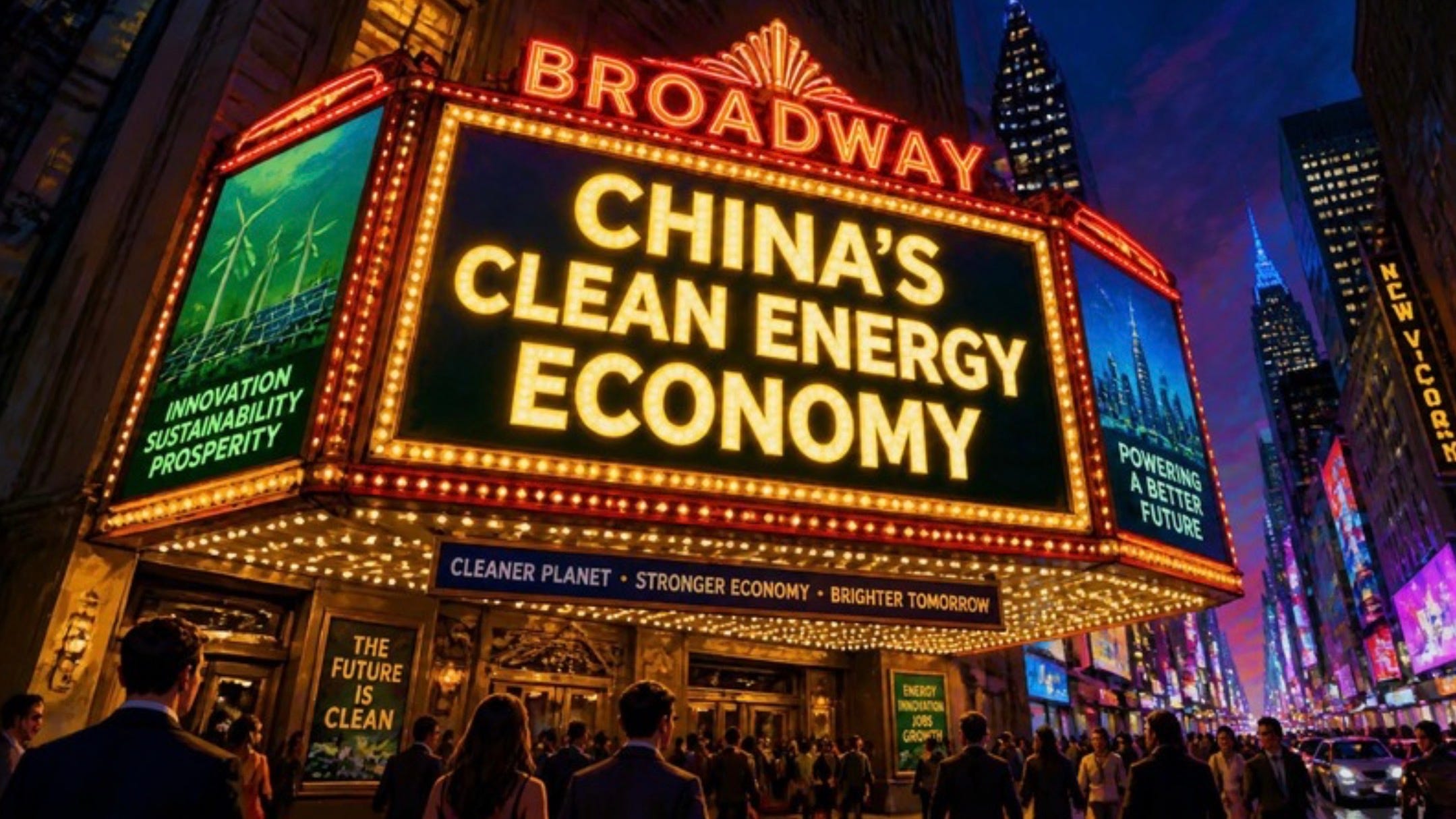
It’s Clean-Up Time. This is good for China, good for the climate, and good for clean growth around the world. But this is bad news for the fossils. It’s twilight for them. We must have no illusions. They’re going to fight this every step of the way. But at least with the world’s biggest emitter we’ve turned a corner and we’re now at the intersection of Clean Street & Broadway heading for a better future.
China is creating a future where the fossils can’t jerk them around. That’s good for us.
Our Response: Bigger, Faster, Juster, Now
So what’s our response? As The Climate Movement, it’s our job to push all governments, including China, to go faster. It’s Clean-Up time. Time to sweep the dirty old fossils into the dustbin of history.
We want more, and we want it today. Impatient? No. We’ve waited far too long already, thanks to the fossils trying to hang on to their profits and power. That’s why we need to bring to bear our three forms of power, our P3: (1) moral power; (2) people power; (3) staying power. The time for patience has been over for over a decade or more. It’s well past time for justice.
We’re still living with the 20th Century energy systems powered by the fossils. Even without the active resistance of the fossils, there is a ton of bureaucratic and legal and even cultural inertia that must be overcome. We’ve got a lot of work to do. That’s why growing and improving The Climate movement is the most important thing all of us can be doing right now. We make the impossible possible and the possible actual and the actual beautiful, our world more just, and our future come faster.
Bigger, faster, juster, now. Join us!
If you are new here, check out our Intro Series. If you like this post, please “like,” comment, and share. And thanks for all you’re doing.