

Affordability for Rural Americans? Yes. We’re talking affordability. But much more.
Freedom.
Self-reliance.
Patriotism.
Neighbors helping neighbors.
Jobs.
Economic Growth.
Clean air and water. A healthy, climate-friendly environment.
A brighter future for your children and communities.
All of this is yours for the taking, if you but believe in yourselves.
It’s Time to Claim and Grow Your Power: P³ in 250.
Rural Americans — in this 250th Anniversary year of our nation’s birth, time to declare your independence by claiming and growing your P-cubed power or P³:
political power,
electric power, and
economic power.
You grow good things for our nation. It’s time to grow your P³ for you. But not just you. Your neighbors. Your country.
How?

First, you must stop listening to those who want to keep you down, keep you from organizing to create political power, keep you from growing your own electric power and through that your economic power.
As Daniel Bell, a Kentucky farmer, put it about growing electric power: “For me, it’s just been about freedom. Freedom to lower bills, freedom to control my own assets.”
If you want affordability that lasts, then tap into your P³. That’s because we’re up against powerful and devious foes.
Fossil companies and those with connections to them have been spreading lies about solar and wind, spending $$ millions to do so. And those lying are pushing bans, telling farmers what they can and can’t do with their land. Unfortunately, they’ve succeeded in having some local officials institute bans.
“I just don’t think it’s right for the county commissioners to tell other property owners that they can’t do what they want with their land,” said Emily Adams, fighting to end a local ban in Richland County, Ohio.
So lies and bans thwarting freedom and self-reliance and affordability.
Emboldened by the truth, it’s time to have the political power necessary to defeat such bans, but also harmful backroom sweetheart deals for AI data centers that have folks paying for it with higher electricity prices, rolling blackouts, and water shortages. If you have already organized to thwart AI data centers (let Erin Brockovich help you, BTW) don’t stop there! These are the same basic fights — big utilities, big tech vs. regular folk.
“I think they count on us being dumb country people and us not pushing back,” said Kassi Solmberg, a homesteading mom in Montana.
Rural Americans must grow your political power to not only defeat local bans and AI data centers, but to defend and enhance longstanding bipartisan federal policies that bolster Rural America’s contribution to energy independence — for both farmers and our nation.
Begun during the George W. Bush years, the Rural Energy for America Program (REAP) has funded $1.8 billion in grants and “backed tens of thousands of renewable energy and energy efficiency projects across the country in that time.”
Unfortunately, in its stupid war on renewables the Trump Administration has halted these grants. Will Congress fix this in the next Farm Bill? At this point it’s anyone’s guess while the bill continues to be bottled up in the Senate.
The fossils and their friends and don’t want farmers to grow clean energy for themselves and the country. Self-reliance, affordability, and patriotism are all wrapped up together in the gift of renewable energy — just what our country needs for its 250th birthday.
As William Becker says:
With oil and gas prices controlled by global markets, and coal and nuclear power producing dangerous wastes, renewable resources are the true path to America’s energy independence. They are the “America First” options.
To reap the full harvest of wind and sunshine Rural Americans must have P³ in 250.

As we have seen, for Rural Americans to maximize your electric power potential, you must grow and flex your political power to overcome the fossils and their liars and powerful friends, and do so emboldened by the truth.
But to do so we must remember that for most residents in Rural America, there are two main types of utilities, and they will require different approaches from us:
state-sanctioned investor-owned monopolies, and;
Rural Electric Cooperatives (RECs).
As the name implies, the first are owned by investors, while the second, as a coop, are owned by the customers.
Investor-Owned Utilities (IOUs)
State-sanctioned investor-owned monopolistic utilities provide electricity to around three out of every four customers nationwide, but that drops significantly in Rural America.
Their acronym is “IOU” — but it should really be YOM — You Owe Me.
Remember: these “YOMs” are in business to make money for their investors, not the customers, not you. They are not looking out for you, your community, or your country.
But that doesn’t mean our interests can’t converge.
For farmers, one way for you, your community, and your country to benefit is by leasing a portion of your land to utilities (and other energy providers) for renewable energy projects.
“Nationwide, wind and solar projects contribute about $3.5 billion annually in combined lease payments and state and local taxes, more than a third of it going directly to rural landowners.”
For example, the IOU MidAmerican in Iowa:
has invested approximately $15.8 billion in wind and solar energy projects;
paid approximately $45.7 million in 2025 to over 4,000 landowners for wind projects and $60 million in property taxes;
generated through their wind projects enough electricity to power over 2.4 million households.

These long-term leases provide financial stability, helping to avoid the need to sell the farm to land developers, permanently taking the land out of agricultural production.
Indeed, as the “agrivoltaics” movement proves, harvesting the sun and wind in Rural America when done right can complement and enhance rather than compete with more traditional cash crops, as research from the National Renewable Energy Labratory (NREL) shows. Renewables are simply another cash crop.
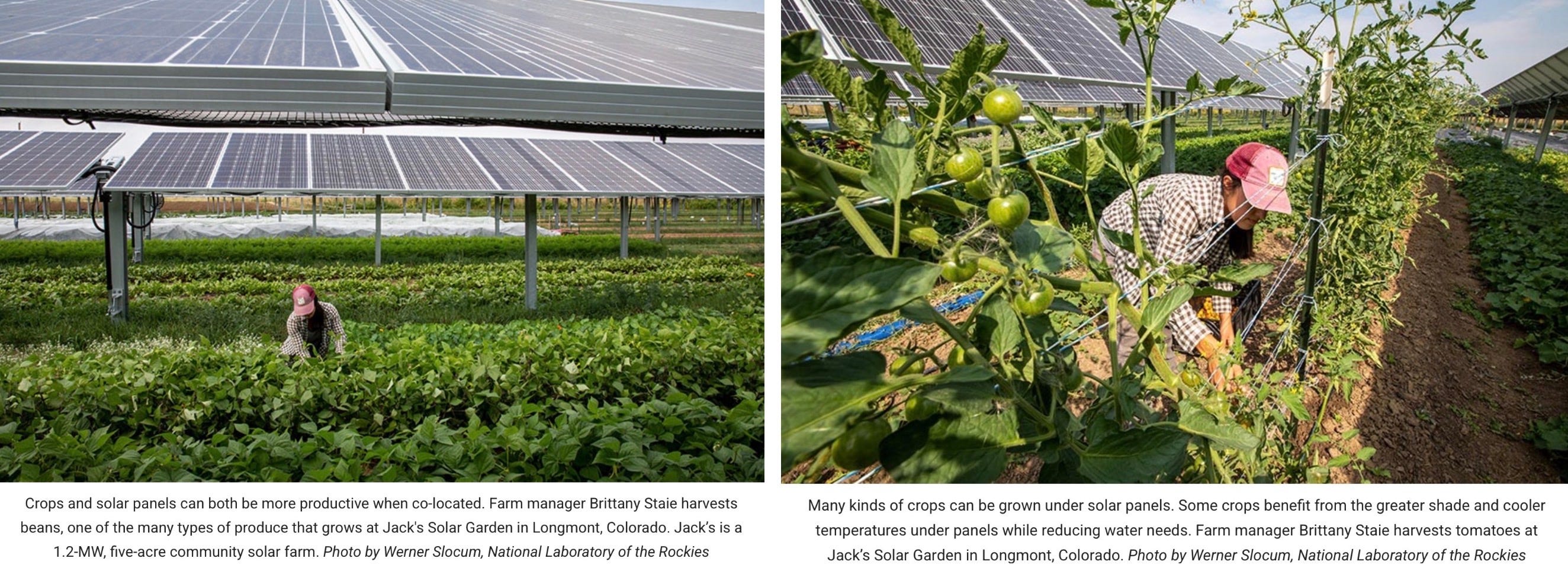
For hard working farmers there are other benefits. William Becker puts it well:
Renewable energy is a dream crop for farmers. It generates income without heavy equipment, labor, expensive inputs, fuel costs, 5 a.m. milkings, or worries about trade tariffs and commodity prices.
The benefits don’t stop there. As mentioned above, contributions to local taxes improve schools, fund police and fire fighters, build and maintain roads, and help keep other taxes low. In Texas, for example, wind energy provided $288.3 million in state and local taxes in 2021.
But what if your interests don’t converge, especially if you are generating your own renewable electricity? In that case you have become a competitor to investor-owned utilities.
As state-sanctioned monopolies, they don’t like red-blooded American competition, and they are doing everything in their power to snuff you out, or at least make you pay. Their political allies have established high mandatory fixed fees in 27 states so far. It doesn’t matter if you use any of their electricity, you still end up with a big monthly bill.
One example is Doug Goyings and his family, who farm about 5,000 acres of barley, soybeans and corn in Paulding county, Indiana.
“I don’t have to pay an electric bill at all, on the generation side. But the transmission and distribution [charges], it’s outrageous …” Speaking of his utility, American Electric Power (AEP): “They got these fees that they put on there.” He used no electricity from them in March. But AEP charged him $918 in fees.
So IOUs will work with you if it benefits them, and work against you when it doesn’t. It’s all about them.
Rural Electric Cooperatives (RECs)
It is the exact opposite with Rural Electric Cooperatives or RECs. What benefits you benefits them and vice versa. That’s because you are them.
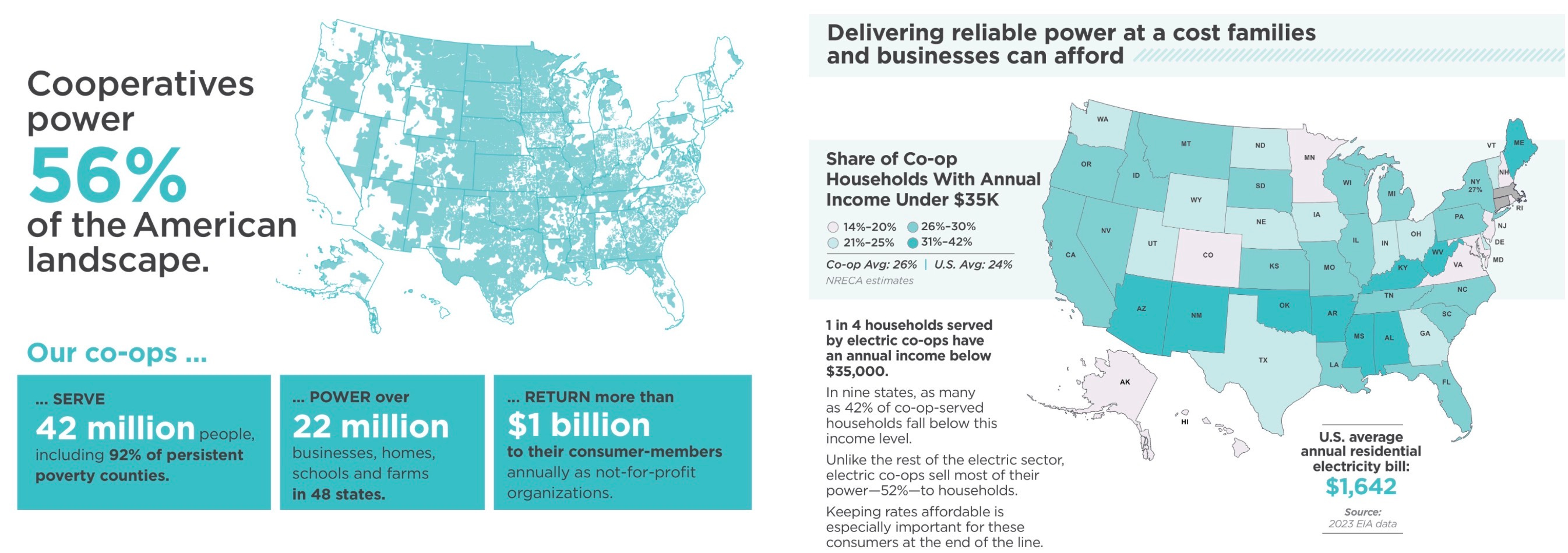
As with any coop, RECs are owned by their customers. Today RECs “serve 42 million people” and “power over 22 million businesses, homes, schools, and farms in 48 states” covering “56% of the American landscape.”
They began in the 1930s because investor-owned utilities couldn’t make enough profit off of rural residents in sparsely populated areas. So RECs were created so folks in most of Rural America could have electricity.
Their main goals were and continue to be reliability and affordability. The latter is crucial, because 1 in 4 households served have annual income below $35,000 and they provide electricity to “92% of persistent poverty counties.” RECs have been about affordability long before it became a political buzz-word.
In contrast to the deep financial pockets of the state-sanctioned investor-owned for-profit monopolies, Rural Electric Cooperatives are not-for-profit organizations that each year “return more than $1 billion to their consumer-members.” They don’t hoard capital. They give it back to their customer-members.
But to keep achieving reliability and affordability, especially today and into the future as demand is rising, requires new capital investments. And homegrown renewables are now the best cost choice for new electricity production. So where can RECs get the capital for such investments since they don’t have deep pockets?
Traditionally, a key source has been US Department of Agriculture (USDA) programs. But other creative options are out there as well.
One way for RECs to achieve reliability, affordability, and a cleaner environment is locally harvested electricity by individuals, groups and local businesses. Given the high expense of maintaining aging long transmission lines over the vast rural landscape, and the increasing vulnerability of such systems to extreme weather and growing demand, RECs are tailor-made for the local clean electricity production by individuals and families, by Community Solar, and by renewable-powered micro-grids. All of them generate power where it is used, avoiding the waste and cost of long transmission, and increase reliability when power outages occur on the “macro grid”.
Such local clean electricity production is anathema to investor-owned monopolies because they are competition. But they totally fit the bill for RECs because they are neighbors helping neighbors, and local businesses, schools, and civic groups generating power for themselves and their communities, all while achieving reliability, affordability, and a cleaner environment.
So why isn’t this happening more quickly? Answer: finance. What is needed is public investment to make this a reality.
With the proper support one study showed that Rural Electric Cooperatives could rapidly deploy renewable energy, reduce their wholesale electricity costs by 10-20%, and retire all coal plants — all the while maintaining reliability.
Affordable, reliable, clean and climate-friendly. We can have it all. But only if we marshal our P³ to push for these investments that are good for Rural Americans and in our national interest.

Our political power and our electric power must join forces to help us create economic power — something Rural America desperately needs.
Studies show there are twice as many rural counties in economic distress as there are prosperous ones. “On average, rural places lag behind non-rural places on nearly every measure of economic well-being from poverty rates to labor force participation,” according to the Economic Innovation Group.
To sum up, Rural Americans can do well by doing good with:
renewable leases,
renewable ownership creating electricity self-reliance,
neighbors helping neighbors with community solar,
local micro-grids, and
agrivoltaics.
All of this can help family farms stay in family hands and keep money in the local economy via the local multiplier effect, generating $2-4 for every $1 spent — another way neighbors can help neighbors and their communities while also creating self-reliance from economic empowerment.
Affordability, yes. But so much more. Time to claim and grow your power, literally — and not just electricity, but political power and economic power.

Finally, The Climate Movement can make those who become involved in a P³ movement in Rural America stronger if we join forces. (And if you want to become a part of The Climate Movement as well, then join us!)
So let’s create P³ in 250 to celebrate real freedom and energy independence in America. Joining together we will have moral power, people power, and staying power to make the changes needed to create a just and prosperous sustainability that enhances wellbeing for everyone and everything — and overcome climate change to boot.
What are we waiting for? Let’s roll.
If you are new here, check out our Intro Series. If you like this post, please “like,” comment, and share. And thanks for all you are doing.