

So here’s the deal of the year. You get to do the right thing — and save 20-45% on your electric bill right now! Do right by the family budget and the Earth’s climate pollution budget. Reduce them both and be a hero in the process.
What’s the catch? To get this particular deal you have to live in New Jersey in the United States where you can sign up for what’s called “Community Solar.” Other states like Virginia are also rapidly expanding Community Solar.
What Is Community Solar?

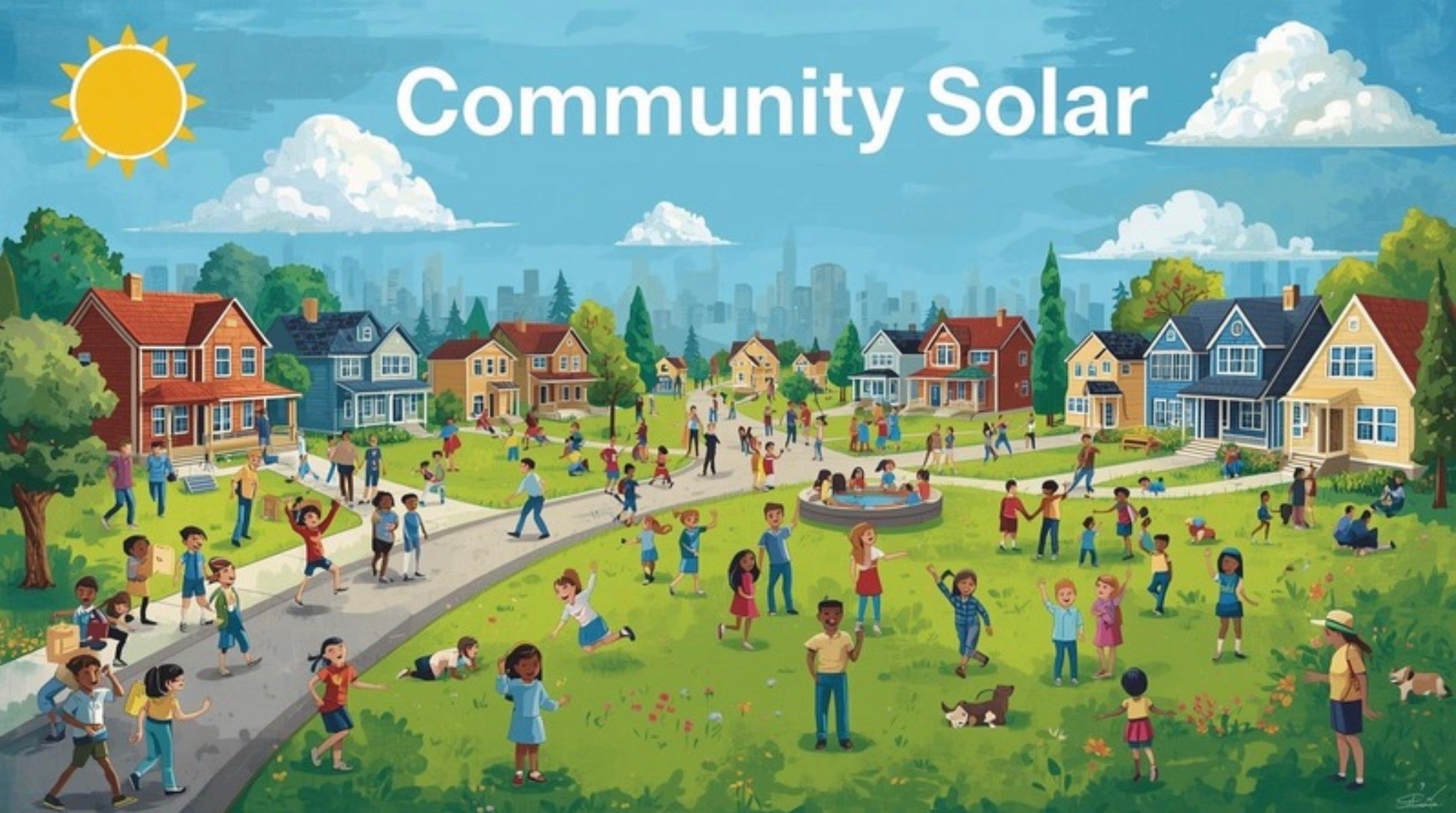
As pictured and explained above by the Coalition for Community Solar Access:
“Community solar refers to local solar facilities shared by multiple community subscribers who receive credit on their electricity bills for their share of the power produced.”
As the Coalition states elsewhere:
“Community solar installations are larger than [individual] rooftop systems but smaller than utility-scale projects, interconnecting at the local distribution level. Their placement on schools, brownfields, parking lots, fallowed agricultural land, and farmland reduces grid congestion, improves reliability, offsets utility investments [that would be paid for by customers], and brings [clean energy] to communities.”
Aren’t able to have your own solar panels? No problem. With Community Solar everyone can have pollution-free electricity, a clear conscience, and in many situations like in New Jersey save money to boot.
Affordability that’s clean and green.
What’s Happening in New Jersey
450,000 homes in New Jersey will be able to participate in Community Solar over the next three years and start saving 20-45% on their electricity bills.
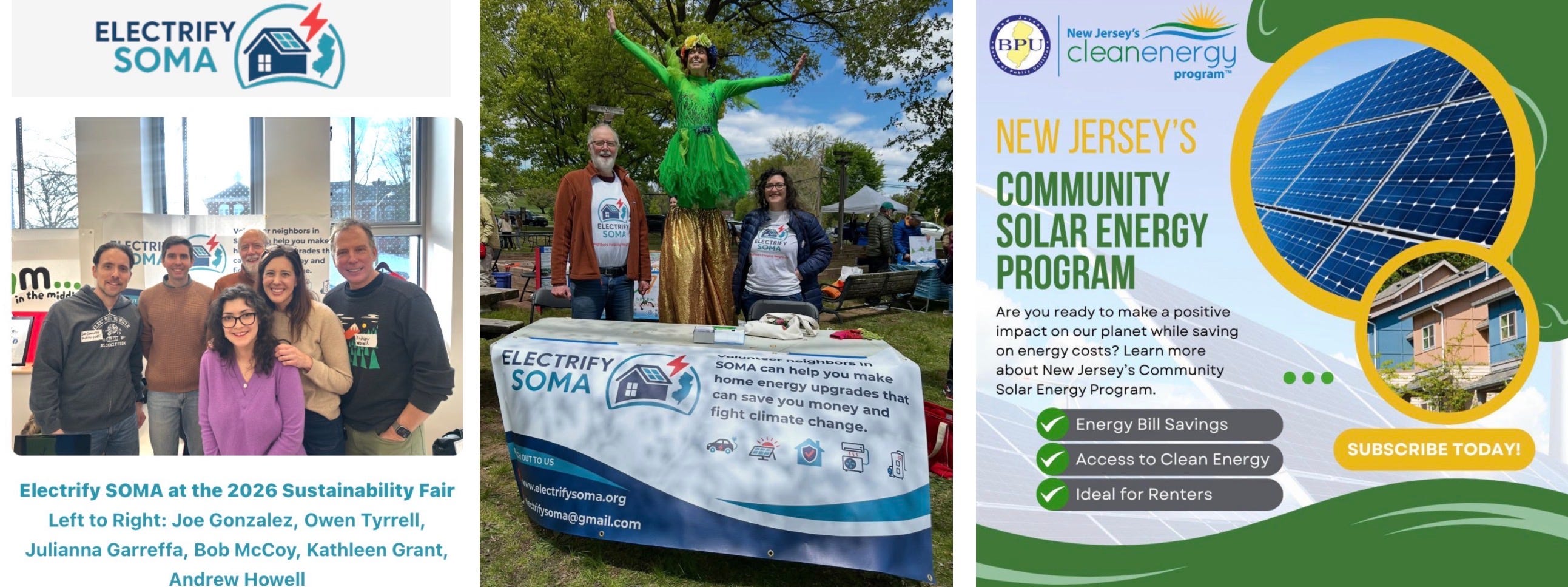
An incredible volunteer group in South Orange New Jersey, Electrify SOMA, has done a terrific job of explaining Community Solar to potential participants in their area (where PSE&G is their utility). Their info below gives a basic sense of how a program is run:
Community Solar is available for renters and homeowners alike, anyone who pays a PSE&G [utility] electricity bill.
No need to install anything at your home.
Your enrollment helps pay for the installation of solar at a remote location and contributes to New Jersey’s clean energy independence.
There are no upfront costs to subscribe: every month, substantially reduced charges completely replace part or most of the PSE&G electricity costs that you would otherwise owe.
The subscription is integrated into your current PSEG electric bill. There are no separate invoices to pay. The power produced by your Community Solar subscription appears as a credit on your bill.
The amount of solar you subscribe to is based on your home’s average usage. If you use less than what the solar panels assigned to you produce, you can bank credit to offset use in future months.
Since you are subscribing to space on real solar arrays, availability is limited.
Providers may start signing residents up for subscriptions while the solar projects are under development, so there may be a waiting period.
To support those who most need relief from high electricity prices, Community Solar projects are required to enroll half of their subscribers with low or moderate annual incomes (defined as annual household income less than $104,200 for 4-person households, $83,400 for 2-person households, and $73,950 for single-person households). Several thousand households in SOMA will qualify.
For more, see their Community Solar Guidebook.
Virginia and Other States
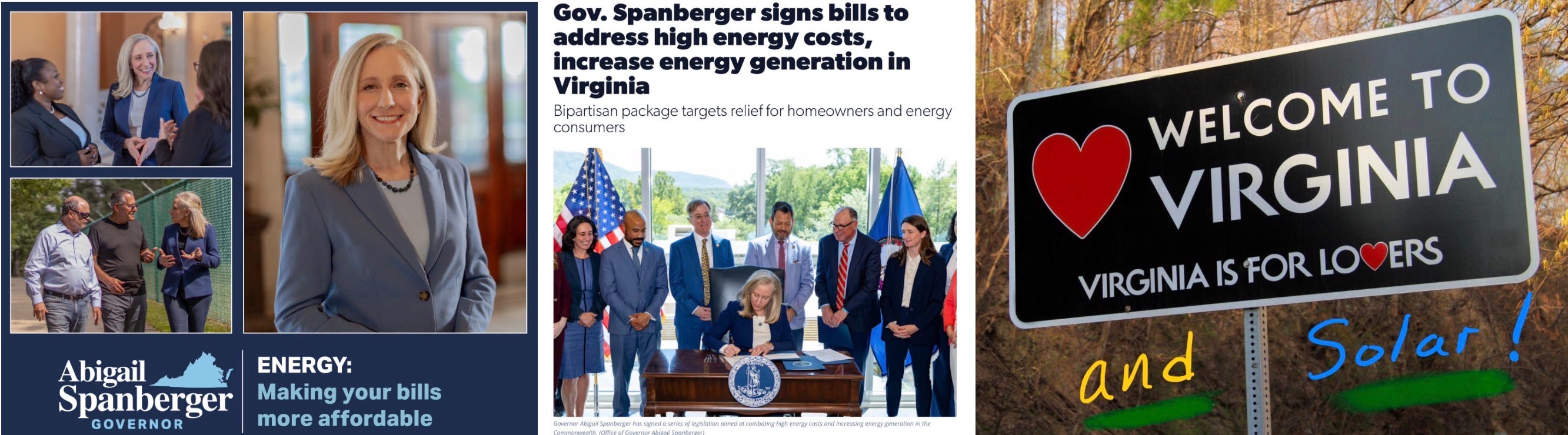
It’s not just New Jersey. Gov. Spanberger in Virginia (VA-D) just signed a slew of bills to make electricity clean and affordable, including expanding the availability of Community Solar by 625 megawatts. This more than doubles what was previously allowed and is enough, conservatively, to power around 160,000 homes.
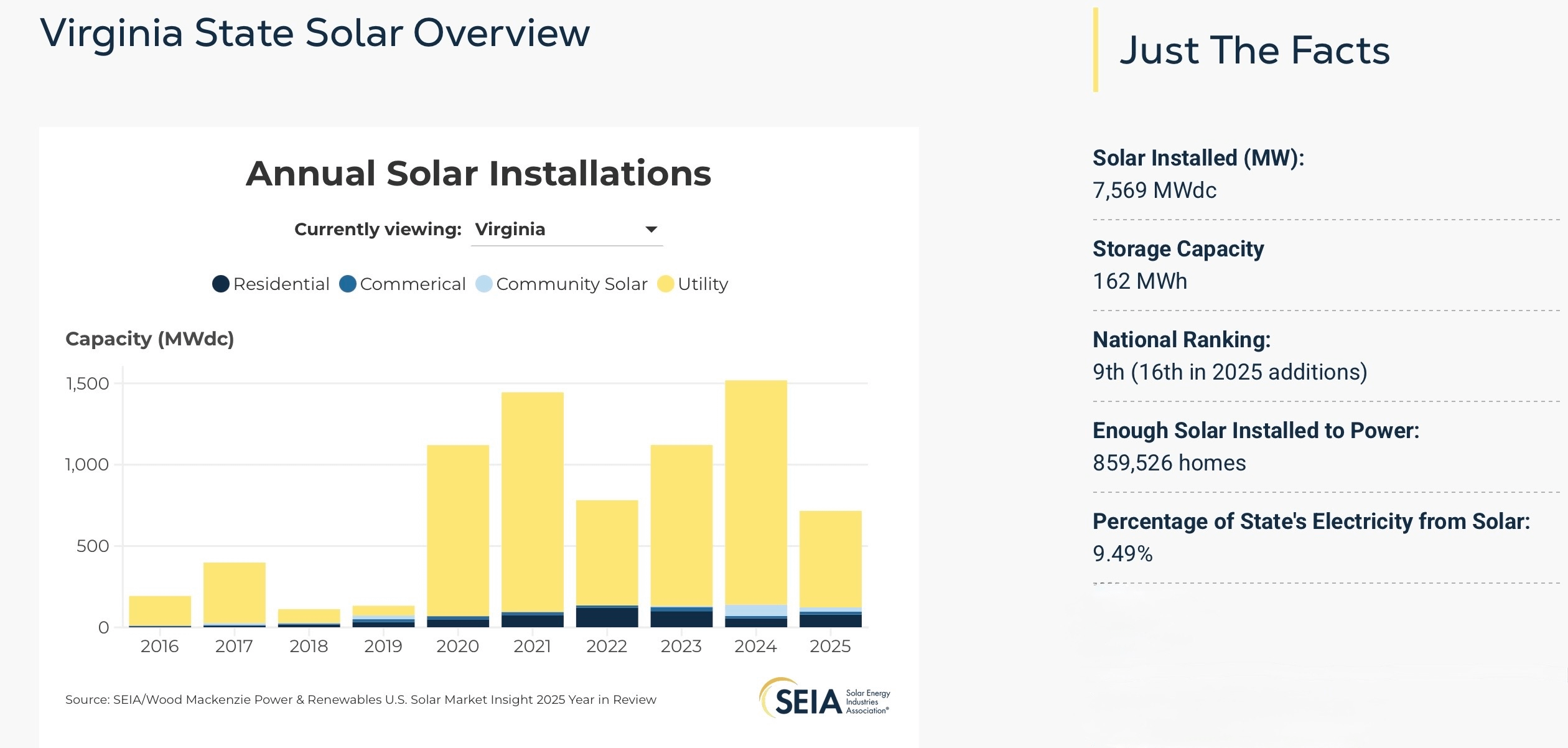
Right now, before these new policies take effect, Virginia has gotten nearly 10% of its electricity from solar, enough to power 850,000 homes.
This amount of solar was hard fought, given the laws and red tape that made it difficult to install new solar and made it much more expensive. In most situations nationwide red tape costs for residential solar are nearly 80% of the total cost of a system.
This package of bills will change that in Virginia, saving up to $6,000 for the installation of a household system and more than doubling the capacity of Community Solar.
Other states — Colorado, New Mexico, Maryland, Minnesota — have also passed legislation related to Community Solar.
Obviously, much more needs to be done!
The Monopolistic Old Guard Ain’t Happy. Don’t Fall For the “Cost-Shifting” BS From Utilities
Community Solar is great! But the state-sanctioned monopolies, i.e., investor-owned utilities, don’t think so. That’s because Community Solar is cutting into their profits; they don’t get $$ for their investors and themselves from energy they don’t generate.
As the Coalition For Community Solar Access puts it in an excellent primer:
“Utilities often oppose customer-driven, third-party owned energy projects like community solar because they threaten shareholder profits. They use ‘cost-shift’ … as a false flag.”

As one seasoned utility observer, Karl Rábago, noted, they are crying crocodile tears for consumers over misleading claims about “cost-shifting,” a situation where certain groups can pay less while others pay more for benefits everyone in the group receives.
But, as Rábago explains, the monopolistic utility system is built on cost-shifting, including shifts from the poor to the rich:
High fixed charges increase overall costs for low-usage customers and allow higher-usage customers to benefit from lower per-unit costs. Connecting very large homes to the grid costs much more than connecting apartments. And customers located near generation resources pay the same transmission rates as everyone else, despite imposing lower costs on the system. Customers at the end of long lines pay the same as customers in the heart of the system, despite often requiring more infrastructure and maintenance to achieve reliable service.
Furthermore, those trying to confuse people about cost-shifting conveniently leave out all the ways Community Solar benefits the group, i.e., all ratepayers.
Rábago:
Utilities claim that when some ratepayers benefit from community solar, others unfairly bear the cost. Studies from multiple states have proven this blanket claim to be false — the benefits of distributed energy resources outweigh their costs.
In other words, when you include all the benefits and costs, Community Solar comes out ahead. For example, in Maine, Community Solar and similar projects deliver $1.23 in savings for every $1 invested.
Climate Action, Affordability, Health, & Wellbeing Go Together
As The Climate Movement here’s what we’re about: overcoming climate change by creating a just and prosperous sustainability that enhances wellbeing for everyone and everything.
This includes making our energy/electricity not just affordable — but cheap, clean, plentiful, and available to all.
Heck, let’s just go ahead and make it FREE — at least some of the hours.
A pipe dream? It’s already happening in Australia where millions of users will get three free hours of electricity midday. Why? Because of all the solar energy they are producing.
In the US we’re behind on this free energy revolution. But with The Climate Movement on the team we can make this happen, and Community Solar can play an important role at the needed speed and scale once we push governments to let them.

If you are new here, check out our Intro Series. If you like this post, please “like,” comment, and share. And thanks for all you’re doing.